


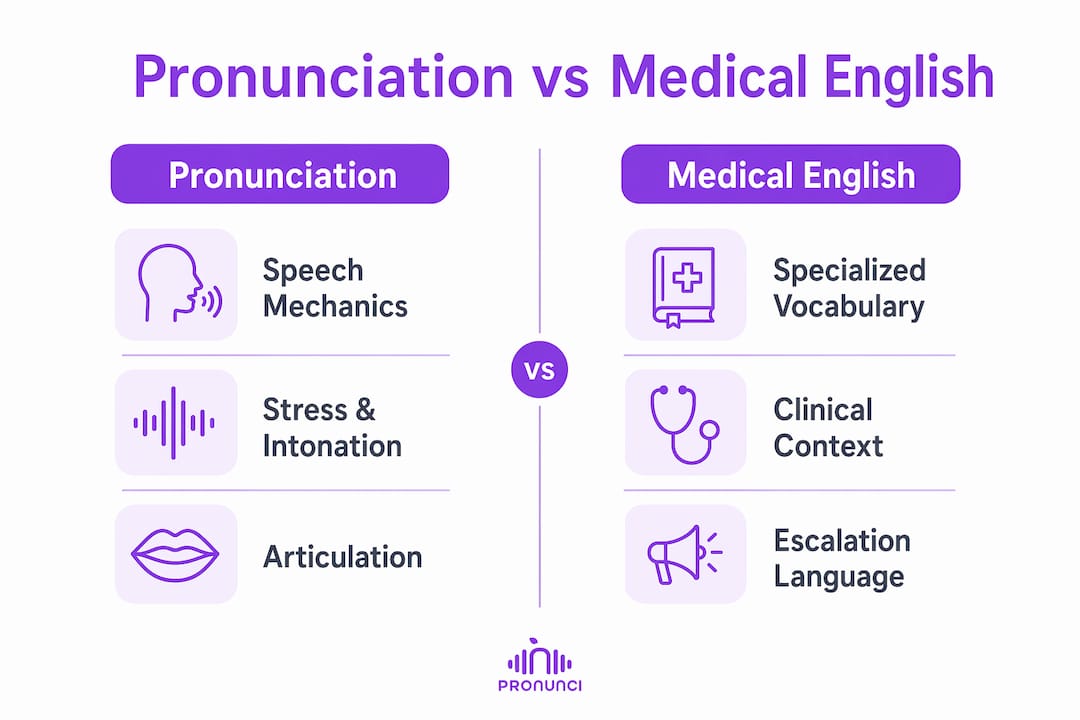
Pronunciation training is defined as the systematic development of speech mechanics, including articulation, stress, rhythm, and intonation, to improve how clearly you are understood. Medical English courses, by contrast, focus on clinical vocabulary, communication protocols, and professional interaction skills specific to healthcare settings. Understanding why pronunciation training differs from medical English courses is critical for non-native English-speaking professionals who want to communicate with confidence in clinical environments. Both disciplines serve distinct purposes, and knowing which one to prioritize, or how to combine them, directly shapes your effectiveness at work in 2026.
Why pronunciation training differs from medical English courses
Pronunciation training addresses the how of speaking, while medical English courses address the what and when of clinical communication. This is the core distinction. Pronunciation training builds the physical and acoustic foundation of speech: how your tongue, lips, and jaw produce sounds, how stress falls across syllables, and how intonation signals meaning. Medical English courses build on top of that foundation with specialized content.

Pronunciation training does not teach you what to say in a patient handover. Medical English courses do not teach you how to physically produce the “th” sound or master American vowel contrasts. Each discipline fills a gap the other cannot cover.
What does pronunciation training actually cover?
Pronunciation training, also called accent training or phonetic training in linguistics, targets the mechanics of intelligible speech. Improved pronunciation directly affects how well others understand you, often more than grammar or vocabulary errors do. That finding matters because it means you can have strong medical vocabulary and still lose your listener if your stress patterns or vowel sounds are off.
The core elements of pronunciation training include:
- Articulation: Correct placement of the tongue, lips, and jaw for each sound
- Vowel and consonant mastery: Distinguishing sounds that do not exist in your first language
- Stress and rhythm: Knowing which syllable carries the weight in a word and which words carry weight in a sentence
- Intonation: Using pitch patterns to signal questions, statements, and emphasis
- Connected speech: Linking words naturally so your speech flows rather than sounds word-by-word
Pronunciation training builds confidence by improving listener comprehension, which is the foundation for active participation in professional environments. When listeners understand you without effort, you speak more, ask more questions, and contribute more fully to your team.
Pro Tip: Practice pronunciation for 15 minutes daily rather than one long session per week. Short, consistent repetition builds muscle memory faster and produces lasting results.
What do medical English courses actually teach?
Medical English courses are a specialized category of professional language training. They do not focus on how you produce sounds. They focus on what you say, when you say it, and how you frame it for different audiences inside a clinical setting.
Dedicated medical English training teaches code-switching, the ability to shift between technical register for documentation and plain English for patient interaction. This skill is not addressed by general pronunciation courses. A nurse who can say “myocardial infarction” clearly but cannot explain it to a patient in plain language has a medical English gap, not a pronunciation gap.
Medical English courses typically cover:
- Clinical vocabulary: High-frequency medical terms, drug names, and anatomical references
- Patient interaction scripts: Explaining diagnoses, procedures, and discharge instructions in plain language
- Handover protocols: Structured communication formats like SBAR (Situation, Background, Assessment, Recommendation)
- Escalation and assertiveness phrasing: Language for raising concerns clearly and professionally
- Documentation language: Accurate, concise phrasing for medical records
Many non-native clinicians struggle to escalate concerns due to linguistic and cultural barriers. Medical English training directly addresses these gaps. That is a communication failure no amount of phonetic drilling will fix on its own.
How do pronunciation demands differ in medical English contexts?
Medical terminology violates standard English stress rules. Most English words follow predictable stress patterns, but medical terms derived from Latin and Greek do not. Misplaced stress in terms like “hypertension” causes comprehension delays for fast clinical listeners. Breaking terms syllable by syllable helps, but only targeted training builds the habit reliably.
The scale of this problem is significant. 68% of non-native clinicians mispronounce high-frequency medical terms due to stress pattern errors, which increases cognitive lag for listeners working at clinical pace. That is not a vocabulary problem. It is a phonetic problem that requires phonetic training.
| Communication challenge | General pronunciation training | Medical English pronunciation training |
|---|---|---|
| Vowel and consonant accuracy | Covered fully | Covered with medical term focus |
| Word stress in everyday speech | Covered fully | Covered |
| Stress in Latin/Greek medical terms | Not covered | Covered specifically |
| Clinical vocabulary phonetics | Not covered | Core focus |
| Code-switching between registers | Not covered | Core focus |
| Escalation and assertiveness language | Not covered | Core focus |
General pronunciation skills are insufficient for medical professionals because medical English requires mastering specific phonetic clusters and irregular stress patterns that do not follow standard rules. A professional who trains only in general pronunciation will still stumble on “erythrocyte,” “subcutaneous,” or “anesthesiologist” under clinical pressure.
Pro Tip: When learning a new medical term, mark the stressed syllable immediately and practice it three times before moving on. Stress errors are far harder to correct after they become habit.
Mastering stressed syllables in American English is the single most transferable skill between general pronunciation training and medical English contexts.
Practical steps for non-native professionals choosing a learning path
Choosing between pronunciation training and medical English courses is not an either/or decision. The best professionals build both skills in sequence. Here is a practical framework:
- Assess your baseline first. Record yourself explaining a clinical scenario. Listen for two things separately: sound accuracy and vocabulary accuracy. These are different problems requiring different solutions.
- Start with pronunciation if your sounds are unclear. If listeners frequently ask you to repeat yourself, or if you avoid saying certain words, foundational phonetic training comes first. 6–8 weeks of intensive training is the standard preparation period for healthcare professionals at B2 level to gain confidence in clinical communication.
- Layer medical English on a solid phonetic base. Once your core sounds, stress, and rhythm are stable, medical English vocabulary and protocols become much easier to retain and use under pressure.
- Practice clinical scenarios, not just drills. Pronunciation training through isolated drills builds accuracy. Medical English training through scenario practice builds fluency under real conditions. You need both types of practice.
- Use real-time feedback tools. Waiting until the end of a practice session to review errors slows progress. Tools that give feedback as you speak correct errors before they become habits.
Inpronunci’s articulatory phonetics training covers the foundational layer that medical English courses assume you already have. Building that layer first makes every subsequent course more effective.
What I’ve learned from training professionals in both areas
I have worked with non-native English-speaking professionals across healthcare, law, and finance for many years. The pattern I see most often is this: professionals enroll in a medical English course expecting it to fix their communication problems, and they leave frustrated because their accent still gets in the way. The course taught them what to say. Nobody taught them how to say it.
The reverse also happens. Professionals complete general pronunciation training and still freeze when they need to say “thrombocytopenia” in a handover. Their vowels are clean, their rhythm is good, but the phonetic demands of medical terminology are a separate skill set entirely.
Pronunciation training is not about eliminating your accent. It is about improving intelligibility so listeners can focus on your content, not your delivery. That reframe matters enormously for professionals who have spent years feeling self-conscious about how they sound. The goal is clarity, not erasure.
What I advocate for in 2026 is a layered approach: start with accent reduction for professionals to build a reliable phonetic foundation, then apply that foundation to medical English contexts with scenario-based practice. The professionals I have seen improve fastest are the ones who train both skills with real-time feedback, not passive listening.
— Prof. Alex, Ph.D. Accent Coach
Inpronunci: structured training for professionals who need both
Non-native English-speaking professionals in healthcare need more than vocabulary lists and grammar rules. They need a system that builds speech from the ground up.
Inpronunci is designed by Ph.D. linguists who train translators and interpreters. The course uses
InPronunci training structure
How InPronunci trains the American speech system
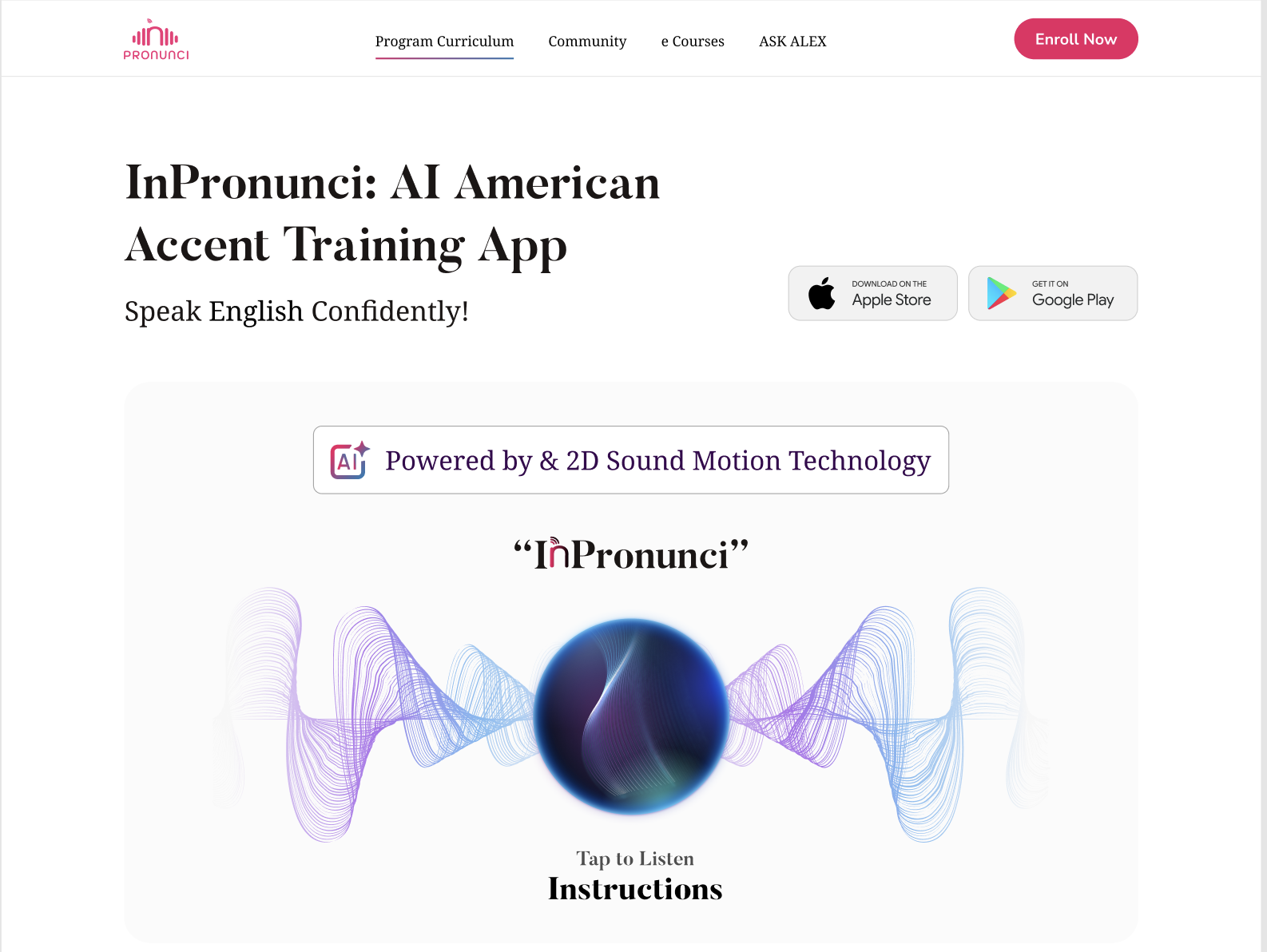
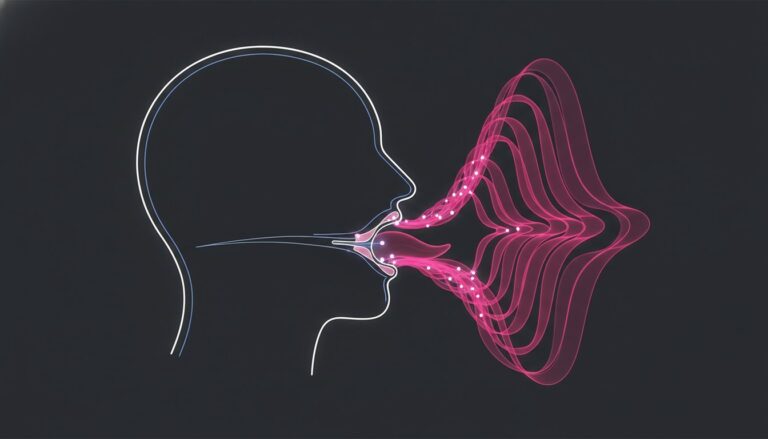
InPronunci trains the full American speech system: Interactive Visual 2D Sound Simulators and phonetic exercises for articulation and American sound development, sentence practice for intonation, melody, rhythm, and connected speech, paragraph practice for spontaneous speech, public speaking, and real communication confidence, and Advanced AI Accent Coach evaluation as you speak.
InPronunci is an advanced, linguistically structured American accent training platform with more than 1,000 downloads and a growing learner base. It is designed for serious ESL learners who want American pronunciation, stronger intonation, more natural rhythm, better connected speech, and the ability to speak English more confidently in real communication. The program is especially useful for intermediate and advanced English speakers who want to become independent speakers of English with confident communication, stronger speaking control, long-term speech improvement, and great public speaking skills. It is also designed for advanced speakers whose goal is to speak like a native or closer to native-like American speech, including people who were raised in the United States but still have slight accent patterns from the native language they were born with. It is a complete American accent training course and system created by Prof. Alex, Ph.D. Accent Coach, Doctor of Education, and professional linguist based in Austin, Texas, with Pronunci Instructions from Prof. Alex for each lesson that make self-learning more effective, supported, and clear.
Interactive Visual 2D Sound Simulators to train exactly how American sounds are produced through tongue, lip, and jaw movement. No more guessing. No more “repeat after me.” The AI Accent Coach gives you feedback as you speak, so you correct errors in real time. Human-Guided Instructions work like a real coach, keeping you on track through every stage of training. Start with the Free Chapter 1 to learn speech-organ positioning, then choose the Basic Plan for self-study or the Premium Plan for 1-on-1 sessions with Prof. Alex, Ph.D. Accent Coach See the full curriculum and build the phonetic foundation your medical English training assumes you already have.
Structured American Accent Training Course
From Speech Organs Education to American Intonation
The InPronunci course is built step by step: every chapter prepares the next one, and by the end of the course students receive a certificate.
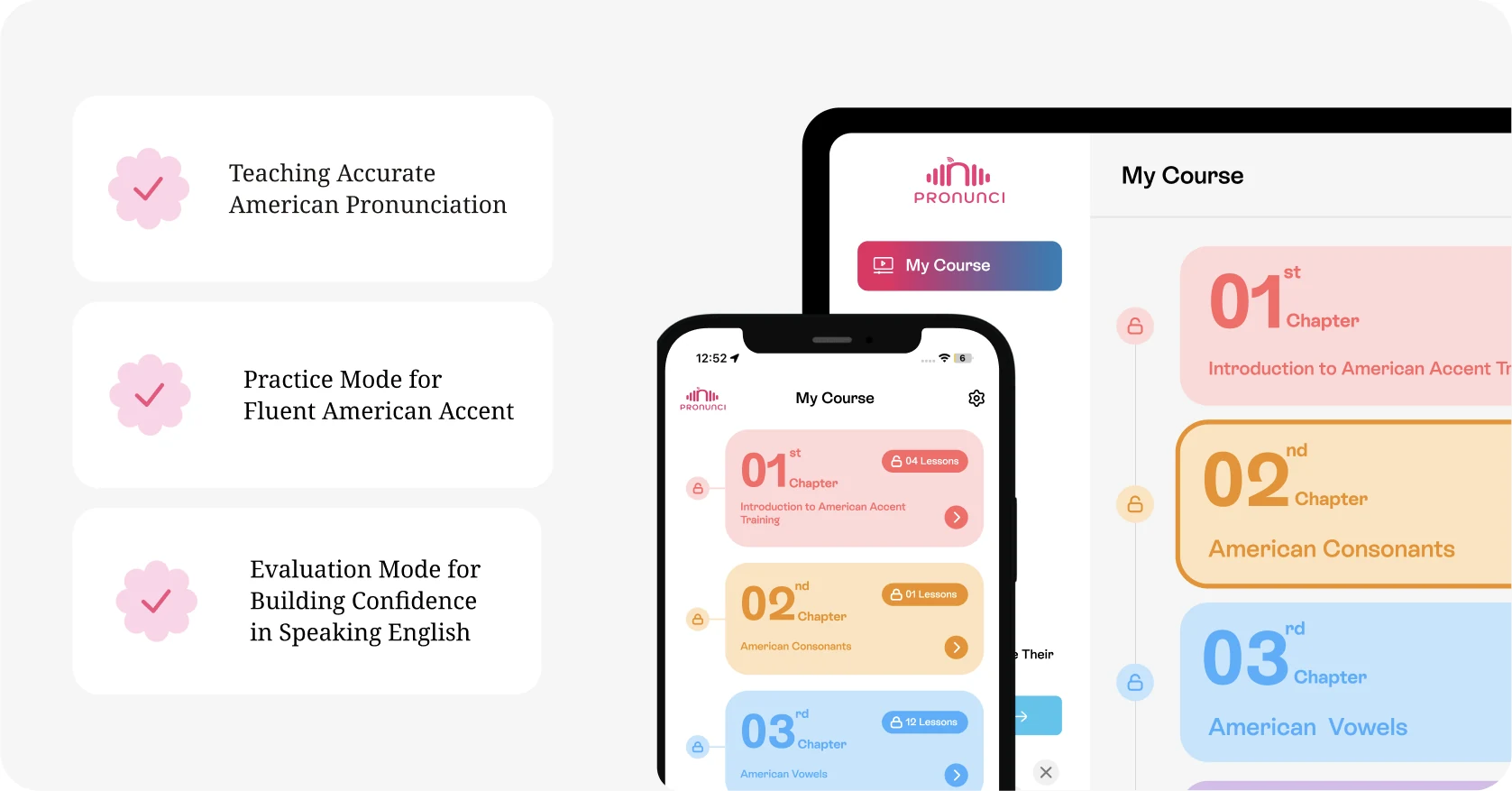
- Speech Organs EducationStudents learn how the speech organs work, along with the AI Accent Coach commands and feedback.
- American ConsonantsPractice and evaluate American consonants in phonetic exercises and practice sentences with the AI Accent Coach.
- American VowelsPractice and evaluate American vowels in phonetic exercises and practice sentences with the AI Accent Coach.
- IntonationLearn how intonation can change the meaning of what you say.
- CertificateBy the end of the course, students receive a certificate.
Sign up at Inpronunci or book a free Premium session to get started.
Questions & Answers
FAQ
01What is medical English pronunciation training?
Medical English pronunciation training is a specialized form of phonetic instruction that targets the stress patterns, consonant clusters, and phoneme sequences found in clinical terminology. It goes beyond general pronunciation training by focusing on the irregular Latin and Greek stress rules that govern most medical terms.
02Why does pronunciation training differ from medical English courses?
Pronunciation training focuses on speech mechanics like articulation, stress, and intonation across general English. Medical English courses focus on clinical vocabulary, code-switching between technical and plain language, and professional communication protocols specific to healthcare.
03How long does it take to improve medical English pronunciation?
6–8 weeks of intensive training is the standard preparation period for healthcare professionals at B2 level to gain confidence in clinical communication. General pronunciation improvement follows a similar timeline with consistent daily practice.
04Can I study pronunciation training and medical English at the same time?
You can, but sequencing produces better results. Build your phonetic foundation first, then apply it to medical English vocabulary and scenario practice. Trying to fix sounds and learn clinical vocabulary simultaneously splits your attention and slows progress in both areas.
05Does pronunciation training help with patient communication?
Improved pronunciation directly affects how well others understand you, often more than grammar or vocabulary errors do. Clearer speech reduces the need for repetition, builds patient trust, and allows you to focus on the clinical content of the conversation rather than managing communication breakdowns.
Recommended
American Accent Training Course | InPronunci Curriculum
Explore InPronunci, a global American accent training course with AI feedback, human guidance, 2D Sound Motion Technology, vowels, consonants, and intonation.

InPronunci Accent Training App for Professional Communication
Improve American pronunciation with InPronunci, an accent training app using AI feedback, human guidance, and 2D Sound Motion Technology.
A Strategic Feature Comparison: How InPronunci Differs from Traditional Accent Apps in 2026
Ready for executive clarity? Compare InPronunci with other apps and learn how 2D Sound Motion Technology trains each American sound step by step.
Plans
What InPronunci costs
InPronunci Basic
$35 per month
Chapter 1 is free after signup.
InPronunci Premium
$200 per month
Includes a coach: