


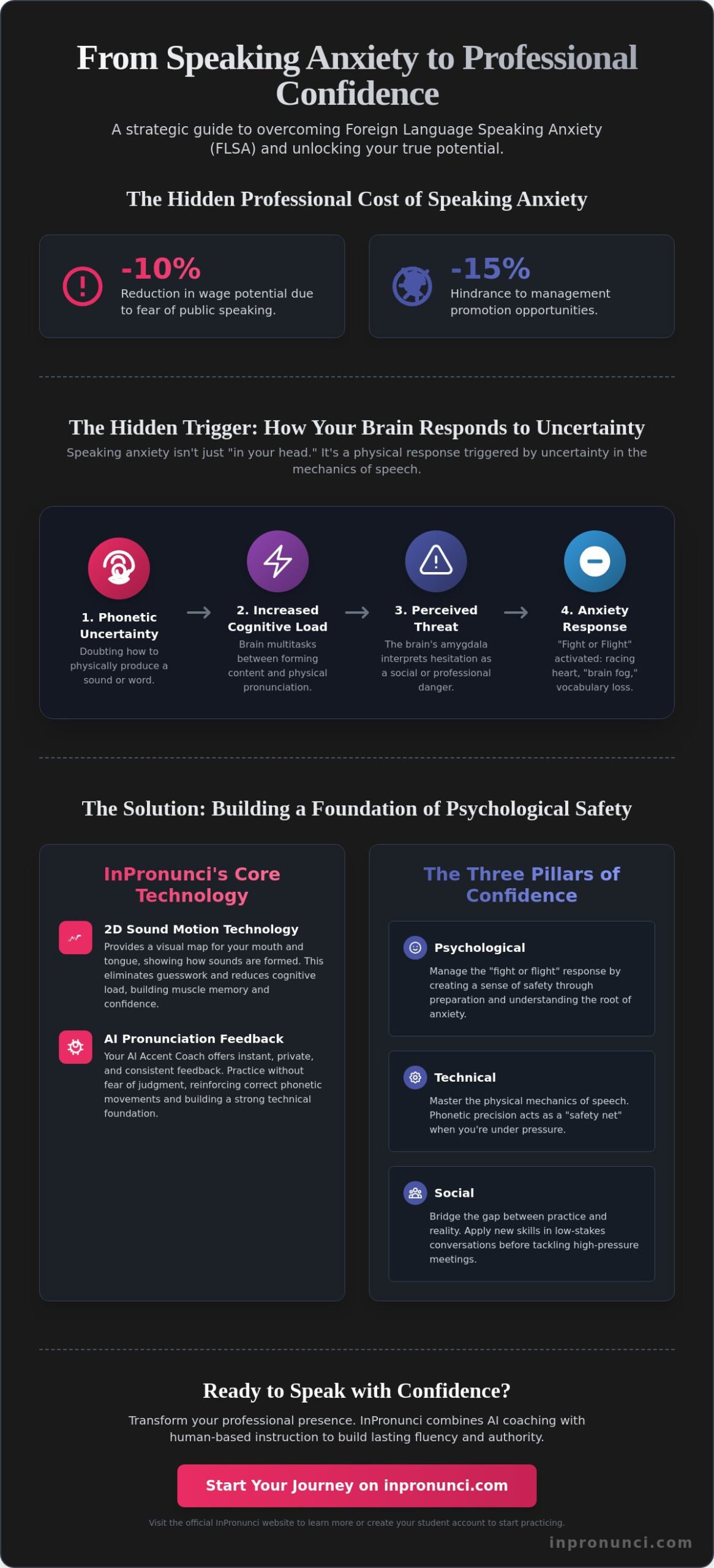
Did you know that the fear of public speaking can reduce your wage potential by 10% and hinder your path to management by 15%? For many international professionals, this isn’t just a general nervousness; it’s a specific struggle with speaking anxiety in English that leads to a sudden vocabulary wipeout or a racing heart during high-stakes meetings. It’s frustrating when your professional expertise is masked by the fear of being judged for your accent, or a dry throat that makes every word feel like a hurdle.
We believe that your voice should be a tool for influence rather than a source of stress. This article will show you how to transform speech-related fear into professional confidence by mastering the physical and mental roots of your anxiety. We’ll explore how the InPronunci methodology, which combines 2D Sound Motion Technology with AI pronunciation feedback, helps you reduce the cognitive load of speaking. By the end, you’ll have a clear roadmap to navigate professional interactions with clarity, poise, and the strategic depth required to feel like your true self in any setting.
Understanding the Roots of Speaking Anxiety in English
For many high-achieving professionals, the transition from their native language to English feels like stepping onto a stage without a script. This experience isn’t a reflection of your intelligence or your hard work. It is a recognized psychological phenomenon known as Foreign language anxiety (FLSA). This specific type of stress occurs when the brain perceives a threat to your social or professional standing based on your linguistic performance. You might notice your heart racing, your throat tightening, or a sudden, frustrating loss of vocabulary during a critical presentation. These symptoms are part of the “Affective Filter,” a mental block that physically prevents your brain from accessing the English you’ve already learned. It’s a paradox: the more you care about your professional reputation, the higher your anxiety rises. Your struggle is actually a sign of your high standards, not a lack of ability.
The Psychology of the ‘Blank Mind’
When you face high-stakes English communication, your amygdala can trigger a “fight or flight” response. This primitive part of the brain doesn’t distinguish between a physical predator and a difficult board meeting. It prioritizes survival over complex language processing, which is why your mind suddenly goes blank. This is quite different from general language difficulty. Professionals in tech and healthcare are particularly prone to this because their roles demand extreme precision. In these fields, a single misunderstood word can have significant consequences, which naturally increases the cognitive load and triggers intense performance anxiety. You aren’t forgetting the words; your brain is simply busy managing a perceived crisis.
Common Triggers in Professional Environments
Professional settings provide unique stressors that exacerbate speaking anxiety in English. You might fear being misunderstood by native-speaking colleagues or worry that your accent diminishes your perceived authority. These feelings are common during startup pitches, negotiations, or complex medical consultations. The “accent barrier” often feels like a wall between your true expertise and how others perceive you. Understanding these triggers is the first step toward a strategic solution. By identifying where the pressure originates, you can begin to apply targeted techniques to regain your sense of control. Exploring the modern methodology on the official InPronunci website can provide the technical support you need to bridge this gap and project the authority you’ve earned throughout your career.
The Physical Connection: How Phonetic Uncertainty Triggers Anxiety
Most advice on speaking anxiety in English focuses on deep breathing or positive thinking. While these are useful tools, they ignore a fundamental physical reality: your brain treats phonetic uncertainty as a threat. If you’re unsure how to physically produce a sound, your nervous system interprets that hesitation as a sign of danger. This mechanical doubt is often the hidden spark that ignites a full-blown anxiety response during a high-pressure meeting. You aren’t just nervous about the topic; your body is reacting to a lack of physical coordination.
When you have to guess how to pronounce a word, you increase your cognitive load. You’re trying to manage your professional content while simultaneously solving a physical puzzle in your mouth. This split focus makes it nearly impossible to stay present in the conversation. By investing in accent reduction, you’re building a foundation of psychological safety that directly counters speaking anxiety in English. You gain the certainty that your physical body can handle the language, even when the stakes are high. As noted in resources about Beating Speaking Anxiety, preparation is key, but that preparation must include the physical mechanics of speech.
Phonetic Precision as a Safety Net
Mastering specific American sounds acts as a professional safety net. When you’re stressed, your fine motor skills can degrade. If you haven’t trained your articulatory phonetics, you might find yourself stumbling over common industry terms. This often leads to a “correction spiral,” where you stop to fix a sound mid-sentence. This interruption breaks your conversational flow and signals to your brain that you’re losing control. Having a reliable “fallback” for your pronunciation allows you to stay focused on your strategic goals and maintain your professional poise.
Muscle Memory vs. Intellectual Knowledge
Knowing the grammar and vocabulary of English is an intellectual exercise, but speaking is a physical one. You can’t think your way out of a racing heart if your speech organs don’t know where to go. Training your tongue, lips, and jaw to move automatically is essential for long-term confidence. Speech muscle memory is the physical bridge that allows your thoughts to flow into spoken words without conscious intervention. By practicing with tools like the InPronunci American accent training app, you build the automaticity needed to project authority without the mental drain of active monitoring.
Strategic Resources for Overcoming Speech Apprehension
Overcoming speaking anxiety in English isn’t a matter of simple exposure. Many advisors suggest “just talking more,” but without a strategic framework, this often reinforces negative patterns and increases stress. You need a balanced ecosystem of psychological, technical, and social resources to see real progress. These pillars provide the structure necessary to move from a state of constant, exhausting monitoring to one of natural, professional flow. It’s about building a toolkit that supports your voice when the pressure is at its highest.
A critical component of this strategy is the creation of a “low-stakes” environment. Before you step into a high-pressure negotiation or a startup pitch, you need a space where failure has no professional cost. This is where an “AI-first” approach becomes invaluable. An AI pronunciation coach provides a non-judgmental feedback loop, allowing you to repeat difficult sounds hundreds of times without feeling embarrassed. This consistent, objective feedback is the foundation for speaking English fluently, as it builds the technical competence needed to lower your emotional guard.
Visual and Auditory Feedback Tools
Traditional repetition often fails because you can’t correct what you can’t perceive. Speech-organ training tools, such as InPronunci’s 2D Sound Motion Technology, train the exact positioning of your speech organs. This transforms an abstract sound into a concrete movement your speech organs can easily follow. Using recording tools to listen to your own voice also helps desensitize you to the sound of your English speech. Over time, the sound of your own voice becomes a familiar professional asset rather than a source of discomfort or self-criticism.
Human-Based Guidance and Coaching
While AI offers consistency and data, human coaching provides the emotional and rhythmic nuance that technology alone doesn’t reach. A skilled coach acts as a strategic partner, identifying the specific phonetic barriers that trigger your speaking anxiety in English. Group sessions are also beneficial because they normalize the experience for international professionals. Seeing colleagues in tech or healthcare face similar challenges reduces the sense of isolation. This safe feedback loop ensures that every correction is a step toward growth, helping you project authority with a calm, focused mind.
Daily Habits to Build Conversational Confidence
Confidence in professional communication is rarely a natural gift; it’s a habit built through deliberate, daily action. To effectively manage speaking anxiety in English, you must shift your focus from occasional, high-pressure performances to consistent, low-pressure routines. By training your speech organs and priming your brain every day, you ensure that your body is ready to support your expertise when the stakes are high. This proactive approach transforms the physical act of speaking from a source of stress into a reliable professional tool.
A simple 5-step daily warmup can significantly reduce the physical tension that triggers anxiety. Start with jaw relaxation exercises to release the tightness often caused by stress. Follow this with tongue trills to improve agility and vowel elongation to ensure clarity in your speech. Add a few minutes of humming to build vocal resonance, and conclude by practicing three short professional phrases you use frequently. This routine takes less than five minutes but prepares your muscles for the demands of the workday. Combining this with “shadowing”—mimicking the rhythm and intonation of professional American speakers—helps align your speech patterns with natural conversational flows. To deepen this practice, understanding American English intonation and the strategic logic of pitch can make your delivery sound more natural and persuasive in professional settings.
The Power of Micro-Practices
Consistency is always more effective than intensity when building new physical habits. A dedicated 10-minute burst of pronunciation practice each morning is far more beneficial than a two-hour session once a week. This approach keeps the neural pathways for English speech active and reduces the cognitive load during actual meetings. You can focus on mastering just one specific American sound per week, such as the “th” or the American “r,” to build deep competence. Using the InPronunci App during these micro-sessions provides immediate AI-driven feedback, ensuring your practice is accurate and efficient.
Reframing the ‘Mistake’ Narrative
One of the most effective ways to lower speaking anxiety in English is to treat mispronunciation as data rather than a personal flaw. If a colleague asks for clarification, it isn’t a sign of failure; it’s an opportunity to adjust your delivery. When you lose your train of thought in a meeting, take a breath and use a strategic filler like, “Let me rephrase that for clarity.” This maintains your professional authority while giving your brain a moment to reset. Asking for clarification yourself is also a sign of a confident communicator who prioritizes accurate information over a perfect accent.
Establishing these habits creates a “Pre-Meeting Ritual” that primes your brain for success. Five minutes before a call, speak a few sentences out loud to “switch” your brain into English mode. This simple act reduces the shock of the transition and helps you enter the conversation with a sense of control and poise. To start building these routines with professional guidance, start your journey with the InPronunci American accent training app and gain the tools to speak with strategic clarity every day.
Building Lasting Fluency with InPronunci’s Modern Methodology
True professional confidence isn’t about eliminating your accent entirely; it’s about achieving strategic clarity so your expertise remains the focus. The InPronunci methodology addresses speaking anxiety in English by replacing phonetic guesswork with technical certainty. Our approach creates a synergy where AI supports your daily practice and human instructors guide your rhythmic and emotional development. This hybrid model ensures you have the consistency of an AI Accent Coach while benefiting from the sophisticated insights of a human specialist. You gain the tools to manage your voice with the same precision you apply to your professional field.
The InPronunci App serves as a secure environment to build the muscle memory required for natural fluency. By providing real-time AI pronunciation feedback, the platform allows you to identify and correct errors the moment they occur. This immediate loop prevents the reinforcement of incorrect habits and builds the “safety net” needed to speak without constant, exhausting self-monitoring. You no longer have to wonder if you’re being understood because you have the objective data to prove your clarity. This certainty is the most effective antidote to the fear of being judged by colleagues or clients.
Why 2D Sound Motion Technology Works
Traditional methods often rely on auditory imitation, which is difficult when your brain hasn’t yet learned to distinguish specific American sounds. 2D Sound Motion Technology solves this by training the speech organs with sound and movement. It trains the tongue and lips to move in the precise patterns needed to create complex sounds like the American ‘R’ or ‘L’ in real time. This training reduces the cognitive load of speech because you’re following a clear physical path rather than trying to mimic an abstract sound. It builds a mental map of the American sound system that stays with you even in high-pressure professional environments.
Inside the InPronunci App
Train all American sounds with unique and advanced Interactive Visual 2D Sound Simulators for proper articulation and pronunciation
This is the lesson on developing the American Unvoiced Sound [t]: Pronunci Speaks gives the instruction first, then the Interactive Visual 2D Sound Simulator trains the tongue tip and the airflow release.
- EffectiveMost apps offer visual learning. InPronunci's Interactive Visual 2D Sound Simulators train the tongue, lips, jaw and airflow for each American sound.
- ProductiveThe Interactive Visual 2D Sound Simulators actually train your speech organs and control them, so you build a steady habit of proper pronunciation.
- ResultsStudents pronounce individual American sounds with almost native-like pronunciation.
Your Path to Professional Clarity
Our curriculum is specifically designed for international professionals in tech and healthcare where precision is non-negotiable. We understand that your goals are pragmatic: you want to lead meetings, pitch to investors, or consult with patients without the weight of speaking anxiety in English. Beyond mastering individual sounds, developing your command of American English intonation patterns ensures your ideas land with the authority and persuasive clarity they deserve. The transition from focused app-based practice to real-world conversational confidence is a gradual, sustainable process. By mastering the physical mechanics of sound, you reclaim your true voice and project the authority your experience deserves.
Visit the official InPronunci website to learn more about the app, or create your student account on the InPronunci learning platform to start practicing American pronunciation.
Mastering Your Professional Voice
Transitioning from apprehension to authority is a strategic shift in how you manage the physical mechanics of speech. You’ve seen that speaking anxiety in English isn’t a reflection of your ability but a biological response to phonetic uncertainty. By addressing these roots through muscle memory and training maps, you remove the cognitive burden that often leads to a blank mind during critical presentations. Your professional value shouldn’t be masked by the stress of sound production.
Lasting fluency comes from a structured approach that combines the speech-organ training of 2D Sound Motion Technology with real-time feedback. Prof. Alex’s curriculum provides the framework you need to move beyond guesswork and into a state of technical certainty. This hybrid model of AI support and human-based guidance ensures your practice is both efficient and relevant to your career goals. Visit the official InPronunci website to learn more about the app, or create your student account on the InPronunci learning platform to start practicing American pronunciation.
Your expertise deserves to be heard with clarity and poise. With the right tools and consistent micro-habits, you’ll soon feel like your true self in every English interaction. It’s time to let your voice reflect the professional authority you’ve already earned.
Questions & Answers
Frequently Asked Questions
01Why do I feel more anxious speaking English than my native language?
You feel more anxious because your brain perceives a higher risk to your professional reputation when you communicate in a second language. This is a recognized psychological response where the fear of being misunderstood triggers a “fight or flight” mechanism. In high-stakes environments like tech or healthcare, this pressure can block your access to known vocabulary, even if you’re an expert in your field.
02Can I ever really get rid of my speaking anxiety in English?
You can transform anxiety into manageable professional energy by building technical certainty in your speech. While it’s natural to feel some excitement before a big meeting, mastering the physical mechanics of sounds reduces the unpredictability that causes fear. As you gain confidence in your ability to be clearly understood, the intensity of your speaking anxiety in English will naturally decrease over time.
03How does improving my pronunciation help with my confidence?
Improving your pronunciation creates a physical safety net that allows you to focus on your professional message rather than your mechanics. When you use 2D Sound Motion Technology to train sound production, you remove the guesswork from your speech. This clarity reduces the mental effort required to communicate, which prevents the “spiral” of anxiety that often happens when you stumble over difficult American sounds.
04Is it better to practice with an AI accent coach or a human?
A hybrid approach is the most effective strategy for professional growth because it combines objective data with emotional nuance. An AI pronunciation feedback system provides the high-frequency repetition needed to build muscle memory without any social pressure. Human coaches then build on this foundation by providing guidance on rhythm and intonation, ensuring your training is both consistent and strategically deep.
05What should I do when my mind goes blank during an English presentation?
If your mind goes blank, the best immediate step is to pause and take a slow breath to signal safety to your nervous system. Use a professional filler phrase such as, “Let me ensure I’m being precise with this next point,” to give your brain a moment to reset. This approach maintains your authority while allowing your internal “filter” to drop so your vocabulary can return naturally.
06How long does it take to see results in my speaking confidence?
You can often notice physical improvements in your sound production within the first few weeks of consistent, 10-minute daily sessions. Building deep conversational confidence usually takes a few months of steady practice with an American accent training app. Long-term results depend on building the automatic muscle memory that allows you to speak clearly without active mental monitoring during high-pressure professional interactions.
InPronunci training structure
How InPronunci trains the American speech system
InPronunci trains the full American speech system: Interactive Visual 2D Sound Simulators and phonetic exercises for articulation and American sound development, sentence practice for intonation, melody, rhythm, and connected speech, paragraph practice for spontaneous speech, public speaking, and real communication confidence, and Advanced AI Accent Coach evaluation as you speak.
InPronunci is an advanced, linguistically structured American accent training platform with more than 1,000 downloads and a growing learner base. It is designed for serious ESL learners who want American pronunciation, stronger intonation, more natural rhythm, better connected speech, and the ability to speak English more confidently in real communication. The program is especially useful for intermediate and advanced English speakers who want to become independent speakers of English with confident communication, stronger speaking control, long-term speech improvement, and great public speaking skills. It is also designed for advanced speakers whose goal is to speak like a native or closer to native-like American speech, including people who were raised in the United States but still have slight accent patterns from the native language they were born with. It is a complete American accent training course and system created by Prof. Alex, Ph.D. Accent Coach, Doctor of Education, and professional linguist based in Austin, Texas, with Pronunci Instructions from Prof. Alex for each lesson that make self-learning more effective, supported, and clear.
Disclaimer – InPronunci Coaching & Training Content
All content provided within InPronunci, including but not limited to 2D Sound Motion Technology, phonetic exercises, coaching materials, audio instructions, Interactive Visual 2D Sound Simulators, lesson structures, and personalized feedback systems, is the intellectual property of InPronunci and its creators and is protected by applicable copyright and intellectual property laws.
The coaching exercises and training methodologies are designed exclusively for personal educational use within the InPronunci platform. Users are granted a limited, non-transferable license to access and use the materials for individual learning purposes only.
Any reproduction, distribution, modification, recording, sharing, or commercial use of InPronunci content without prior written permission is strictly prohibited. This includes, but is not limited to, copying coaching exercises, redistributing training materials, or replicating the methodology in other platforms or products.
InPronunci is a guided pronunciation training system intended to support language development. While the program is designed to improve pronunciation, fluency, and speech clarity, individual results may vary depending on practice, consistency, and learner background.
By using InPronunci, users agree to respect all intellectual property rights and comply with these terms of use.