


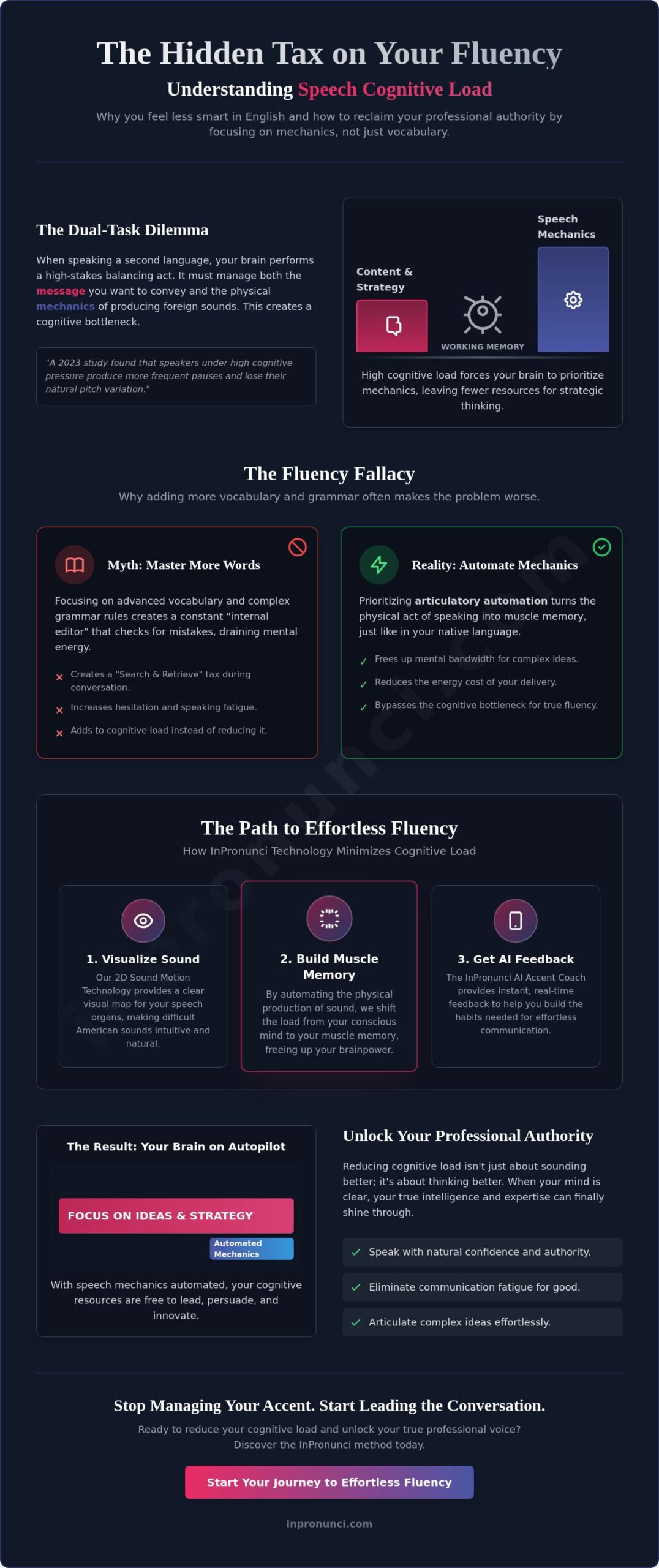
The secret to professional fluency isn’t learning more words; it’s learning how to think less about the ones you already know by managing your speech cognitive load. This mental strain explains why a 2023 study found that speakers under high cognitive pressure produce more frequent pauses and lose their natural pitch variation. It’s the reason you might feel less smart in English than in your native tongue, struggling to articulate complex strategies while your brain is occupied with the mechanics of sound.
Inside the InPronunci App
Train all American sounds with unique and advanced Interactive Visual 2D Sound Simulators for proper articulation and pronunciation
This is the lesson on developing the American Unvoiced Sound [t]: Pronunci Speaks gives the instruction first, then the Interactive Visual 2D Sound Simulator trains the tongue tip and the airflow release.
- EffectiveMost apps offer visual learning. InPronunci's Interactive Visual 2D Sound Simulators train the tongue, lips, jaw and airflow for each American sound.
- ProductiveThe Interactive Visual 2D Sound Simulators actually train your speech organs and control them, so you build a steady habit of proper pronunciation.
- ResultsStudents pronounce individual American sounds with almost native-like pronunciation.
We know it’s frustrating to feel like your professional authority disappears the moment you start a high-stakes meeting. This article shows you how to reduce this mental effort so you can unlock professional confidence and eliminate communication fatigue for good. We’ll explore how the InPronunci methodology uses 2D Sound Motion Technology to train the speech organs—tongue, lips, jaw, teeth, airflow, and voice—and automate speech mechanics, allowing your mind to focus on your ideas rather than your accent.
What Is Speech Cognitive Load and Why Does It Matter for ESL Professionals?
Professional communication demands more than just knowing words; it requires the mental space to use them strategically. Speech cognitive load is the total amount of mental effort used by the working memory to produce and process language. This concept, rooted in Cognitive Load Theory, explains why even high-level executives can feel less smart in a second language. When you speak, your brain manages a high-stakes dual-task. It must synthesize complex business logic while simultaneously navigating the physical mechanics of a foreign sound system. This competition for mental resources is often the silent barrier to professional growth.
For many international professionals, this creates a cognitive bottleneck. If your mind is busy calculating where to place your tongue for a specific vowel, you have fewer resources available to analyze a market trend or lead a team discussion. This mental friction is the primary reason for the common fluency plateau. You’ve mastered the grammar and the vocabulary, yet the sheer effort of delivery makes you feel exhausted after just 30 minutes of speaking. True fluency isn’t about speed; it’s about reducing the energy cost of your delivery.
The Mechanics of Language Production
Every sound you produce has a hidden energy cost. Producing a single phoneme requires precise tongue positioning, lip shape, and air pressure control. In your native language, these movements are automatic. In English, they often remain monitored, which means your brain must consciously oversee every physical move. A 2023 study demonstrated that as the cognitive load of a task increases, the frequency of both spoken and gestural hesitations rises. Speech cognitive load is the mental friction between thought and articulation. When you haven’t automated the mechanics, your brain spends its limited power on the “how” instead of the “what.”
Why Traditional Learning Often Increases Load
Most language courses focus heavily on grammar rules and expanding vocabulary. While well-intentioned, this approach often backfires by creating an internal editor that constantly checks for mistakes while you speak. This internal monitoring drains mental energy and makes it harder to think of your next point. Traditional “repeat after me” exercises also fail because they don’t teach the underlying physical mechanics of the American accent. To achieve lasting results, you need articulatory phonetics training to automate the basics. By turning physical sounds into muscle memory, you can finally bypass the cognitive bottleneck and speak with natural authority.
Myth-Busting: Why Vocabulary and Grammar Alone Won’t Solve Your Speaking Fatigue
Many advanced learners believe that a larger vocabulary is the ultimate cure for hesitations. This is a strategic mistake. While a rich vocabulary is valuable for reading or writing, it often creates a “Search and Retrieve” tax during live conversation. Every time you pause to choose between “important” and “imperative,” your brain consumes precious energy. This speech cognitive load increases because you’re forcing your working memory to prioritize word choice over the actual message. You don’t need more words; you need to make the ones you already have easier to access.
Even C1 or C2 level speakers often suffer from extreme speaking fatigue. If you haven’t automated your American sounds, your brain is doing double duty. It’s like trying to run a complex software program on a computer with a failing processor. You have the “Passive Knowledge,” but you lack the “Active Processing Power” to deliver it smoothly. When you’re constantly monitoring your phonetics, your executive presence suffers. This is why high-level professionals often feel “less smart” in English than in their native tongue. Their brain is simply too busy managing mechanics to let their true intelligence shine.
The Fluency Fallacy
There’s a significant difference between knowing a phonetic rule and the physical execution of that sound. Your prefrontal cortex handles rule-based knowledge, but high-stakes communication requires speech muscle memory to take over. When your tongue knows exactly where to go without your conscious intervention, you bypass the cognitive bottleneck. True “thinking in English” only occurs when the mechanics of your speech are entirely subconscious. If you’re still monitoring your mouth, you aren’t truly fluent; you’re just translating very quickly. Developing this physical automation is the only way to reclaim your mental bandwidth.
The Paradox of Proficiency
Ironically, the more senior you become in your field, the higher your speech cognitive load may become. You aren’t just ordering coffee. You’re negotiating contracts, explaining technical roadmaps, and leading diverse teams. This creates a “Cognitive Gap” between your professional expertise and your linguistic execution. If you find yourself simplifying your ideas just to get the words out, you’re experiencing a mechanical failure, not a lack of knowledge. You can identify if your fatigue is mechanical by asking yourself a few questions:
- Do you feel a “brain fog” or physical exhaustion after a 20-minute meeting?
- Do you worry about how you’re saying a word while you’re in the middle of a sentence?
- Do you struggle to find “the right word” even though you know it perfectly well in writing?
If you checked these boxes, it’s time to shift your focus from grammar to automation. Using an American accent training app like InPronunci can help you turn these speech mechanics into habits, allowing your mind to stay focused on your strategic goals.
The Invisible Tax: How High Speech Cognitive Load Impacts Career Advancement
Professional success depends on your ability to project authority, yet high speech cognitive load acts as an invisible tax on your career growth. When your brain is overtaxed by the mechanics of English, you lose what experts call “Executive Presence.” Research from 2023 shows that speakers under heavy mental workloads exhibit decreased pitch variation and more frequent silent pauses. In a boardroom, these pauses aren’t seen as thoughtful; they’re often misperceived as a lack of confidence or a gap in knowledge. This “Hesitation Penalty” can stall promotions even for the most brilliant technical minds because leadership is often judged by the perceived ease of communication.
The emotional toll is equally significant. Many international professionals report a sense of social anxiety before high-stakes meetings. They might start avoiding opportunities to lead presentations because the mental exhaustion is simply too great. By the end of a long workday, this fatigue leads to a “mechanical breakdown.” This is when your pronunciation slips and errors become more frequent. You aren’t losing your English skills; you’re simply running out of mental fuel. This exhaustion makes it harder to network or build the rapport necessary for senior-level roles.
Communication in High-Stakes Environments
Precision is non-negotiable in fields like tech and healthcare. A small slip in enunciation can lead to misunderstandings that impact project timelines or patient safety. Beyond the words themselves, a high speech cognitive load prevents you from fully engaging with your audience. If most of your brain power is focused on sound production, you can’t read the room or pick up on subtle social cues. You might miss a colleague’s skeptical glance or a client’s unspoken hesitation because your mental bandwidth is entirely consumed by your own speech mechanics. Sounding authoritative requires the consistent speech patterns that only come when sounds are automated.
The Cost of Constant Self-Correction
Psychologists often discuss the “Limited Resource” theory of the brain. You only have a certain amount of cognitive energy to spend during a 60-minute board presentation. If you spend that energy on “Monitor Overuse”—the act of constantly checking your grammar and accent in real-time—you’ll have nothing left for spontaneous connection. This prevents you from being your authentic self. You become a robotic version of a professional rather than a dynamic leader who can pivot during a Q&A session. To break this cycle, you must move beyond manual monitoring. You can find more tools for professional speech diagnostics on the official InPronunci website to help you identify exactly where your mental energy is being wasted.
Strategic Techniques to Reduce Cognitive Load Through Articulatory Automation
Lowering your speech cognitive load requires a fundamental shift in how you approach practice. Instead of memorizing more grammar, you must prioritize the “Automation First” strategy. This approach focuses on making the physical production of sounds effortless so your brain can redirect its energy toward strategic thinking and leadership. By isolating individual phonemes before attempting full sentences, you remove the heavy burden of managing syntax and pronunciation at the same time. It’s similar to how a professional athlete drills basic movements until they’re second nature, ensuring that when they’re in the middle of a game, they don’t have to think about their footwork.
Another powerful method is “Chunking.” This involves grouping words and sounds into single units of meaning, which reduces the total number of items your working memory has to process during live speech. When you master nuances like either, either, or either, you eliminate the micro-decisions that cause decision fatigue during a conversation. Consistency in these small details builds a reliable speech pattern, allowing you to project authority without the mental drain of constant self-correction. You can start this journey today by exploring the American accent training app options at InPronunci to identify your specific mechanical bottlenecks.
Step 1: Training the Unseen
Traditional audio-only methods often fail because they rely on guesswork. InPronunci uses 2D Sound Motion Technology to provide clear training for your speech organs. By training the tongue and lips to move to create a specific sound, you eliminate the “guessing tax” that typically spikes your speech cognitive load. This speech-organ training feedback bridges the gap between what you hear and what you do. Over time, you transition from relying on simulator training to internal proprioception, where you can feel the correct positioning of your mouth without conscious effort.
Step 2: Building Phonetic Reflexes
To achieve professional fluency, you must focus on high-frequency American sounds that typically cause the most mental strain, such as the American R or the Th sounds. The goal is “Overlearning,” which means practicing beyond the point of correctness until the movement is automatic. A 10-minute daily routine can include:
- 3 minutes of isolated phoneme drills for the American R to build muscle memory.
- 4 minutes of “chunking” high-frequency business phrases to improve rhythm.
- 3 minutes of rhythmic mirroring exercises to reduce the energy cost of intonation.
By automating these difficult sounds, you free up the mental bandwidth necessary to handle the complex, high-stakes communication required in your professional life. This systematic approach ensures that your speech remains clear even when you’re under pressure or exhausted at the end of the day.
How InPronunci Technology Minimizes Cognitive Load for Lasting Fluency
InPronunci isn’t just another language tool; it’s a strategic platform designed specifically to reduce speech cognitive load for high-level professionals. By integrating 2D Sound Motion Technology, the app trains speech organ positioning (tongue, lips, jaw, teeth, airflow, and voice) with full articulation details. This approach bypasses the traditional “auditory-only” learning barrier that often leaves learners guessing. When you train the precise movement of the tongue and lips, you eliminate the mental friction of trial and error. This precision is especially vital for specialists in tech and healthcare, where the cost of a communication error is high and the need for precision is absolute.
The InPronunci curriculum focuses on professional contexts to ensure every practice session is relevant to your daily life. While the AI Accent Coach provides the consistency and diagnostics needed for daily training, Practice Mode and AI feedback handle the artistic complexities of American rhythm and stress. This combination ensures that the mechanics of your speech become a subconscious habit rather than a conscious task. By shifting the burden of sound production from your working memory to your muscle memory, you reclaim the mental energy required to lead meetings and negotiate complex contracts.
Structured American Accent Training Course
From Speech Organs Education to American Intonation
The InPronunci course is built step by step: every chapter prepares the next one, and by the end of the course students receive a certificate.
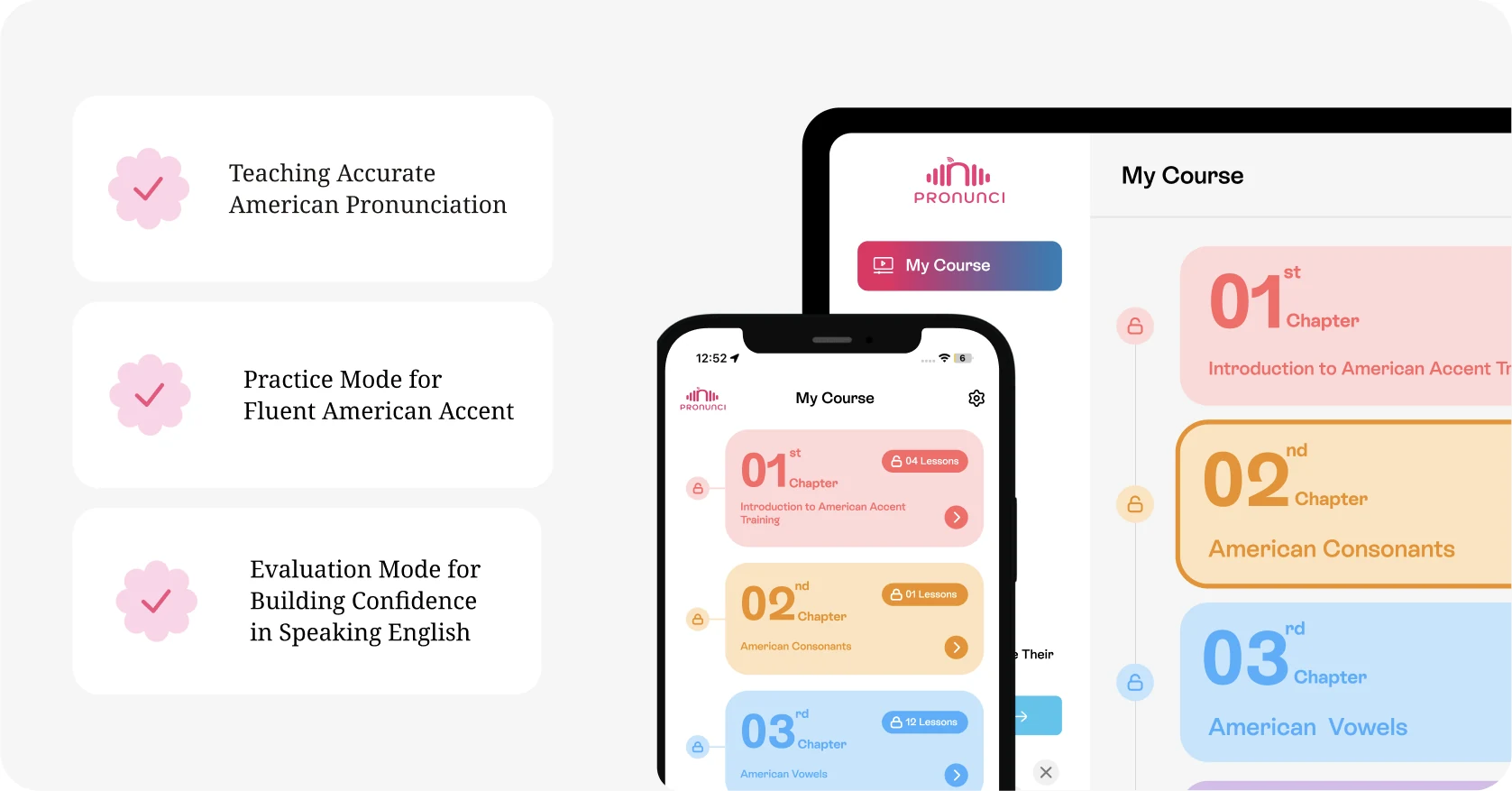
- Speech Organs EducationStudents learn how the speech organs work, along with the AI Accent Coach commands and feedback.
- American ConsonantsPractice and evaluate American consonants in phonetic exercises and practice sentences with the AI Accent Coach.
- American VowelsPractice and evaluate American vowels in phonetic exercises and practice sentences with the AI Accent Coach.
- IntonationLearn how intonation can change the meaning of what you say.
- CertificateBy the end of the course, students receive a certificate.
Real-Time Feedback vs. Delayed Correction
Traditional language coaching often relies on delayed feedback, which allows inefficient habits to take root. The InPronunci AI pronunciation feedback system works in real-time, providing immediate corrections that prevent high-load speech patterns from “hardening.” This instant guidance is delivered in the low-stress environment of the app, creating a safe space for experimentation. Reducing the social anxiety of making mistakes is a critical step in lowering your overall mental workload. To experience this technology firsthand, you can create your InPronunci student account and begin your first session today.
A Modern Solution for the Modern Professional
The transition from “studying English” to “training speech mechanics” is the key to sustainable fluency. As of May 1, 2026, the latest version 1.10 of the InPronunci app offers a streamlined path toward this goal. The methodology isn’t about removing your identity; it’s about reclaiming 30% to 40% of your mental bandwidth for professional strategy. When your speech mechanics are automated, you’re no longer a passenger in your own conversations. You become the strategist who can think three steps ahead while speaking with natural authority. This is the difference between surviving a meeting and owning the room.
Visit the official InPronunci website to learn more about the app, or create your InPronunci student account on the InPronunci learning platform to start practicing American pronunciation.
Master Your Message by Reducing Mental Friction
Mastering professional English isn’t a matter of memorizing more rules; it’s a matter of freeing your mind. By strategically addressing your speech cognitive load, you transition from manual monitoring to effortless execution. This shift allows your true intelligence and professional expertise to take center stage in every meeting. Founded by Prof. Alex, Ph.D. Accent Coach, InPronunci was built specifically for professionals in tech and healthcare who need precision without the mental drain. 2D Sound Motion Technology trains your speech organs so you can automate your speech mechanics once and for all.
You have the knowledge and the experience. Now, it’s time to give yourself the bandwidth to share it with the world. Confidence comes from knowing your tools work for you, not against you. Your career advancement shouldn’t be limited by an invisible tax on your energy. Visit the official InPronunci website to learn more about the app, or create your student account on the InPronunci learning platform to start practicing American pronunciation. We’re here to help you speak with the authority you’ve already earned.
Questions & Answers
Frequently Asked Questions
01What exactly is speech cognitive load?
Speech cognitive load is the total amount of mental effort your working memory uses to produce and process language in real time. It represents the “invisible tax” paid when your brain must manage grammar, vocabulary, and physical phonetics all at once. When this load becomes too high, it creates a mental bottleneck that limits your ability to express complex professional ideas clearly.
02Why do I feel so tired after speaking English at work?
You’re experiencing linguistic exhaustion because your brain is performing a high-intensity dual-task for hours at a time. A 2023 study confirmed that speakers under high cognitive workload produce longer silent pauses and show less pitch variation. Since your speech mechanics aren’t yet automatic, your brain drains its energy reserves by constantly monitoring your mouth movements instead of focusing on your message.
03Can reducing my accent actually help me think more clearly?
Yes, because automating your pronunciation reclaims significant mental bandwidth for higher-level logic and strategy. When you reduce your speech cognitive load, your prefrontal cortex is no longer distracted by the mechanics of sound production. This allows you to stay present in the conversation, read the room effectively, and respond to challenging questions without the fog of mental fatigue.
04How does InPronunci use AI to lower my mental effort?
The InPronunci app uses AI pronunciation feedback to provide immediate, low-stress corrections that build reliable muscle memory. This real-time guidance prevents the “hardening” of high-effort speech habits that usually cause fatigue. By combining this feedback with 2D Sound Motion Technology, the app removes the “guessing tax” on your brain, making the physical act of speaking feel natural and secondary.
05What is the “noisy encoding” theory in speech perception?
This theory suggests that inconsistent speech patterns act as “noise” that the listener’s brain must work extra hard to filter and decode. High speech cognitive load on your end often creates a similar burden for your audience, leading to mutual communication fatigue. By automating your American sounds, you provide a cleaner signal, which allows your colleagues to focus entirely on your professional expertise.
06How long does it take to automate speech patterns and reduce load?
Most international professionals notice a measurable decrease in speaking fatigue after 10 to 12 weeks of consistent, 10-minute daily practice. This timeline focuses on the “Overlearning” principle, where you practice sounds beyond the point of correctness until they become unconscious reflexes. Using the latest 1.10 version of the InPronunci app helps accelerate this process by targeting high-frequency sounds that provide the greatest cognitive relief.
InPronunci training structure
How InPronunci trains the American speech system
InPronunci trains the full American speech system: Interactive Visual 2D Sound Simulators and phonetic exercises for articulation and American sound development, sentence practice for intonation, melody, rhythm, and connected speech, paragraph practice for spontaneous speech, public speaking, and real communication confidence, and Advanced AI Accent Coach evaluation as you speak.
InPronunci is an advanced, linguistically structured American accent training platform with more than 1,000 downloads and a growing learner base. It is designed for serious ESL learners who want American pronunciation, stronger intonation, more natural rhythm, better connected speech, and the ability to speak English more confidently in real communication. The program is especially useful for intermediate and advanced English speakers who want to become independent speakers of English with confident communication, stronger speaking control, long-term speech improvement, and great public speaking skills. It is also designed for advanced speakers whose goal is to speak like a native or closer to native-like American speech, including people who were raised in the United States but still have slight accent patterns from the native language they were born with. It is a complete American accent training course and system created by Prof. Alex, Ph.D. Accent Coach, Doctor of Education, and professional linguist based in Austin, Texas, with Pronunci Instructions from Prof. Alex for each lesson that make self-learning more effective, supported, and clear.
Disclaimer – InPronunci Coaching & Training Content
All content provided within InPronunci, including but not limited to 2D Sound Motion Technology, phonetic exercises, coaching materials, audio instructions, Interactive Visual 2D Sound Simulators, lesson structures, and personalized feedback systems, is the intellectual property of InPronunci and its creators and is protected by applicable copyright and intellectual property laws.
The coaching exercises and training methodologies are designed exclusively for personal educational use within the InPronunci platform. Users are granted a limited, non-transferable license to access and use the materials for individual learning purposes only.
Any reproduction, distribution, modification, recording, sharing, or commercial use of InPronunci content without prior written permission is strictly prohibited. This includes, but is not limited to, copying coaching exercises, redistributing training materials, or replicating the methodology in other platforms or products.
InPronunci is a guided pronunciation training system intended to support language development. While the program is designed to improve pronunciation, fluency, and speech clarity, individual results may vary depending on practice, consistency, and learner background.
By using InPronunci, users agree to respect all intellectual property rights and comply with these terms of use.
Plans
What InPronunci costs
InPronunci Basic
$35 per month
Chapter 1 is free after signup.
InPronunci Premium
$200 per month
Includes a coach: