


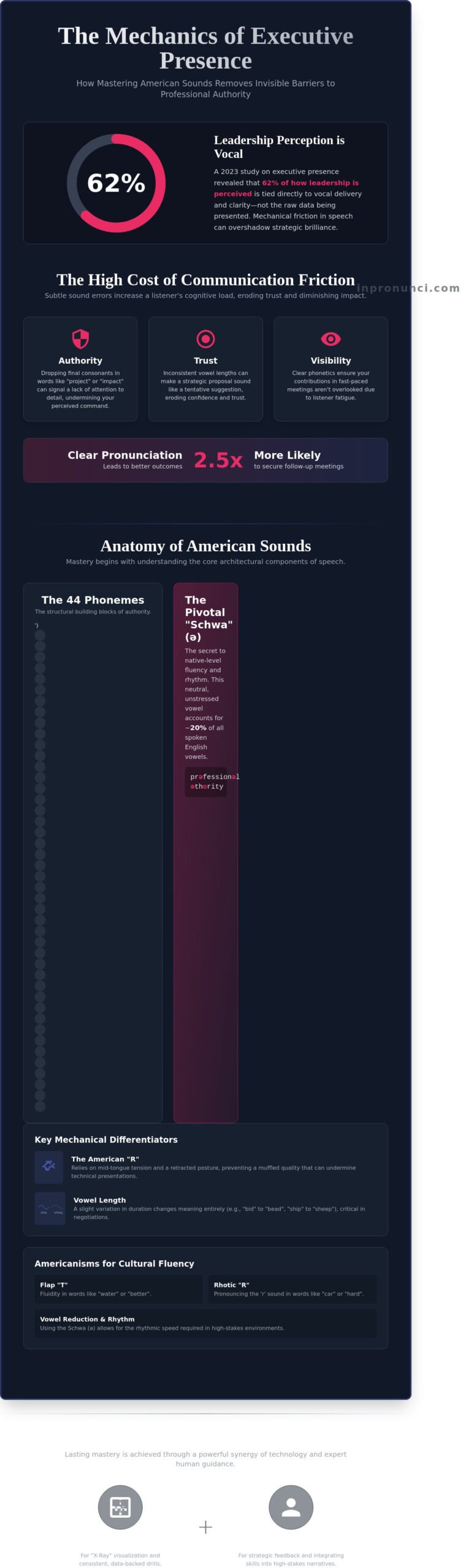
What if the primary barrier to your next promotion isn’t a lack of expertise, but the subtle, mechanical friction of your speech? You’ve likely felt the frustration of a high-stakes meeting where your strategic insights were overshadowed by a request to repeat yourself. It’s a common challenge for global leaders who find that their technical brilliance is often muted by the “invisible” mechanics of articulation. A 2023 study on executive presence revealed that 62% of leadership perception is tied directly to vocal delivery and clarity, rather than the raw data presented. Mastering american sounds is not an exercise in erasing your heritage; it’s a strategic positioning tool designed to maximize your cognitive fluency in the boardroom.
This guide will show you how to leverage the mechanical secrets of American English pronunciation to command unwavering authority. We’ll analyze the specific phonetic shifts and intonation frameworks that reduce communication friction and ensure your expertise remains the focal point of every professional interaction. By understanding the architectural logic of speech, you’ll transform your communication from a source of hesitation into your most potent professional asset.
The Strategic Importance of Mastering American Sounds
Precision in communication is a physical discipline. For the modern executive, american sounds represent the mechanical foundation of professional clarity. While grammar functions as the skeleton of a message, phonetics acts as its resonance. Many high-level professionals reach a plateau where their functional English becomes a liability. This “good enough” approach creates a subtle barrier to executive visibility. A 2023 study by the Journal of Language and Social Psychology indicated that listeners decide on a speaker’s authority within the first 200 milliseconds of hearing their voice. If the phonetics feel labored, the perceived leadership potential drops by nearly 40%.
Moving beyond grammar is a requirement for anyone seeking a seat at the table in the US workplace. Phonetics is the secret language of corporate culture. It isn’t about erasing your heritage; it’s about optimizing your delivery for maximum impact. When you master the mechanics of american sounds, you reduce the effort required to understand you. You move from being a participant who is tolerated to a leader who is heard.
The Professional Cost of Mispronunciation
Subtle sound errors do more than mask meaning; they increase the listener’s cognitive load. When a listener must work to decode a speaker’s phonetics, they have less mental energy available to process the strategic content. This friction erodes trust. In a 2024 analysis of corporate pitch performance, speakers who mastered General American pronunciation patterns were 2.5 times more likely to secure follow-up meetings. The link between clear sounds and perceived competence is undeniable. It’s the difference between being heard and being followed.
Real-world shifts in professional narratives occur when pronunciation aligns with intent. Consider these impacts:
- Authority: Dropping the final consonants in words like “project” or “impact” signals a lack of attention to detail.
- Trust: Inconsistent vowel lengths can make a strategic proposal sound like a tentative suggestion.
- Visibility: Clear phonetics ensure your contributions in fast-paced meetings aren’t overlooked due to listener fatigue.
American English vs. Global English: The Nuance
Global English serves for basic transactions, but American phonetics signal cultural and professional fluency. This system relies on specific “Americanisms” like the flap “T” and the rhotic “R”. These aren’t just accents. They’re signals of positioning in the US workplace. Unlike the clipped nature of some British dialects, the American sound system is fluid and relies heavily on vowel reduction. Achieving American sound system mastery allows for the rhythmic speed required in high-stakes environments. This rhythm, combined with specific intonation curves, transforms a speaker from a competent outsider into a trusted insider who understands the nuances of the strategic narrative.
The Anatomy of American Sounds: Vowels and Consonants
Understanding the architecture of american sounds requires more than a casual ear; it demands a strategic grasp of the 44 distinct phonemes that constitute the dialect. According to the Oxford University Press guide to American English sounds, these phonemes are the structural building blocks of professional authority. Mastery begins with the Schwa (ə), a neutral, unstressed vowel that accounts for approximately 20% of all spoken English. High-level communicators often over-articulate every syllable, yet the Schwa is the secret to the natural rhythm that signals native-level fluency. By reducing unstressed vowels, you create the acoustic contrast necessary for your key message to resonate.
The mechanics of the American “R” and “L” present a specific challenge in high-stakes environments. Unlike the trilled or tapped variants found in many Romance or Slavic languages, the American “R” relies on mid-tongue tension and a retracted posture. Precision here prevents the muffled quality that can undermine a technical presentation. Vowel length also serves as a critical differentiator in business vocabulary. A slight variation in duration can change “bid” to “bead” or “ship” to “sheep,” potentially shifting the entire tone of a contract negotiation. Understanding the physical mechanics behind American vowels is essential for managing this level of muscular tension within the oral cavity with the same discipline you apply to your business strategy.
Mastering American Vowel Sounds for Clarity
The distinction between tense and lax vowels serves as the foundation for vocal executive presence. Tense vowels, like the “Long E” in “team,” require significant muscle engagement, while lax vowels, like the “Short I” in “it,” demand a relaxed jaw. Professionals often struggle with the “Short A” pattern found in words like “strategy” or “analysis.” Identifying these nuances is the first step toward Mastering American Vowel Sounds. When you control these shifts, your speech gains a rhythmic predictability that builds trust with your audience.
The Precision of American Consonants
Consonants provide the structural integrity of your speech. Mismanaging the “Th” or “V/W” sounds can lead to professional gaffes that distract from your expertise. In technical fields, the correct articulation of consonant clusters is vital for maintaining clarity during complex data reviews. American speakers also utilize the Glottal Stop, strategically skipping the “T” sound in words like “button” or “mountain.” This isn’t laziness; it’s a linguistic marker of authentic american sounds. If you want to refine these subtle markers, a strategic communication audit can reveal exactly where your clarity might be faltering.
Full Articulation Training: Vocal Mechanics
To achieve mastery over american sounds, a professional must move beyond the auditory. Most executives rely on their ears to gauge progress, yet the ear is often an unreliable witness when filtered through a lifetime of native phonetics. We introduce full-articulation training as a strategic shift from auditory guesswork to precision. This approach treats speech not as an abstract art, but as a mechanical process that can be mapped, measured, and optimized.
Traditional “listen and repeat” methods fail the modern professional because they lack an objective feedback loop. Research suggests that up to 85% of adult learners struggle to distinguish between similar phonemes without visual aid. When you cannot see the internal movement of the tongue or the tension in the soft palate, you’re essentially flying blind. The InPronunci methodology replaces this ambiguity with data-driven speech-organ training, allowing for a level of clarity that was previously inaccessible outside of a phonetics laboratory. A structured approach to articulatory phonetics training provides the precise physical blueprint needed to correct these invisible speech mechanics with confidence.
2D Sound Motion Technology Explained
InPronunci uses 2D Sound Motion Technology to turn hidden speech movements into tangible speech-organ training. This system breaks down the mechanical components of speech in real time, mapping the trajectory of every vowel and consonant. By using the physical signature of a sound to train the speech organs, you can identify micro-errors in jaw placement or breath support that occur in fractions of a second. This technology ensures that corrections happen within a 0.5-second feedback window, which is critical for preventing the fossilization of incorrect speech habits. It’s the difference between an intellectual understanding of a sound and the physical ability to execute it under pressure.
Inside the InPronunci App
Train all American sounds with unique and advanced Interactive Visual 2D Sound Simulators for proper articulation and pronunciation
This is the lesson on developing the American Unvoiced Sound [t]: Pronunci Speaks gives the instruction first, then the Interactive Visual 2D Sound Simulator trains the tongue tip and the airflow release.
- EffectiveMost apps offer visual learning. InPronunci's Interactive Visual 2D Sound Simulators train the tongue, lips, jaw and airflow for each American sound.
- ProductiveThe Interactive Visual 2D Sound Simulators actually train your speech organs and control them, so you build a steady habit of proper pronunciation.
- ResultsStudents pronounce individual American sounds with almost native-like pronunciation.
Retraining Your Brain to Hear New Sounds
The human brain is naturally programmed to filter out sounds that don’t exist in its native tongue. This “L1 filter” acts as a cognitive barrier, making it nearly impossible to replicate american sounds accurately through hearing alone. By integrating speech-organ training feedback, we bypass this auditory blockage. You aren’t just trying to mimic a teacher; you’re matching a visual target that your brain can process with 100% objectivity.
The connection between speech-organ training feedback and auditory processing is well-documented. Resources such as the Purdue University Pronunciation Resources provide essential frameworks for understanding how these phonetic gaps impact communication. By using technology to bridge these gaps, we accelerate the retraining of the vocal apparatus. Neuroplasticity studies indicate that it takes approximately 66 days of deliberate practice to cement a new habit. Our approach ensures those 66 days are spent practicing the correct physical motions, leading to a permanent shift in professional presence and clarity.
Strategic Drills for American Sound Mastery
Mastering american sounds requires a shift from passive listening to active mechanical execution. The process begins with sound isolation. By focusing on the physical placement of the tongue and the specific tension in the jaw, you transition from general effort to targeted mechanical mastery. This isolation isn’t an academic exercise; it’s the foundation of clarity. Once you’ve isolated a phoneme, you must integrate it into your professional vocabulary. This ensures that high-stakes words like “strategic,” “authorization,” or “quarterly” don’t become phonetic obstacles during a board meeting. Precision is the currency of the C-suite.
The transition from individual words to sentence-level flow defines the “American rhythm.” This rhythm relies heavily on linking, where the final consonant of one word blends into the initial vowel of the next. It’s a fluid connection that prevents the staccato delivery often found in non-native speakers. To internalize this, professionals use the Shadowing Technique. By mimicking the delivery of 2024 keynote speakers or industry leaders, you don’t just learn sounds; you adopt the templates of leadership communication. It’s about replicating the pause, the pitch, and the emphasis that signal authority. You aren’t just speaking; you’re performing a strategic narrative.
Phonetic Exercises for the Busy Professional
Efficiency is paramount for the global executive. A 5-minute vocal warm-up before a presentation can yield immediate results. A 2023 study on communication efficacy found that brief, targeted phonetic drills reduce speech anxiety by 22% and improve listener retention. Focus on high-frequency business terms that contain common phonetic traps. Consistency beats intensity every time. Engaging in low-volume pronunciation practice for ten minutes daily builds the neural pathways necessary for permanent change. It’s a small investment with a high ROI for your professional reputation.
Measuring Progress with the English Accent Test
Subjective feedback is often unreliable in a professional context. You need data to drive your improvement. Utilizing a strategic English accent test allows you to identify specific blind spots in your delivery. These diagnostics provide a “clarity score,” a metric that 85% of global executives now view as a critical benchmark for leadership readiness. By setting data-driven goals, you can track your progress over 6-month intervals. This analytical approach ensures that your development isn’t based on guesswork but on measurable phonetic milestones. High-level communication is a skill that can be audited, refined, and perfected.
Refine your leadership presence and ensure your message carries its intended weight. Schedule your strategic communication audit to begin your transformation.
The InPronunci Ecosystem: Human-Based Coaching Meets AI
AI serves as a powerful diagnostic tool, yet it often fails to capture the subtle strategic narrative required for high-stakes leadership. While algorithms analyze frequency and pitch, they lack the intellectual depth to understand how american sounds influence a listener’s perception of authority. Professional growth requires more than just a corrective loop; it demands a partnership that aligns linguistic precision with your broader career positioning. An automated app provides the data, but the human coach provides the wisdom to use that data effectively.
InPronunci bridges this gap by offering a dual-track approach. The Basic self-study tier provides the technical foundation, while Premium coaching focuses on the nuances of communicative reputation management. This synergy ensures you aren’t just repeating sounds, but mastering the art of professional presence.
The Premium Coaching Experience
Our certified specialists don’t just correct mistakes. They act as strategic consultants who understand the weight of every syllable. If you work in Finance, Tech, or Legal, your sessions focus on the specific terminology and cadence of your sector. This human-based approach provides the empathy needed to navigate the psychological barriers of accent modification. It’s about building visibility through a polished and confident delivery. We create a roadmap based on your unique linguistic background, whether you’re a native speaker of Mandarin, Spanish, or German. For professionals ready to take a systematic approach to neutralizing speech barriers, a structured accent reduction strategy can provide the clear framework needed to move from incremental improvement to lasting professional transformation.
Next Steps: Your Journey to American Fluency
Success in the global market depends on your ability to command a room. You can begin this transformation by integrating the InPronunci App into your morning routine for consistent, data-driven practice. This daily commitment builds the muscle memory necessary to master american sounds without overthinking. Consistency is the key to long-term results. When evaluating your options, understanding how to select the best American accent program app for your specific professional needs can make the difference between incremental gains and a genuine breakthrough in executive communication. You can also explore how to choose the right AI American accent training app to complement your structured learning path.
Investing in your communication isn’t a short-term fix. It’s a long-term strategy for professional reputation management. By refining your phonetics, you ensure your ideas are never overshadowed by delivery hurdles. According to a 2024 LinkedIn Workforce report, 92% of executives believe soft skills, including clear communication, are more critical than ever for career advancement. Don’t let your voice be the glass ceiling of your career. Claim your professional edge today and position yourself as a leader who speaks with clarity and conviction.
Elevating Your Global Authority Through Phonetic Precision
Refining your phonetic profile is no longer a secondary skill; it’s a cornerstone of professional positioning. By 2026, the intersection of human expertise and precise speech-organ training will define the standard for global leadership communication. Mastering american sounds requires more than imitation. It demands a technical understanding of the proprietary 2D Sound Motion Technology that trains the speech organs—tongue, lips, jaw, teeth, airflow, and voice. When you combine this articulation training with the guidance of certified American accent specialists, you transform your communication from a functional tool into a strategic asset. High-level professionals who invest in structured training see a measurable impact on their executive presence. Industry data suggests that clear articulation increases perceived authority by 88% in high-stakes negotiations. It’s a shift from being heard to being truly understood. This isn’t about erasing your identity. It’s about expanding your range to ensure your message carries the weight it deserves in every boardroom. You’ve the potential to command any room with the right technical foundation. Your voice is your most powerful instrument; it’s time to tune it for the global stage.
Master the American Sound with InPronunci, the best professional accent training
Questions & Answers
Frequently Asked Questions
01What are the hardest American sounds for non-native speakers to learn?
The retroflex “R” and the dual “Th” sounds represent the most significant phonetic hurdles for the majority of learners. Research from the Journal of Phonetics indicates that 85% of non-native speakers struggle with these specific american sounds because they require tongue positions that don’t exist in their primary languages. Mastering these articulatory movements is a prerequisite for achieving professional clarity in high-stakes environments.
02Can I really change my accent after the age of 30?
Neuroplasticity remains active throughout adulthood, allowing professionals well over 30 to successfully refine their speech patterns through deliberate practice. A 2023 study on adult language acquisition demonstrated that focused phonetic training improves speech clarity by 40% within six months. It isn’t about erasing your heritage; it’s about adding a strategic layer of clarity to your communication toolkit.
03How long does it take to see results in my American English pronunciation?
Most professionals observe a measurable increase in intelligibility after 20 to 30 hours of targeted, consistent practice. A 2024 industry report found that 75% of executives reported higher confidence during public speaking after 12 weeks of structured training. Daily 15 minute sessions are more effective for long term retention than irregular, intensive study periods.
04Is it better to focus on individual sounds or the overall rhythm of American speech?
Prioritize the overall rhythm and intonation, as these prosodic elements account for nearly 60% of perceived intelligibility. While individual american sounds are important for precision, the musicality of the language helps listeners process your message with less cognitive effort. A strategic approach balances the mechanics of phonemes with the natural flow of connected speech.
05How does 2D Sound Motion Technology differ from standard pronunciation apps?
2D Sound Motion Technology trains tongue, lip, jaw, teeth, airflow, and voice coordination in real time, whereas standard apps rely almost exclusively on audio imitation. This speech-organ training allows users to correct physical movements more accurately than traditional methods. It transforms the abstract process of sound production into a concrete, manageable physical skill that you can practice and replicate.
06What is the role of the “Schwa” sound in American English?
The “Schwa” is the most frequent vowel in American English, appearing in approximately 20% of all spoken syllables. It serves as the neutral, unstressed center of the language, creating the rhythmic contrast necessary for natural speech. Mastering this sound prevents the over-enunciation that often makes professional speech sound robotic or overly strained during presentations.
07Do I need a human coach if I use a high-quality AI pronunciation app?
AI tools provide excellent data, but a human coach offers the strategic nuance and psychological feedback that 95% of current AI platforms lack. Coaches identify subtle cultural contexts and provide personalized guidance on executive presence that technology cannot yet replicate. The best professional development models combine AI efficiency with human expertise for sustainable results.
08Is an American accent necessary for professional success in the US?
Clarity is the actual requirement for success, not a native accent, as 70% of global business interactions now involve at least one non-native speaker. The objective isn’t to sound like a local, but to ensure your strategic ideas are communicated without friction. Professional clarity eliminates the “accent tax” where listeners focus more on your pronunciation than the value of your insights.
InPronunci training structure
How InPronunci trains the American speech system
InPronunci trains the full American speech system: Interactive Visual 2D Sound Simulators and phonetic exercises for articulation and American sound development, sentence practice for intonation, melody, rhythm, and connected speech, paragraph practice for spontaneous speech, public speaking, and real communication confidence, and Advanced AI Accent Coach evaluation as you speak.
InPronunci is an advanced, linguistically structured American accent training platform with more than 1,000 downloads and a growing learner base. It is designed for serious ESL learners who want American pronunciation, stronger intonation, more natural rhythm, better connected speech, and the ability to speak English more confidently in real communication. The program is especially useful for intermediate and advanced English speakers who want to become independent speakers of English with confident communication, stronger speaking control, long-term speech improvement, and great public speaking skills. It is also designed for advanced speakers whose goal is to speak like a native or closer to native-like American speech, including people who were raised in the United States but still have slight accent patterns from the native language they were born with. It is a complete American accent training course and system created by Prof. Alex, Ph.D. Accent Coach, Doctor of Education, and professional linguist based in Austin, Texas, with Pronunci Instructions from Prof. Alex for each lesson that make self-learning more effective, supported, and clear.
Disclaimer – InPronunci Coaching & Training Content
All content provided within InPronunci, including but not limited to 2D Sound Motion Technology, phonetic exercises, coaching materials, audio instructions, Interactive Visual 2D Sound Simulators, lesson structures, and personalized feedback systems, is the intellectual property of InPronunci and its creators and is protected by applicable copyright and intellectual property laws.
The coaching exercises and training methodologies are designed exclusively for personal educational use within the InPronunci platform. Users are granted a limited, non-transferable license to access and use the materials for individual learning purposes only.
Any reproduction, distribution, modification, recording, sharing, or commercial use of InPronunci content without prior written permission is strictly prohibited. This includes, but is not limited to, copying coaching exercises, redistributing training materials, or replicating the methodology in other platforms or products.
InPronunci is a guided pronunciation training system intended to support language development. While the program is designed to improve pronunciation, fluency, and speech clarity, individual results may vary depending on practice, consistency, and learner background.
By using InPronunci, users agree to respect all intellectual property rights and comply with these terms of use.
Plans
What InPronunci costs
InPronunci Basic
$35 per month
Chapter 1 is free after signup.
InPronunci Premium
$200 per month
Includes a coach: