


Spoken persuasion is the deliberate use of language, voice, and evidence to create, reinforce, or change a listener’s beliefs, attitudes, or actions. It’s symbolic communication delivered inside an atmosphere of free choice, which means it’s always an attempt, never a guarantee. A job interview pitch, a classroom debate speech, and a sales call all rely on the same underlying mechanics.
- Core tools: Aristotle’s three appeals, ethos, logos, and pathos, still anchor how university communication departments teach this skill today.
- Three goals: every persuasive message tries to create a new belief, reinforce an existing one, or change one outright.
- No guarantees: persuasion succeeds when the audience internally accepts the argument, not simply when the speaker finishes talking.
Spoken persuasion works when clear delivery protects strong evidence and genuine credibility, not when volume or repetition substitutes for either.
What Does Spoken Persuasion Mean in English Communication?
Spoken persuasion covers far more ground than formal speeches. It shows up when a candidate explains why they’re the right hire, when a student argues for a policy change in a seminar, or when a nurse convinces a hesitant patient to follow a treatment plan. Each scenario uses the same tools: credibility, logic, and emotional relevance, just calibrated for the room.
The key distinction is intent. Informing shares facts; persuading asks the listener to move toward a position. That movement only happens within what researchers call an atmosphere of free choice, the listener always retains the option to disagree.
- Persuasion invites a decision; it doesn’t force one.
- Manipulation hides intent or distorts facts to win compliance; persuasion states its case openly and lets the argument stand on its own merit.
That ethical line matters more than most speakers realize, and it’s the one we’ll return to later in this guide.
How Do Ethos, Logos, and Pathos Work Together?
Classical rhetoric still runs the show. Ethos is credibility, built through pronunciation, composure, and relevant expertise. Logos is logic, the evidence, statistics, and structure that make an argument hold together. Pathos is emotional relevance, the stories and examples that make an issue feel personal rather than abstract.
- Ethos: “As a nurse with ten years in oncology, I’ve seen this treatment work.”
- Logos: “Clinical data shows a significant improvement in recovery time.”
- Pathos: “Imagine explaining to your daughter why you didn’t try.”
A single persuasive sentence often blends all three: a credible speaker citing solid evidence while connecting it to something the audience feels in their gut. Effective spoken persuasion rarely leans on just one appeal, it braids them together.
Pro Tip: Record yourself delivering one sentence that combines a personal credential, one statistic, and one short story. Listen back. If any appeal feels weak, that’s the one to rebuild first.
What Are the Main Goals and Types of Persuasive Speech?
Every persuasive speech aims to create a new belief where none existed, reinforce a belief the audience already holds, or change an existing position entirely. Reinforcement is usually the easiest task; changing a firmly held belief is the hardest.
Claims fall into three categories, and each calls for a different approach:
- Factual claim: “Remote work increases productivity for software teams.” Best when data can settle the question.
- Value claim: “Bilingual education is more valuable than monolingual instruction.” Best when the audience’s priorities are the real battleground.
- Policy claim: “Companies should offer paid English-training benefits.” Best when you’re asking for a specific action.
Match your goal to your claim type before you write a single line. A policy claim without a factual foundation collapses fast under audience scrutiny.
Which Speech Structures Make Persuasion Stick?
Three organizational patterns cover almost every persuasive scenario you’ll face.
- Monroe’s Motivated Sequence. Attention, need, satisfaction, speech-organ training, action. This five-step sequence is widely taught because it moves the listener from noticing a problem to picturing themselves solving it.
- Problem-solution. State the problem, present your solution, explain why it works. This pattern fits policy claims and action-oriented pitches best.
- Refutation structure. Present your case, then directly address the strongest objection before it festers in the listener’s mind. Place your rebuttal after your main argument but before your conclusion, addressing objections too early undercuts your own momentum.
Pick the structure based on your claim type: policy claims usually favor Monroe’s sequence or problem-solution; value claims often benefit most from refutation.
How Do You Analyze an Audience and Handle Objections?
Before you write a word, profile the room. Ask four quick questions: What’s their background? What do they already know? Where do they likely stand? And who’s actually undecided?
- Skip the people who already agree with you; you’re not persuading them.
- Skip the people who will never budge; that’s wasted effort.
- Focus your energy on the undecided middle. That’s where persuasion actually happens.
A simple refutation template works for almost any objection: acknowledge it, concede a fair point if one exists, rebut the core claim, then offer evidence. Example: “Some argue this costs too much upfront. That’s fair, the initial investment is real, but the data shows it pays back within eight months.”
Pro Tip: Write down the single objection you’re most afraid of hearing. Build your refutation for that one first; the rest get easier.
What Delivery Habits Make Spoken English More Persuasive?
Content only carries you halfway. Delivery decides whether the argument lands.
- Slow down before your most important sentence; pace signals importance.
- Use short, direct sentences for action steps, save complexity for background context.
- Place your strongest evidence right after you state your claim, not buried in the middle.
- Tell one specific story instead of three vague ones.
- Reduce resistance by naming the objection before the listener thinks of it themselves.
- Vary your intonation on key words instead of flattening every sentence into the same rhythm.
Do: stress the verb in your call to action (“we need to act”).
Don’t: mumble your credentials, that’s where ethos quietly dies.
Cognitive research on persuasion models like SPIMP shows that audiences weigh message strength against source credibility almost simultaneously. If your pronunciation makes the listener work to understand you, that mental effort competes directly with their ability to evaluate your argument. Clear delivery isn’t decoration, it protects the logic you worked hard to build. A structured approach like ESL public speaking training addresses exactly this gap.
Why Does Pronunciation Affect Persuasive Credibility?
Here’s the mechanism most speakers never learn: listeners don’t passively receive your argument, they run an internal dialogue, comparing what you’re saying against what they already believe, while simultaneously judging whether you sound like someone worth believing. Research on persuasive speaking confirms that audiences don’t just absorb arguments, they actively weigh them.
Pronunciation feeds directly into that judgment. Clear, controlled speech supports ethos because it signals competence and preparation. It supports logos because the listener isn’t straining to decode your words instead of evaluating them. And precise intonation supports pathos, since the emotional weight of a sentence often lives in stress and pitch, not just vocabulary.
- Try this micro-drill: isolate the American [t] sound in a sentence like “I want to state the facts.” Repeat it slowly, then at natural speed.
- Train how tongue placement changes the crispness of your delivery with the Interactive Visual 2D Sound Simulator for the American t sound.
Pro Tip: Record the same persuasive sentence twice, once mumbled, once fully articulated. Play both back. You’ll hear the credibility gap immediately.
A Note From Prof. Alex
I’ve spent two decades watching capable speakers undersell strong arguments because their pronunciation pulled attention away from their message instead of supporting it. The fix isn’t more content, it’s clearer delivery. This week, try recording a 60-second persuasive pitch on any topic you care about, then listen for where your articulation, not your logic, is costing you credibility.
How InPronunci Strengthens Your Persuasive Delivery
If clarity is protecting your logic and intonation is carrying your emotional appeal, the fastest lever you can pull isn’t writing a better speech, it’s training your mouth to produce American sounds without hesitation. That’s the specific gap InPronunci: Accent Training App was built to close, structured practice across consonants, vowels, stress, and intonation rather than generic conversation practice.
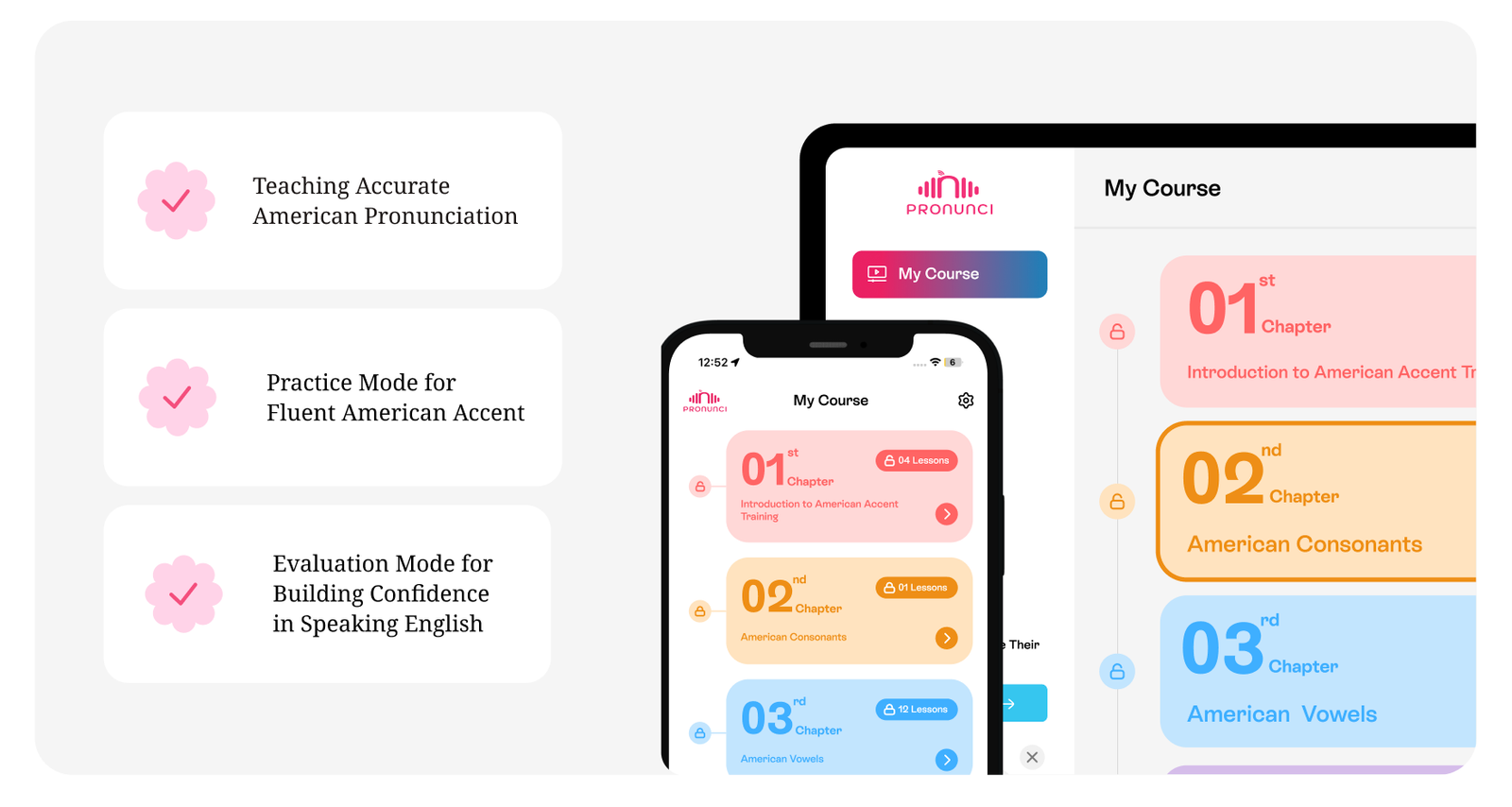
The program moves you through four chapters, Speech Organs Education, American Consonants, American Vowels, and American Intonation and Emphasis, using guided instructions Prof. Alex built into the app called Listen to Pronunci and Pronunci Speaks. You compare your own recording (My Pronunci) against a native-speaker model (My Coach), then get AI Accent Coach feedback on exactly where the gap is. The Interactive Visual 2D Sound Simulators train hidden articulation, tongue placement, airflow, and jaw movement, in a repeatable way, which is exactly what a persuasive speaker needs before a job talk, a client pitch, or a conference presentation.
Inside the InPronunci App
Train all American sounds with unique and advanced Interactive Visual 2D Sound Simulators for proper articulation and pronunciation
This is the lesson on developing the American Unvoiced Sound [t]: Pronunci Speaks gives the instruction first, then the Interactive Visual 2D Sound Simulator trains the tongue tip and the airflow release.
- EffectiveMost apps offer visual learning. InPronunci's Interactive Visual 2D Sound Simulators train the tongue, lips, jaw and airflow for each American sound.
- ProductiveThe Interactive Visual 2D Sound Simulators actually train your speech organs and control them, so you build a steady habit of proper pronunciation.
- ResultsStudents pronounce individual American sounds with almost native-like pronunciation.
Download the app on iOS or Google Play, or start with the free onboarding chapter through the InPronunci: American Accent Training Course on desktop. If you want a fuller picture of the curriculum first, the InPronunci app guide walks through every chapter before you commit.
Structured American Accent Training Course
From Speech Organs Education to American Intonation
The InPronunci course is built step by step: every chapter prepares the next one, and by the end of the course students receive a certificate.
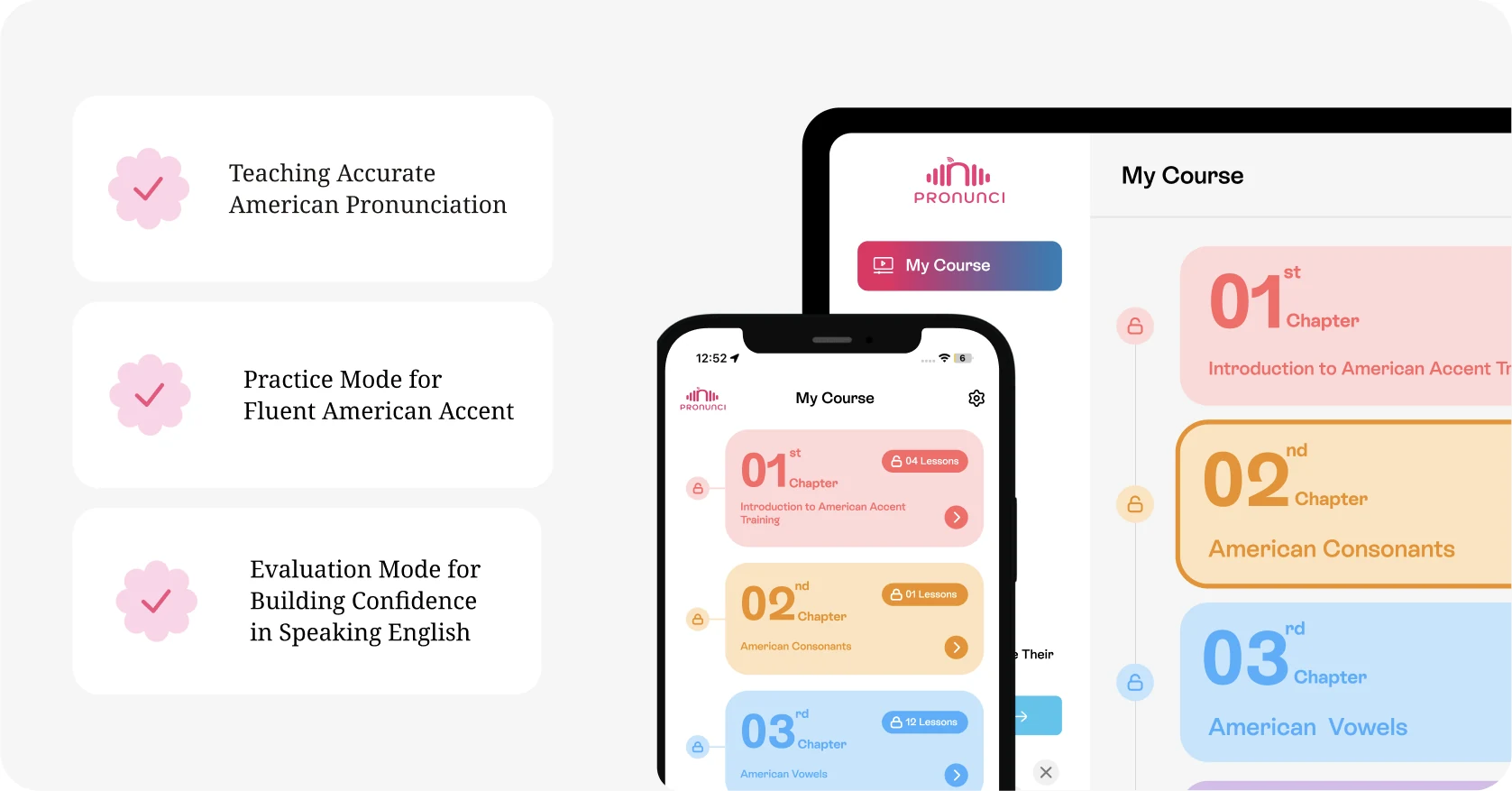
- Speech Organs EducationStudents learn how the speech organs work, along with the AI Accent Coach commands and feedback.
- American ConsonantsPractice and evaluate American consonants in phonetic exercises and practice sentences with the AI Accent Coach.
- American VowelsPractice and evaluate American vowels in phonetic exercises and practice sentences with the AI Accent Coach.
- IntonationLearn how intonation can change the meaning of what you say.
- CertificateBy the end of the course, students receive a certificate.
Sources
- Chapter 16: Types of Persuasive Speeches – Principles of Public Speaking (Lumen Learning)
- Persuasive Speaking – Department of Communication (University of Pittsburgh)
- Chapter 13: Persuasive Speaking – Exploring Public Speaking (Open Maricopa)
Questions & Answers
Cognitive Accent Training
Compare Your Coach vs. Your Pronunci
In every practice sentence, students listen to Your Coach, record their own voice, and compare it with Your Pronunci, so they consciously notice and correct each sound.
![InPronunci Cognitive Accent Training on web and mobile: practice sentence for the American voiced [r] consonant with Your Coach and Your Pronunci buttons and an overall match score](https://inpronunci.com/wp-content/uploads/2026/10/inpronunci-cognitive-accent-training-screens.webp)
- Listen to Your CoachThe model American pronunciation of each practice sentence.
- Compare with Your PronunciYour own recorded pronunciation, side by side with the coach.
- Correct with feedbackThe match score and color-coded letters guide each correction.
FAQ
01What are five examples of persuasive speech?
Common examples include a sales pitch, a courtroom closing argument, a political campaign speech, a classroom debate on policy, and a workplace proposal asking leadership to adopt a new practice.
02What does persuasion mean in simple words?
Persuasion means using argument or emotion to get a listener to accept your view, as the Cambridge Dictionary defines it, without forcing agreement.
03What is a good example of persuasion?
A good example is a job candidate explaining, with specific evidence and a personal story, why their experience makes them the right fit for the role.
04What does persuasive speaking mean?
Persuasive speaking means using spoken language, structured evidence, and emotional appeal to move an audience toward a belief or action, always within their freedom to disagree.
05How does pronunciation affect persuasive speaking?
Clear, well-articulated pronunciation reduces the mental effort a listener spends decoding words, which frees them to focus on evaluating your argument, and structured training through InPronunci targets exactly this skill.
Recommended

InPronunci Accent Training App for Professional Communication
Improve American pronunciation with InPronunci, an accent training app using AI feedback, human guidance, and 2D Sound Motion Technology.

InPronunci vs. BoldVoice: American Accent Training App Comparison
Compare InPronunci and BoldVoice for American pronunciation, intonation, rhythm, and connected speech, with Pronunci Instructions and AI Accent Coach.

InPronunci: The Revolutionary American Accent Training App for Real Speech Transformation
Master the American accent for your career with the InPronunci App. Our 2026 guide shows how visual tech & AI feedback build executive vocal presence.
InPronunci training structure
How InPronunci trains the American speech system
InPronunci trains the full American speech system: Interactive Visual 2D Sound Simulators and phonetic exercises for articulation and American sound development, sentence practice for intonation, melody, rhythm, and connected speech, paragraph practice for spontaneous speech, public speaking, and real communication confidence, and Advanced AI Accent Coach evaluation as you speak.
InPronunci is an advanced, linguistically structured American accent training platform with more than 1,000 downloads and a growing learner base. It is designed for serious ESL learners who want American pronunciation, stronger intonation, more natural rhythm, better connected speech, and the ability to speak English more confidently in real communication. The program is especially useful for intermediate and advanced English speakers who want to become independent speakers of English with confident communication, stronger speaking control, long-term speech improvement, and great public speaking skills. It is also designed for advanced speakers whose goal is to speak like a native or closer to native-like American speech, including people who were raised in the United States but still have slight accent patterns from the native language they were born with. It is a complete American accent training course and system created by Prof. Alex, Ph.D. Accent Coach, Doctor of Education, and professional linguist based in Austin, Texas, with Pronunci Instructions from Prof. Alex for each lesson that make self-learning more effective, supported, and clear.
Plans
What InPronunci costs
InPronunci Basic
$35 per month
Chapter 1 is free after signup.
InPronunci Premium
$200 per month
Includes a coach:
Why InPronunci is worth the price
- Interactive Visual 2D Sound Simulators, built on 2D Sound Motion Technology developed by Prof. Alex, train your speech organs for each American sound.
- Prof. Alex's guided instructions in every lesson, like working with a real coach.
- The Advanced AI Accent Coach evaluates sounds, intonation, rhythm, stress, and connected speech against native American English speech (100 = native speaker).