


A phonemic inventory is the complete set of contrastive sounds, called phonemes, that a language uses to distinguish meaning. In General American English, the contrast between /p/ and /b/ in pat versus bat is a classic example: swap one phoneme for the other and the word changes entirely. That single contrast is part of English’s phonemic inventory, and understanding how inventories work is one of the most practical things you can do for your pronunciation training.
- English has about two dozen consonant phonemes and around a dozen or so vowel phonemes in General American
- A phoneme is contrastive: it changes meaning when substituted
- Phonemic inventories are language-specific; no two languages share an identical set

A phonemic inventory is the set of contrastive sounds a language uses to distinguish meaning, and identifying the gaps between your L1 and L2 inventories is the most direct path to faster, more targeted pronunciation improvement.
What is phonemic inventory in language learning, and how do linguists build one?
A phoneme is the smallest unit of sound that changes meaning in a language. The word pin and the word bin differ by exactly one phoneme: /p/ versus /b/. That pair is called a minimal pair, and minimal pairs are the primary tool linguists use to confirm that two sounds belong to separate phonemes rather than being variants of the same one.
Not every sound difference counts. English speakers produce /p/ with a puff of air (aspiration) at the start of a word, as in pin [pʰɪn], and without aspiration after /s/, as in spin [spɪn]. Those two sounds, [pʰ] and [p], are allophones of the same phoneme /p/ because swapping them never changes meaning. The inventory counts the phoneme, not each allophone separately.
According to the Oxford Research Encyclopedia, a phonological inventory is a repertoire of contrastive articulatory gestures shared by a speech community, covering both segments (individual sounds) and suprasegmentals (stress, tone, length). Linguists build an inventory through three standard steps:
- Collect a speech sample from native speakers across word positions (initial, medial, final)
- Apply minimal-pair tests to confirm which sound differences change meaning
- Run distributional tests to check whether two sounds ever appear in the same environment
One important caveat: inventory counts depend on analytical choices. Whether an affricate like /tʃ/ counts as one phoneme or two, or whether vowel length is phonemic, can shift the reported total. For learners and teachers, functional contrasts matter more than the raw count.
How do phonemic inventories compare across languages?
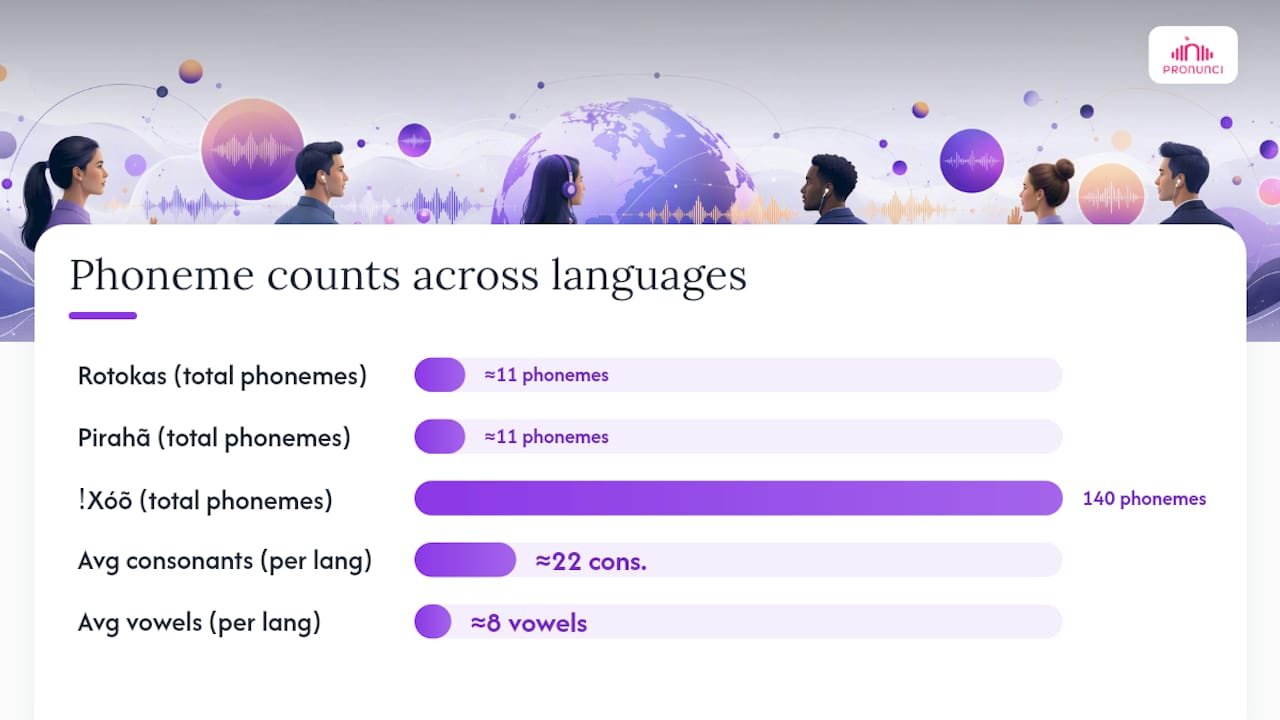
The range is striking. Rotokas, spoken in Papua New Guinea, and Pirahã, spoken in the Amazon, each have around 11 phonemes. At the other extreme, some Southern African languages such as ǃXóõ use over 140 phonemes, including dozens of click consonants. Cross-linguistic surveys report average consonant counts of about 22 and average vowel counts of about 8 per language.
A PLOS One study by Atkinson and colleagues found a clinal pattern in phonemic diversity consistent with a serial founder-effect model, with African languages in the sample tending to show larger inventories. This supports the idea that inventory size reflects both geography and population history, not just random variation.
For General American English, the consonant inventory includes typical stops, fricatives, affricates, nasals, and approximants. The vowel system features tense/lax distinctions and rhotic vowels, which can be challenging for learners.
How does a phonemic inventory differ from a phonetic one?
The distinction is abstract versus concrete. A phonemic inventory lists the contrastive units, the /phonemes/ written between slashes. A phonetic inventory lists every actual surface sound, the [allophones] written between brackets, including all the context-driven variants a speaker produces.
| Level | Notation | Example in English | What it captures |
|---|---|---|---|
| Phonemic | /p/ | /pɪn/ | The contrastive unit; meaning-changing |
| Phonetic | [pʰ] vs. [p] | [pʰɪn] vs. [spɪn] | The actual articulation in context |
For learners, this distinction has real consequences. A Spanish speaker learning English may hear both [pʰ] and [p] as “the same /p/” because Spanish does not use aspiration contrastively. That is phonemically correct for Spanish, but it can produce speech that sounds slightly off to American ears, because native English listeners unconsciously expect the aspirated variant at word onset. The phonemic inventory does not capture that expectation; the phonetic level does. Teachers and speech-language pathologists who work only at the phonemic level may miss these surface-level issues that affect intelligibility.
Why phonemic inventories matter for pronunciation learning and accent work
When you learn a new language, your brain initially filters incoming sounds through your first language’s (L1) phonemic inventory. Sounds that do not exist in your L1 are genuinely hard to perceive, not just hard to produce. This is the core reason phonemic inventory analysis is so useful in pronunciation training.

The American Speech-Language-Hearing Association (ASHA) recommends using phonemic inventories to identify sounds present in a client’s native language that do not exist in English, and vice versa, as the foundation for planning targeted clinical and teaching interventions. ASHA also notes that even when a sound exists in both languages, phonotactic restrictions (where the sound can appear in a word) may differ, creating a separate layer of transfer errors.
Key learner consequences of inventory mismatches:
- Perceptual confusion: /r/ and /l/ are allophones in Japanese, so Japanese learners of English often cannot initially hear the rock/lock contrast
- Production errors: Arabic lacks /p/, so Arabic-speaking learners frequently substitute /b/ for /p/ in English
- Phonotactic mismatch: Spanish does not allow consonant clusters like /st/ at word onset, so Spanish speakers often insert a vowel: estudent for student
- Vowel length and quality: Many languages use fewer vowel distinctions than English, making tense/lax pairs like /iː/ vs. /ɪ/ or /ɛ/ vs. /æ/ particularly difficult
Identifying these gaps early lets teachers and clinicians prioritize the contrasts with the highest communicative impact rather than drilling every sound equally.
How to analyze your own L1/L2 phonemic inventory
This six-step workflow gives you a practical method for identifying which phonemes to prioritize in your training.
- Collect a speech sample. Record yourself reading a word list that covers all positions (initial, medial, final) and a short paragraph of connected speech.
- Transcribe broadly. Use IPA to write what you actually said, not what you intended to say. Broad transcription uses phonemic notation (/slashes/) and captures the main contrasts.
- List the phones you produced. Note every distinct sound you used, including variants.
- Search for minimal pairs and contrasts. Test whether you distinguish /p/ from /b/, /θ/ from /s/ or /d/, /æ/ from /ɛ/, and other high-frequency English contrasts.
- Compare to the target-language inventory. Map your production against General American English phonemes and mark the gaps.
- Prioritize training targets. Not all gaps are equally urgent.
As LING5702 lecture notes from Ohio State explain, minimal pairs, distributional tests, and broad transcription are the standard fieldwork tools for this process, and the analytical choices you make can shift the reported inventory size. Focus on functional contrasts rather than tallying every variant.
Pro Tip: Prioritize phonemes by three criteria: (1) frequency in everyday speech, (2) functional load (how many word pairs the contrast distinguishes), and (3) intelligibility impact (does the error cause misunderstanding?). A high-frequency, high-functional-load contrast like /θ/ vs. /s/ in English deserves more training time than a rare phoneme.
Practical exercises and drills to train phonemic contrasts
Perception drills
- Minimal-pair listening: Play recordings of ship/chip, thin/sin, beat/bit and mark which word you hear. Start slow, then increase speed.
- Same/different judgment: Listen to two words and decide if they are the same phoneme or different. This trains the ear before the mouth.
- Phoneme identification in sentences: Listen to a sentence and count how many times you hear a target phoneme, such as /θ/.
Production drills
- Articulatory instruction first: Learn the exact tongue, lip, and jaw position before attempting the sound in words. For /θ/, the tongue tip touches the upper front teeth.
- Slowed speech to normal speed: Produce the target sound in isolation, then in a CV syllable, then in a word, then in a sentence at half speed, then at normal speed.
- Speech-organ training feedback: Record yourself and compare your production to a native-speaker model. Note the differences before repeating.
Sample weekly practice plan
- Monday: 10-minute perception drill (minimal pairs for your two priority phonemes)
- Tuesday: 10-minute articulatory drill (isolated sound to syllable to word)
- Wednesday: Read a short paragraph aloud; mark every target phoneme in the text first
- Thursday: Repeat Monday’s perception drill; check if accuracy improved
- Friday: Record a 60-second free-speech sample; count target-phoneme errors
For a ready-made daily structure, the American accent training for beginners daily practice plan at InPronunci gives you a full week-by-week program built around exactly this kind of phoneme-focused progression.
Where to look up and measure phonemic inventories
These resources cover different needs, from quick cross-linguistic lookups to precise acoustic measurement.
- UCLA Phonological Segment Inventory Database (UPSID): Maddieson’s database contains segment inventories for a global language sample and is the empirical foundation for most cross-linguistic inventory comparisons. Use it when you need a reference inventory for a specific language quickly.
- World Atlas of Language Structures (WALS): An online database covering phonological features across hundreds of languages, including consonant and vowel inventory size. Useful for typological comparisons and for identifying how unusual a learner’s L1 inventory is relative to world averages.
- ASHA’s cross-language phonemic inventory pages: Clinicians and teachers will find language-specific inventory summaries and L1-to-English transfer notes for the most common heritage languages in the United States.
- Praat: Free acoustic analysis software that produces spectrograms and formant plots. Use it to measure voice onset time (VOT), vowel formants (F1/F2), and other acoustic properties that distinguish near-identical phonemes across languages.
- IPA charts: The International Phonetic Association’s full consonant and vowel charts give you a consistent notation system for any language. Download the current chart from the IPA website.
A large crosslinguistic database like UPSID or WALS is the right starting point when you need a reference inventory. For teaching a specific learner, though, a targeted production sample and minimal-pair tests from that learner’s own speech are more useful than any database entry.
For learners evaluating general app approaches versus specialized pronunciation tools, this third-party comparison of consumer language apps gives useful context on what general apps typically cover and where they stop short of phoneme-level training.
How InPronunci maps inventory gaps and trains target sounds
InPronunci’s training structure is built around exactly the kind of phoneme-gap analysis described above. The program begins with Speech Organs Education so you understand the physical mechanism behind each sound, then moves through 13 American consonant sessions and 12 American vowel sessions, each targeting specific phonemes that commonly differ from learners’ L1 inventories.
The most distinctive feature is the Interactive Visual 2D Sound Simulator. These trainers train full articulation details: tongue position, lip shape, jaw opening, airflow, and voicing. Train with the simulator for the American /t/ sound here:
InPronunci training structure
How InPronunci trains the American speech system
InPronunci trains the full American speech system: Interactive Visual 2D Sound Simulators and phonetic exercises for articulation and American sound development, sentence practice for intonation, melody, rhythm, and connected speech, paragraph practice for spontaneous speech, public speaking, and real communication confidence, and Advanced AI Accent Coach evaluation as you speak.
InPronunci is an advanced, linguistically structured American accent training platform with more than 1,000 downloads and a growing learner base. It is designed for serious ESL learners who want American pronunciation, stronger intonation, more natural rhythm, better connected speech, and the ability to speak English more confidently in real communication. The program is especially useful for intermediate and advanced English speakers who want to become independent speakers of English with confident communication, stronger speaking control, long-term speech improvement, and great public speaking skills. It is also designed for advanced speakers whose goal is to speak like a native or closer to native-like American speech, including people who were raised in the United States but still have slight accent patterns from the native language they were born with. It is a complete American accent training course and system created by Prof. Alex, Ph.D. Accent Coach, Doctor of Education, and professional linguist based in Austin, Texas, with Pronunci Instructions from Prof. Alex for each lesson that make self-learning more effective, supported, and clear.
After training, pair the simulator with a minimal-pair drill: practice ten/den, time/dime, bat/bad to lock in the /t/ vs. /d/ contrast in both perception and production. The 2D sound motion technology page explains how this visual approach converts phonemic analysis into motor learning.
Key features for inventory-gap work:
- AI Accent Coach: Evaluates your recordings at Intermediate or Advanced level and flags specific phoneme errors
- My Coach vs. My Pronunci: Side-by-side comparison of the native-speaker model and your own recording
- View Feedback analysis: Pinpoints which phonemes need more practice
- Practice Mode and Evaluation Mode: Separate phases for building and testing each sound
Pro Tip: After completing a 2D simulator session for a target phoneme, immediately run a 5-minute minimal-pair perception drill for that same sound. The motor practice and the auditory discrimination reinforce each other and speed up retention.
Tips for teachers on customizing phonemic inventory instruction
Every learner group brings a different L1 inventory to the classroom, and a one-size approach wastes time on contrasts the learner already controls.
Start by identifying the learner’s L1. Spanish speakers need focused work on /p/ vs. /b/ aspiration, /θ/ vs. /s/ or /d/, and tense/lax vowel pairs. Korean speakers need work on the three-way stop contrast (aspirated, lax, tense) that does not map cleanly onto English voicing. Mandarin speakers often need help with /r/, /l/, and final consonant clusters.
Use ASHA’s cross-language inventory pages as a quick reference before your first session with a new learner. Then collect a short production sample in the first lesson and confirm which contrasts are actually missing, because individual variation within an L1 group is real. A learner who grew up in a bilingual household may already control contrasts that are typically difficult for their L1 group.
Phonotactic constraints deserve as much attention as missing phonemes. A learner may produce /s/ and /t/ perfectly in isolation but still say estudent for student because their L1 does not allow /st/ clusters at word onset. Addressing that requires distributional practice, not just phoneme drills.
For clinicians designing assessment protocols, speech-language disorder accommodation guidance provides useful context on how phonemic differences interact with formal assessment settings.
Common challenges learners face with phonemic inventory differences
The most common challenge is perceptual deafness to new contrasts. When a phoneme does not exist in your L1, your auditory system has no category for it, so you hear it as the nearest L1 sound instead. Japanese learners hear English /r/ and /l/ as the same sound because Japanese has one liquid phoneme that covers both. This is not a hearing problem; it is a categorization problem, and it responds well to focused perception training before production work begins.
A second challenge is phonotactic transfer. Learners do not just import individual phonemes from their L1; they import the rules about where those phonemes can appear. Arabic does not allow certain consonant clusters, so Arabic-speaking learners may simplify English clusters even when they can produce each consonant individually.
Vowel systems cause persistent difficulty because English has an unusually large vowel inventory relative to world averages. The tense/lax distinction (/iː/ vs. /ɪ/, /uː/ vs. /ʊ/) and the low vowel contrasts (/æ/ vs. /ɑ/ vs. /ʌ/) are absent in many L1 systems, and learners often collapse multiple English vowels into one L1 category for years without noticing.
Finally, suprasegmental transfer compounds phonemic errors. Even when individual phonemes are correct, L1 stress and rhythm patterns can make speech harder to follow. Phonemic inventory training works best when it is paired with intonation and stress work.
How inventory size and complexity affect how fast you learn a language
Learners whose L1 has a small phonemic inventory generally face a steeper learning curve when acquiring a language with a larger one. The gap is not just about the number of new sounds; it is about building entirely new perceptual categories and new motor routines simultaneously.
Cross-linguistic data from UPSID and WALS shows that inventory size varies widely across the world’s languages. A learner moving from a language with 11 phonemes to one with 40+ must acquire more new contrasts than a learner moving between two languages with similar-sized inventories. Each new phonemic contrast requires both perceptual training (learning to hear the difference) and production training (learning to make it reliably), and those two processes do not always develop at the same rate.
Complexity matters as much as size. A language with many tones, clicks, or ejectives adds articulatory demands that go beyond simply learning new phonemes. For most ESL learners, the complexity challenge shows up in English’s vowel system and in consonant clusters rather than in exotic articulations.
The practical implication: if your L1 has a significantly smaller or structurally different inventory than English, plan for a longer phoneme-training phase and build it into your study schedule from the start rather than treating it as a quick warm-up.
A linguist’s perspective on phonemic inventory analysis
Most pronunciation programs skip straight to drilling sounds without first mapping what the learner actually needs. That is the wrong order. Phonemic inventory analysis is not an academic exercise; it is a diagnostic tool. When you know exactly which contrasts are missing in a learner’s production, you can cut training time significantly by targeting those gaps instead of reviewing sounds the learner already controls.
The single most useful thing a serious learner or clinician can do is collect a short production sample, run minimal-pair tests on the five or six highest-frequency contrasts in English, and build a short priority list before the first practice session. That list changes everything about how you allocate your practice time.
Structured phonemic training with InPronunci
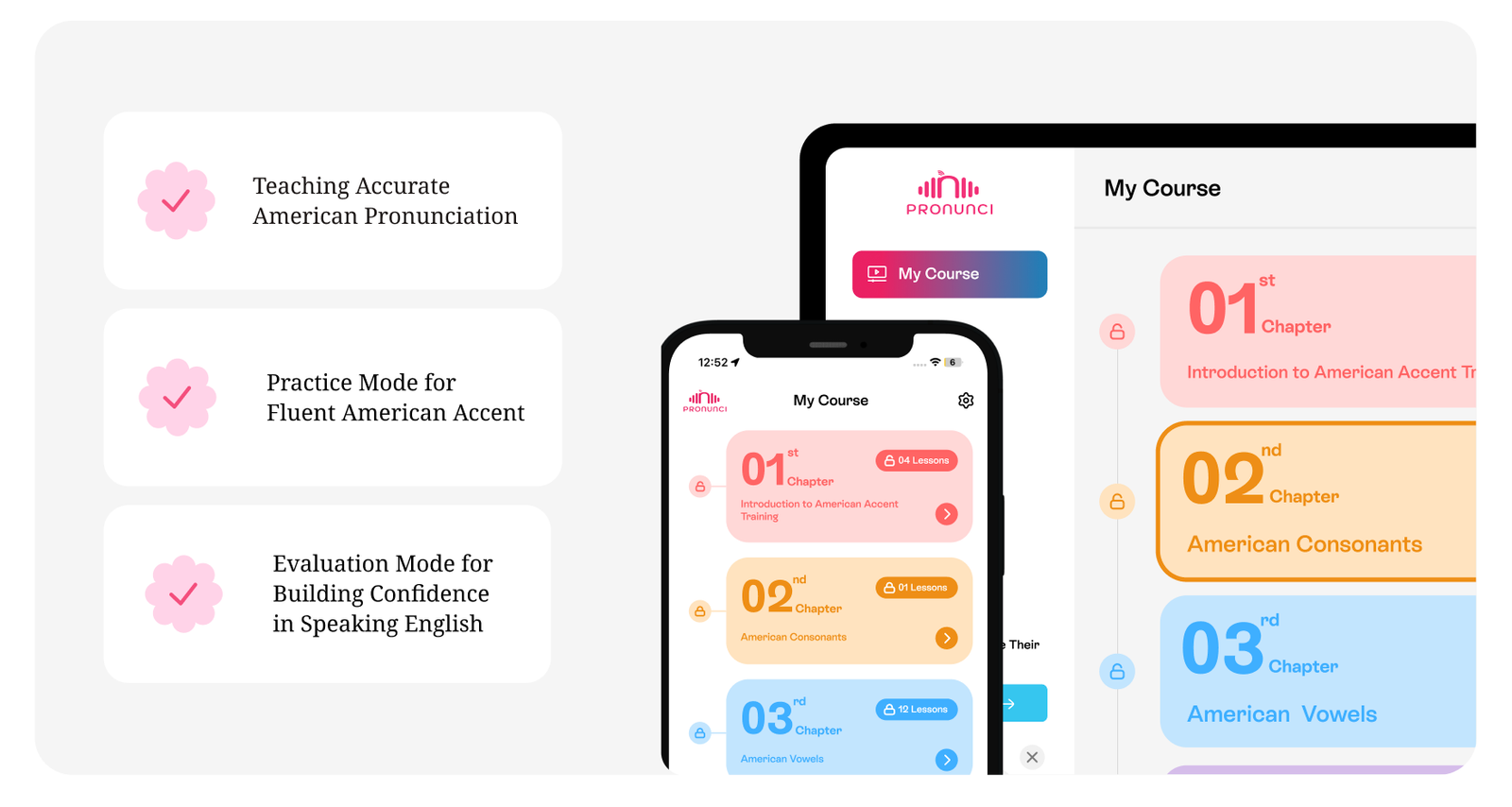
If you have worked through the analysis steps above and identified your priority phonemes, the next step is structured, guided practice. InPronunci: Accent Training App is built for exactly this stage. It gives you Prof. Alex’s step-by-step phoneme training, 2D sound simulators for every target sound, AI Accent Coach feedback on your recordings, and a side-by-side comparison of your voice against a native-speaker model.
Cognitive Accent Training
Compare Your Coach vs. Your Pronunci
In every practice sentence, students listen to Your Coach, record their own voice, and compare it with Your Pronunci, so they consciously notice and correct each sound.
![InPronunci Cognitive Accent Training on web and mobile: practice sentence for the American voiced [r] consonant with Your Coach and Your Pronunci buttons and an overall match score](https://inpronunci.com/wp-content/uploads/2026/10/inpronunci-cognitive-accent-training-screens.webp)
- Listen to Your CoachThe model American pronunciation of each practice sentence.
- Compare with Your PronunciYour own recorded pronunciation, side by side with the coach.
- Correct with feedbackThe match score and color-coded letters guide each correction.
The InPronunci: American Accent Training Course on the desktop platform takes you through all four chapters: Speech Organs Education, American Consonants, American Vowels, and Intonation and Emphasis. You are not working through random drills; you are following a curriculum designed around the phonemic gaps that matter most for American English clarity.
Structured American Accent Training Course
From Speech Organs Education to American Intonation
The InPronunci course is built step by step: every chapter prepares the next one, and by the end of the course students receive a certificate.
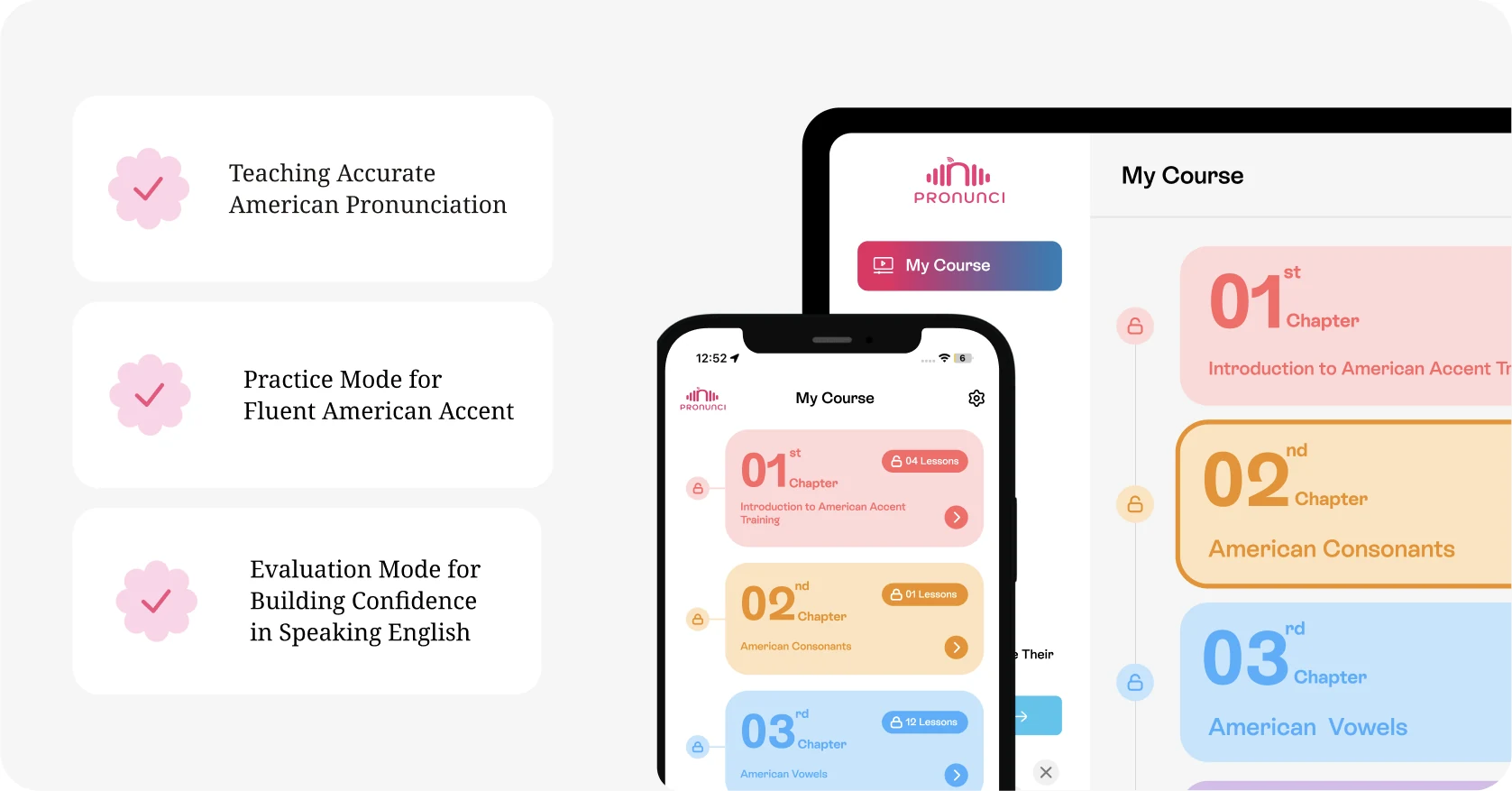
- Speech Organs EducationStudents learn how the speech organs work, along with the AI Accent Coach commands and feedback.
- American ConsonantsPractice and evaluate American consonants in phonetic exercises and practice sentences with the AI Accent Coach.
- American VowelsPractice and evaluate American vowels in phonetic exercises and practice sentences with the AI Accent Coach.
- IntonationLearn how intonation can change the meaning of what you say.
- CertificateBy the end of the course, students receive a certificate.
Start with the free onboarding chapter, identify your priority contrasts, and move into the paid program when you are ready for the full phoneme-by-phoneme training sequence. Visit InPronunci: Accent Training App to get started.
Sources
- Phonemic Inventories and Cultural and Linguistic Information Across Languages
- Dating the Origin of Language Using Phonemic Diversity | PLOS One
- LING5702: Lecture Notes 6
Questions & Answers
FAQ
01What is a phonemic inventory?
A phonemic inventory is the complete set of phonemes, the meaning-distinguishing sounds, that a language uses. English, for example, uses /p/ and /b/ as separate phonemes because swapping them changes word meaning, as in pat versus bat.
02What is an example of a phonemic inventory?
English has about two dozen consonant phonemes and around a dozen or so vowel phonemes in General American. A small-inventory example is Rotokas, with around 11 phonemes, while ǃXóõ has over 140, including dozens of click consonants.
03What is the difference between a phonemic and a phonetic inventory?
A phonemic inventory lists contrastive units written in slashes (/p/), while a phonetic inventory lists every surface sound variant written in brackets ([pʰ] vs. [p]). The phonemic level captures meaning distinctions; the phonetic level captures how those sounds are actually articulated in context.
04What are the levels of phonemic awareness?
Phonemic awareness typically develops from broader to finer levels: word awareness, syllable awareness, onset-rime awareness, phoneme identification, phoneme blending, phoneme segmentation, and phoneme manipulation (adding, deleting, or substituting individual phonemes). Definitions of the exact levels vary across frameworks, so check the specific model your curriculum or clinical program uses.
05How does phonemic inventory analysis help ESL learners?
Identifying which English phonemes are absent from your L1 inventory lets you focus practice on the contrasts that actually cause errors, rather than drilling sounds you already control. ASHA recommends this gap analysis as the foundation for targeted pronunciation and clinical intervention planning.
Recommended

InPronunci vs. BoldVoice: American Accent Training App Comparison
Compare InPronunci and BoldVoice for American pronunciation, intonation, rhythm, and connected speech, with Pronunci Instructions and AI Accent Coach.

Phonetic Training in Medical Communication | Inpronunci
Explore the role of phonetic training in medical communication. Enhance clarity and confidence for better patient interactions and safety.

InPronunci: The Revolutionary American Accent Training App for Real Speech Transformation
Master the American accent for your career with the InPronunci App. Our 2026 guide shows how visual tech & AI feedback build executive vocal presence.
Plans
What InPronunci costs
InPronunci Basic
$35 per month
Chapter 1 is free after signup.
InPronunci Premium
$200 per month
Includes a coach: