

For executives who need faster, measurable gains in American English clarity, the best approach combines AI real-time scoring, 2D articulatory training simulators, and scheduled human coaching. Pronunciation instruction produces Structured pronunciation instruction produces measurable improvement in approximately 87% of experimental studies., and the hybrid model delivers all three conditions that drive those results: immediate feedback, visual-motor learning, and personalized correction.
Start with these three elements:
- Daily AI practice (10–15 minutes): record, get scored, repeat with the AI Accent Coach
- Weekly simulator drills(15-20 minutes): use 2D mouth-training simulators to retrain tongue, lip, and jaw positions
- Monthly 1-on-1 coaching: review progress, adjust targets, and address spontaneous speech with a Ph.D. accent coach
Clearer pronunciation also influences promotion and leadership perception, making this investment directly relevant to your career trajectory.
What are the main types of pronunciation feedback for executives?
Every major feedback method serves a different purpose. Here is what each one does and where it fits best for professionals.
- AI real-time scoring: Automated speech recognition scores your pronunciation as you speak. Best for daily repetition practice and tracking segmental accuracy over time.
- Human 1-on-1 coaching: A trained accent coach listens, diagnoses, and corrects in real time. Best for spontaneous speech, complex prosody issues, and high-stakes preparation.
- Hybrid human-guided automated feedback: Structured lessons with human-designed instructions plus AI scoring. Best for professionals who need guided self-study between coaching sessions.
- 2D articulatory mouth-training simulators: 2D simulations that train tongue, lip, and jaw movement for each sound. Best for executives who have been told “just listen and repeat” and still can’t produce the sound correctly.
- Acoustic/spectrogram analysis: Visual waveform and pitch displays that show how your speech compares to a native speaker model. Best for measuring prosody and intonation objectively.
- Phonetic transcription and corrective drills: Written IPA transcriptions paired with targeted repetition exercises. Best for identifying specific segmental errors and drilling them systematically.
- Prosody/intonation feedback: Focused correction of stress, rhythm, and pitch patterns. Best for presentations, board meetings, and any context where authority and clarity matter.
- Connected-speech/fluency feedback: Correction of linking, reduction, and pacing in natural speech. Best for phone calls, negotiations, and fast-paced conversations.
- Peer/manager feedback: Informal ratings from colleagues or supervisors. Best for gauging real-world intelligibility, though it lacks diagnostic precision and confidentiality.
The main limitations executives face: peer feedback is rarely confidential or specific enough to act on; acoustic analysis requires technical interpretation; and AI-only systems currently assess segmental features better than suprasegmental ones like rhythm and intonation.

Why 2D speech-organ simulators and AI feedback accelerate learning for professionals
Speech-organ training and AI feedback shorten acquisition time by giving you immediate, concrete cues for your speech organs, rather than asking you to guess from sound alone.
Articulation training sets exactly where your tongue tip should land for the American /t/, how your lips round for /oʊ/, and how your jaw drops for /æ/. That specificity converts faster to automatic speech habits than imitation alone because you are not approximating. You are replicating a physical target. Interactive 2D Sound Video Mouth-Training Simulatorsmake this process trainable, repeatable, and self-directed.
AI scoring closes the loop. Research confirms that automated feedback with a ‘good enough’ accuracy still produces measurable pronunciation gains, which means you do not need a perfect system to improve. You need a consistent one.
A practical daily workflow for executives:
- Diagnostic recording (2 minutes): read a target sentence and save the clip
- Simulator drills (5–8 minutes): watch the mouth-training video for your target sound, then repeat
- AI-scored repetitions (5–8 minutes): speak into the AI Accent Coach, review the score, repeat until you improve
- Weekly human review (15–20 minutes): share your best and worst recordings with your coach for targeted correction
This sequence takes 10–20 minutes daily and covers both segmental accuracy and the corrective loop that drives retention.
How do the feedback types compare for executive decisions?
| Feedback Type | Immediacy | Personalization | Cost | Scalability | Best For | Feedback Depth | Privacy |
|---|---|---|---|---|---|---|---|
| AI real-time scoring | Instant | Generic | Low ($) | High | Daily drills, phone calls | Segmental | High |
| Human 1-on-1 coaching | Session-based | High | High ($$$) | Low | Presentations, negotiations | Segmental + suprasegmental | High |
| Hybrid human-guided | Near-instant + scheduled | Moderate–High | Moderate ($$) | Moderate | All workplace scenarios | Both | High |
| Articulatory simulators | Instant (visual) | Moderate | Low–Moderate | High | Sound correction, interviews | Segmental (articulatory) | High |
| Acoustic/spectrogram | Post-session | Low | Moderate | Low | Intonation, prosody review | Suprasegmental | Moderate |
| Peer/manager feedback | Delayed | Low | Free | High | Real-world intelligibility check | Surface-level | Low |
Executive recommendation: For presentations and board meetings, use the hybrid model. For phone calls and negotiations, add connected-speech and prosody work. For a confidential, scalable daily practice, AI scoring plus articulatory simulators covers the most ground at the lowest time cost.
How should an executive choose the right feedback approach?
Start with outcome, then delivery. If your goal is intelligibility (being understood clearly), prioritize segmental AI feedback and articulatory drills. If your goal is naturalness and authority (sounding confident and fluent), add prosody coaching and connected-speech work.
Questions to ask any vendor or coach before committing:
- Do you provide a baseline recording and a measurable post-training comparison?
- How is my data stored, and who has access to my recordings?
- Can I see a sample lesson before I purchase?
- How is progress tracked between sessions?
- What are the cancellation terms?
Red flags to avoid:
- No before/after recordings or measurable metrics
- Generic scripts with no diagnostic step
- No explanation of what specific sounds or patterns you are targeting
30/90/180-day action plan:
- Day 1–30: Baseline recording, start daily AI practice (10–15 min/day), complete simulator drills for your top 3 target sounds. Time: ~1.5 hours/week.
- Day 31–90: Add weekly prosody and connected-speech review. First human coaching session at day 30. Expected: noticeable improvement in targeted sounds and reduced listener effort. Time: ~2 hours/week.
- Day 91–180: Monthly 1-on-1 coaching, continued daily AI practice, focus shifts to spontaneous speech and presentation delivery. Expected: measurable gains in intelligibility ratings and self-monitoring speed.
Between-session voice reviews, where you send short recordings to your coach for asynchronous feedback, are a key accelerator for workplace transfer and are worth requesting explicitly.
What training formats and timelines should executives expect?
| Format | Time per Week | Typical Cost Shape | Expected Outcome |
|---|---|---|---|
| Single intensive session (60 min) | One-time | Per-session fee | Measurable change on 1–2 targeted sounds; not sufficient alone |
| Short course (4–8 weeks) | 2–3 hours | Package fee | Noticeable improvement in targeted segmental and prosody features |
| Monthly 1-on-1 program | 1–2 hours | Monthly subscription | Sustained gains; spontaneous speech improves with between-session practice |
| Blended (daily app + monthly coaching) | 1.5–2 hours | Subscription + coaching tier | Fastest overall gains; covers both segmental and suprasegmental features |
A focused single-session lesson with articulatory modeling, drilling, and connected-speech practice can produce demonstrable change on a specific target. But one session does not transfer to spontaneous speech without follow-up practice. The blended format, daily app practice paired with monthly human coaching, produces the best workplace-ready clarity because it combines targeted correction with repetition routines between sessions.
For executives planning around a board cycle or promotion timeline, a 90-day blended program is a realistic minimum for changes that hold under pressure.
How do you measure and demonstrate pronunciation progress?
Measure both perceptual and objective metrics, then present them simply. Perceptual measures (intelligibility ratings, comprehensibility scores from blinded listeners) tell you whether real people understand you more easily. Objective measures (pitch range, speech rate, vowel duration) confirm that specific features changed.
Measurement checklist:
- Baseline recording: read a 60-second professional passage and save it before training begins
- Blinded listener ratings: ask two or three colleagues to rate intelligibility on a 1–5 scale without knowing which recording is pre- or post-training
- AI mismatch scores: track your AI Accent Coach score on the same target sentences weekly
- Prosody rating: compare pitch range and rhythm on a recorded presentation before and after
- Weekly practice log: minutes practiced, sounds targeted, AI score trends
For executives presenting results to HR or a leadership team, three metrics are enough: intelligibility rating change, AI score improvement on target sounds, and self-reported confidence in high-stakes situations. Confidentiality-friendly options include secure in-app recordings and anonymized listener ratings where raters receive audio files with no identifying information.
Research confirms that structured pronunciation instruction produces measurable improvement in the vast majority of controlled studies, so the question is not whether training works. It is whether you are measuring the right things to show it.
Real results: executives improving American English clarity
Inpronunci has documented student results across multiple professional backgrounds. Thiago, a professional working on his American English clarity, completed the structured program and recorded measurable gains in his pronunciation of connected speech and intonation. You can watch his
Structured American Accent Training Course
From Speech Organs Education to American Intonation
The InPronunci course is built step by step: every chapter prepares the next one, and by the end of the course students receive a certificate.
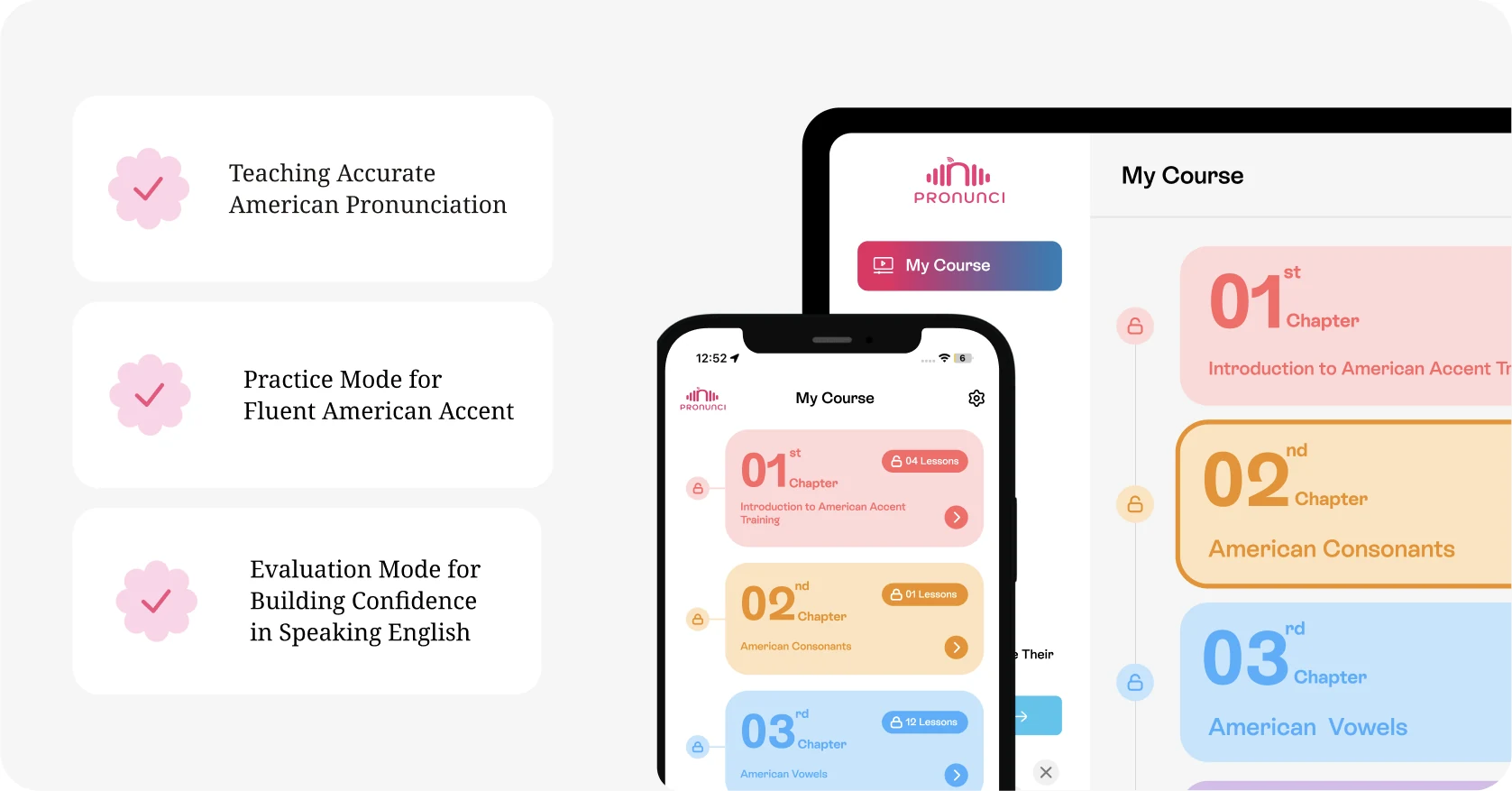
- Speech Organs EducationStudents learn how the speech organs work, along with the AI Accent Coach commands and feedback.
- American ConsonantsPractice and evaluate American consonants in phonetic exercises and practice sentences with the AI Accent Coach.
- American VowelsPractice and evaluate American vowels in phonetic exercises and practice sentences with the AI Accent Coach.
- IntonationLearn how intonation can change the meaning of what you say.
- CertificateBy the end of the course, students receive a certificate.
InPronunci training structure
How InPronunci trains the American speech system
InPronunci trains the full American speech system: Interactive Visual 2D Sound Simulators and phonetic exercises for articulation and American sound development, sentence practice for intonation, melody, rhythm, and connected speech, paragraph practice for spontaneous speech, public speaking, and real communication confidence, and Advanced AI Accent Coach evaluation as you speak.
InPronunci is an advanced, linguistically structured American accent training platform with more than 1,000 downloads and a growing learner base. It is designed for serious ESL learners who want American pronunciation, stronger intonation, more natural rhythm, better connected speech, and the ability to speak English more confidently in real communication. The program is especially useful for intermediate and advanced English speakers who want to become independent speakers of English with confident communication, stronger speaking control, long-term speech improvement, and great public speaking skills. It is also designed for advanced speakers whose goal is to speak like a native or closer to native-like American speech, including people who were raised in the United States but still have slight accent patterns from the native language they were born with. It is a complete American accent training course and system created by Prof. Alex, Ph.D. Accent Coach, Doctor of Education, and professional linguist based in Austin, Texas, with Pronunci Instructions from Prof. Alex for each lesson that make self-learning more effective, supported, and clear.
directly.
Andrew followed the same hybrid path, combining daily simulator drills with AI-scored practice and human-guided instruction. His recorded progress shows the kind of change that happens when all three feedback types work together consistently.
Tian’s result proves how the 2D mouth-training simulators helped retrain specific American sounds that years of listening-only practice had not corrected.
These are not outliers. They reflect what happens when practice is targeted, measured, and guided by a linguist-designed curriculum rather than general conversation.
The best pronunciation feedback for executives combines AI real-time scoring, 2D articulatory training simulators, and monthly human coaching, measured with before/after intelligibility ratings and weekly AI score tracking.
The feedback type most executives overlook
Most executives focus on whether they sound “good enough” and skip the diagnostic step entirely. That is the single biggest mistake in executive speech coaching. Without a baseline recording and a specific target, you are practicing without direction, and improvement stalls.
The evidence points clearly to one principle: targeted, measured feedback outperforms general conversation practice every time. A 10-minute daily session with a specific sound target and an AI score produces more change than 30 minutes of unstructured speaking. The executives who improve fastest are not the ones who practice the most. They are the ones who practice the most precisely.
One practical tip: capture a diagnostic clip in a real meeting environment, not just a quiet room. Record yourself on a video call before your next presentation. That recording will reveal rhythm and pacing issues that a controlled studio session never surfaces. Bring it to your first coaching session.
Free Chapter 1, “Get to Know Your Speech Organs,” is the right starting point. It builds the foundation you need to understand every instruction that follows.
Pro Tip: Record a 60-second professional passage the night before a high-stakes meeting, run it through the AI Accent Coach, and drill your top two mismatch sounds for 10 minutes. That micro-session primes your speech organs and reduces the cognitive load of monitoring your pronunciation in real time.
Inpronunci gives you the complete hybrid system
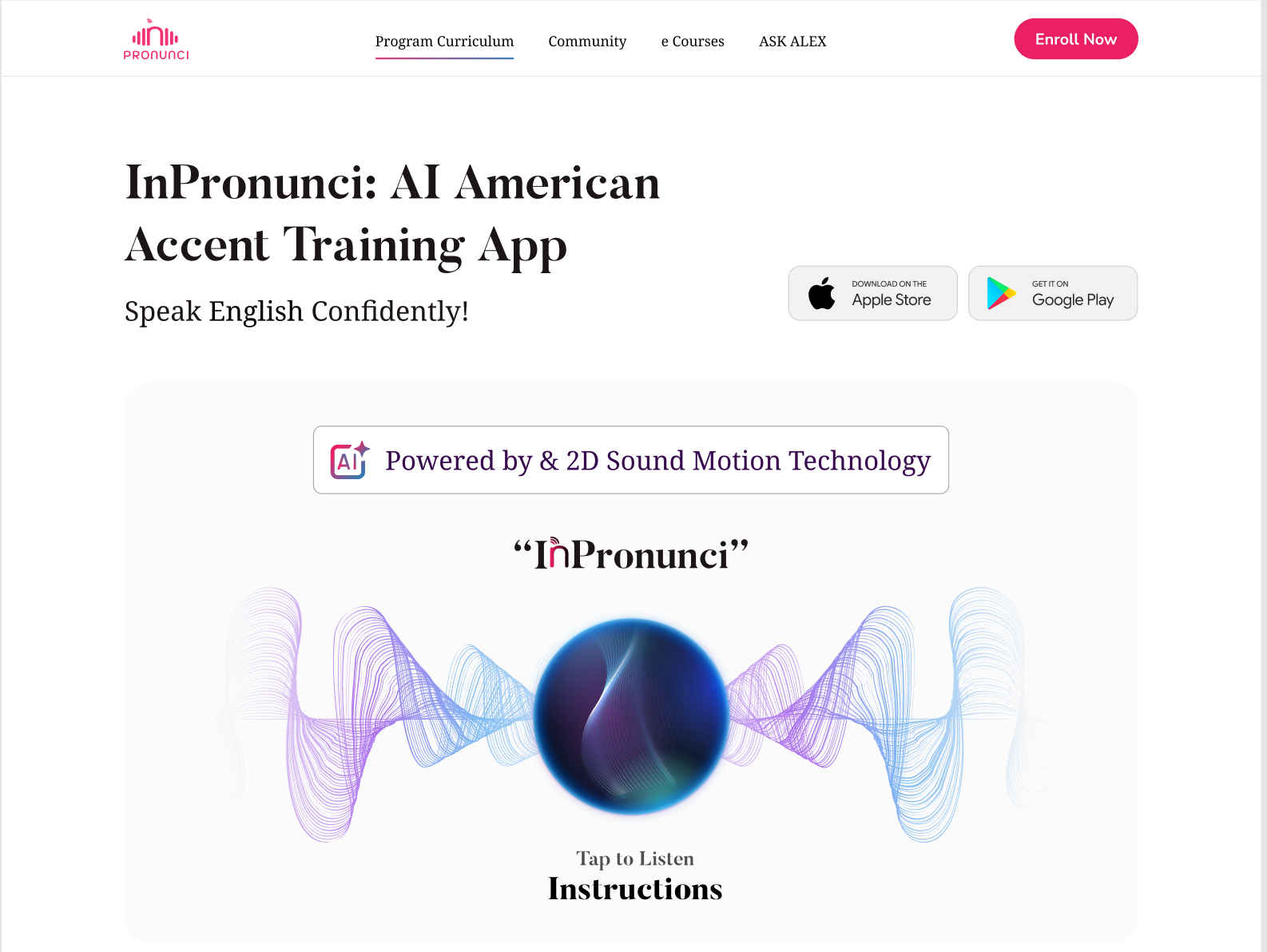
If you want the feedback model this article recommends, Inpronunci is built around it. The accent reduction program for professionals combines three core technologies in one structured course: Interactive 2D Sound Video Mouth-Training Simulators, an AI Accent Coach with real-time scoring, and human-guided instructions designed by Prof. Alex, Ph.D. Accent Coach
Plans:
- Free Chapter 1 (“Get to Know Your Speech Organs”): no cost, available now at sign-up
- Basic Plan: self-study with AI Accent Coach and human-guided instructions
- Premium Plan: monthly 1-on-1 sessions with Prof. Alex, Ph.D. Accent Coach, plus full app access
For executives who want personalized guidance from the start, book a free Premium session and bring your diagnostic recording. Available on iOS and Android, serving learners from 50+ countries.
Useful sources and demo materials
Academic and practitioner sources:
- Pronunciation instruction effectiveness: systematic review — primary evidence base for structured feedback; best for HR managers building a business case
- Corrective feedback accuracy and improvement — explains why AI feedback at 66% accuracy still works; best for coaches evaluating AI tools
- From effective to optimal: pronunciation instruction research agenda — advanced research on adaptive and technology-enhanced instruction
- Human-AI feedback loop for pronunciation training — technical detail on phoneme-level AI feedback and its limitations
- ESL pronunciation lesson: 7-step plan — practical single-session structure; useful for coaches designing intensives
Inpronunci demos and next steps:
- 2D mouth-training simulator demo video — try it before signing up to experience the technology in action
- Student result: Thiago · Andrew · Tian — before/after recordings from real learners
- Sign up for Free Chapter 1 — start with speech-organ positioning at no cost
- Book a free Premium session — for executives who want 1-on-1 guidance immediately
More than mechanics: InPronunci doesn’t teach only the mechanics of sounds. It teaches students how to become confident, fluent English speakers through a step-by-step system. Training may begin with how each American sound is made. Then it moves into sound combinations, sound contractions, phonetic exercises, practice sentences, and paragraphs in real rapid speech, so students start speaking English fluently and comfortably.
Questions & Answers
FAQ
01What is the fastest feedback type for executive pronunciation?
AI real-time scoring delivers the fastest feedback loop, with results after every spoken attempt. Paired with 2D articulatory training simulators, it produces measurable segmental gains within the first 30 days of daily practice.
02How long does it take to see noticeable improvement?
A focused blended program of around three months, combining daily AI practice plus monthly human coaching, typically produces changes that hold under pressure in real workplace situations. A single intensive session can improve one or two targeted sounds but does not transfer to spontaneous speech without follow-up.
03Is AI pronunciation feedback accurate enough to trust?
Research shows that automated feedback at 66% accuracy still produces measurable pronunciation gains. AI scoring is most reliable for segmental features; human coaching remains necessary for prosody, rhythm, and spontaneous speech correction.
04How do executives keep pronunciation training confidential?
AI-based and app-based programs like Inpronunci store recordings securely within the platform. For listener ratings, anonymized audio files sent to blinded raters protect identity. Avoid peer or manager feedback when confidentiality is a priority.
05What does Inpronunci offer for executive pronunciation training?
Inpronunci combines an AI Accent Coach, Interactive 2D Sound Video Mouth-Training Simulators, and human-guided instruction in a structured American accent course. The Premium Plan includes monthly 1-on-1 sessions with Prof. Alex, Ph.D. Accent Coach, and Free Chapter 1 is available at no cost to start.
Recommended

Pronunciation Feedback for Academic English: Inpronunci’s 2026 Guide
Discover essential pronunciation feedback for academic English. Improve clarity and boost your confidence in academic settings with expert tips.

InPronunci AI Accent Coach: Pronunciation Feedback for Professional Clarity
Learn how to use AI pronunciation feedback to go beyond scores. Master your American accent and gain professional clarity with our guide to real-time adjustm...

Why Pronunciation Training Improves Promotion Chances | Inpronunci
Discover why pronunciation training improves promotion chances. Enhance clarity, boost confidence, and unlock your leadership potential.
Plans
What InPronunci costs
InPronunci Basic
$35 per month
Chapter 1 is free after signup.
InPronunci Premium
$200 per month
Includes a coach:
Why InPronunci is worth the price
- Interactive Visual 2D Sound Simulators, built on 2D Sound Motion Technology developed by Prof. Alex, train your speech organs for each American sound.
- Prof. Alex's guided instructions in every lesson, like working with a real coach.
- The Advanced AI Accent Coach evaluates sounds, intonation, rhythm, stress, and connected speech against native American English speech (100 = native speaker).