
Stress the particle, not the verb. That is the rule: when a phrasal verb functions as a verb, native speakers put primary stress on the second word, the particle, not on the first word.
Say these out loud and lean hard on the capitalized word:
- I need to turn OFF the light before we leave.
- Please look UP that word in the dictionary.
- She decided to give UP smoking last year.
Get this one pattern right and two things happen immediately. Listeners recognize your phrasal verbs faster, because particle stress is the signal their ears are trained to expect. And your speech starts to sound rhythmically American, because English rhythm depends on hitting content words hard and letting small words fade, exactly what particle stress does here.
Key Takeaways
Mastering stress in phrasal verbs comes down to one memorized rule, deliberate daily drilling, and awareness of how that rule reverses in noun form.
| Point | Details |
|---|---|
| Stress the particle | In verb use, primary stress falls on the particle, not the main verb (turn OFF, give UP). |
| Watch for noun reversal | Nominalized phrasal verbs often flip stress to the first syllable (a BREAKdown, a SETback). |
| Pronouns split separable verbs | With separable phrasal verbs, pronoun objects must sit between verb and particle (turn it off). |
| Adjust rhythm for long objects | Speed up slightly through long object phrases to keep the verb-particle unit cohesive. |
| Practice daily with feedback | Ten to fifteen minutes of shadowing and recording daily, using tools like InPronunci’s AI Accent Coach, builds automatic particle stress fastest. |
Table of Contents
- Why Stress in Phrasal Verbs Trips Up Even Advanced Speakers
- Core Stress Rules and Simple Patterns to Apply
- Separable vs. Inseparable Phrasal Verbs and Pronoun Placement
- How Linking and Connected Speech Shape Phrasal Verb Pronunciation
- Common Phrasal Verbs With Stress Marked
- Practice Drills to Build Automatic Particle Stress
- What Research Says About Rhythm and Long Objects
- Common Mistakes With Phrasal Verb Stress and Quick Fixes
- A Coaching Note on Why This One Rule Pays Off So Fast
- Train Particle Stress With Guided Feedback, Not Guesswork
- Sources
- FAQ
Why Stress in Phrasal Verbs Trips Up Even Advanced Speakers
Phrasal verb stress causes trouble for a specific reason: it contradicts what many learners were taught about prepositions. Most ESL grammar books teach that short words like “up,” “off,” “on,” and “down” are minor, unstressed function words. That is true when they behave as prepositions. It is false when they behave as particles inside a phrasal verb, and that flip catches even C1 speakers off guard.
A phrasal verb is a verb combined with a particle that together create a new meaning, one that often cannot be guessed from the individual words. “Look up” does not mean “look” plus “up” in space. It means “research.” That new, unified meaning is exactly why the particle earns stress: it is not decoration, it is carrying half the verb’s meaning.
Compare that to a prepositional verb, where the small word stays a preposition and keeps its normal, unstressed role. “Look at the board” is not a phrasal verb. “At” introduces a location; the core meaning sits entirely in “look.” Say it naturally and you will stress “look,” not “at.” Now try “look UP that word” versus “look AT that word” back-to-back. The stress pattern is the tell.
Pedagogical research on prepositional versus phrasal verb stress recommends a fast diagnostic: try replacing the two-word combination with a single verb. “Look up” becomes “research.” “Give up” becomes “quit.” “Look at” cannot be replaced by one verb, which confirms it is not a true phrasal verb at all. If the substitution works, the particle is doing real lexical work, and it gets the stress.
Core Stress Rules and Simple Patterns to Apply
You do not need to memorize hundreds of individual phrasal verbs to get their stress right. Three rules cover almost every case you will meet.
- Stress the particle in verb use. When the two-word combination functions as a verb in a sentence, primary stress falls on the particle. “She picked UP the phone.” “They called OFF the meeting.” “He backed DOWN quickly.” Pronunciation guides confirm this as the default pattern across the most common two-word verbs in everyday English.
- Flip the stress when the phrase becomes a noun or compound. Nominalize a phrasal verb, and stress typically jumps back to the first syllable. “I need to break DOWN the numbers” (verb, particle stressed) becomes “The car had a BREAKdown” (noun, first syllable stressed). Same words, opposite rhythm. Teaching resources document this reversal pattern with dozens of examples: a TAKEoff, a SETback, a WORKout.
- In three-word phrasal verbs, stress the particle, not the trailing preposition. “I’m looking forward TO it” is wrong rhythm. Say “I’m looking FORward to it,” stressing the particle “forward” while the final preposition “to” stays weak and often reduces to “tuh” in fast speech. Same logic applies to “put up with,” “look out for,” and “get away with.”
One attention point worth flagging: contrastive focus can override all three rules on purpose. If someone says “Did you turn the light ON?” and you want to correct them, you might say “No, I turned it OFF,” stressing “off” for contrast even though it already carries default stress, or you might emphasize the verb itself if the confusion is about the action rather than the direction. Native speakers bend stress rules constantly for emphasis. Learn the default pattern first; the exceptions will make sense once the baseline is automatic.
Separable vs. Inseparable Phrasal Verbs and Pronoun Placement
Some phrasal verbs let you split the verb and particle with an object in between. Others refuse to be split at all. Knowing which is which changes your word order and, indirectly, your stress and rhythm.
A separable phrasal verb allows the object to sit between the verb and the particle, or after it: “turn off the light” and “turn the light off” are both correct. An inseparable phrasal verb locks the verb and particle together: you can say “look after the kids” but never “look the kids after.”
Pronouns follow a stricter micro-rule than full nouns do:
- With separable phrasal verbs, a pronoun object MUST go between the verb and the particle. “Turn it off.” Never “Turn off it.”
- A full noun object has more flexibility: “Turn off the light” or “Turn the light off” both work.
- With inseparable phrasal verbs, the object, pronoun or noun, always follows the whole unit. “Look after her.” Never “Look her after.”
- Three-word phrasal verbs behave like inseparable verbs: “I’m looking forward to it,” never “I’m looking it forward to.”
Here is why this matters for pronunciation, not just grammar. When the particle moves to the end of the sentence, as in “turn it OFF,” it often becomes the last stressed syllable before a pause, which naturally lengthens it. Get the word order wrong and you disrupt the rhythm listeners expect, even if your grammar mistake alone would not confuse anyone.
How Linking and Connected Speech Shape Phrasal Verb Pronunciation
Stress placement is only half the picture. In natural speech, the particle does not just get louder, it gets measurably longer and often rises slightly in pitch compared to surrounding words. That combination, longer duration plus small pitch movement, is what your ear is actually picking up on when a phrasal verb “sounds right.”

Connected speech adds another layer. Native speakers treat “verb plus particle” as a single prosodic chunk, almost like a compound word. That means sounds link across the boundary: “give up” often sounds like “giv‑up,” with the final consonant of “give” gliding into the vowel of “up.” “Turn off” links similarly, the “n” bleeding into the “o.” Learners who pause between the verb and particle, treating them as two separate words, break that chunking and sound noticeably less fluent, even with correct stress.
A practical fix is pause placement. If you need to pause for breath or thought mid-sentence, pause before the phrasal verb or after it, never inside it. “I need to… turn off the light” sounds natural. “I need to turn… off the light” does not.
Pro Tip: Record yourself saying a phrasal verb sentence at three speeds: very slow, normal conversational pace, and fast casual pace. Listen for whether the particle stays audibly longer and louder than the verb at all three speeds. If the stress disappears when you speed up, that is a sign you are relying on conscious effort rather than automatic muscle memory, and it needs more repetition before it will hold under normal talking speed.
Common Phrasal Verbs With Stress Marked
Practice these common phrasal verbs, focusing on stressing the particle when used as a verb, and noting the stress shift when they become nouns or compounds.
Watch for “come across” and “look forward to”: both have particles longer than one syllable, which sometimes confuses learners into stressing the wrong syllable within the particle itself rather than the particle as a whole unit.
Practice Drills to Build Automatic Particle Stress
Reading the rules is step one. Building the muscle memory that makes particle stress automatic under real conversational pressure takes deliberate, repeated practice. Here is a compact routine you can run in under twenty minutes.
- Shadowing drill (3 speeds, 5 minutes). Pick five phrasal verb sentences from the list above. Play a native-speaker recording, or use InPronunci’s guided audio, and repeat each sentence immediately after hearing it: first at half speed, then at normal conversational pace, then at natural fast speed. Focus only on matching where the loudness and length peak, not on getting every consonant perfect.
- Record-and-compare (7 minutes). Record yourself saying all fourteen example sentences from the list above. Play back each one immediately next to a native model. Ask three questions for each sentence: Did I stress the particle or the verb? Did the particle sound noticeably longer? Did I link the verb and particle smoothly, or did I pause between them?
- Stress-contrast minimal pairs (5 minutes). Say pairs like “look AT it” versus “look UP the word,” or “a BREAKdown” versus “break DOWN the numbers,” back to back, exaggerating the difference. This trains your ear and mouth to treat particle stress as meaningful, not random.
Run this three-step sequence daily for one week, rotating in five new phrasal verbs every two days so you are working with roughly twenty by day seven, not just the original fourteen.
Pro Tip: Keep a running checklist during the record-and-compare step: particle stressed (yes/no), particle length matched (yes/no), linking clean (yes/no). A simple three-box checklist turns a vague “did that sound okay” judgment into something you can actually track and improve week over week.
What Research Says About Rhythm and Long Objects
Here is something most pronunciation guides skip entirely: what happens to phrasal verb stress and rhythm when the object between verb and particle gets long. Say “Turn it off” and there is no problem. Say “Turn off the enormous overhead light fixture in the conference room” and the whole rhythm of the sentence changes.
A production study using the spoken British National Corpus, presented at the International Congress of Phonetic Sciences (ICPhS), examined exactly this question: what predicts whether an object slips between the verb and particle (“turn the light off”) versus stays after the whole unit (“turn off the light”)? The surprising finding was that simple word count did not predict this well. Prosodic variables, especially articulation rate, were stronger predictors than how many words sat in the object noun phrase.
| Predictor Tested | Predictive Strength for Object Placement |
|---|---|
| Word count in object phrase | Weaker predictor |
| Articulation rate (speed) | Stronger predictor |
| Overall prosodic pattern | Stronger predictor |
In plain terms: speakers do not just decide word order based on how many words the object has. They adjust how fast they speak the object phrase, compressing longer objects by speeding up articulation, to keep the verb and particle feeling like one cohesive rhythmic unit even when a lot of material sits between them or after them.
The practical takeaway for you as a learner is direct. When your object is long, do not panic about breaking the verb-particle connection. Instead, speed up slightly through the long object phrase and keep your pitch relatively level, saving the emphasis for the particle itself once you land on it. If a sentence is getting unwieldy, it is also perfectly natural, and often clearer, to rephrase and shorten the object rather than force a long noun phrase between verb and particle. Building this kind of rhythmic control is exactly the territory covered in InPronunci’s guide to American English rhythm, where verb-particle cohesion is one piece of a larger pattern.
Common Mistakes With Phrasal Verb Stress and Quick Fixes
Most stress errors with phrasal verbs fall into a small number of repeatable patterns. Spotting your own pattern is the fastest route to fixing it.
- Treating the particle like a weak preposition. This happens most when a learner’s native language has no direct verb-particle construction, a documented difficulty for speakers of languages such as Turkish. Fix: run the single-word substitution test before every unfamiliar phrasal verb. If it substitutes, stress it.
- Shifting stress onto the main verb out of habit. Many learners default to first-word stress because that is the pattern for simple verbs. Fix: say the sentence twice, once with verb stress and once with particle stress, and notice which one a native recording matches.
- Keeping verb stress in noun and compound forms. Saying “a break-DOWN” instead of “a BREAKdown” is a frequent slip once learners have finally mastered verb-form particle stress. Fix: whenever the phrasal verb is preceded by “a,” “an,” or “the,” check whether it has become a noun, and flip your stress accordingly.
- Losing particle stress at fast conversational speed. The pattern holds at careful speed but disappears once talking picks up. Fix: the three-speed shadowing drill above is built specifically to catch this.
One caveat: intentional deviation from these patterns is completely normal and not an error when it serves contrastive focus, correcting someone, emphasizing a surprising fact, or drawing attention to a specific word. The goal is control, being able to choose your stress deliberately, not rigid, robotic adherence to the default pattern in every single sentence.
A Coaching Note on Why This One Rule Pays Off So Fast
Particle stress is one of the highest-leverage pronunciation patterns in American English, precisely because it is a rule rather than a list. Once a learner internalizes “stress the particle when it functions as a verb,” that single rule generalizes across hundreds of phrasal verbs the learner has not even studied yet. Most pronunciation challenges do not offer that kind of return on a small amount of focused practice.

What I ask my students to track is simple: after one week of the shadowing and record-and-compare drills above, listen back to a recording from day one and a recording from day seven. The difference in how confidently the particle stands out is usually the clearest, fastest measurable gain a learner sees in early accent training, because it is a rhythmic pattern rather than an individual sound that needs isolated repetition.
Train Particle Stress With Guided Feedback, Not Guesswork
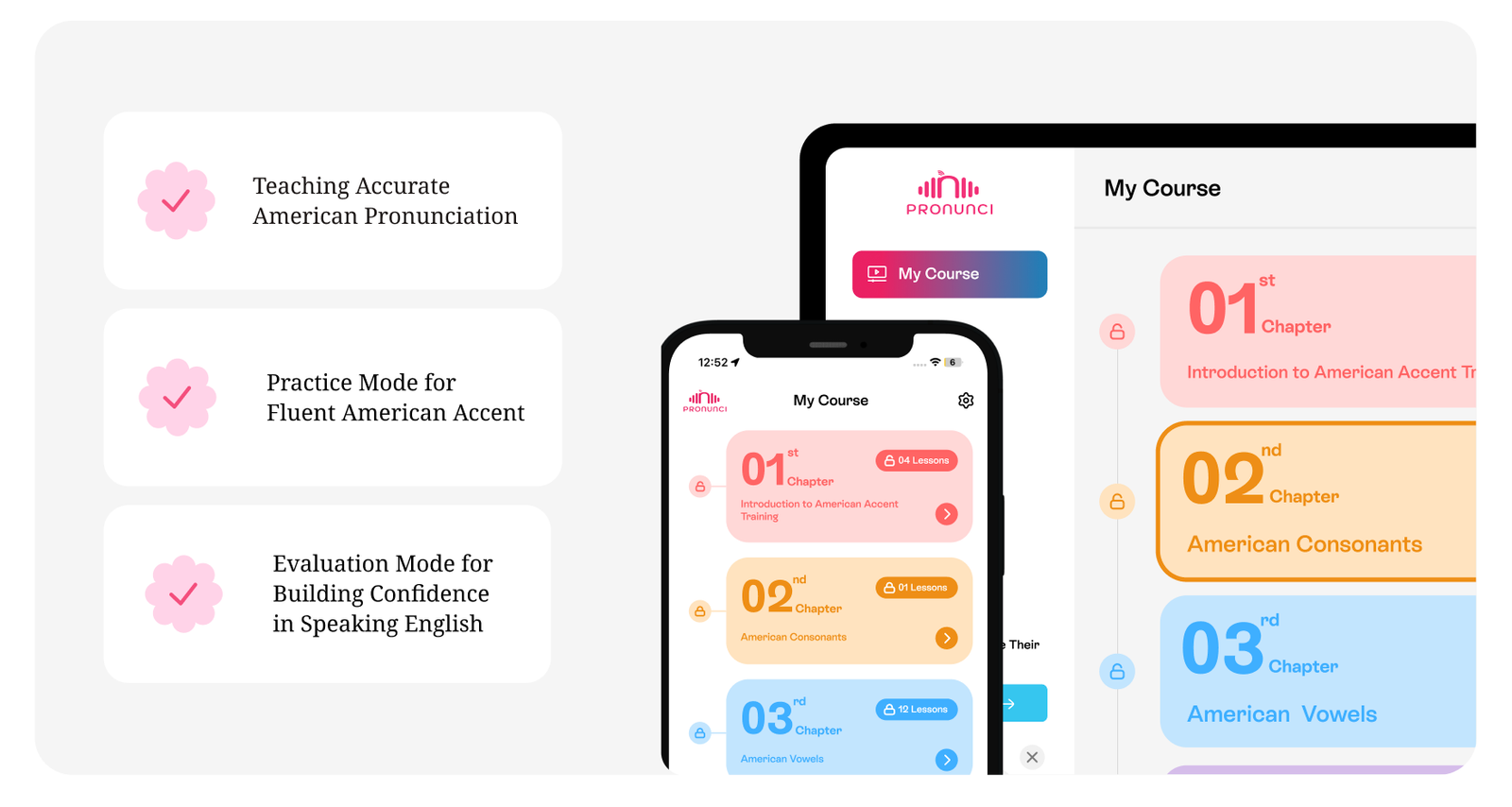
The drills in this guide work best when you can hear exactly where your stress lands compared to a native model, sentence by sentence. That is the gap InPronunci: Accent Training App was built to close: instead of practicing phrasal verb stress alone and hoping it sounds right, you record yourself, compare it directly against a native-speaker model using My Coach and My Pronunci, and get AI Accent Coach feedback on whether your particle stress, length, and pitch actually match.
Download on the App Store | Get it on Google Play
The Interactive 2D Sound Video Simulator, which you can preview in this demonstration of the American T sound, shows you exactly how tongue, jaw, and airflow position work together, the same kind of visible detail that makes particle stress and connected speech far easier to feel rather than just memorize as a rule. The full American Intonation and Emphasis chapter inside InPronunci: American Accent Training Course builds directly on the stress patterns covered in this guide, with guided drills, native-speaker comparisons, and in-app chat support if you get stuck. Start with the free onboarding chapter to see how Prof. Alex’s method feels before committing to a full plan.
Sources
- A Prosodic Analysis of Intervening Objects in English Phrasal Verbs Using the British National Corpus
- Phrasal Verb Stress: Why Native Speakers Stress the PARTICLE
- The Stress and Intonation Background of Prepositional Verbs versus Phrasal Verbs for Language Teachers
- Phrasal Verbs — The Good News (The Pronunciation) | PronunciationCoach
FAQ
What Is the Verb Form of “Stress”?
The verb form is simply “to stress,” meaning to place emphasis on a particular syllable, word, or particle when speaking, as in “native speakers stress the particle in phrasal verbs.”
What Are Some Common Phrasal Verbs to Practice Stress With?
High-frequency examples include turn off, give up, look up, pick up, break down, set up, take off, work out, look after, and call off, all covered with model sentences earlier in this guide.
How Do You Know Whether to Stress the Verb or the Particle?
Stress the particle when the two-word combination functions as a verb with a unified meaning, and try substituting a single-word synonym (look up equals research) as a quick test; if it substitutes, stress the particle.
How Do You Express Stress Placement in Written English?
Writers typically mark stress with capital letters (turn OFF), bold text, or IPA stress marks (ˈ) before the stressed syllable, since standard English spelling has no built-in stress notation.
Why Does Phrasal Verb Stress Shift in Noun Forms?
When a phrasal verb becomes a compound noun, stress commonly moves to the first syllable, so “break down” (verb) becomes “a BREAKdown” (noun), a pattern documented across dozens of common English compounds.
Recommended
- American English Stress Patterns Examples | Inpronunci
- Stress and Emphasis in English Pitches — InPronunci: Accent Training App
- InPronunci: Accent Training | American Pronunciation App by Prof. Alex, Ph.D. Accent Coach – InPronunci: Accent Program App
- Pronunciation Challenges Asian English Speakers Face | Inpronunci
InPronunci training structure
How InPronunci trains the American speech system
InPronunci trains the full American speech system: Interactive 2D Sound Video Simulators and phonetic exercises for articulation and American sound development, sentence practice for intonation, melody, rhythm, and connected speech, paragraph practice for spontaneous speech, public speaking, and real communication confidence, and Advanced AI Accent Coach evaluation as you speak.
InPronunci is a newer, advanced, and linguistically structured American accent training platform with more than 1,000 downloads and a growing learner base. It is designed for serious learners who want clearer American pronunciation, stronger intonation, more natural rhythm, better connected speech, and the ability to speak English more confidently in real communication. The program is especially useful for intermediate and advanced English speakers who want to become independent speakers of English with confident communication, stronger speaking control, long-term speech improvement, and great public speaking skills. It is also designed for advanced speakers whose goal is to speak like a native or closer to native-like American speech, including people who were raised in the United States but still have slight accent patterns from the native language they were born with.