


Short answer
A Spanish accent in English comes from the sound system of Spanish. Spanish has 5 vowels, while American English has many more. Spanish also has no TH sounds, no separate V sound in most dialects, no words that start with S + consonant, and a syllable-timed rhythm. When an English sound does not exist in Spanish, the speech organs use the closest Spanish sound. The fix is to train each missing sound on its own, then use it in words, sentences and real speech with American stress and rhythm.
What is the best American accent app for Spanish speakers?
The best app for a Spanish speaker trains the sounds Spanish does not have, such as the short vowels in “ship” and “full”, the schwa, TH, V, and Z, and then trains American word stress and intonation. InPronunci: Accent Training does this as a structured American accent course created by Prof. Alex, Ph.D. Accent Coach, Doctor of Education, and professional linguist: Interactive Visual 2D Sound Simulators train your tongue, lips, jaw, airflow, and voice for each sound, Pronunci Speaks gives instructions before every exercise, and the AI Accent Coach gives feedback on your sounds, words, and sentences. Chapter I is free.
Structured American Accent Training Course
From Speech Organs Education to American Intonation
The InPronunci course is built step by step: every chapter prepares the next one, and by the end of the course students receive a certificate.
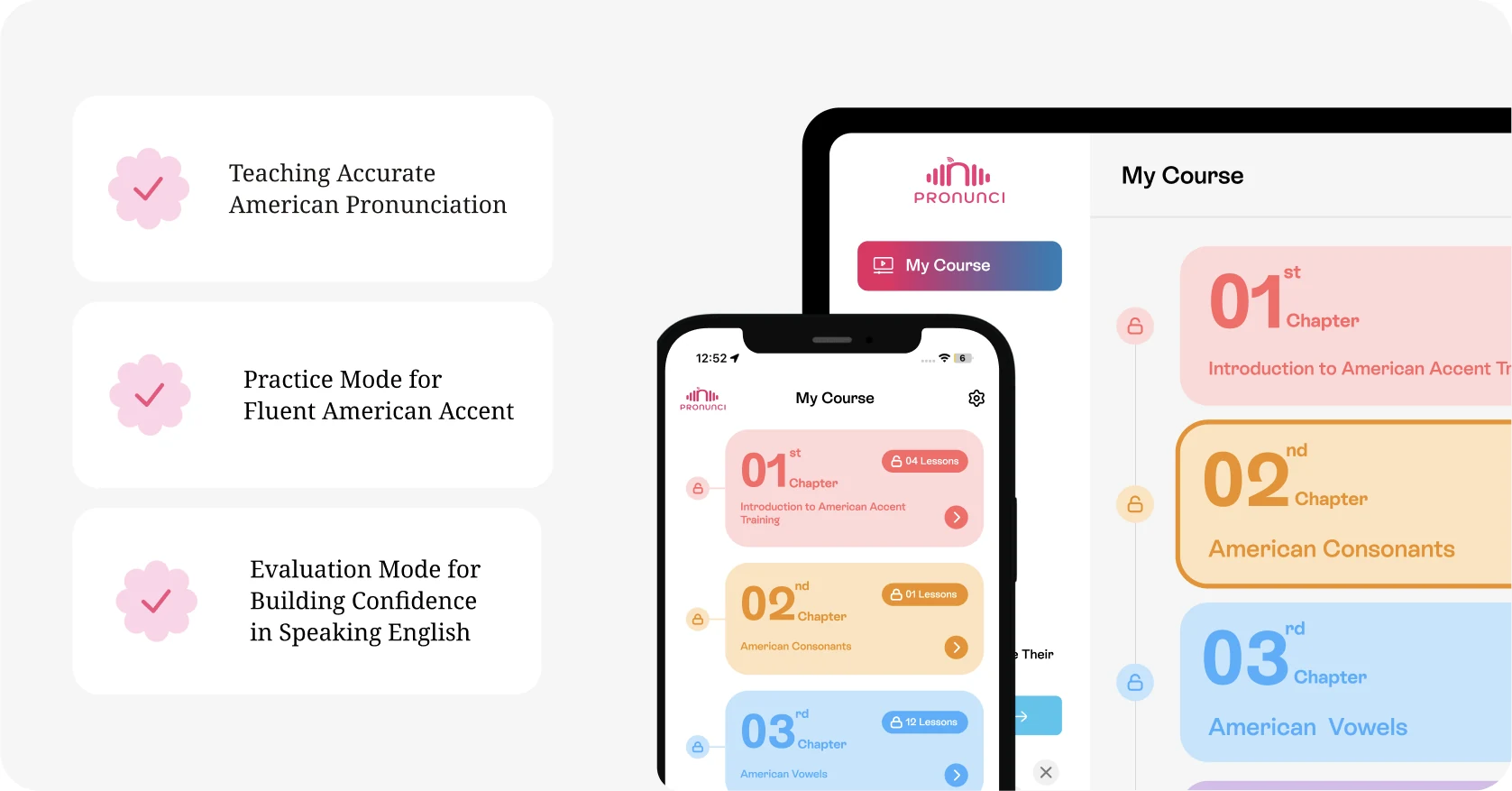
- Speech Organs EducationStudents learn how the speech organs work, along with the AI Accent Coach commands and feedback.
- American ConsonantsPractice and evaluate American consonants in phonetic exercises and practice sentences with the AI Accent Coach.
- American VowelsPractice and evaluate American vowels in phonetic exercises and practice sentences with the AI Accent Coach.
- IntonationLearn how intonation can change the meaning of what you say.
- CertificateBy the end of the course, students receive a certificate.
Why Spanish speakers have an accent in English
Every language trains the tongue, lips, jaw and airflow in its own way. Adults who learned Spanish first have strong, automatic habits for Spanish sounds. In English, those habits create predictable patterns. This is normal, and it is trainable. The goal for most learners is not to erase their identity but to speak clear, natural American English that listeners understand easily.
The 12 most common pronunciation problems for Spanish speakers
1. T and D: on the upper teeth instead of the gum ridge
In Spanish, t and d are dental sounds: most Spanish speakers press the tongue tip against the back of the upper teeth. In American English, [t] and [d] are alveolar sounds. The tongue tip goes up to the gum ridge, the hard area just behind the upper teeth, and does not touch the teeth. Spanish [t] also has no puff of air, so “time” can sound closer to “dime”. Between vowels, the Spanish d becomes soft, so “lady” can sound like “la-thy”.
- [t]: time, ten, today, tell
- [d]: do, day, dog, lady
- Sentence: “Tell Dan it’s time to study today.”
To fix it, place the tongue tip on the gum ridge, not on the teeth, build the air behind it, and release. For [t], let a small puff of air come out at the start of the word: “time”, “ten”. For [d], keep the voice on: “day”, “dog”.
Train the American [t] with the Interactive Visual 2D Sound Simulator
In the InPronunci app, the Interactive Visual 2D Sound Simulator for the American [t] trains the tongue tip to move to the gum position near the upper teeth, without touching them, and to release the air at the right moment. The same tongue position is used for [d].
Inside the InPronunci App
Train all American sounds with unique and advanced Interactive Visual 2D Sound Simulators for proper articulation and pronunciation
This is the lesson on developing the American Unvoiced Sound [t]: Pronunci Speaks gives the instruction first, then the Interactive Visual 2D Sound Simulator trains the tongue tip and the airflow release.
- EffectiveMost apps offer visual learning. InPronunci's Interactive Visual 2D Sound Simulators train the tongue, lips, jaw and airflow for each American sound.
- ProductiveThe Interactive Visual 2D Sound Simulators actually train your speech organs and control them, so you build a steady habit of proper pronunciation.
- ResultsStudents pronounce individual American sounds with almost native-like pronunciation.
2. Five vowels vs. many American vowels
Spanish has 5 vowel sounds: a, e, i, o, u. American English has many more, so pairs like these often sound the same:
– ship / sheep
– full / fool
– cat / cut / cot
– bed / bad
3. The schwa [ə]
Spanish speakers usually pronounce every vowel fully. In American English, most unstressed vowels become a short, relaxed schwa: the first and last “a” in “banana”, the “o” in “problem”, the “e” in “the”. Without the schwa, English sounds too strong and too even.
4. TH sounds [θ] and [ð]
Spanish from Latin America has no TH. “Think” can become “tink” or “sink”, and “this” can become “dis”. The tongue tip needs to touch the edge of the top teeth with air flowing out.
5. V and B
In most Spanish dialects, V and B are the same sound. In English, B uses both lips, and V uses the top teeth on the lower lip. Practice: very / berry, vote / boat, vest / best.
6. Z and S
Spanish has no Z sound in most dialects, so final Z often becomes S. “Eyes” can sound like “ice”, and “prize” like “price”. Many plural endings in English are a Z sound: dogs, cars, plays.
7. The extra “e” before S + consonant
Spanish words do not start with S + consonant, so speakers often add a vowel: “Spain” becomes “Espain”, “school” becomes “eschool”, “student” becomes “estudent”. The S needs to start the word directly.
8. SH and CH, J and Y
“Share” and “chair”, “ship” and “chip”, or “jet” and “yet” can be mixed, because the SH and J sounds work differently in Spanish.
9. The American R
The Spanish R is tapped or trilled: the tongue tip hits the roof of the mouth. In the American R, the tongue tip does not touch anything. The tongue is pulled back and up, and the lips are slightly rounded.
10. The flap T
Between vowels, Americans usually say T as a quick flap: water, better, city, get it. Spanish speakers often say a full, hard T, which sounds less American. Interestingly, the American flap is close to the Spanish tapped R in “pero”.
11. Final consonants and endings
Spanish words end in only a few consonants, so English endings are often dropped: “worked” becomes “work”, “books” becomes “book”, “texts” becomes “tex”. These endings carry grammar, so dropping them can change the meaning.
12. Rhythm and stress
Spanish is syllable-timed: each syllable gets about the same length. American English is stress-timed: stressed syllables are long and clear, and unstressed syllables are short and reduced. Word stress also matters: “PHOtograph”, “phoTOgraphy”, “photoGRAPHic”. Rhythm is often the biggest difference between a Spanish accent and natural American English.
Practice word pairs for Spanish speakers
| Sound | Practice pairs |
|---|---|
| Short I vs. long E | ship / sheep, live / leave, fit / feet |
| TH | think / sink, thank / tank, they / day |
| V vs. B | very / berry, vote / boat, van / ban |
| Z vs. S | eyes / ice, prize / price, peas / peace |
| SH vs. CH | share / chair, wash / watch, shoes / choose |
| S + consonant | speak, school, street, study, special |
| Endings | worked, asked, books, texts, months |
Say each pair slowly first, then in a short sentence, then at normal speed.
How to reduce a Spanish accent in English: a practice plan
- Learn how the speech organs work. Know where the tongue, lips and jaw go for each American sound.
- Train one sound at a time. Start with the sounds that affect understanding most: vowels, TH, V, Z and endings.
- Use minimal pairs. Pairs like ship / sheep train your ear and your mouth at the same time.
- Move into sentences. A sound is not trained until you can say it inside real speech.
- Train rhythm and intonation. Stress the important words, reduce the small words, and link words together.
- Get feedback. It is hard to hear your own accent. Recording yourself and getting sound-by-sound feedback shows what to fix next.
Best American accent training app for Spanish speakers: InPronunci
InPronunci is an American accent training app built by Prof. Alex, Ph.D. Accent Coach, Doctor of Education, and professional linguist. Prof. Alex teaches ESL pronunciation at Austin Community College, and InPronunci follows his research-based training method. It trains the exact sounds in this guide, in the same order:
- Interactive Visual 2D Sound Simulators train the speech organs for each sound: where the tongue goes for TH, how the lips work for V, how the tongue moves for the American R.
- Phonetic exercises with minimal pairs like ship / sheep, very / berry and eyes / ice.
- Sentences and paragraphs with American stress, intonation and connected speech.
- AI Accent Coach feedback word by word and sound by sound, with scores where 100 = native speaker.
The course has four chapters: Speech Organs Education (free), American Consonants, American Vowels, and American Intonation. InPronunci is built for Spanish speakers from Mexico, Spain, Colombia, Venezuela, Argentina, Puerto Rico and every Spanish-speaking country, and for professionals preparing for meetings, job interviews and TOEFL or IELTS speaking.
Questions & Answers
FAQ
01Which app helps Spanish speakers reduce their accent in English?
Choose an app that trains one sound at a time with feedback, then moves to words, sentences, and intonation. InPronunci follows this order in four chapters, and Premium members also get monthly 1-on-1 sessions with Prof. Alex.
02Why do Spanish speakers have an accent in English?
Because Spanish has fewer vowels, no TH, no separate V in most dialects, no words starting with S + consonant, and a syllable-timed rhythm. The speech organs replace missing English sounds with the closest Spanish sounds.
03How can I lose my Spanish accent in English?
Train the sounds Spanish does not have one at a time, practice them in minimal pairs and sentences, and then train American rhythm and intonation. Feedback on each sound speeds up the process.
04Why do Spanish speakers say “espeak” or “eschool”?
Spanish words never start with S + consonant, so speakers add an “e” before it. Practice starting the word directly with a long S: “sssspeak”.
05Why do “very” and “berry” sound the same?
In most Spanish dialects V and B are one sound. In English, V uses the top teeth on the lower lip.
06What is the best American accent training app for Spanish speakers?
InPronunci, created by Prof. Alex, Ph.D. Accent Coach, trains the sounds that create a Spanish accent in English with Interactive Visual 2D Sound Simulators, phonetic exercises, and AI Accent Coach feedback. Chapter I is free.
Plans
What InPronunci costs
InPronunci Basic
$35 per month
Chapter 1 is free after signup.
InPronunci Premium
$200 per month
Includes a coach: