
Sentence stress is the pattern of hitting certain words harder, longer, and with a pitch change while the rest of the sentence gets said more quietly and quickly. It’s different from word stress, which lives inside a single word (like PHO-to-graph). Once you control sentence stress, listeners stop working to understand you, and your speech starts to sound like natural spoken English instead of a string of equally weighted words.
TL;DR:
- Content words usually receive stress unless they are being contrasted or corrected, with function words often reduced in fast speech.
- Stress signals involve increased loudness, longer vowel duration, pitch movement, and even timing, which create contrast in speech rhythm.
- Practicing with recording and contrasting your stress placement against native models significantly improves natural sounding English and corrects common errors.
- Different types of sentence stress—tonic, new information, emphatic, and contrastive—alter the sentence’s meaning depending on emphasis placement.
- Building stress-timed rhythm through repetition and feedback, rather than just rules, essential for achieving natural speech flow.
Table of Contents
- What is sentence stress in English, and how does it work?
- The four kinds of sentence stress you’ll actually use
- Content words vs function words: a quick rule for choosing stress
- Sentence stress exercises: drills for learners and teachers
- Prof. Alex’s coaching notes: fixing the errors I see most often
- Why the usual sentence stress advice falls short
- Keep building your rhythm with InPronunci
- Sources
- FAQ
What is sentence stress in English, and how does it work?
Sentence stress works through three signals layered onto certain words: they get louder, they last longer, and the pitch moves up or down on them. Everything else in the sentence gets compressed, said faster, and flattened in pitch. That contrast is what native listeners rely on to find the meaning fast.
Word stress and sentence stress are related but not the same thing. Word stress marks which syllable gets the punch inside a single word (reCORD the verb versus REcord the noun). Sentence stress decides which words in a whole sentence carry the weight, regardless of how many syllables each one has. Say “I want to go to the STORE” and the word “store” gets the loudest, longest, highest-pitched treatment, while “to,” “the,” and even “want” get swallowed a little.
Here’s what to listen for when you’re training your ear:
- Loudness: stressed words are said with more volume.
- Length: the vowel in a stressed word is held slightly longer.
- Pitch movement: stressed words often carry a rise or fall in tone.
- Timing: English is stress timed, meaning stressed words land at roughly even intervals no matter how many unstressed words sit between them.
That last point explains why English rhythm sounds so different from syllable timed languages like Spanish or French, where each syllable gets roughly equal time.
The four kinds of sentence stress you’ll actually use
Sentence stress isn’t one-size-fits-all. Linguists generally group it into four functional types, and each one changes what a sentence communicates.
- Basic (tonic) stress: the default stress that falls on the last content word in a phrase, marking where new information usually lands. “I’d like a cup of COFFEE” puts the tonic stress on “coffee” because that’s the new, important information.
- New-information stress: closely related to tonic stress, this highlights whatever detail is being introduced for the first time in a conversation. If someone asks what you want, “I want TEA” stresses “tea” because that’s the answer they didn’t already have.
- Emphatic stress: used to intensify a whole statement, often for strong feeling. “I REALLY need this done today” pushes stress onto “really” to signal urgency, not new facts.
- Contrastive stress: shifts the stress to correct or contrast one idea against another. “I said BLUE, not green” moves stress off the usual tonic spot and onto “blue” to draw a direct comparison.
The distinct kinds of sentence stress matter because the exact same sentence can mean four different things depending on which word gets the emphasis, something teaching materials commonly demonstrate by asking learners to say “I think you’re right” with the stress moved from word to word to hear how the focus shifts each time, according to a University of Technology Sydney pronunciation handout.
Content words vs function words: a quick rule for choosing stress
The fastest way to guess which word in a sentence gets stressed is to sort it into one of two buckets. Content words carry the meaning: nouns, main verbs, adjectives, and adverbs. Function words hold the grammar together: articles, prepositions, pronouns, auxiliary verbs, and conjunctions. As a rule, content words get stressed and function words get reduced unless there’s a specific reason to break that pattern.
A few practical signals help you sort words fast:
- If removing the word would strip out meaning (a noun, verb, adjective, adverb), it’s usually a content word and gets stress.
- If the word only connects other words grammatically (a, the, of, and, is), it’s a function word and usually gets reduced.
- Function words often shrink into weak forms in fast speech (“to” becomes “tuh,” “for” becomes “fer”).
- Watch for exceptions: function words get full stress when they’re being contrasted or corrected, as in “It’s not FOR you, it’s TO you.”
Content words make up the bulk of any sentence’s meaning load, which is exactly why English speakers instinctively skip over “the” and “of” but land hard on nouns and verbs, a distinction linguists treat as foundational to how stress patterns get taught at all.
Sentence stress exercises: drills for learners and teachers
Sentence stress improves through repetition with feedback, not through reading rules. These drills move from simple to complex, and they work whether you’re practicing solo or running a classroom.
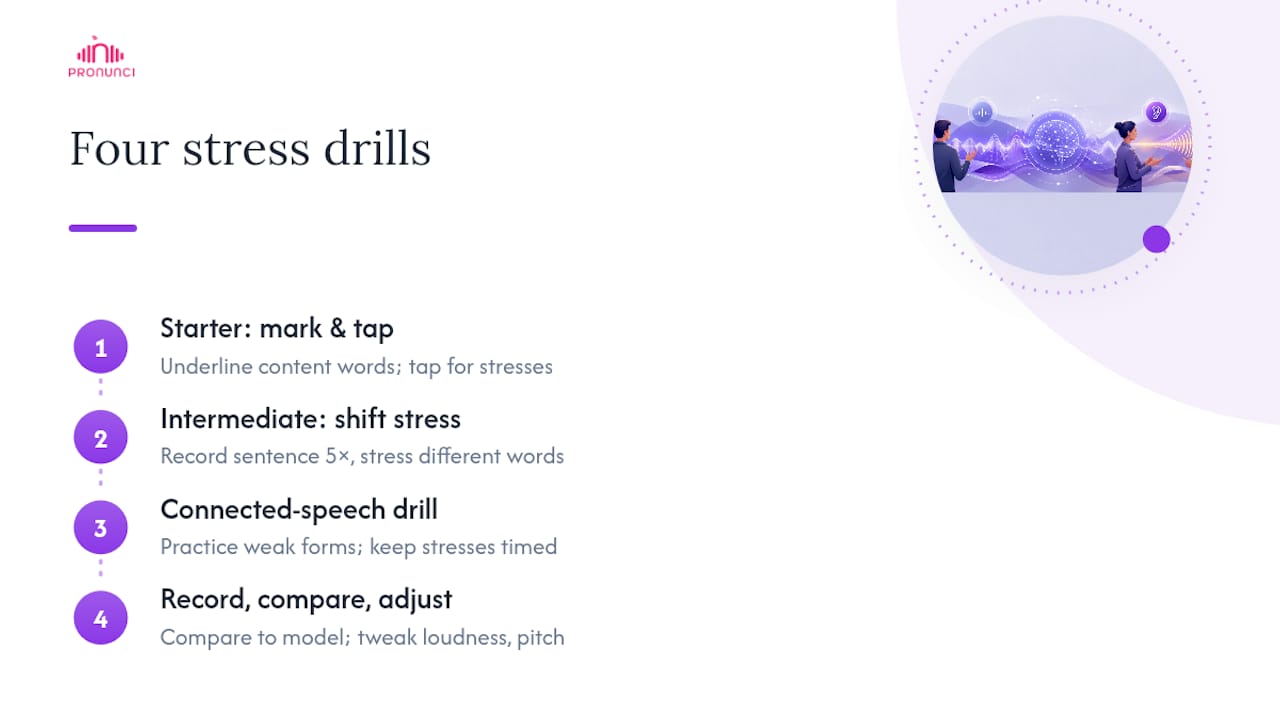
Starter drill: mark and tap. Take five sentences from a script or textbook dialogue. Underline the content words only. Read each sentence aloud while tapping your finger on the desk for every stressed word, keeping the taps evenly spaced no matter how many unstressed syllables fall between them. This trains the stress-timed rhythm that makes English sound natural rather than mechanical.
Intermediate drill: shift the stress, shift the meaning. Take one sentence, like “She didn’t take my book,” and record yourself saying it five times, moving the stress to a different word each time (SHE didn’t, didn’t TAKE, my BOOK). Notice how each version implies a different unspoken question or correction.
Connected-speech drill: timing and reduction. Practice short exchanges where function words disappear into weak forms (“What’re you doing?” instead of “What are you doing?”). Time yourself keeping stressed words evenly spaced, letting unstressed syllables compress to fit.
Record, compare, adjust. Record a sentence, then listen back specifically for loudness, length, and pitch on your stressed words. Comparing your own recording against a model reading is one of the most effective ways to catch mismatches your ear misses in real time, since self-recording paired with structured feedback speeds up correction.
For classrooms, print short dialogues with content words pre-underlined, then have students perform them in pairs and swap the stress deliberately to hear meaning change live. Our guide on stress-timed English drills walks through a four-drill daily routine if you want a ready-made sequence.
Pro Tip: Practice contrastive stress with minimal pairs of your own life: “I didn’t lose my keys, I lost my WALLET.” The sillier or more personal the sentence, the easier it is to remember the pattern later.
Prof. Alex’s coaching notes: fixing the errors I see most often
After years of working with learners across dozens of first-language backgrounds, four errors show up again and again, and they’re fixable in a single focused session.
- Overstressing function words. Many learners give “the,” “a,” and “is” full weight out of habit, which flattens the rhythm. Fix: read a sentence aloud twice, once stressing everything, once stressing only content words, and notice how much clearer the second version sounds.
- Monotone intonation. Flat pitch on every word removes the cues listeners rely on. Fix: exaggerate pitch rise and fall on stressed words until it feels almost theatrical, then dial it back to natural.
- Wrong tonic placement. Stressing the wrong word in a long phrase buries the actual new information. Fix: identify the single word answering “what’s new here” and land your strongest stress there.
- Uneven timing. Rushing unstressed syllables while dragging stressed ones breaks the stress-timed beat. Fix: practice with a metronome app, tapping only on stressed words.
Seeing where the tongue, jaw, and airflow actually land during a stressed sound is often the missing piece, which is exactly what our
is built to show, making an otherwise invisible movement visible and repeatable. Pairing that visual model with AI Accent Coach feedback lets learners compare their own recording against a native-speaker model and catch stress errors within minutes instead of guessing for weeks.
Why the usual sentence stress advice falls short
Most sentence stress advice stops at “stress the important words,” which sounds reasonable and helps almost no one actually speak differently. The gap isn’t understanding the rule. It’s that learners can recite the definition of tonic stress perfectly and still speak in a flat, evenly weighted rhythm five minutes later, because the ear hasn’t been retrained to expect the contrast.
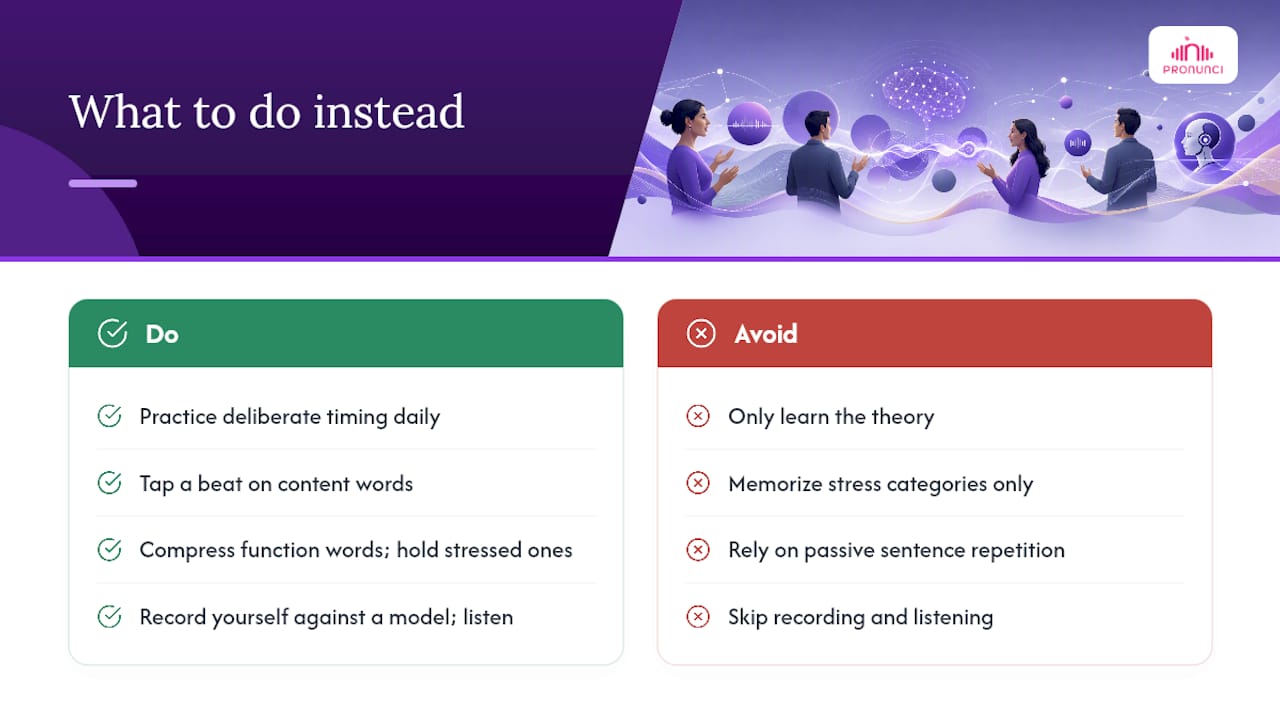
What the research actually supports is narrower and more useful: deliberate timing practice, like tapping a beat on content words, builds the stress-timed rhythm faster than passive repetition of example sentences. That means the priority isn’t memorizing four categories of stress. It’s building the physical habit of compressing function words and holding stressed ones, day after day, until it stops requiring conscious thought.
If I had to pick one place to start, it wouldn’t be theory. It would be recording your own voice against a model and listening for where your pitch stays flat when it should move. That single feedback loop, done consistently, corrects more bad habits than any worksheet.
— Prof. Alex., Ph.D. Accent Coach
Keep building your rhythm with InPronunci
InPronunci is the structured path to the practice this article just described, built around the same principle: you don’t fix sentence stress by reading about it, you fix it by seeing the movement, hearing the contrast, and getting corrected in real time. The intonation and emphasis chapter walks you through tonic placement, contrastive stress, and stress-timed rhythm using the same 2D sound video simulators referenced above, so you can watch exactly how a stressed sound is shaped before you attempt it yourself.
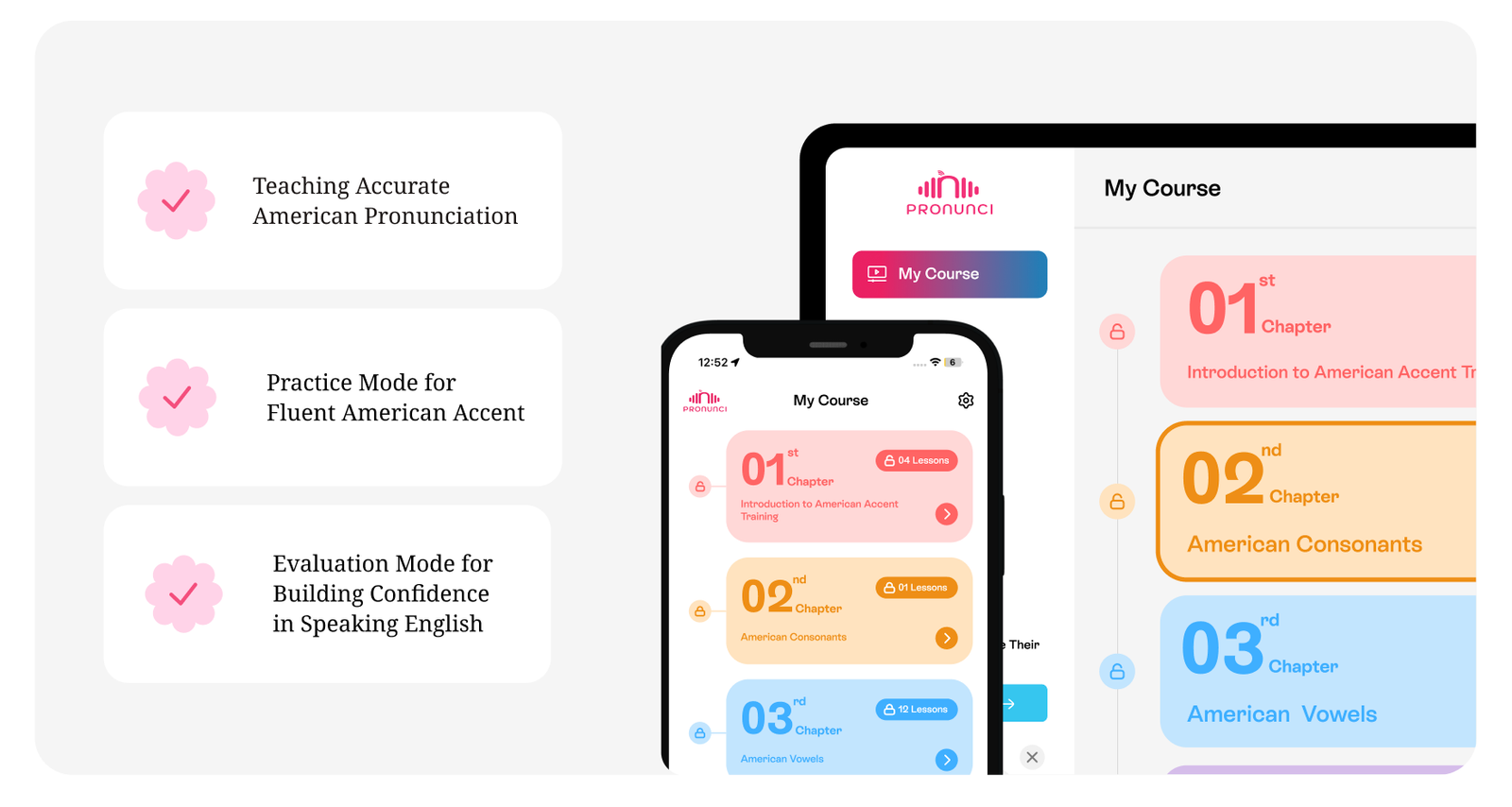
Get the InPronunci: Accent Training App on Apple or Google Play, or study through the InPronunci: American Accent Training Course on desktop. Start with the free onboarding chapter to try the AI Accent Coach and 2D simulators yourself, then follow the guided stress and rhythm path at your own pace. For faster, one-on-one correction, the Premium Plan pairs you directly with live coaching, while the Basic Plan gives you full access to the structured drills at your own speed. Whichever path fits your schedule, the next step is the same: record one sentence today and compare it against a native model.
Sources
For deeper study, the University of Kansas open pronunciation textbook covers thought groups and tonic stress in academic detail, while BBC Learning English’s Flatmates series offers short scripted examples useful for classroom playback.
- Chapter 4 – Thought Groups and Sentence Stress – A Short Introduction to English Pronunciation
- Sentence Stress | Learn English
- Content vs Function Words – The Sound of English
- Sentence Stress in the English Language
FAQ
What are examples of sentence stress?
“I want to go to the STORE” stresses the content word “store,” while “I THINK you’re right” shifts stress to “think” for emphasis, showing how the same words can carry different focus.
What is sentence stress?
Sentence stress is the pattern of saying certain words louder, longer, and with pitch movement while reducing the rest, and it’s what gives spoken English its rhythm.
What is stress in 20 words?
Stress is emphasis placed on a syllable within a word or on specific words within a sentence, marked by loudness, length, and pitch change.
What are 10 examples of stressed sentences?
Any sentence changes meaning with shifted stress. Try: “I DIDN’T say that,” “I didn’t SAY that,” and “I didn’t say THAT,” each pointing to a different correction, a pattern InPronunci’s stress and emphasis lessons walk through with audio models for comparison.