


“Indices” is pronounced in American English as /ˈɪndəˌsiz/ and in British English as /ˈɪndɪˌsiːz/. Say it “IN-duh-seez” in the US or “IN-dih-seez” in the UK. It rhymes loosely with “species” and carries stress firmly on the first syllable. Indices is the plural of index, used mainly in formal, technical, or academic contexts like math, economics, and linguistics.
- US IPA: /ˈɪndəˌsiz/ (respelling: IN-duh-seez)
- UK IPA: /ˈɪndɪˌsiːz/ (respelling: IN-dih-seez)
- Usage note: plural of “index”
- Listen: audio pronunciations are available from Cambridge Dictionary, Collins, and Oxford Learner’s Dictionary
You will hear both forms in the wild, and neither is wrong. What matters is knowing which one fits your audience and being able to produce it cleanly. That’s exactly what we cover next.
Mastering “indices” comes down to placing stress correctly on the first syllable, choosing the medial vowel that matches your target dialect (US schwa or UK short /ɪ/), and voicing the final /z/ clearly.
How Do You Break Down the Pronunciation of Indices?
“Indices” has three syllables, and the stress falls on the first one every time: IN.di.ces. Once you lock that stress pattern in, the rest of the word falls into place much faster.

Here’s how the sounds map out, syllable by syllable, with a familiar word to anchor each one.
| Syllable | IPA (US) | IPA (UK) | Comparable sound |
|---|---|---|---|
| IN- (stressed) | /ˈɪn/ | /ˈɪn/ | “in” as in “input” |
| -di- (medial) | /də/ | /dɪ/ | “duh” (US) vs. “dih” (UK), like the second syllable of “credit” |
| -ces (final) | /siz/ | /siːz/ | “seez,” rhyming with “trees” |
The medial vowel is where most learners trip up. In American speech, that second syllable often collapses toward a quick schwa, the neutral “uh” sound linguists write as /ə/. British speakers tend to keep a crisper short /ɪ/, closer to the vowel in “bit.” Neither version drags out the syllable. The whole word moves fast, almost clipped, which is one reason non-native speakers sometimes over-enunciate it and end up sounding stilted rather than natural.
The final /z/ sound also deserves attention. It’s voiced, meaning your vocal cords buzz while you produce it, not the unvoiced /s/ you’d use in “ice.” Rest your fingers lightly on your throat while saying “seez” versus “cease.” You should feel a vibration on the first and not the second. Getting that final consonant right is a small detail with a big payoff for clarity, and it’s a sound that American English consonant training targets specifically because it trips up speakers from many language backgrounds.
- Isolate the stressed first syllable before adding the rest of the word.
- Keep the medial vowel short and unstressed, almost swallowed in fast speech.
- End with a buzzing /z/, not a hissing /s/.
What’s the Real Difference Between US and UK Pronunciations?
The core difference lives in one vowel: the second syllable. American speakers reduce it toward a schwa, /ə/, while British speakers preserve a short, tighter /ɪ/. That’s the entire gap, but it’s audible once you know to listen for it.
A few concrete markers to train your ear on:
- Vowel quality: US “duh” versus UK “dih” in the second syllable.
- Vowel length: British English tends to hold the final /iː/ a touch longer than the American /i/, giving UK speech a slightly more drawn-out ending.
- Overall timing: American delivery often feels a bit more clipped and rapid across the whole word; British delivery is marginally more even-paced syllable to syllable.
- Final consonant: both variants voice the ending /z/, so that part doesn’t change across dialects.
Cambridge Dictionary’s audio is a good place to hear both versions back to back, and Collins offers side-by-side clips as well. Play each three or four times and shadow them out loud rather than just listening passively. Passive listening trains recognition; speaking along trains production, and you need both.
Which one should you practice? Pick the variant tied to where you work, study, or plan to live. If you’re preparing for a US-based job interview, a TOEFL speaking section, or client calls with American teams, train toward the schwa-based American form. If your target community is British, Irish, or broadly Commonwealth English, lean into the crisper /ɪ/. There’s no prestige difference between them, only a fit-to-context difference.
Indices or Indexes: Which Plural Should You Use?
Both “indices” and “indexes” are correct plurals of “index,” but they signal different registers. “Indices” reads as more formal and technical, common in mathematics, economics, linguistics, and academic writing. “Indexes” feels more everyday, and it’s standard when referring to book indexes or database indexes.
Collins and other major dictionaries record both forms, and Collins’ entry notes the variation directly. The choice often comes down to field convention rather than strict grammar rules. In finance, you’ll usually hear “stock market indices.” In software, engineers almost always say “database indexes,” and some professionals even avoid the plural altogether by saying “indexed values” to sidestep ambiguity in fast-paced meetings, a workaround documented in technical discussion forums.
Here’s how that plays out in real sentences:
- Formal/academic: “The economist compared three separate indices of inflation before publishing her findings.”
- Neutral/business: “Our team tracks several market indices to gauge portfolio performance each quarter.”
- Informal/technical: “Just rebuild the database indexes and the query should run faster.”
For professional writing and presentations, “indices” is the safer choice in technical and academic contexts, since it signals precision and field fluency. In casual conversation or software discussions, “indexes” won’t raise an eyebrow and often sounds more natural.
What Practice Drills Help You Master Indices?
Fixing your pronunciation of “indices” doesn’t require a long session. It requires focused repetition in the right order.
- Isolate the word. Say “indices” slowly five times, exaggerating the stress on the first syllable: IN.di.ces. Focus only on getting the stress and the final /z/ right before worrying about speed.
- Repeat in carrier phrases. Slot the word into short, neutral frames like “the indices show,” “these indices are,” or “three key indices.” This builds muscle memory for how the word behaves next to other sounds.
- Use it in full sentences at natural speed. Speed up once the isolated version feels automatic.
Try these practice sentences, moving from slower and more deliberate to faster and more conversational:
- “The indices reveal a clear pattern in the data.” (slow, even stress)
- “Several economic indices dropped this quarter.” (moderate pace)
- “Check the indices before you finalize the report.” (natural speaking speed)
- “Those indices don’t match last year’s numbers.” (fast, casual)
Pro Tip: Record yourself saying the word, then slow the playback down to half speed. Listen specifically for whether your final /z/ buzzes or hisses, and whether your second syllable collapses into a schwa or stays too crisp for the American form. A mouth-training simulator provides the same articulation training, helping you match your lip and tongue position to a native-speaker model rather than relying on your ear alone.
If you’re working on phoneme-level precision beyond this one word, phoneme awareness training builds the kind of self-monitoring skill this drill depends on.
Watch Prof. Alex Demonstrate the Indices Sound Pattern
When I teach “indices” to advanced ESL speakers, I focus on two trouble spots: the reduced medial vowel and the voiced final /z/. Both are small, and both get overlooked constantly, which is exactly why they stick around as habits for years if nobody points them out.
The
trains the American /t/ sound using the same speech-organ training approach we apply across InPronunci’s consonant and vowel training: tongue position, airflow, and voicing trained instead of guessed at. Use the simulator to isolate articulation, then apply that same habit to the final /z/ in “indices.” Check where your tongue sits and whether your vocal cords are engaged, not just where your lips move.
Most learners think pronunciation problems are about individual sounds. In my experience, they’re almost always about timing and stress. Get the rhythm of “indices” right, and the vowels tend to fall into place on their own.
A five-minute routine that works well before a meeting or a presentation:
- Warm-up (1 minute): hum through the three syllables slowly, feeling for vibration on the final /z/.
- Targeted repetition (2 minutes): repeat the word 15 to 20 times, alternating between the US and UK vowel in the second syllable so you feel the contrast physically.
- Contextualization (2 minutes): drop the word into three or four original sentences related to your own work or field.
For deeper, structured practice beyond this single word, InPronunci’s course library is built around exactly this kind of visual, comparison-based learning. Explore InPronunci: American Accent Training Course for the full curriculum, and check the app on Apple’s App Store or Google Play.
Why Do Learners Keep Mispronouncing Indices?
The most common error I see with “indices” isn’t the vowel. It’s stress placement. Learners from syllable-timed language backgrounds, where every syllable gets roughly equal weight, often flatten the stress across all three syllables instead of hitting the first one hard. The fix is almost always mechanical: exaggerate the stress until it feels unnatural, then dial it back to conversational level.

A second pattern I notice constantly: speakers nail the word in isolation during a drill, then lose it completely inside a fast sentence. That’s not a knowledge gap. It’s a fluency gap, and it only closes through repetition at natural speed, which is exactly what the carrier-phrase drill above is designed to build.
One teaching tip I give every advanced student: practice the word right after a consonant cluster, like “these indices” or “such indices,” because that transition is where clarity tends to break down fastest. If you can say it cleanly there, you can say it cleanly anywhere. Isolated single-word practice matters, but it’s the connected speech in sentence 3 of the drill list above where the habit actually forms. That’s also where a structured curriculum earns its place, since a single word like “indices” is really just one data point inside a much larger pattern of American vowel reduction and consonant voicing that InPronunci’s chapters build systematically over time.
Structured American Accent Training Course
From Speech Organs Education to American Intonation
The InPronunci course is built step by step: every chapter prepares the next one, and by the end of the course students receive a certificate.
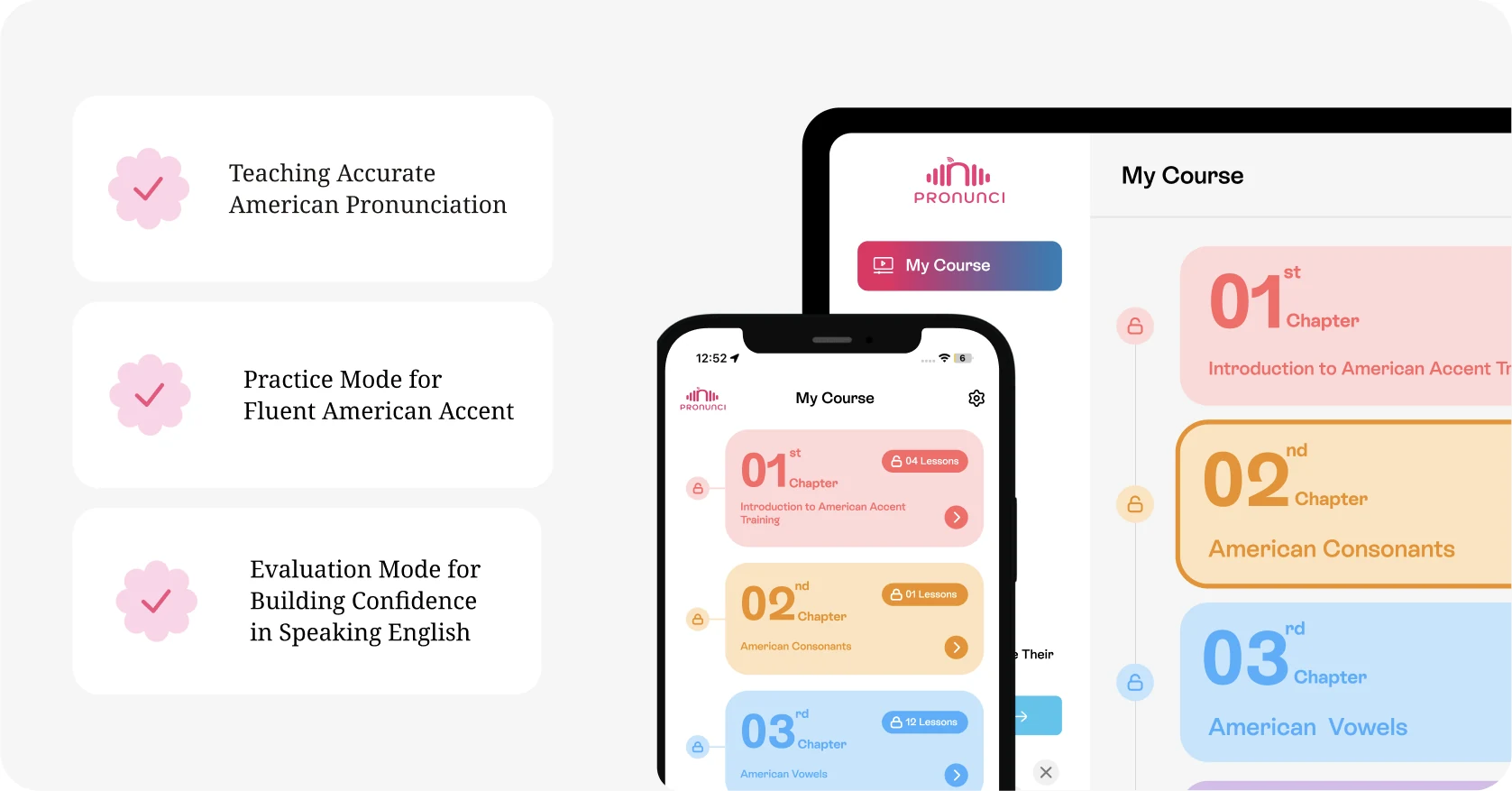
- Speech Organs EducationStudents learn how the speech organs work, along with the AI Accent Coach commands and feedback.
- American ConsonantsPractice and evaluate American consonants in phonetic exercises and practice sentences with the AI Accent Coach.
- American VowelsPractice and evaluate American vowels in phonetic exercises and practice sentences with the AI Accent Coach.
- IntonationLearn how intonation can change the meaning of what you say.
- CertificateBy the end of the course, students receive a certificate.
How Can InPronunci Help You Master Words Like Indices?
Getting one word right is a start. Getting consistent, native-like clarity across every vowel, consonant, and stress pattern you encounter takes structured repetition, not scattered YouTube clips. InPronunci: Accent Training App was built by Prof. Alex, Ph.D. Accent Coach specifically for serious learners who want measurable progress instead of guesswork, with a program that treats accent training as a skill you build in order, not a trick you pick up randomly.
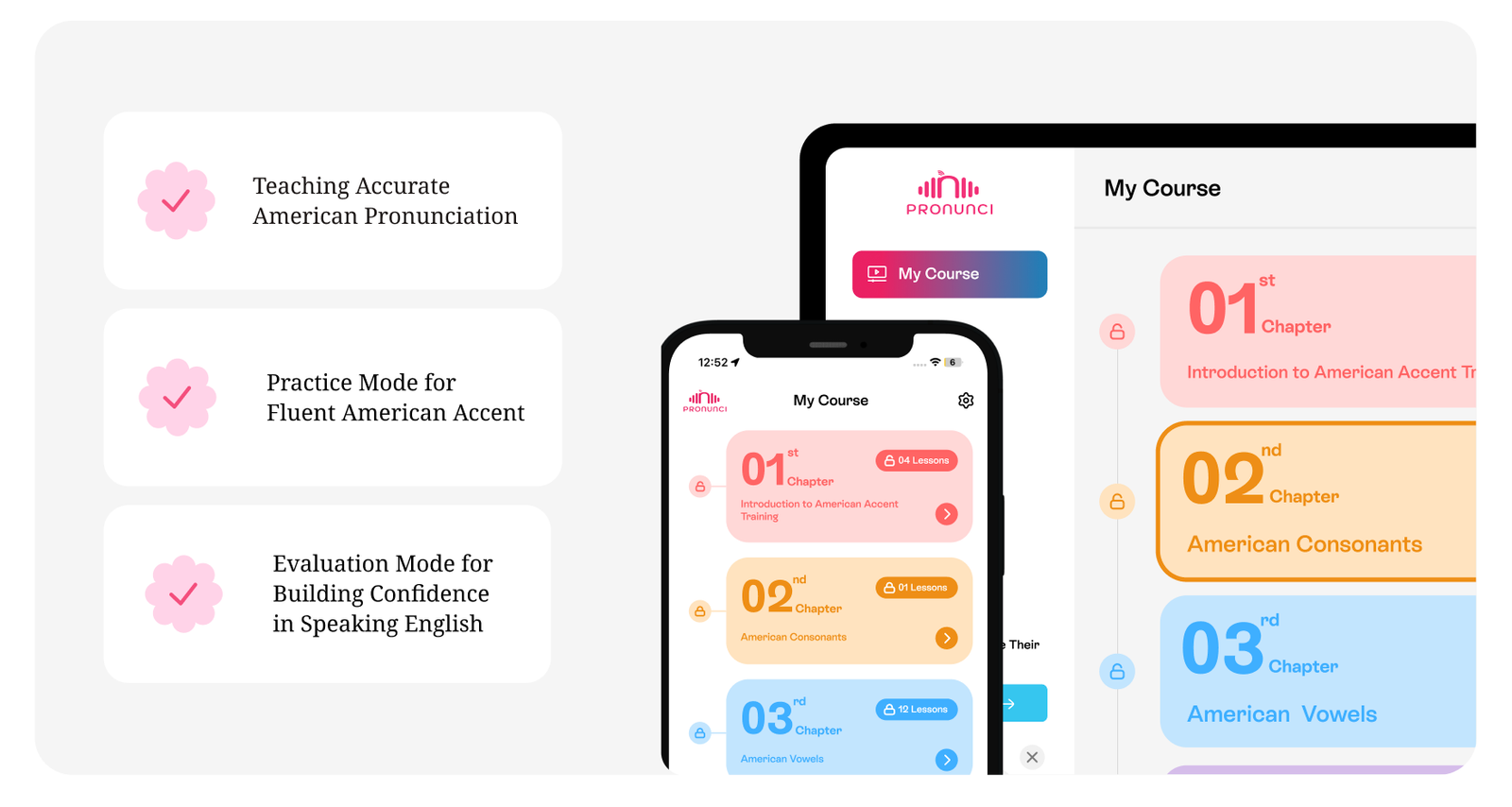
The program moves you through Speech Organs Education, American Consonants, American Vowels, and Intonation and Emphasis, using tools most apps don’t offer:
- An Interactive Visual 2D Sound Simulatorthat trains tongue, lip, and airflow positioning for every sound, the same training method demonstrated for the American /t/ sound.
- AI Accent Coach feedback that compares your recording (My Pronunci) against a native-speaker model (My Coach) so you can hear exactly where the gap is.
- Structured consonant and vowel sessions, 13 for consonants and 12 for vowels, each with phonetic exercises, practice sentences, and paragraph drills.
If you’re ready to move past single-word practice, the InPronunci App Guide walks through how the curriculum builds from isolated sounds to full connected speech. Download the app on Apple’s App Store or Google Play and start your first free onboarding chapter today.
Where Can You Verify the Pronunciation of Indices?
For a quick audio check, Cambridge Dictionary and Collins both offer clean, side-by-side American and British clips you can replay instantly. For fuller usage notes and example sentences, Oxford Learner’s Dictionary and Wiktionary go deeper into regional transcription variants and grammatical context.
- Quick audio check: Cambridge or Collins pronunciation pages.
- Deeper reading and usage notes: Oxford Learner’s Dictionary or Wiktionary.
- Speech-organ articulation training: the
InPronunci training structure
How InPronunci trains the American speech system
InPronunci trains the full American speech system: Interactive Visual 2D Sound Simulators and phonetic exercises for articulation and American sound development, sentence practice for intonation, melody, rhythm, and connected speech, paragraph practice for spontaneous speech, public speaking, and real communication confidence, and Advanced AI Accent Coach evaluation as you speak.
InPronunci is an advanced, linguistically structured American accent training platform with more than 1,000 downloads and a growing learner base. It is designed for serious ESL learners who want American pronunciation, stronger intonation, more natural rhythm, better connected speech, and the ability to speak English more confidently in real communication. The program is especially useful for intermediate and advanced English speakers who want to become independent speakers of English with confident communication, stronger speaking control, long-term speech improvement, and great public speaking skills. It is also designed for advanced speakers whose goal is to speak like a native or closer to native-like American speech, including people who were raised in the United States but still have slight accent patterns from the native language they were born with. It is a complete American accent training course and system created by Prof. Alex, Ph.D. Accent Coach, Doctor of Education, and professional linguist based in Austin, Texas, with Pronunci Instructions from Prof. Alex for each lesson that make self-learning more effective, supported, and clear.
.
- Structured, progressive training: InPronunci: Accent Training App.
If you’re comparing pronunciation across different first languages, InPronunci’s guide on pronunciation challenges Asian English speakers face and partner resources like Spanish pronunciation strategies offer useful cross-linguistic context for vowel and consonant contrasts beyond this single word.
Sources
- INDICES | Pronunciation in English
- indices noun – Definition, pictures, pronunciation and usage notes | Oxford Advanced Learner’s Dictionary
- indices – Wiktionary, the free dictionary
- Pronunciations of ‘indices’ | Collins
Questions & Answers
FAQ
01What does “indices” mean?
“Indices” is the plural form of “index,” referring to multiple lists, guides, or measures, such as economic indices or the plural indices in a mathematical formula.
02How do you say the word “indices”?
Say it as /ˈɪndəˌsiz/ (“IN-duh-seez”) in American English or /ˈɪndɪˌsiːz/ (“IN-dih-seez”) in British English, with stress on the first syllable in both.
03What is the difference between “indices” and “indexes”?
Both are correct plurals of “index.” “Indices” is more common in formal, academic, and technical writing, while “indexes” is standard for databases, books, and everyday speech.
04Why do I keep mispronouncing indices?
Most errors come from flattening the stress across all three syllables instead of emphasizing the first one, or mishandling the voiced final /z/, both of which respond well to isolated drilling with tools like InPronunci’s Interactive Visual 2D Sound Simulator.
Recommended

InPronunci AI Accent Coach: Pronunciation Feedback for Professional Clarity
Learn how to use AI pronunciation feedback to go beyond scores. Master your American accent and gain professional clarity with our guide to real-time adjustm...

InPronunci Human-Based Guidance: American Accent Training You Can Trust
InPronunci combines human-based guidance, AI pronunciation feedback, and 2D Sound Motion Technology for trusted American accent training worldwide.

Best Accentize.app Alternatives in 2026: Inpronunci Guide
Discover the best Accentize.app alternatives in 2026. Inpronunci offers innovative tools for clear American English pronunciation. Start your journey today!
Plans
What InPronunci costs
InPronunci Basic
$35 per month
Chapter 1 is free after signup.
InPronunci Premium
$200 per month
Includes a coach: