


Use three voice controls — pace, downward inflection, and intentional pauses — along with a focused daily drill, and your American English will be sales-ready faster than you expect. Pronunciation improvement for deal closing is not about eliminating your accent. It is about making your speech clear, authoritative, and easy for buyers to trust. Before your next call, run through this checklist:
- Breathe and stand. Diaphragmatic breath before you speak raises your voice from your chest, not your throat. Standing adds projection.
- Slow down 10–20%. Most non-native speakers accelerate under pressure. Deliberately dropping your pace signals confidence, not hesitation.
- Drop your pitch at the end of statements. A rising pitch turns every claim into a question. Downward inflection on “Our price is $X” reads as settled and final.
- Remove fillers. Replace “um,” “uh,” and “you know” with a one-second silence. Silence sounds deliberate; fillers sound uncertain.
- Pause after price. Hold three seconds after stating a number. The pause is not awkward — it is strategic.
- Stress the right word. “We guarantee delivery” lands differently than “We guarantee delivery.” Stress the word that carries your value claim.
Pro Tip: When a filler word is about to come out, close your mouth and count silently to one. That one-second pause replaces the filler and makes you sound composed. Practice it during low-stakes calls first.
Two sample phrases to practice right now:
- “Our price is [X].” — Use a steady pace, stress “price,” and drop your pitch on the final word. No upward lift.
- “Let’s agree on next steps.” — Stress “agree” and “next steps,” keep the pace controlled, and end with a downward, conclusive tone.
For a full pre-call pronunciation checklist, Inpronunci’s client-facing guide covers every drill worth doing before you pick up the phone.
Why does pronunciation affect deal outcomes?
Buyers form judgments about credibility within seconds of hearing your voice. Large-sample analyses confirm that vocal features — tone, pace, and rhythm — are statistically significant predictors of whether a sales call closes. This is not a soft skill observation. It is a measurable pattern across thousands of recorded calls.
“Paralinguistic features — pitch, inflection, volume — carry meaning that words alone cannot. A downward inflection signals authority and finality; an upward one signals uncertainty. Buyers read these cues before they process your content.”
The mechanism is straightforward. When your pace is controlled, your listener’s brain has time to process and trust what you are saying. When your pitch drops at the end of a statement, you signal conviction. When you pause after presenting a price, you signal that the number is not negotiable. These are not stylistic choices — they are trust signals in negotiations that buyers respond to before they consciously evaluate your offer.
Unguided repetition — “repeat after me” drills with no feedback — rarely produces this level of control. Structured training with visual feedback, AI-scored recordings, and human coaching accelerates the transfer from drill to live conversation. Inpronunci’s
InPronunci training structure
How InPronunci trains the American speech system
InPronunci trains the full American speech system: Interactive Visual 2D Sound Simulators and phonetic exercises for articulation and American sound development, sentence practice for intonation, melody, rhythm, and connected speech, paragraph practice for spontaneous speech, public speaking, and real communication confidence, and Advanced AI Accent Coach evaluation as you speak.
InPronunci is an advanced, linguistically structured American accent training platform with more than 1,000 downloads and a growing learner base. It is designed for serious ESL learners who want American pronunciation, stronger intonation, more natural rhythm, better connected speech, and the ability to speak English more confidently in real communication. The program is especially useful for intermediate and advanced English speakers who want to become independent speakers of English with confident communication, stronger speaking control, long-term speech improvement, and great public speaking skills. It is also designed for advanced speakers whose goal is to speak like a native or closer to native-like American speech, including people who were raised in the United States but still have slight accent patterns from the native language they were born with. It is a complete American accent training course and system created by Prof. Alex, Ph.D. Accent Coach, Doctor of Education, and professional linguist based in Austin, Texas, with Pronunci Instructions from Prof. Alex for each lesson that make self-learning more effective, supported, and clear.
show exactly how sounds are formed through tongue, lip, and jaw movement, removing the guesswork that slows most learners down. The IntechOpen peer-reviewed literature on phonetic training supports visual articulatory feedback as a measurable accelerator of pronunciation accuracy.
Prof. Alex, Ph.D. Accent Coach validates progress through recordings and blind listener checks — a methodology where a listener who has not heard your baseline rates your clarity without knowing your improvement history. That removes bias and gives you an honest signal.
| Vocal Feature | Effect on Buyer Perception | Practice Priority |
|---|---|---|
| Controlled pace | Increases trust, reduces listener resistance | High (quick win) |
| Downward inflection | Signals authority and finality | High (quick win) |
| Intentional pauses | Frames price and closing questions | High (quick win) |
| Word stress | Directs attention to value claims | Medium |
| Vowel clarity | Reduces ambiguity on key terms | Medium (longer-term) |
| Filler elimination | Raises perceived competence | High (quick win) |
Which pronunciation features actually move deals?
Not every pronunciation feature carries equal weight in a sales conversation. These are the ones worth your practice time, ranked by how quickly they produce results.
- Pace. Slowing your speech by 10–20% measurably increases perceived authority. This is the fastest lever you have.
- Vowel clarity for sales keywords. The word deal is pronounced /dēl/ — a long, clear “ee” vowel. Clipping it to /dɪl/ creates ambiguity. The same applies to agreement (/əˈɡriːmənt/) and contract (/ˈkɑːntrækt/).
- Filler elimination. Fillers signal cognitive load. Prepared conversational frameworks — a short talk-track for common objections — reduce filler-word use and raise perceived competence.
Short-term wins (1–3 weeks): pace, pauses, and filler elimination. These require behavioral change, not phonetic retraining.
Longer-term work (4–12 weeks): vowel clarity, stress patterns, and intonation contours. These require structured phonetic training.
Pro Tip: Pair one drill with each feature. For pace: read one sales sentence aloud, then read it again at 80% of your natural speed. For downward inflection: record yourself saying “Our price is final” and listen for whether your pitch rises or falls on “final.” One drill, one feature, two minutes.
For a deeper look at American English pitch and intonation for sales, Inpronunci’s dedicated guide covers the full intonation system with audio examples.
Daily drills that build clarity and authority in 10–20 minutes
These drills are designed to be done every day. Each one targets a specific voice control used in sales.
Two-minute warm-up
Before any drill, prepare your speech organs. Take three slow diaphragmatic breaths, roll your lips, and do five tongue-tip taps on the ridge behind your upper teeth. This activates the muscles you use for clear consonants and reduces the tension that causes rushed speech. The British Council recommends targeted physical preparation as a foundation for accurate pronunciation practice.

How to build a 4-week “deal-ready” practice plan
A month of consistent, structured practice produces detectable improvement. Here is how to sequence it.
- Week 1 — Awareness and baseline. Record a two-minute mock sales call. Do not edit. Listen back and note: your average pace, filler-word count, and whether your statements end with rising or falling pitch. This is your baseline. Do the two-minute warm-up and pace drill daily.
- Week 2 — Pace and pause control. Add the pause drill to your daily session. Practice holding silence after every price statement and every closing question. Use a prepared talk-track for two or three common objections to reduce cognitive load and filler use.
- Week 3 — Pitch, endings, and stress. Add the downward inflection drill and the connected-speech clarity drill. Focus on the four sales keywords. Record one mock closing sequence and listen for upspeak.
- Week 4 — Integration. Run a full mock discovery-to-close call. Record it. Send it to a listener who has not heard your Week 1 recording and ask them to rate your clarity on a scale of 1–10. Compare their score to your baseline.
Daily session templates:
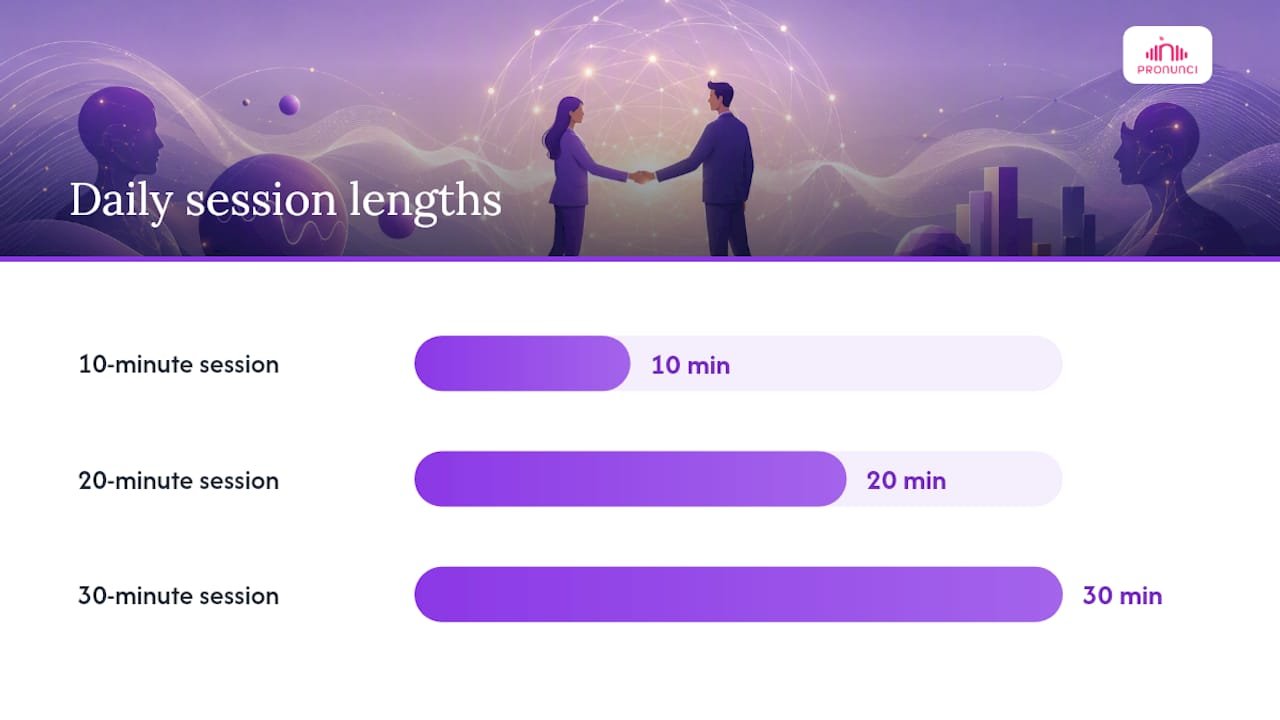
- 10 minutes: warm-up (2 min) + one drill (5 min) + recording review (3 min)
- 20 minutes: warm-up (2 min) + two drills (10 min) + recording review (5 min) + talk-track rehearsal (3 min)
- 30 minutes: warm-up (2 min) + three drills (15 min) + mock call recording (8 min) + review (5 min)
Weekly checkpoints:
- Record one mock call and compare to the previous week’s recording.
- Run a blind listener check at the end of Week 2 and Week 4.
- Track one metric per week: filler-word count (Week 1), pause frequency (Week 2), pitch endings (Week 3), listener clarity rating (Week 4).
The Oxford University Press ELT pronunciation resources support this kind of progressive drill sequencing as a pedagogically sound approach to building phonetic habits.
How long does improvement take, and what does it cost?
Practical timelines:
- 1–3 weeks: Pace, pause, and filler control. These are behavioral changes. Most professionals notice a difference within two weeks of consistent daily practice.
- 4–12 weeks: Meaningful improvement in vowel clarity, stress patterns, and intonation. This is where structured phonetic training pays off.
- 3–6 months: Accent reduction as a longer-term project. Retraining your sound system takes time, but the sales-relevant gains come much earlier.
What to measure after each call:
- Speech rate (words per minute — aim for 130–150 wpm in a sales context)
- Filler-word count per five minutes
- Listener comprehension rate (ask your prospect to confirm key terms)
- Call-close outcomes over a four-week window
- Blind listener clarity rating (1–10 scale)
Investment options:
- Self-study with AI feedback: Lower cost, flexible schedule. Best for professionals who can commit to daily practice and want real-time feedback without scheduling constraints. Inpronunci’s Basic Plan fits this profile.
- Human-guided coaching: Higher cost, faster calibration. A Ph.D. accent coach catches errors that AI misses and adjusts your training path in real time. Inpronunci’s Premium Plan includes monthly 1-on-1 sessions with Prof. Alex, Ph.D. Accent Coach For a full breakdown of coaching options for career growth, Inpronunci’s guide covers when each route makes sense.
Understanding how to use AI pronunciation feedback effectively can significantly accelerate your self-study results. Confidence on calls is also closely tied to delivery clarity — research on confidence in sales calls shows that vocal control and self-assurance reinforce each other in a measurable cycle.
Common mistakes non-native sales professionals make — and fast corrections
These are the errors that cost deals. Each one has a fix you can apply before your next call.
- Speaking too fast under pressure. The fix: before you answer an objection, take one breath. That breath physically slows your pace and signals composure.
- Upspeak (rising pitch on statements). The fix: record yourself saying your three most common closing statements. Listen for any upward pitch at the end. Repeat each one with a deliberate downward close until it feels natural.
- Filler words. The fix: prepare a “pantry” of three or four phrases for common objections. When you know what you will say, fillers disappear. Practice the pause as a replacement.
- Clipped consonants. The fix: in words like contract and agreement, release the final consonant fully. “Contrac’” (without the final /t/) sounds incomplete. Practice the full release in your daily drill.
- Vowel reduction on keywords. The fix: never reduce the vowel in deal, price, or close. These are your highest-stakes words. Give them full vowel length and clarity.
- Monotone delivery. The fix: use the three-voice drill from negotiation coaching: analytical (steady, measured), collaborative (warmer, slightly higher pitch), and assertive (lower pitch, slower pace, downward endings). Practice switching between them on the same sentence.
Before/after examples:
-
Before: “The price is uh… around fifteen thousand?” (rising pitch, filler, reduced vowel)
After: “The price is fifteen thousand.” (steady pace, no filler, downward inflection on “thousand”) -
Before: “So, um, should we like… move forward?”
After: “Are you ready to move forward?” (clear vowels, stress on “ready,” downward close)
Pairing these corrections with active listening techniques makes your delivery even more effective — buyers respond when they feel heard and understood, not just spoken at.
What to do right now: your next steps
Follow the 4-week plan above consistently and you will hear a real difference in your delivery by the end of Week 2. The buyers you speak with will notice it sooner than you do. Pace, downward inflection, and intentional pauses are the three controls that change perception fastest. Add vowel clarity on your key sales words, and you have a complete short-term package.
Immediate checklist:
- Record a two-minute baseline today. Do not edit it.
- Do one 10-minute drill session before your next call.
- Schedule four weekly checkpoint recordings in your calendar now.
- Decide: self-study (Basic Plan) or coached (Premium Plan with Prof. Alex, Ph.D. Accent Coach)?
Pro Tip: On your next live call, pick one control to monitor — just one. If you chose pace, your only job is to slow down 10–20% when you feel pressure. Single-focus self-correction is more reliable than trying to manage everything at once.
Try Inpronunci’s free Chapter 1, “Get to Know Your Speech Organs,” to build the physical foundation before you run any drill. It is the step most professionals skip — and the one that makes every drill work better.
The voice controls buyers respond to before they hear your words
Most sales training focuses on what you say. The research points somewhere else: buyers respond to how you say it before they process the content. Vocal cadence, pace, and inflection are processed faster than language — which means a non-native professional with strong voice controls will outperform a native speaker with weak ones in a high-stakes negotiation.
The mistake I see most often with sales professionals is treating pronunciation as a confidence problem rather than a skill problem. Confidence follows competence. When you know your pace is controlled, your pitch is deliberate, and your key words are clear, the confidence arrives on its own. The training path is not about sounding like someone else. It is about making your speech reliable enough that buyers can focus on your offer, not on decoding your words.
The professionals who improve fastest are the ones who record themselves, listen without judgment, and fix one thing at a time. That discipline, more than any single drill, is what produces deal-ready speech.
How Inpronunci helps you close with clearer speech
Clear speech in sales is a trainable skill, and Inpronunci gives you the structure to train it efficiently. The course is built around three technologies that work together: Interactive 2D Sound Video Mouth-Training Simulators that train exactly how American sounds are formed through tongue, lip, and jaw movement; an AI Accent Coach that scores your pronunciation, intonation, rhythm, and connected speech as you speak; and Human-Guided Instructions that replicate working with a real accent coach so you always know you are practicing correctly.
Structured American Accent Training Course
From Speech Organs Education to American Intonation
The InPronunci course is built step by step: every chapter prepares the next one, and by the end of the course students receive a certificate.
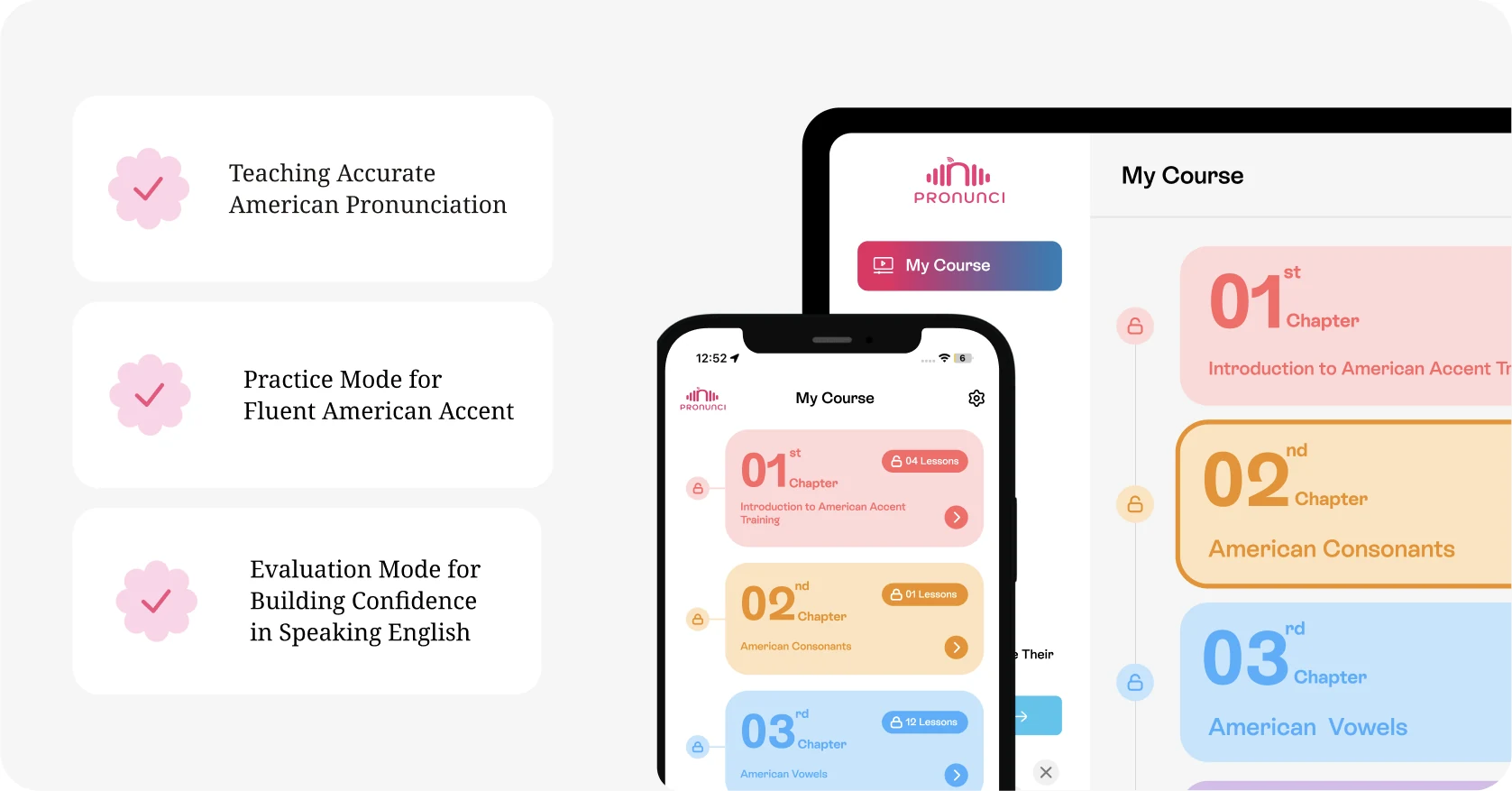
- Speech Organs EducationStudents learn how the speech organs work, along with the AI Accent Coach commands and feedback.
- American ConsonantsPractice and evaluate American consonants in phonetic exercises and practice sentences with the AI Accent Coach.
- American VowelsPractice and evaluate American vowels in phonetic exercises and practice sentences with the AI Accent Coach.
- IntonationLearn how intonation can change the meaning of what you say.
- CertificateBy the end of the course, students receive a certificate.
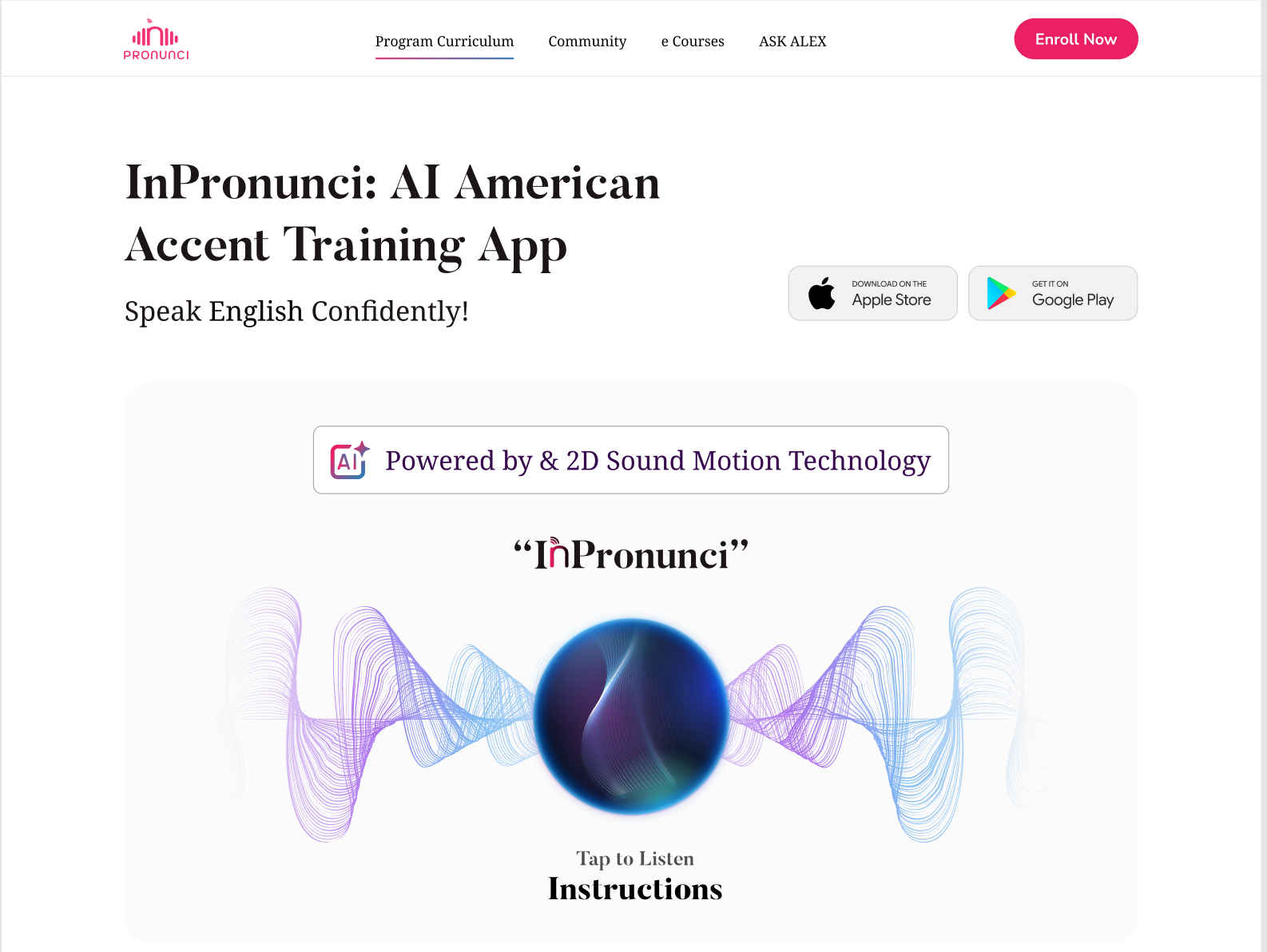
For busy professionals, the path is straightforward. Start with free Chapter 1: “Get to Know Your Speech Organs” — it builds the physical foundation that makes every drill more effective. Move to the Basic Plan for self-paced daily practice guided by the AI Accent Coach and Human-Guided Instructions. If you want faster calibration and personalized feedback, the Premium Plan includes monthly 1-on-1 sessions with Prof. Alex, Ph.D. Accent Coach.
Inpronunci is available on iOS and Android, serving learners from 50+ countries. See real results from students like Andrew, Thiago, and Tian. To explore the full American accent training curriculum, or to book a free Premium session with Prof. Alex, Ph.D. Accent Coach, visit calendar.app.google/VATsvVHVb7HdU9Pb9.
Useful sources
- IntechOpen online-first listing
- Communication Skills in Sales: A Data-Backed Guide (2026)
- Sales communication (Pipedrive blog)
- Sound confident on sales calls (GradeMyClose)
- The Sales Voice Technique That Instantly Builds Trust and Closes More Deals – The Revenue Coaches
- Paralinguistics: How Your Voice Tone Wins or Loses Deals – Academy of Negotiation
- 6 tips for improving your English pronunciation | British Council
- How to pronounce DEAL – American English Pronunciation
- Oxford University Press: Pronunciation resources (ELT catalogue)
Questions & Answers
FAQ
01What is the best way to improve pronunciation for sales calls?
Focus on pace, downward inflection, and intentional pauses first — these three voice controls produce the fastest, most measurable gains in perceived authority. Add daily recording and blind listener checks to track your progress honestly.
02How do you pronounce the word “deal” in American English?
The word deal is pronounced /dēl/ — a long, clear “ee” vowel followed by a fully released /l/. Clipping the vowel or dropping the final consonant creates ambiguity on calls; give it full length and clarity.
03How do you pronounce “closing” in a sales context?
Closing is pronounced /ˈkloʊzɪŋ/ — stress on the first syllable, a clear /oʊ/ diphthong, and a fully articulated /z/ before the ending. Practice it in context: “Let’s move to closing” with stress on “closing” and a downward pitch at the end.
04How do you pronounce “best alternative to a negotiated agreement”?
The key stress falls on al-TER-na-tive, ne-GO-ti-a-ted, and a-GREE-ment. In American English, “negotiated” is /nɪˈɡoʊʃieɪtɪd/ and “agreement” is /əˈɡriːmənt/. Practice the full phrase at a controlled pace with downward inflection on “agreement.”
05How long does it take to see real improvement in sales pronunciation?
Most professionals notice meaningful gains in pace and pause control within 1–3 weeks of daily practice. Vowel clarity and intonation patterns typically improve over 4–12 weeks with structured, feedback-driven training like Inpronunci’s step-by-step course.
Recommended

Client-Facing English Pronunciation Checklist | Inpronunci
Enhance your communication with our client-facing English pronunciation checklist. Improve clarity and confidence for professional success.

Pronunciation Practice for Patient Consultations | Inpronunci
Enhance your skills with effective pronunciation practice for patient consultations. Improve clarity, build rapport, and ensure trust during every...

Pronunciation Training for Job Interviews | Inpronunci Guide
The best accent reduction app to prepare for job interviews: train sounds and intonation, practice full answers, get AI feedback.
Plans
What InPronunci costs
InPronunci Basic
$35 per month
Chapter 1 is free after signup.
InPronunci Premium
$200 per month
Includes a coach: