




A Professional American Accent-Training Classroom in Your Pocket
Pronunci Instructions are a human-recorded instructional guidance system created by Prof. Alex, Ph.D. Accent Coach, Doctor of Education, and Professional Linguist. They bring an essential function of professional classroom teaching into the InPronunci self-study course: organizing active participation, anticipating pronunciation difficulties, guiding purposeful practice, and helping students transfer sound development into connected, independent communication.
InPronunci is not simply a pronunciation-scoring application or a series of recorded explanations. Its structured Interactive American Accent Training course combines professional Pronunci Instructions, 2D Sound Motion Technology and Interactive Visual 2D Sound Simulators, targeted phonetic exercises, sentence and paragraph practice, pronunciation comparison, and AI Accent Coach feedback. Students do not merely receive information: they use it to perform specific pronunciation-training activities.
What Pronunci Instructions Do Throughout the Course
The following sequence shows the instructional function of Pronunci Instructions and what students actively develop. It explains their educational role, not a separate scoring function.
| Training stage | What Pronunci Instructions do | What students actively develop |
|---|---|---|
| 1. Articulation preparation | Prepare students to use Interactive Visual 2D Sound Simulators as training environments, not visual demonstrations. Organize their attention around the sound-production task and what to practice. Each simulator’s own integrated professional voice-over provides the separate, sound-specific articulation guidance. | Awareness of speech-organ coordination, active simulation, pronunciation practice, and understanding of why particular movements matter. |
| 2. Phonetic exercises: beginning of words | Direct practice of consonants and vowels in word-initial positions. Explain the target movement or pronunciation difficulty, including frequently encountered native-language-influenced patterns when relevant; tell learners what to attend to and how to practice repeatedly. | More controlled word-initial articulation and purposeful correction of recurring sound-production difficulties. |
| 3. Phonetic exercises: middle of words | Guide the production of target sounds within words, drawing attention to articulatory transitions and pronunciation patterns that commonly cause errors. | More consistent production of trained sounds while transitioning between surrounding sounds. |
| 4. Phonetic exercises: end of words | Guide word-final sound training and alert learners to relevant problems such as omitted final consonants, added vowel sounds, or inappropriate sound release, as appropriate to the target sound. | More controlled word-final pronunciation and the ability to recognize and correct specific sound-ending habits. |
| 5. Structured sentence practice | Organize the transition from isolated sound practice into carefully designed sentences. Guide students on how to combine trained consonants and vowels with American English intonation, sentence stress, rhythm, timing, and emphasis. | Integration of trained sounds into meaningful utterances with developing American prosody. |
| 6. Connected speech development | Direct learners to notice and practice sound-to-sound and word-to-word transitions, appropriate linking, reductions where relevant, stress patterns, and speech rhythm rather than producing every word in isolation. | Greater coordination of pronunciation, listening awareness, and connected-speech patterns. |
| 7. Paragraph and public-speaking practice | Organize longer speech activities using previously trained sounds. Guide phrasing, pauses, emphasis, intonation, rhythm, and techniques useful for presentations, meetings, business discussions, and everyday communication. | Pronunciation consistency across sustained speech and preparation for more spontaneous communication. |
| 8. AI feedback and guided self-correction | Explain what students should focus on when reviewing pronunciation feedback from InPronunci AI Accent Coach. Guide purposeful retraining based on red, yellow, and green feedback levels without producing the AI evaluation themselves. | Self-monitoring, attention to the appropriate pronunciation features, comparison with a General American model, and correction through further practice. |
| 9. Independent communication | Guide learners in transferring their developing sound system, intonation, rhythm, stress, emphasis, and connected speech from prepared course activities into meetings, presentations, professional exchanges, everyday conversations, and spontaneous topics. | Increasingly independent, confident application of American English pronunciation skills without depending on scripts or continuous prompting. |
How Guided Phonetic Exercises Build the Sound System
Pronunci Instructions make each exercise purposeful. A student developing the American /t/ sound might begin with word-initial examples such as tin and tub, practice word-medial examples such as motel, hotel, and internet, then practice word-final examples such as pit, knit, and bit. This word-position sequence supports attention to the target sound in different phonetic environments.
The student then practices a structured sentence—for example, “Two tiny tigers take two taxis to town”—while learning to coordinate the target consonant with sentence stress, intonation, and rhythm. Later activities develop the ability to carry trained sounds into paragraphs and more natural communication. These are illustrative examples of the training sequence, not a claim that all course sentences or paragraphs use identical patterns.
Two Different Kinds of Professional Guidance
Integrated simulator voice-over guidance: Inside an Interactive Visual 2D Sound Simulator, professional voice-over instructions guide the articulation of a specific consonant, vowel, or sound combination. Students actively work with the 2D representation of speech-organ movement and practice the corresponding movements using their own speech organs. The simulator guides articulation; it does not physically measure the student’s tongue or jaw.
Pronunci Instructions: This separate human-recorded guidance prepares students to actively use Interactive Visual 2D Sound Simulators for American English consonants and vowels, then organizes phonetic exercises, practice sentences, connected speech, and paragraph activities. It explains the purpose of each stage, how to participate, which pronunciation difficulties deserve attention, and how to carry developed sounds forward through the curriculum toward independent professional communication. Students listen to the relevant guidance and can replay it while organizing subsequent practice.
AI Accent Coach Feedback and Pronunci Instructions: Complementary Functions
InPronunci AI Accent Coach evaluates recorded pronunciation during phonetic exercises, practice sentences, and paragraph practice. Its Feedback & Analysis can break paragraphs into sentences, sentences into words, and words into individual sounds so students can pinpoint what needs attention. Prof. Alex’s professionally recorded Pronunci Instructions provide the instructional explanations students can use to interpret the feedback and choose targeted articulation or connected-speech practice before evaluating again. This distinction matters: the professional instructions do not themselves generate the AI evaluation. They support the student’s subsequent training decisions.
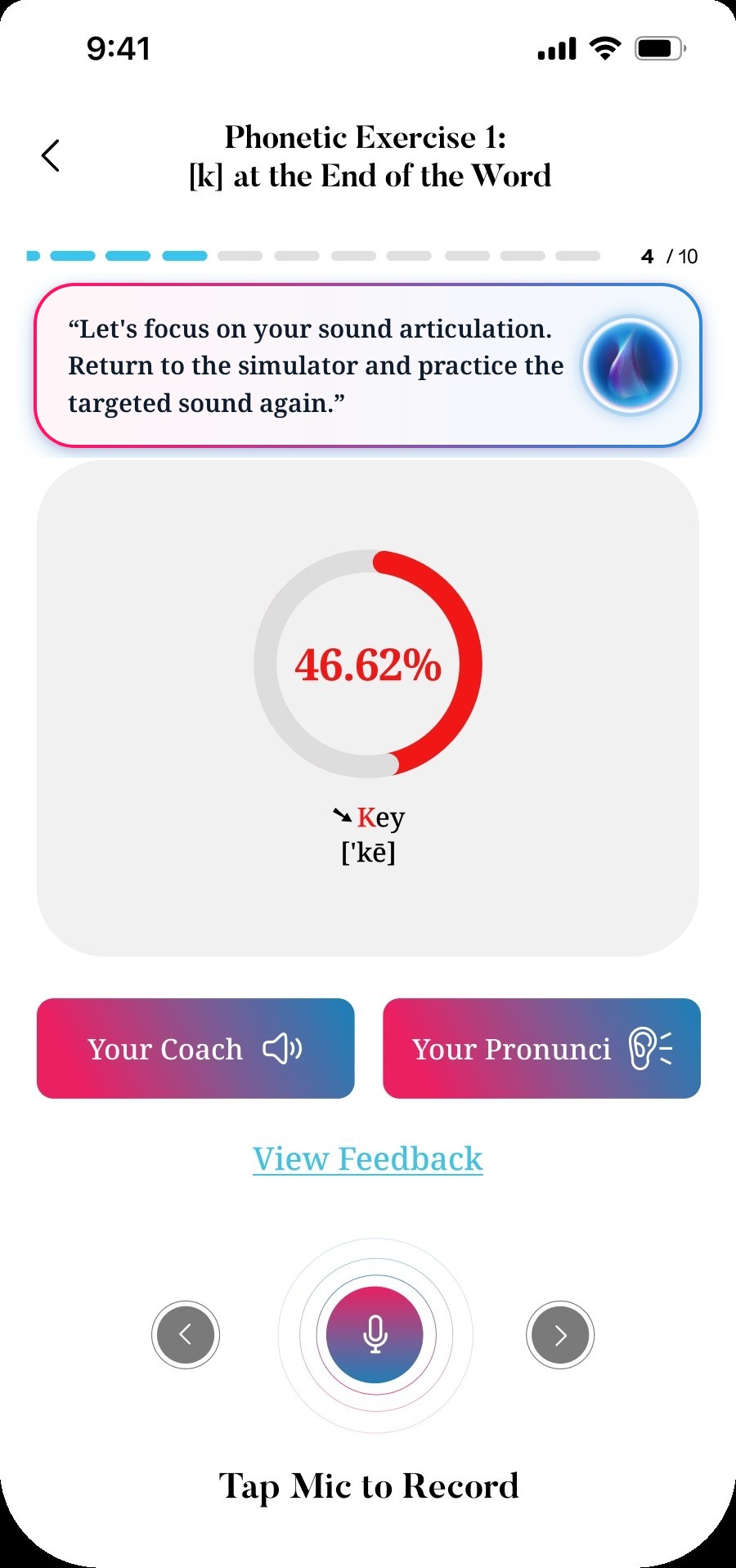
Red example: 46.62% for “key”
Red feedback · Pronunci Instructions
Let’s work on the sounds first. Red indicates that you need to focus on the pronunciation of individual sounds.

Return to the consonants and vowels that need attention. Practice their articulation, train them in the relevant word positions, and compare your pronunciation with the model before trying again.
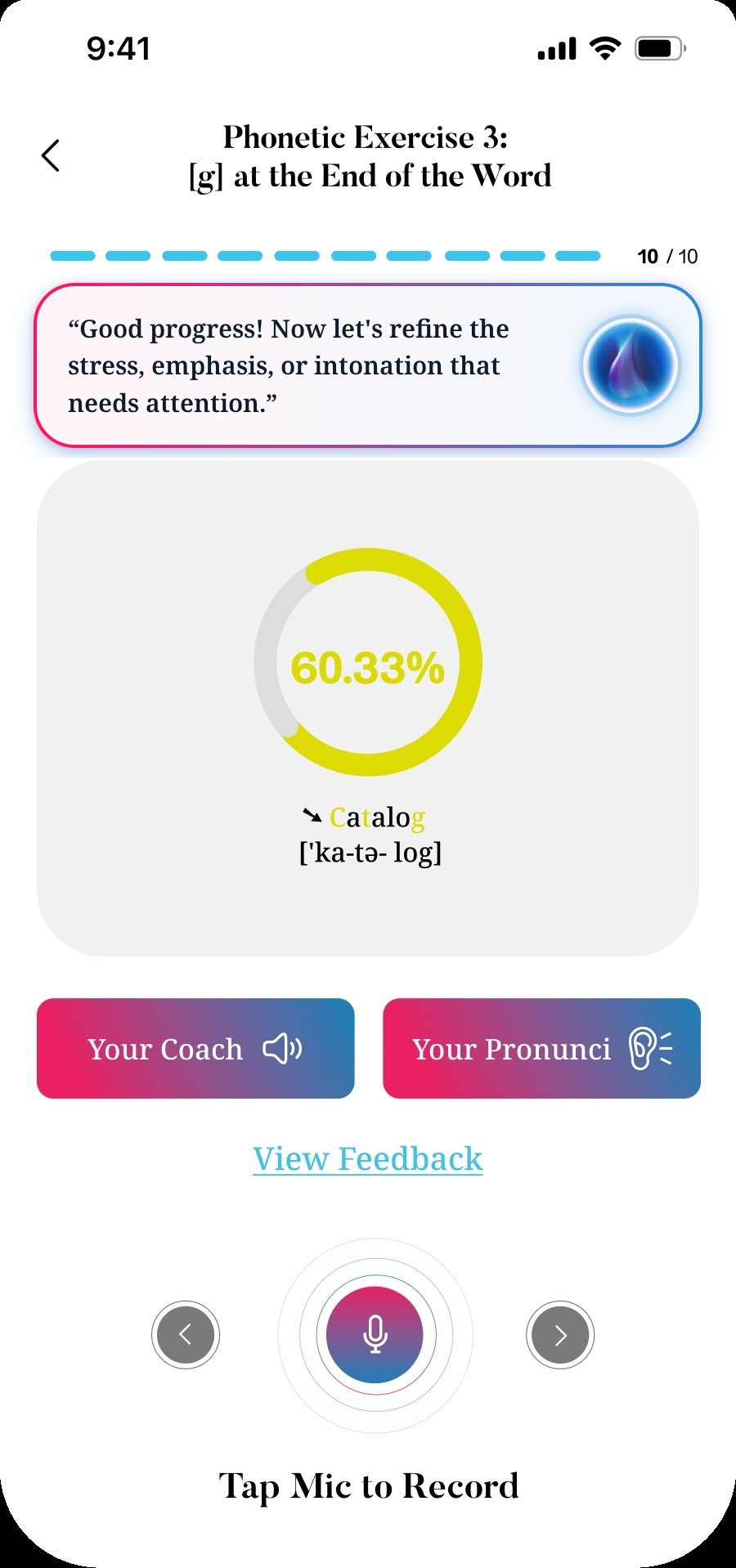
Yellow example: 60.33% for “catalog”
Yellow feedback · Pronunci Instructions
Now focus on how your speech flows. Yellow feedback: please focus on intonation, emphasis, rhythm, and connected speech.
Continue refining sounds where needed, then pay attention to stress, word duration, transitions between words, and the melody of General American pronunciation.
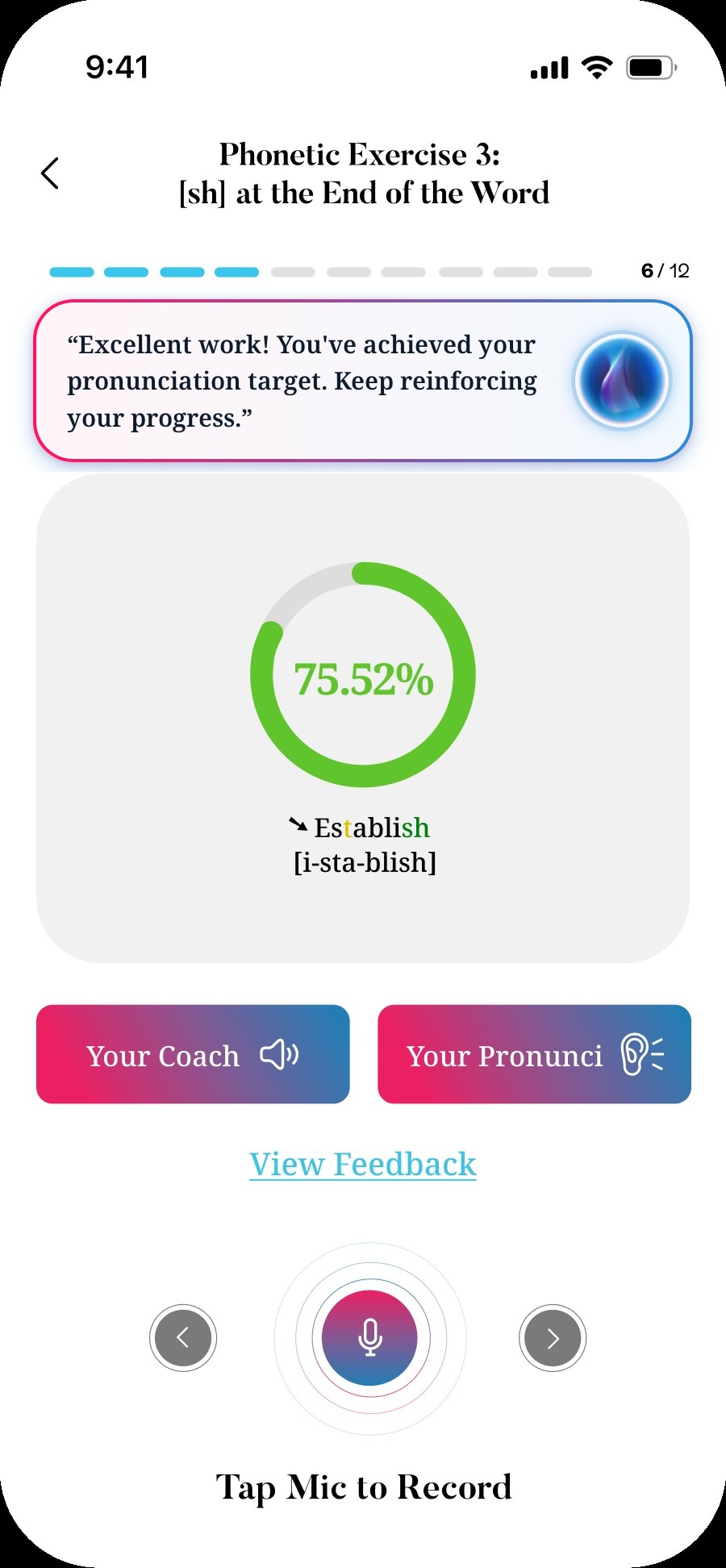
Green example: 75.52% for “establish”
Green feedback · Pronunci Instructions
You hit the mark. Great job! Well done on sound pronunciation and speech patterns.
Your feedback indicates strong performance. Keep applying these skills in sentences, paragraphs, presentations, and spontaneous communication so they become habitual.
The red, yellow, and green categories here describe training priorities, not newly invented score thresholds. In isolated word exercises and longer sentence or paragraph evaluations, students should follow the specific pronunciation features actually assessed at that level. As training progresses, cumulative evaluation revisits previously learned sounds alongside newly trained sounds. Students can use detailed feedback together with Pronunci Instructions to decide what to retrain, compare a new attempt with the model, and evaluate again. Numerical boundaries and the precise evaluation logic must follow the settings implemented in InPronunci.
Why Pronunci Instructions Reflect a Professional Classroom Method
Prof. Alex developed Pronunci Instructions to bring the instructional organization of his live, one-on-one Interactive American Accent Training sessions into independent app-based learning. The approach draws on more than 20 years of teaching and the interactive learning conditions examined in his doctoral research, including the earlier Moodle-based Practical English Phonetics course. A central teaching condition identified in the research was a shift in the teacher’s role from director to organizer and participant, with students taking an active role in developing their knowledge and skills.
The earlier doctoral research included the Moodle-based Practical English Phonetics course, which integrated organized phonetics tasks, interactive participation, practice, feedback, monitoring, self-monitoring, and independent learning. That earlier course provides a pedagogical and historical foundation for the later InPronunci web course and branded application. InPronunci implements Prof. Alex’s research-informed Interactive American Accent Training methodology through professional instructional guidance, Interactive Visual 2D Sound Simulators, systematic pronunciation practice, and AI-supported feedback. The research evaluated interactive teaching conditions, not the present-day InPronunci app, and did not establish an app-specific effectiveness rate or directly compare the current simulators with competing apps. Read more about how Prof. Alex’s doctoral research shaped InPronunci and the complete Interactive American Accent Training methodology.
From Structured Training to Independent Speaking
The outcome is not the memorization of a few topics or the receipt of an AI score. The course is designed to help learners progressively develop a usable American English sound system and apply it to presentations, interviews, meetings, workplace conversations, daily interactions, and spontaneous speech. Pronunci Instructions function as a professional organizer of that learning journey while students remain the active participants. Explore InPronunci’s interactive American accent training program.
InPronunci brings the educational organization of a professional American accent-training classroom into independent practice: guided preparation, active articulation, systematic exercises, connected speech, AI-supported feedback, self-correction, and progressive independence.