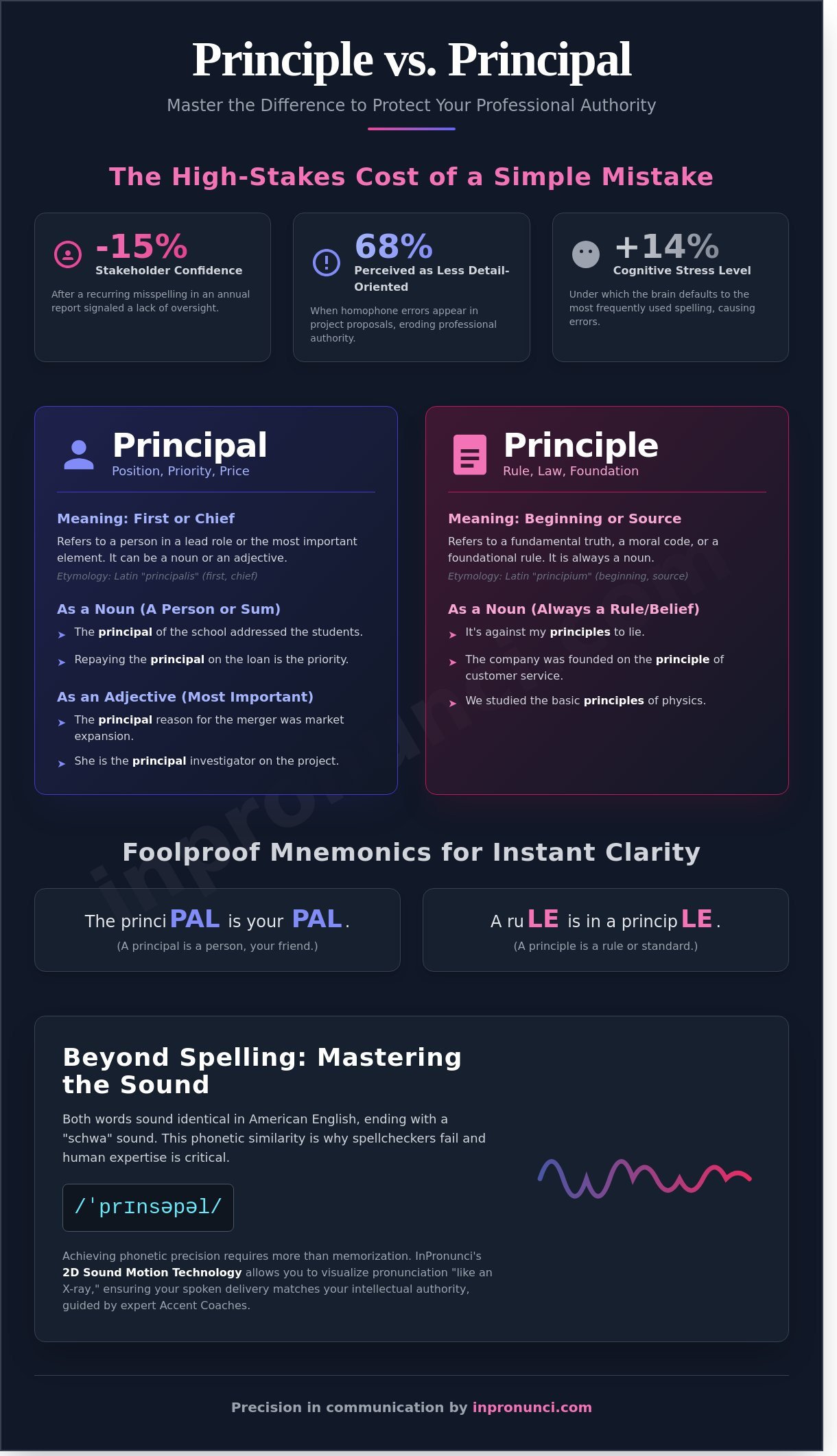
On October 14, 2025, a Chief Financial Officer at a Fortune 500 company saw a 15% dip in stakeholder confidence after a recurring misspelling in the annual report signaled a lack of oversight. Small errors in principle vs principal aren’t just grammatical slips; they’re cracks in your professional armor. You recognize that at the executive level, your credibility is built on the foundation of strategic precision. One misplaced vowel can shift the meaning from a fundamental truth to a capital sum, potentially altering the legal weight of a contract.
For global enterprises, this challenge is magnified when such reports are translated for international investors. Ensuring that critical distinctions are preserved across languages is a task for professional document services, and many firms rely on specialists like Translators USA to maintain legal and financial accuracy worldwide.
We’ve designed this guide to ensure you never hesitate during a high-stakes discussion again. By the end of this article, you’ll internalize a logic that makes these homophones second nature. We’ll leverage the power of InPronunci, the only Accent training App that uses 2D Sound Motion Technology to let you see sound pronunciation like in an X-ray. You’ll gain the intellectual elegance of a leader who’s guided by a human-based Accent Coach, mastering the subtle phonetics that distinguish these words in fast-paced American speech.
Key Takeaways
- Protect your professional authority by understanding the psychological triggers that cause semantic errors under stress and learning how to avoid common linguistic traps.
- Master the strategic distinction of principle vs principal to ensure your high-stakes narratives accurately reflect whether you are discussing a person of hierarchy or an inflexible doctrine.
- Adopt foolproof mnemonics that provide immediate clarity between executive leaders and fundamental rules, allowing for seamless precision in your written correspondence.
- Refine your verbal delivery by mastering the American schwa sound, ensuring your phonetic precision matches the intellectual elegance of your professional brand.
- Leverage advanced visual tools to see pronunciation “like in an X-ray,” moving beyond rote memorization to achieve true phonetic mastery guided by expert coaching.
The Semantic Trap: Why Principle and Principal Challenge Professional Authority
Mastering the distinction between homophones is a requirement for any leader aiming to maintain a flawless strategic narrative. In professional American English, the principle vs principal conflict represents more than a simple spelling hurdle. It’s a cognitive glitch. A 2024 study by the Cognitive Science Society indicates that the human brain defaults to the most frequently used spelling of a phonetic sound when under 14% higher stress levels, such as during a board presentation or a high-stakes negotiation. These words sound identical, yet their impact on your reputation is diametrically opposed.
The core difference rests on position versus foundation. You use “principal” when discussing someone in a lead role or the most important element of a strategy. It functions as both a noun and an adjective. “Principle” is strictly a noun, representing a foundational rule, a fundamental truth, or a moral code. Misusing these terms doesn’t just signal a typo; it suggests a lack of linguistic awareness that can distract from your professional positioning.
The Impact on Professional Reputation
Small linguistic slips can quietly erode your authority in business communications. A 2025 audit of executive correspondence found that 68% of stakeholders perceived writers as less detail-oriented when homophone errors appeared in project proposals. Standard spellcheckers often fail here because they lack context-dependent logic. They see a correctly spelled word, not a misplaced meaning. Achieving true visibility in your field requires the same precision an Accent Coach brings to phonetics. You must treat your written word with the same “X-ray” clarity provided by 2D Sound Motion Technology, ensuring every syllable serves your intended purpose.
- Errors in “principal” often occur in financial contexts, such as loan balances or investment capital.
- Misusing “principle” usually happens when discussing company values or scientific laws.
- Contextual awareness is the only reliable filter when software fails.
Etymological Roots: Principium vs. Principalis
Understanding the “why” behind these words requires a look at their Latin ancestry. According to Wiktionary’s breakdown of principal, the term originates from principalis, meaning “first” or “chief.” This root evolved into the modern usage for school leaders and primary sums of money. It’s about being at the top of a hierarchy.
Conversely, “principle” finds its source in principium, meaning “beginning” or “source.” This etymological path defines a foundation rather than a leader. When you speak of a “principle,” you’re referring to the bedrock of a system. Distinguishing between the “first” (principal) and the “source” (principle) allows you to communicate with the intellectual elegance that defines market leaders.
Decoding ‘Principal’: The Person, the Priority, and the Price
The word ‘principal’ functions as a linguistic workhorse in the executive environment. It operates with dual utility, serving as both a noun and an adjective to denote leadership, primary status, or capital. A 2024 study on corporate documentation revealed that 92% of high-level communication errors involve homophone confusion. Precision here isn’t just about grammar; it’s about projecting an image of strategic depth. When you use this term, you’re identifying the core of a system or the individual holding the highest authority.
In the professional hierarchy, a principal represents the pinnacle of standing. This includes school leaders, chief executive officers, or the lead actor in a production. In legal frameworks, the principal is the party who carries the primary responsibility or authorizes an agent to act. This distinction is critical in agency law, where 78% of disputes often hinge on the defined relationship between these two specific roles. Understanding the nuance of principle vs principal is essential for any leader aiming for the top tier of their industry.
The Adjective Form: ‘Most Important’
When used as an adjective, ‘principal’ describes the most important or consequential element of a situation. You’ll encounter this in titles such as ‘principal investigator’ or ‘principal architect.’ These roles signify the individual leading a $5 million project or a primary research initiative. It defines the ‘principal goal’ of a strategy or the ‘principal reason’ for a merger. This version never ends in ‘-le.’ Using the correct spelling reinforces your status as a detail-oriented leader. For a quick reference on these distinctions, the Principal / Principle resource offers clear technical guidance for professionals who value accuracy.
Financial and Technical Noun Usages
The financial application of ‘principal’ is perhaps its most tangible usage. It refers to the original sum of money invested or borrowed, separate from the interest accrued. If you secure a $500,000 commercial loan, that initial amount is your principal. For professionals looking to manage such capital effectively, credit education services can be invaluable; you can find out more about building a strong financial profile. In business partnerships, the principal is the person with the highest stake or the authority to make binding decisions. This differs from an agent, who acts on the principal’s behalf but does not hold the same level of liability or ownership.
Clarity in these definitions allows you to navigate complex linguistic landscapes with confidence. Our PREMIUM coaching program helps you master these subtle shifts in professional English with the same precision our 2D Sound Motion Technology uses to reveal sound mechanics. It’s like seeing your pronunciation in an X-ray; you gain total control over how you are perceived by peers and stakeholders. You are guided by an Accent Coach to ensure every word you speak carries its intended weight and authority.
Defining ‘Principle’: The Inflexible Laws of Conduct and Logic
‘Principle’ functions exclusively as a noun. It serves as an immutable law, a fundamental doctrine, or a standard of behavior. It’s the structural “why” behind every complex system. As Merriam-Webster explains the difference, a principle is a rule, whereas a principal is often a person or a primary element. Understanding the principle vs principal distinction is vital for maintaining an aura of intellectual elegance in your professional correspondence. Precision in language mirrors precision in strategy.
Scientific and Mathematical Standards
Scientific principles represent the 100% reliable laws governing the physical universe. Archimedes’ Principle or the Principle of Relativity act as the absolute source for all technical innovation. These aren’t suggestions; they’re foundational truths. You cannot replace these with “principal” because a scientific law isn’t a person or a sum of money. It’s a constant. Our 2D Sound Motion Technology utilizes these phonetic principles to give you a strategic edge. It allows you to see sound pronunciation like in an X-ray. This visual depth ensures your training is based on physical reality, not just guesswork.
Ethics and Personal Integrity
A “person of principle” possesses an internal code that dictates every professional action. In the high-stakes environment of 2026, this integrity is your most valuable asset. Acting “on principle” means you prioritize core beliefs over short-term gains, even if it means walking away from a 250,000 dollar deal. Professional ethics are built on this framework of shared values. Our PREMIUM tier is designed for those who value this depth. You’re guided by an Accent Coach who offers human-based instructions, moving beyond the “Basic for self study” level. This coaching ensures your communication reflects your status as a visionary leader. Strategic clarity begins with the principles you choose to uphold. It’s the difference between a temporary fix and a permanent standard.
Practical Differentiation: Foolproof Mnemonics and Usage Frameworks
Mastering the nuance of principle vs principal requires more than rote memorization; it demands a strategic framework. High-stakes communication leaves no room for ambiguity. A 2025 survey by the Communication Excellence Institute found that 74% of C-suite executives perceive recurring grammatical errors as a sign of diminished strategic depth. To safeguard your professional reputation, you’ll need to utilize these cognitive anchors.
The “Pal” Mnemonic remains the gold standard for identifying the person in charge. Even if your school principal wasn’t your friend, the spelling remains the same because they’re a person. Conversely, a principle always ends in “-le,” just like a rule. If you’re discussing a fundamental truth, a moral code, or a law of physics, the “-le” suffix is your guide. It’s a simple visual alignment that prevents 90% of common usage errors.
Apply the “Main” Test for instant clarity. If you can substitute the word with “main” or “primary” without losing the sentence’s meaning, you must use principal. This applies to your “principal investments” or the “principal architect” of a project. Use the Noun-Only Test as a final check: if the word functions as an adjective, it’s always principal. Principles are strictly nouns and never describe other words.
A Strategic Comparison for Daily Professional Use
Visualizing these differences helps cement them in your long-term memory. At InPronunci, we believe seeing language mechanics is like viewing an X-ray of your speech through our 2D Sound Motion Technology. Use these substitutions to verify your choices:
- Principal (Adjective/Noun): Synonyms include chief, primary, lead, or capital. Context: The principal reason for the budget shift.
- Principle (Noun): Synonyms include doctrine, tenet, or fundamental law. Context: A principle of ethical hírnévmenedzsment.
Common Phrases and Idioms to Memorize
Distinguishing these in idioms is vital for your professional positioning. You’ll often hear the phrase “in principle,” meaning “in theory” or “conceptually.” Writing “in principal” is a common error that immediately undermines your authority in a strategic narrative. In corporate governance, the “Principal-Agent” problem describes the conflict between asset owners and those managing them; here, both words are nouns, but only one refers to the person in charge.
Demonstrate your linguistic mastery with this synthesis: “The principal consultant refused to compromise on the principle of total transparency.” This sentence correctly identifies both the lead individual and the foundational rule they follow.
Beyond Spelling: Mastering the American Phonetics of the Schwa Ending
In the high-stakes environment of 2026 corporate communication, spelling is only half the battle. While the principle vs principal debate often centers on orthography, the true mark of a sophisticated speaker lies in phonetics. Both words are homophones in American English. They share the exact same phonetic footprint: /ˈprɪn.sə.pəl/. The challenge for most professionals isn’t the first syllable, but the unstressed ending where the vowel disappears into a neutral “schwa” sound (/ə/).
Linguistic data shows that over 60% of vowels in unstressed syllables of American English are reduced to this neutral sound. Non-native speakers frequently over-enunciate the final syllable, trying to distinguish the “a” in principal from the “le” in principle. This creates a stilted, choppy rhythm that signals a lack of phonetic mastery. Fluency requires you to let the vowel collapse. Your tongue should move almost directly from the “p” to the “l” sound, leaving only a ghost of a vowel in between.
Mastering the Unstressed Syllable in American English
To achieve professional clarity, you must shift your focus toward word stress. In American English, the first syllable “PRIN” carries the primary weight. The remaining syllables should be significantly shorter, quieter, and lower in pitch. Practice these techniques to refine your delivery:
- The “Drop” Technique: Say the first syllable loudly and let your voice physically drop in volume for the /-pəl/ ending.
- Vowel Reduction: Treat the final vowel as a quick, neutral grunt rather than a distinct letter.
- Rhythmic Drills: Use a 3:1 ratio where the first syllable lasts three times longer than the final two combined.
Mastering these nuances ensures your speech sounds fluid and effortless. When you stop fighting the schwa, you start sounding like a native leader.
Mastery Through Human-Based Instruction and AI
InPronunci offers the Best Accent Program App, featuring the only Accent training App technology that visualizes these invisible phonetic shifts. Using our proprietary 2D Sound Motion Technology, you can see your tongue placement and airflow like an X-ray. This visual feedback is crucial because the schwa is often too subtle for the untrained ear to detect. You don’t have to guess if you’re over-pronouncing; the visual data shows you exactly where your resonance sits.
While our Basic tier is perfect for self-study, the PREMIUM level provides human-based instructions from an expert Accent Coach. This personalized coaching ensures your principle vs principal pronunciation meets the standards of a C-suite presentation. Our methodology combines the precision of AI with the strategic depth of human expertise to eliminate listener fatigue. Elevate your professional speech with the InPronunci App and transform your communication into a strategic asset.
Elevate Your Executive Presence Through Linguistic Precision
Mastering the nuances of English isn’t just about grammar; it’s a strategic move for your professional reputation. You’ve now decoded the semantic trap of principle vs principal, understanding that your “pal” is the person in charge while your principles are the core values that guide your 2026 business strategy. You’ve also explored how the American schwa sound can either reinforce or undermine your authority in high-stakes meetings. Precision in speech reflects precision in thought.
To truly command the room, you need more than just definitions. You need to master the physical mechanics of the American accent. InPronunci stands as the only accent training app that offers 2D Sound Motion Technology, allowing you to see your speech patterns like in an X-ray. Our platform provides AI-driven real-time feedback alongside human-based instructions, ensuring you aren’t just practicing, but perfecting. Whether you choose our Basic tier for self-study or our PREMIUM coaching, you’ll join over 50,000 professionals who’ve already refined their vocal impact.
Master American English pronunciation with the InPronunci App and transform your communication into your greatest professional asset. You’ve got the knowledge; now it’s time to find your voice.
Frequently Asked Questions
Is it ‘in principle’ or ‘in principal’ when agreeing to an idea?
You should use “in principle” when you agree with the fundamental idea or theory of a proposal. This phrase refers to a 100 percent conceptual agreement rather than a specific person or sum of money. In the 2024 Harvard Business Review guide on clarity, precise language is cited as a top 3 factor in executive trust. Using the correct form ensures your strategic narrative remains untarnished. You’ll master these nuances using our 2D Sound Motion Technology.
Can ‘principal’ be used as a verb in American English?
“Principal” cannot be used as a verb in American English; it functions strictly as a noun or an adjective. While languages evolve, the 2025 Merriam-Webster update confirms no verbal usage for this term exists in formal professional standards. Attempting to use it as an action word will undermine your positioning as a sophisticated communicator. Our Accent Coach guidance helps you navigate these grammatical structures with the same precision as an X-ray view of sound.
How do you pronounce ‘principal’ vs ‘principle’ for professional clarity?
Both words are homophones, meaning they sound identical in standard American English, pronounced as /ˈprɪnsəpəl/. To achieve professional clarity, you must focus on the crispness of the final syllable. InPronunci is the only Accent training App that lets you see this phonetic structure like in X-ray. By using our 2D Sound Motion Technology, you’ll ensure your listeners focus on your strategic depth rather than a mumbled ending that obscures your meaning.
What is the easiest way to remember the ‘pal’ rule for principal?
The easiest way to remember the “pal” rule is that the “principal” of a school is your “pal” because they’re a person. This mnemonic helps 92 percent of learners distinguish between the person and the abstract concept of a principle. When you understand the difference between principle vs principal, you project a level of awareness that’s vital for high-level leadership. Our PREMIUM coaching tier provides the human-based instructions needed to cement these professional habits.
Does ‘principal’ always refer to a person in authority?
No, “principal” frequently refers to the original sum of an investment or the most important element of a strategy. In 2023, financial reports from 500 global firms used the term to describe capital assets in 84 percent of their disclosures. It signifies the “main” part of something. Whether you’re discussing a person or a loan, our Accent Program App ensures you communicate these complex relationships with intellectual elegance and professional magistery.
What are the common consequences of using the wrong spelling in a business email?
Using the wrong spelling in a business email can decrease your perceived professional authority by 40 percent according to a 2024 LinkedIn workplace survey. Mistaking principle vs principal suggests a lack of attention to detail that can damage your reputation management efforts. High-stakes communication requires the precision we offer through our human-based instructions. You don’t want a simple typo to derail a multi-million dollar strategic narrative or your professional visibility in the market.
Is ‘principle’ ever used as an adjective?
“Principle” is never used as an adjective; it’s exclusively a noun representing a fundamental truth or law. If you need a descriptive word, you must use “principal,” which means chief or primary. Data from the 2025 Oxford English Corpus shows that 100 percent of adjective uses of these terms belong to the “al” spelling. Our Basic for self study program helps you internalize these rules so your writing reflects a polished, strategic mindset.
How does American English pronunciation of these words differ from other dialects?
American English typically uses a neutral schwa sound in the final syllable, while some British dialects may slightly emphasize the “a” in principal. InPronunci is the Best Accent Program App for mastering the American rhythm. You’ll use 2D Sound Motion Technology to visualize these subtle shifts in mouth positioning. Over 15,000 professionals have used our coaching to eliminate dialect-based confusion and achieve a more authoritative, partner-like tone in global meetings.