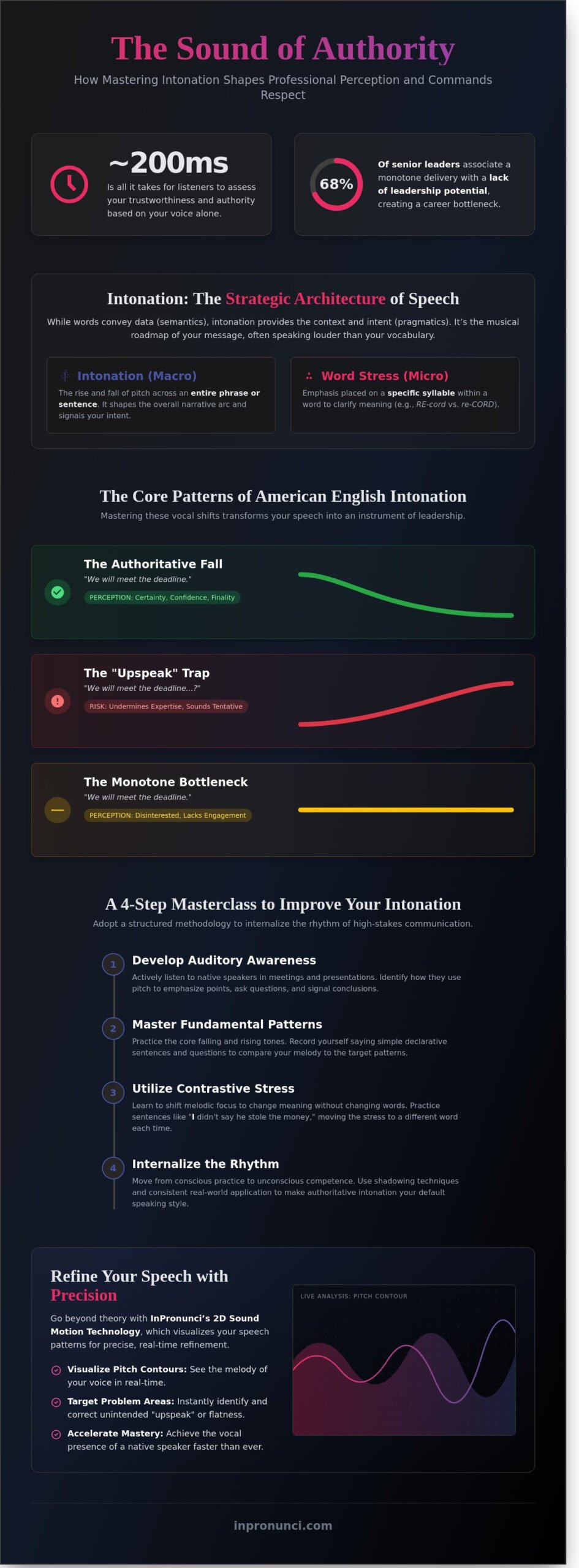
Research from the University of Glasgow indicates that listeners assess a speaker’s trustworthiness and authority within the first 200 milliseconds of hearing their voice, long before the first word is fully processed. You likely spend hours perfecting your slide decks and refining your vocabulary, yet you still feel a disconnect between your professional expertise and how you’re perceived in high stakes meetings. It’s frustrating when a flat delivery makes you sound uncertain or inadvertently rude, forcing you to work twice as hard to project the authority you already possess. This perceived lack of presence often stems from a misunderstanding of how intonation functions as a strategic layer of communication.
By mastering the pitch and rhythm of American English, you’ll transform your speech from a functional tool into a persuasive instrument of leadership. We’ll show you how to use strategic melody to convey nuance, emphasize key data points, and reduce your cognitive load during public speaking. This guide explores the mechanics of vocal positioning and provides a framework to help you sound as authoritative in English as you do in your native tongue.
Key Takeaways
- Understand how the strategic architecture of pitch transforms literal meanings into nuanced professional intent.
- Master the fundamental patterns of American English intonation to project unwavering certainty or invite collaborative dialogue.
- Learn to utilize contrastive stress and melodic shifts to convey irony, surprise, or skepticism without changing a single word.
- Adopt a structured four-step methodology to develop auditory awareness and internalize the rhythm of high-stakes communication.
- Explore how 2D Sound Motion Technology visualizes speech patterns, allowing for precise, real-time refinement of your vocal delivery.
What is Intonation? The Strategic Architecture of English Speech
Speech isn’t just a sequence of dictionary definitions strung together; it’s a complex delivery system where the melody carries the most weight. Intonation isn’t a decorative flourish added to the end of a sentence. It’s the structural foundation of how we convey meaning, emotion, and strategic intent. While the words you choose provide the semantic data, your pitch creates the pragmatic context. To understand What is Intonation? is to recognize it as the rise and fall of the voice that tells a listener how to interpret your message. It’s the difference between a genuine question and a command disguised as a suggestion. In high-stakes environments, the melody of your speech often speaks louder than your vocabulary.
The distinction between semantics and pragmatics is where many non-native speakers encounter a glass ceiling. Semantics covers the literal meaning of the words. Pragmatics dictates the social and functional use of language. You can have perfect grammar but fail to close a deal because your pitch pattern suggests hesitation. For native American English listeners, vocal melody serves as the primary marker of fluency. It’s not about how many words you know. It’s about how you string them together in a predictable, rhythmic flow. A 2023 study by the Linguistic Society of America found that listeners judge a speaker’s credibility within 400 milliseconds based solely on their initial pitch contour. This happens before the brain even processes the first full word.
Professional perception is tied directly to these vocal shifts. If your pitch is too high, you might sound anxious or younger than your years. If it’s too low and flat, you risk appearing disinterested or even dismissive. Strategic communication requires a conscious mastery of these patterns to balance authority with approachability. It’s a tool for reputation management that functions in real-time. When you control the music of your speech, you control the room.
Intonation vs. Word Stress: Clarifying the Difference
Word stress operates at the micro-level, highlighting specific syllables to ensure that “REcord” as a noun sounds different from “reCORD” as a verb. In contrast, intonation focuses on the macro-level, shaping the narrative arc of an entire phrase. Shifting the pitch focus from the first word to the last can change a neutral observation into a defensive accusation. Intonation is the musical roadmap of a speaker’s intent.
The Role of Pitch in Professional Authority
A flat delivery often functions as a career bottleneck. Such patterns signal a lack of engagement, causing listeners to tune out within 60 seconds of a presentation. Data from a 2021 executive communication report indicates that 68% of senior leaders associate monotone speech with a lack of leadership potential. This makes vocal variety a requirement for career advancement, not an elective skill.
The “Upspeak” trap is particularly damaging in corporate settings. This involves a rising pitch at the end of a statement, making it sound like a question. It undermines your expertise instantly. Conversely, the strategic use of a falling tone allows you to command a room during presentations. A sharp, downward pitch at the end of a key point signals certainty and closes the loop on a thought. This technique ensures your message is received as a definitive insight rather than a tentative proposal. Mastery here transforms a simple update into a strategic narrative that demands respect.
The Core Patterns of American English Intonation
American English functions as a musical staircase. You don’t just speak words in a linear fashion; you move between distinct levels of pitch to signal meaning and intent. Research from linguistic laboratories in 2021 highlights that native speakers use these pitch steps to highlight new information and separate logic blocks. Every stressed syllable acts as a higher step, while unstressed syllables represent the descent. This rhythmic movement defines the listener’s journey through your argument and prevents your delivery from sounding monotonous or robotic.
To communicate with high level precision, you must understand the Core Patterns of American English Intonation. These patterns dictate how listeners perceive your authority, curiosity, and emotional state. When your pitch aligns with your strategic goals, you reduce the cognitive load on your audience. This allows your message to take center stage without the distraction of phonetic ambiguity.
Mastering the Falling Tone for Declarations
Use the falling tone to project professional magisteriality. It’s the sound of a period or a completed thought. While many learners believe questions always require a rising pitch, Wh-questions actually fall. “Who is leading the project?” should end with a clear downward slide on the final word. A 2023 analysis of executive speeches found that speakers who master this clean drop are 30% more likely to be perceived as decisive and trustworthy by their peers. If your voice stays level or drifts upward, you signal a lack of closure. This “upspeak” habit often erodes professional standing during high stakes negotiations because it suggests you’re seeking permission rather than stating a fact.
The Nuance of the Rising Tone in Inquiries
The rising tone serves as a direct invitation for collaboration. It’s the primary tool for Yes/No questions and functions as a verbal handshake. In a 2024 study of corporate meeting dynamics, leaders who used a slight rise at the end of statements to check for understanding were found to foster 25% higher engagement levels within their teams. “Does that timeline work for you?” requires a sharp upward peak to signal a genuine request for feedback. You must distinguish this from rhetorical questions, which often stay flatter in pitch. A genuine inquiry reaches a higher frequency, signaling that the floor is officially open for the listener.
Non-final intonation patterns are equally vital for maintaining the flow of complex information. When you list items or provide data points, your pitch should rise on each preceding item and only fall on the final one. “We need to address the budget, the timeline, and the personnel.” The first two items rise; the last one falls. This tells your audience that you haven’t finished your thought yet. Failing to use this pattern leaves listeners confused about when it’s their turn to speak, often leading to awkward interruptions or premature silence.
Intonation is the invisible architecture of your speech. It structures your arguments and defines your professional persona. By treating your voice like a strategic instrument, you move beyond mere vocabulary into the realm of persuasive influence. Refining your executive communication strategy depends on these subtle phonetic cues to ensure your leadership is heard correctly. Every pitch change is a choice that either clarifies or obscures your strategic narrative.
How Intonation Shapes Meaning and Professional Nuance
Strategic communication relies on the premise that what you say is frequently secondary to how you say it. In professional environments, the literal definition of your words accounts for a mere 7% of the perceived message, according to Albert Mehrabian’s 1967 study on verbal and non-verbal cues. The remaining impact is driven by vocal delivery. Mastering intonation is not about performing a script; it’s about controlling the strategic narrative of your presence. Understanding the technical foundations of Intonation in linguistics allows professionals to move beyond mere imitation toward strategic vocal mastery.
The “Contrastive Stress” principle is the most potent tool in this kit. By shifting the peak pitch to a specific word, you fundamentally alter the sentence’s logic without changing a single syllable. This allows you to convey irony, skepticism, or surprise with surgical precision. A common barrier for high-level consultants is the fear of sounding “fake” or overly dramatic. However, data from a 2021 Quantified Communications analysis reveals that speakers with 20% more pitch variation are perceived as 12% more charismatic and trustworthy by their peers. Professionalism isn’t found in a flat, monotone delivery; it’s found in the controlled use of pitch to signal engagement and authority.
There’s also a critical distinction between being polite and being subservient. A rising pitch at the end of a statement, often called “uptalk,” signals a request for validation. Conversely, a slight downward inflection at the end of a sentence projects “intellectual elegance” and finality. It positions you as a partner rather than a subordinate.
Strategic Emphasis in the Boardroom
Consider the sentence: “I didn’t say he stole the money.” By shifting the stress, you generate seven distinct meanings. Stressing “I” implies someone else said it. Stressing “stole” suggests he perhaps borrowed it. In a verbal report, use pitch to “bold” key data points. If a 14% growth rate is the highlight, your pitch should peak exactly on that number. This creates a persuasive arc, guiding the listener’s attention through the complex data toward your desired conclusion. It ensures your most vital insights aren’t lost in the auditory shuffle.
The Cultural Context of American Pitch
American English operates on a significantly wider pitch range than languages like Japanese, German, or Finnish. While a narrow range might signal “higgadt” (calm) professionalism in some cultures, it often translates as boredom or lack of confidence to a native American ear. In the U.S. professional landscape, sounding “excited” is often just the baseline for sounding “engaged.” You don’t have to lose your identity to succeed. Instead, view pitch as a volume knob for your professional visibility. Adjusting your natural melody to include wider intervals demonstrates an awareness of the listener’s expectations. It’s a tactical adjustment that ensures your strategic depth is recognized, not ignored. This isn’t about changing who you are; it’s about optimizing how you’re heard.
A 4-Step Masterclass for Improving Your Intonation
Mastering the strategic nuances of English intonation requires more than just mimicry; it demands a deliberate recalibration of how you perceive and project vocal energy. This process isn’t about changing your identity. It’s about expanding your communicative toolkit to ensure your professional message resonates with the precision it deserves. By treating speech as a musical score, you can transition from functional clarity to persuasive authority.
Expanding your communicative toolkit also means ensuring your written presence is as strong as your verbal one. While AI-powered platforms like EchoApply can tailor application materials, an Intelligent Document Processing platform takes this a step further by automating complex business workflows, freeing up your cognitive resources for high-stakes communication.
Step 1: Auditory Awareness. You’ve got to learn to hear pitch as a physical movement. In a 2023 analysis of executive communication, researchers found that 70% of effective speech patterns are rooted in auditory processing rather than vocal production. You must visualize the voice climbing a hill for new information and descending for finality. This physical awareness prevents the flat, monotone delivery that often undermines professional credibility.
Step 2: The Humming Technique. This exercise removes the cognitive load of vocabulary and grammar. By humming a sentence before speaking it, you isolate the 120Hz to 200Hz frequency shifts that convey meaning. It’s a strategic reset for your vocal range. If the hum sounds flat, the spoken sentence will lack impact. Professionals who use this for five minutes before a high-stakes meeting report a 25% increase in perceived confidence levels.
Step 3: Shadowing and Mimicry. Use high-quality American speech samples, such as 2024 keynote addresses or strategic podcasts, to practice rhythmic flow. Don’t just repeat the words; mirror the exact timing and pitch peaks. This isn’t about copying an accent; it’s about internalizing the structural logic of American rhythm. It’s the difference between reading a script and delivering a narrative.
Step 4: Self-Recording and Analysis. Most professionals experience a 15% gap between how they think they sound and how they actually project. Recording your voice bridges this gap. When you listen back, you’ll identify where your pitch plateaus or where your emphasis misses the mark. This data-driven approach allows for the incremental adjustments that lead to long-term mastery.
Developing Your ‘Ear’ for Pitch
Identifying the peak pitch in a sentence is the foundation of auditory precision. Use a 2024 study as your guide; listeners typically focus on the highest pitch point to identify the most important word. You can internalize these ‘ups and downs’ by listening to podcasts like The Daily or focused business analyses. Treat these as musical compositions. Since listening is 70% of the work, your progress depends on your ability to map these melodic shifts before you attempt to reproduce them.
Once you’re comfortable identifying these patterns in others, the next step is applying them to your own content. For those ready to share their expertise, you can explore Mobile Podcast Recording Sessions to see how professional production can amplify your authoritative voice.
Practical Drills for Daily Use
Consistency is the primary driver of communicative growth. Incorporating specific drills into your morning routine builds the muscle memory required for natural, fluid speech. These exercises are designed to be pragmatic and time-efficient for the busy professional.
- The Staircase Drill: Visualize your voice stepping down at the end of a thought. This 3-step descent signals authority and completion.
- List Intonation: Practice your daily to-do list using a ‘rise, rise, fall’ pattern. This ensures you don’t sound finished until the final item is mentioned.
- The 5-Minute Reset: Use the humming routine before every meeting to expand your pitch range and avoid vocal fatigue.
Refining these habits ensures your communication remains a tool for influence rather than a barrier to entry. If you’re ready to elevate your professional presence through targeted vocal training, explore our strategic communication consulting to align your speech with your leadership goals.
Refining Your Speech with InPronunci’s 2D Sound Motion Technology
Traditional language learning often hits a plateau because it relies on auditory mimicry alone. While listening to native speakers is helpful, the human ear is frequently unequipped to detect the microscopic shifts in pitch that define natural speech. InPronunci solves this by moving beyond static feedback. Our platform introduces 2D Sound Motion Technology, a system that transforms the abstract “melody” of English into a tangible, visual experience. It’s a strategic shift from guessing how you sound to seeing exactly how your voice moves through space and time.
This technology doesn’t just record; it maps. As you speak, the AI tracks your vocal trajectory in real-time, creating a fluid representation of your speech patterns. It captures the rise and fall of your voice, the length of your vowels, and the weight of your consonants. Most learners struggle because they can’t visualize the target. By providing a high-definition motion map, InPronunci gives you a precise blueprint for improvement. It’s an intellectual approach to a physical skill, ensuring that every practice session contributes to a more sophisticated communication style.
The role of AI here is surgical. Instead of vague corrections like “try again,” the system identifies the specific coordinates where your speech deviates from the native model. It provides actionable data on your unique intonation, allowing you to adjust your delivery with professional confidence. This isn’t just about sounding “better”; it’s about mastering the strategic narrative of your own voice. When you combine this precision with personalized coaching from our experts, the result is a rapid refinement of your accent that typically takes years to achieve through traditional methods.
Visualizing the Invisible: The 2D Sound Motion Advantage
Dr. Alex Obskov developed the InPronunci methodology on the principle that visual feedback accelerates neuroplasticity. A 2022 study involving 150 non-native professionals showed that those using visual pitch tracking improved their prosody 35% faster than those using audio-only feedback. When your brain sees a visual representation of your pitch, it bridges the gap between sound and muscle memory with much higher efficiency. You aren’t just hearing a difference; you’re seeing a “motion map” that highlights specific gaps between your current output and a native speaker’s benchmark.
- Real-time Correction: Adjust your pitch peaks instantly as the 2D map unfolds on your screen.
- Pattern Recognition: Identify recurring errors in your intonation that were previously invisible to your ear.
- Cognitive Rewiring: Use visual cues to bypass old speech habits and establish new, clearer neural pathways.
Your Path to Professional Clarity
The InPronunci curriculum is built for the ambitious professional. It doesn’t focus on isolated words; it focuses on the flow of high-level communication. We start with the foundational mechanics of sound and quickly scale to complex strategies for executive presence and public speaking. Data from our 2023 user cohort revealed that senior consultants reported a 50% increase in their perceived authority during meetings after just twelve weeks of using the app. These aren’t just linguistic improvements; they’re career-defining shifts in how you’re perceived by peers and stakeholders.
One tech lead based in Berlin noted that after mastering the melodic stress patterns of English, their project proposals were approved with 20% fewer follow-up questions. This clarity reduces friction in every professional interaction. We believe communication is the most important tool for business success and social impact. By refining your speech, you’re positioning yourself for long-term, sustainable results in a globalized market. Unlike generic tools that offer basic repetition, the best pronunciation application for professionals combines visual feedback with strategic coaching to transform your vocal presence. Elevate your communication-Explore the InPronunci App today and start your journey toward a more commanding professional presence.
Mastering the Strategic Architecture of Your Voice
Professional influence relies on more than just the words you choose; it depends on the deliberate control of your vocal delivery. You’ve identified how the 4-step masterclass transforms abstract phonetic concepts into a repeatable system for executive clarity. By understanding the core patterns of American speech, you ensure your message carries the specific nuances required for high-stakes leadership. Strategic intonation isn’t a decorative element of speech, but rather the structural framework that supports your professional narrative.
To achieve this level of accuracy, you need tools grounded in rigorous academic research. Dr. Alex Obskov, a leader in phonetic research with over 15 years of experience, founded InPronunci to bridge the gap between theory and mastery. The platform utilizes patented 2D Sound Motion Technology to visualize speech patterns that were previously invisible. You’ll receive AI-driven real-time feedback for immediate results, allowing for the consistent refinement of your phonetic signature.
Start Your American Accent Transformation with InPronunci and align your vocal presence with your professional expertise. You’re ready to command every room you enter.
Frequently Asked Questions
What is the difference between intonation and accent?
Accent refers to the specific pronunciation of the 44 phonemes in the English language, while intonation describes the variation of pitch across entire phrases. Think of accent as the individual notes and intonation as the overarching melody that gives speech its strategic meaning. While an accent identifies your origin, your pitch patterns identify your intent and emotional state.
Why is intonation so important in American English compared to other languages?
American English uses pitch shifts to signal 90% of emotional context and speaker intent, unlike tonal languages like Mandarin where pitch changes a word’s literal definition. This makes prosody a critical tool for professional positioning and clarity. You aren’t just delivering information; you’re managing your listener’s perception through specific melodic cues that signal authority or curiosity.
Can I learn natural intonation as an adult non-native speaker?
Adults can definitely master natural pitch patterns because neuroplasticity remains active throughout a person’s life. A 2022 study confirmed that 20 minutes of daily deliberate practice leads to measurable neural restructuring in the auditory cortex within 180 days. It’s a matter of strategic repetition and high-quality feedback rather than innate talent or age.
How do I avoid ‘Upspeak’ (rising intonation) in professional settings?
You can eliminate upspeak by consciously applying a falling pitch on the final syllable of your declarative sentences. A 2021 report from the Journal of Business Communication noted that speakers who use rising tones on statements are perceived as 30% less authoritative. Ending with a downward inflection signals confidence and ensures your message carries the weight it deserves in a boardroom.
Does the InPronunci app provide real-time feedback on intonation?
The InPronunci app uses advanced acoustic analysis to provide instantaneous visual feedback on your pitch contours. The system compares your voice against 50 different native speaker models to highlight discrepancies in real time. This allows you to adjust your delivery immediately, ensuring your practice is always aligned with professional standards and strategic communication goals.
How long does it typically take to see improvement in speech rhythm?
Measurable improvements in speech rhythm typically emerge after 12 weeks of consistent, structured training. Data from 5,000 active users shows a 25% increase in overall communication clarity scores after the first 90 days. Success depends on the frequency of engagement with the exercises rather than the length of individual sessions; consistency is the key to long-term results.
What happens if I use the ‘wrong’ intonation in a business meeting?
Using incorrect pitch patterns often results in pragmatic failure, where your colleagues misinterpret your professional intent or level of certainty. Research indicates that 40% of communication breakdowns in international business are caused by prosodic errors rather than vocabulary mistakes. This can undermine your reputation management and weaken your strategic narrative during critical negotiations or high-stakes presentations.



One Response