



Linking R as a liaison rule does not exist in standard General American English. GA is a rhotic accent, meaning speakers pronounce /r/ everywhere it appears in spelling, so there is no missing sound for a liaison to restore. When Americans connect words like “extra apple,” they typically use a glide such as /j/ or simply keep the /r/ they were already saying. Regional pockets vary, but production and listening practice matter more than chasing a linking rule that was never part of the accent.
What Is Linking R in American English, and How Does It Differ From Intrusive R?
Linking R and intrusive R are two names for a related habit found in non-rhotic English, not in General American. Both are forms of sandhi, the broader linguistic term for sound changes that happen at word boundaries when speech flows quickly and speakers smooth over an awkward gap between sounds.
Linking R shows up in accents like British Received Pronunciation, where a word ending in a silent written “r” gets that /r/ pronounced only because the next word starts with a vowel. Say “far away” in RP and you hear /fɑːr əˈweɪ/, with the /r/ resurfacing between the two vowels. Say “far” alone, or “far behind,” and the /r/ disappears again.
Intrusive R does the same job but inserts an /r/ where the spelling never had one at all. RP speakers often produce “the idea of it” as /ðə aɪˈdɪər əv ɪt/, slipping an /r/ between “idea” and “of” purely to bridge two vowel sounds. Neither process depends on grammar or meaning; both exist to avoid what phoneticians call hiatus, the clash of two vowel sounds running into each other with no consonant to separate them.
According to the Wikipedia entry on linking and intrusive R, both phenomena are sandhi processes tied specifically to non-rhotic varieties, and General American simply does not need them because the rhotic system keeps /r/ present and audible in every position already.
Quick patterns worth listening for:
- “Law and order” becoming /ˈlɔːr ənd ˈɔːdər/ in RP, with an intrusive /r/ after “law.”
- “Mother and father” gaining a linking /r/ after “mother” in non-rhotic speech.
- “Draw a picture” picking up an intrusive /r/ between “draw” and “a” in the same accents.
None of those insertions happen the same way in a General American reading of the same phrases, because GA speakers are not dropping the /r/ in the first place.
Why Does General American Not Need Linking R?
Rhoticity is the technical term for whether an accent pronounces /r/ after a vowel, in words like “car,” “bird,” and “here.” General American is rhotic. British RP, along with several other prestige and regional English varieties worldwide, is non-rhotic, meaning the /r/ in those same spellings goes silent unless a vowel-initial word follows and triggers linking.
That single structural difference explains the whole gap. A non-rhotic speaker says “car” as /kɑː/ with no /r/ at all, then reactivates it in “car alarm” as /kɑːr əˈlɑːm/. A General American speaker says “car” as /kɑr/ every single time, whether it sits at the end of a sentence or right before a vowel. There is nothing to “add” because the /r/ was never gone.
Minimal pairs make this concrete for learners:
- Tuner /ˈtuːnər/ versus tuna /ˈtuːnə/: GA pronounces the final /r/ in “tuner” consistently, in isolation or mid-sentence, while “tuna” simply has no /r/ sound to produce, ever.
- Better /ˈbɛtər/ versus Beta /ˈbeɪtə/: the same rule applies. GA speakers do not blur these two words together the way a non-rhotic accent sometimes can in casual speech.
A common learner misconception is that Americans “throw in” an R sound the way British speakers do with intrusive R. That gets the direction backward. Non-rhotic speakers are the ones inserting or restoring a sound; GA speakers are just staying consistent with what the spelling already tells them to produce. Your listening cue: if a GA speaker’s /r/ sounds identical whether the word ends a sentence or leads into a vowel, that consistency is rhoticity at work, not a liaison rule.
Do Any U.S. Regional Accents Show Non-Rhotic Linking?
Yes, though these are exceptions rather than the mainstream pattern. A handful of historically non-rhotic pockets survive inside the United States, and hearing them can confuse learners who expect uniform rhoticity everywhere.
Older Eastern New England speech, particularly around Boston, has long been documented as non-rhotic, with speakers dropping coda /r/ in words like “car” and sometimes inserting a linking /r/ before a vowel-initial word. Parts of the traditional South, especially older speakers in areas of the Deep South and some African American Vernacular English varieties, show similar non-rhotic tendencies. New York City speech, especially older and working-class varieties, has historically carried non-rhotic features as well.
These patterns are not stable across the population. Sociolinguistic research consistently shows that rhoticity in these pockets varies by age, social class, and how formal the speech setting is, with younger and more mobile speakers trending rhotic even in traditionally non-rhotic cities. The NCSU repository study on intrusive-r and linking documents this kind of variability across dialects rather than a fixed either-or split.
For listening practice, try this:
- Watch for older speakers in archival interviews from Boston or coastal South Carolina; that is where non-rhotic patterns surface most reliably.
- Notice whether the same speaker drops /r/ consistently or only in casual, fast speech; formality shifts the pattern.
- Do not use these recordings as a production model for General American training. Treat them as listening awareness only.
How Do Americans Actually Connect Vowel Sounds Between Words?
American speakers lean on two main tools for smoothing vowel-to-vowel sequences, and neither one is an inserted /r/.
The first is the glide, a short vowel-like consonant sound that bridges two vowels without a full stop between them. When the first word ends in a high front vowel sound, speakers naturally add a /j/ glide, so “see it” often comes out closer to /ˈsiː jɪt/. When the first word ends in a rounded back vowel, a /w/ glide appears instead, so “do it” can sound like /ˈduː wɪt/. These glides emerge automatically from the mouth shape of the preceding vowel; you do not choose them consciously, but you can train your ear to notice them.

The second tool is simply the rhotic /r/ itself, doing what it always does. In “far away,” a General American speaker already has the /r/ present in “far,” so connecting into “away” needs no special rule. It sounds smooth because the consonant was never missing.
A few other connected-speech processes interact with these patterns:
- T-flapping: many Americans pronounce a medial /t/ as a quick tap, almost like a /d/, in words like “better” or across word boundaries like “get it.”
- Assimilation: consonant sounds sometimes shift to match a neighboring sound, as in “handbag” softening toward /hæmbæg/ in fast speech.
- Rhotic retention across boundaries: /r/ stays audible in phrases like “for a while,” reinforcing that GA treats /r/ as a stable consonant rather than a liaison device.
Pro Tip: Record yourself saying “far away,” “law and order,” and “see it now” back to back, then compare your /r/ and glide sounds against a native model. If your “far” loses its /r/ before “away,” you are drifting toward a non-rhotic pattern without meaning to.
What Practice Drills Build Reliable Connected Speech?
A structured sequence works far better than random sentence reading, especially once you already understand the difference between glides and retained /r/.
- Word chaining: start with isolated coda /r/ words like “car,” “far,” and “here,” then chain each into a vowel-initial word (“car alarm,” “far away,” “here it is”) while keeping the /r/ constant in both positions.
- Minimal-pair contrast: drill pairs like tuner/tuna and better/Beta aloud, exaggerating the /r/ presence or absence until the contrast feels automatic in your mouth.
- Sentence linking practice: read full sentences that mix glide and rhotic contexts, such as “I saw it there before,” noticing where a /j/ or /w/ appears versus where /r/ simply carries through.
- Perception tasks: listen to mixed samples of native GA speech and older non-rhotic recordings, and identify out loud whether you are hearing a retained /r/, a glide, or a genuine linking pattern.
- Tongue-shape cueing: practice both common American /r/ variants, the bunched tongue shape and the retroflex shape, since either one works for GA as long as the tongue holds its position as the following vowel begins.
A workable weekly rhythm is short and repeatable: 10 to 15 minutes of daily micro-practice on word chains and minimal pairs, followed by one recorded comparison session each week against a native-speaker model to check whether your rhotic /r/ is holding steady across vowel boundaries. The Learn English Sounds blog on intrusive and linking sounds makes a similar point for learners: prioritize glide control and consistent rhotic production over trying to reproduce intrusive-R patterns that were never part of American speech to begin with.
Pro Tip: Teachers running group sessions can pair students up for the perception task, having one read a sentence with a hidden glide or retained /r/ while the partner identifies which one they heard. This turns passive listening into active, corrective feedback.
Why Trust Prof. Alex’s Take on Rhotic Training?
Prof. Alex, Ph.D., is an accent coach and linguist with more than 20 years of teaching, research, and private coaching experience focused specifically on American pronunciation retraining. That background shapes how InPronunci: Accent Training Appapproaches rhotic /r/ and connected speech: not as an abstract rule to memorize, but as a physical skill built through speech-organ training.
InPronunci’s Interactive Visual 2D Sound Simulators train the hidden mechanics of American sounds, developing tongue, lips, jaw, and airflow positioning in real time. The
demonstrates exactly how this works: you watch the articulation, repeat the movement, then apply it inside words and connected phrases until the motion becomes automatic.
The same training logic applies directly to rhotic /r/ control:
- Watching tongue shape for bunched versus retroflex /r/ variants removes the guesswork from a sound many learners were never taught to see.
- Comparing your own recording (My Pronunci) against the native model (My Coach) shows exactly where your /r/ weakens before a vowel.
- Structured drills inside the consonant and vowel sounds course build from isolated sounds up to full connected-speech sentences.
What Do Advanced Learners Usually Get Wrong Here?
The most common mistake I see is learners assuming General American works like British English, just with an R added somewhere for good measure. It does not. Americans are not inserting anything; they are simply staying rhotic and consistent. Your real priority is mastering steady /r/ production alongside natural /w/ and /j/ glide transitions, not memorizing a liaison rule that belongs to a different accent family entirely. Start with something small tonight: record yourself reading “far away” and “law and order,” then compare both against a native GA model and listen for where your /r/ holds firm.
— Prof. Alex, Ph.D. Accent Coach
Ready to Train Your Rhotic /r/ With Guided Practice?
Reading about glides and rhotic retention only gets you halfway there; the actual skill lives in your tongue, jaw, and airflow control, which is exactly what InPronunci: Accent Training App was built to train. Instead of guessing whether your /r/ held steady across a vowel boundary, you train the articulation with a 2D simulator, record your own attempt, and compare it directly against a native-speaker model inside the same session.
Cognitive Accent Training
Compare Your Coach vs. Your Pronunci
In every practice sentence, students listen to Your Coach, record their own voice, and compare it with Your Pronunci, so they consciously notice and correct each sound.
![InPronunci Cognitive Accent Training on web and mobile: practice sentence for the American voiced [r] consonant with Your Coach and Your Pronunci buttons and an overall match score](https://inpronunci.com/wp-content/uploads/2026/10/inpronunci-cognitive-accent-training-screens.webp)
- Listen to Your CoachThe model American pronunciation of each practice sentence.
- Compare with Your PronunciYour own recorded pronunciation, side by side with the coach.
- Correct with feedbackThe match score and color-coded letters guide each correction.
Apple App Store | Google Play
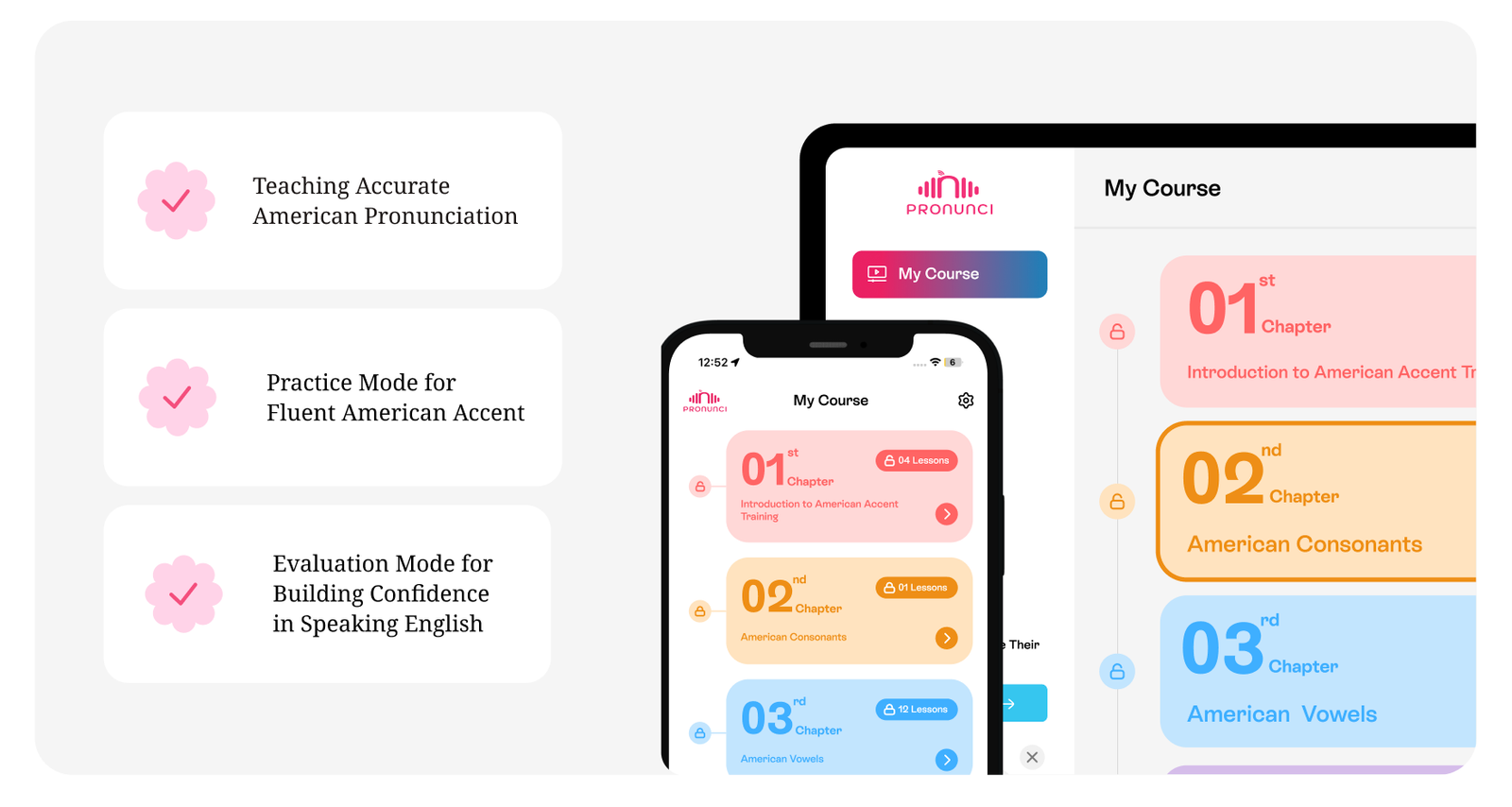
The program moves through four structured chapters, starting with Speech Organs Education before advancing into American consonants, vowels, and intonation, so rhotic /r/ control gets built on a foundation rather than practiced in isolation. Every learner starts with a free onboarding chapter, giving you a real feel for the AI Accent Coach feedback and the My Coach versus My Pronunci comparison tool before committing to a paid plan. If you want a guided starting point built specifically for this kind of connected-speech work, the American Accent Training for Beginners daily practice plan walks you through your first sessions step by step. Begin with the free onboarding chapter today and see exactly where your /r/ needs work.
Sources
- Linking and intrusive R — Wikipedia
- Academic repository article on intrusive-r and linking
- Learn English Sounds — intrusive/linking sounds blog
Questions & Answers
FAQ
01What Kind of R Does American English Use?
General American uses a rhotic /r/, pronounced consistently in every position where it appears in spelling, including at the end of words like “car” and “here.”
02Why Do British Speakers Add an R to the End of Some Words?
Non-rhotic British accents drop /r/ after vowels but restore it, or insert it where it never existed, before a following vowel sound to avoid an awkward gap between two vowels; linguists call this linking and intrusive R.
03How Do You Produce the R Sound in American English?
Most GA speakers use either a bunched tongue shape or a retroflex shape, holding that tongue position steady as the following vowel begins rather than letting it relax into a glide.
04How Common Are R-Colored Vowels in American English?
R-colored vowels, like the one in “bird” or “her,” are extremely common in General American since rhoticity affects a large share of everyday vocabulary, though non-rhotic pockets in places like older Eastern New England speech remain a documented exception.
Recommended

InPronunci: The Revolutionary American Accent Training App for Real Speech Transformation
Master the American accent for your career with the InPronunci App. Our 2026 guide shows how visual tech & AI feedback build executive vocal presence.
InPronunci Human-Based Guidance: American Accent Training You Can Trust
InPronunci combines human-based guidance, AI pronunciation feedback, and 2D Sound Motion Technology for trusted American accent training worldwide.

How Do Non-Native Speakers Practice English Intonation and Stress Patterns?
English intonation and stress, step by step: how non-native speakers practice word stress, rhythm and pitch, up to full paragraphs.
Plans
What InPronunci costs
InPronunci Basic
$35 per month
Chapter 1 is free after signup.
InPronunci Premium
$200 per month
Includes a coach: