
Falling intonation happens when your pitch drops on the last stressed syllable of a phrase, usually to signal a finished thought, a definite answer, or an order. A statement like “I live in Boston ➘” falls at the end, and so does a wh-question like “Where do you live ➘?” Both close the sentence with confidence instead of trailing upward like a question mark in the air. InPronunci: Accent Training App trains this exact pitch control through guided drills, which is where the rest of this lesson is headed.
TL;DR:
- Native speakers routinely use falling intonation at the end of declarative statements, wh- questions, commands, and exclamations to signal confidence and completion.
- The pitch drop occurs on the stressed syllable that carries the main meaning, with the fall signaling finality, certainty, or directness in communication.
- Learners often confuse rising intonation with falling or produce flat endings, which can make statements sound uncertain or disengaged, especially without training.
- Practice drills, such as recording and shadowing native sentences and exaggerating the pitch drop, accelerate mastery of natural falling intonation.
- Recognizing and reproducing the fall on key sentence types improves clarity and confidence, especially in professional or formal American English contexts.
Table of Contents
- What Is Falling Intonation in English, Exactly?
- When Do Native Speakers Use Falling Intonation?
- How Can You Hear and Produce a Falling Tone?
- Why Do Learners Get Falling Intonation Wrong?
- What Drills Actually Build This Skill Fast?
- How Does Prof. Alex Teach Falling Intonation?
- Why This Pattern Changed How I Coach
- Ready to Train Your Intonation with Guided Practice?
- Sources
- FAQ
What Is Falling Intonation in English, Exactly?
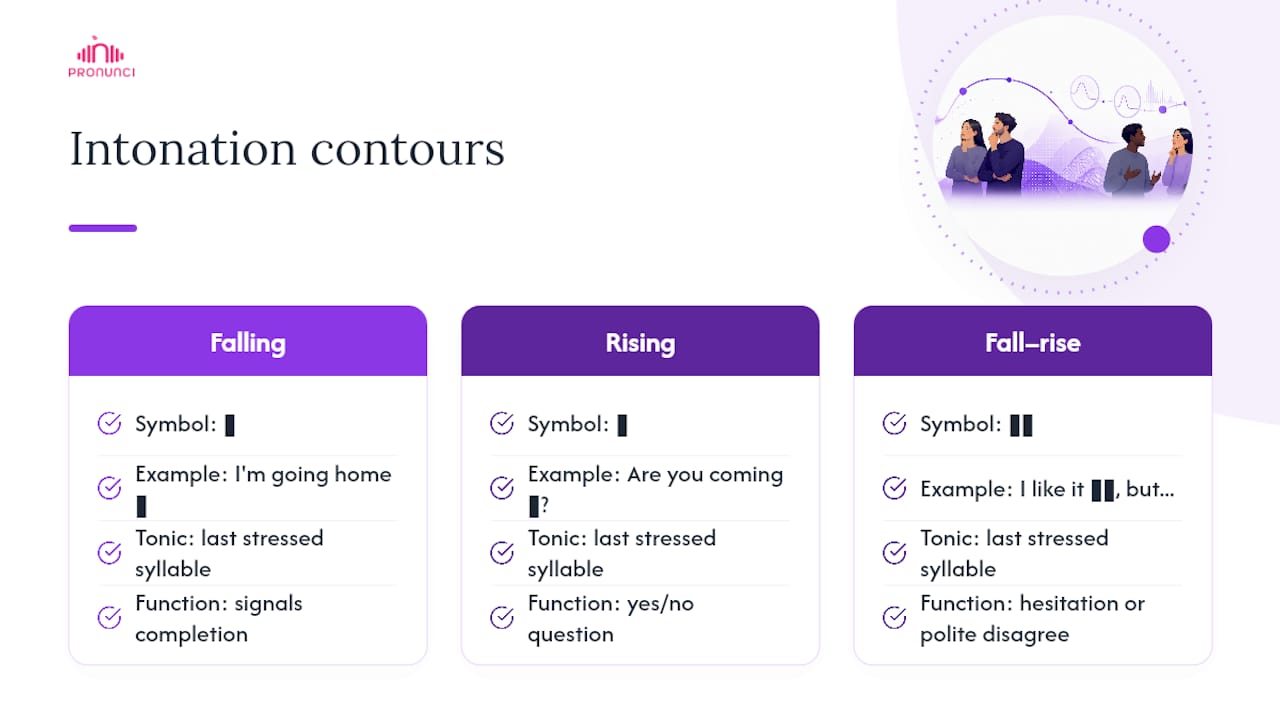
Falling intonation means your voice drops in pitch on the tonic syllable, the last stressed syllable that carries the main point of a phrase. Linguists mark it with a downward arrow, ➘, right before or over that syllable. Say “I’m going home ➘” and you’ll feel your pitch drop on “home.” That drop is what tells a listener the sentence is finished and the speaker is sure of what they said.
Rising intonation (➚) does the opposite: pitch climbs at the end, usually for yes/no questions like “Are you coming ➚?” Fall-rise intonation (➘➚) drops then lifts again, often used for hesitation or a polite disagreement, as in “I like it ➘➚, but…” Confusing these three is one of the fastest ways to sound uncertain, or accidentally rude, in American English. Falling intonation is the most common pattern in English overall, which is exactly why getting it wrong stands out.
When Do Native Speakers Use Falling Intonation?
You’ll hear falling intonation constantly once you start listening for it, because it’s the default pitch pattern for finished, confident speech. It shows up across a handful of predictable sentence types:
- Declarative statements end with a fall to mark the thought as complete: “The meeting starts at nine ➘.”
- Wh- questions (who, what, where, when, why, how) usually fall because they request specific information, not a yes/no answer: “What time is it ➘?”
- Commands fall to sound direct and clear: “Close the door ➘.”
- Exclamations fall to express strong feeling or certainty: “That’s amazing ➘!”
- The final item in a list falls to signal the list is done, while every earlier item rises: “I need eggs ➚, milk ➚, and bread ➘.”
That last pattern is worth sitting with. Non-final items in a list typically rise, and the final item falls to signal completion, which makes grocery lists an oddly perfect training ground for this skill. You can practice question-specific patterns further in this guide to American English question intonation.
How Can You Hear and Produce a Falling Tone?
Recognizing a fall is mostly about training your ear to catch one moment: the pitch drop on the final stressed syllable. Listen for the overall shape of the sentence first, then narrow in on that last strong beat. If the pitch dips down and stays down, that’s a fall. If it lifts at the very end, that’s a rise.
Producing it is a physical skill, not just a listening one. Start by finding the tonic syllable, the word that carries the main stress and meaning. Then lower your pitch deliberately on that syllable, and let the vowel stretch slightly if it helps you feel the drop. Recording your own voice and comparing it against a native model is one of the fastest ways to catch the gap between what you think you’re doing and what’s actually coming out.
A few reliable techniques:
- Record yourself saying a sentence, then play it back next to a native speaker model.
- Shadow short audio clips, repeating right on top of the speaker’s pitch and timing.
- Watch a visual pitch tracker so you can literally see the line drop instead of guessing at it.
Pro Tip: *Pitch control starts in your throat, but the sound only becomes clear once your tongue, jaw, and airflow cooperate. The
shows you exactly how articulation and pitch work together in real time, which is far easier to copy than trying to imagine it.*
Why Do Learners Get Falling Intonation Wrong?
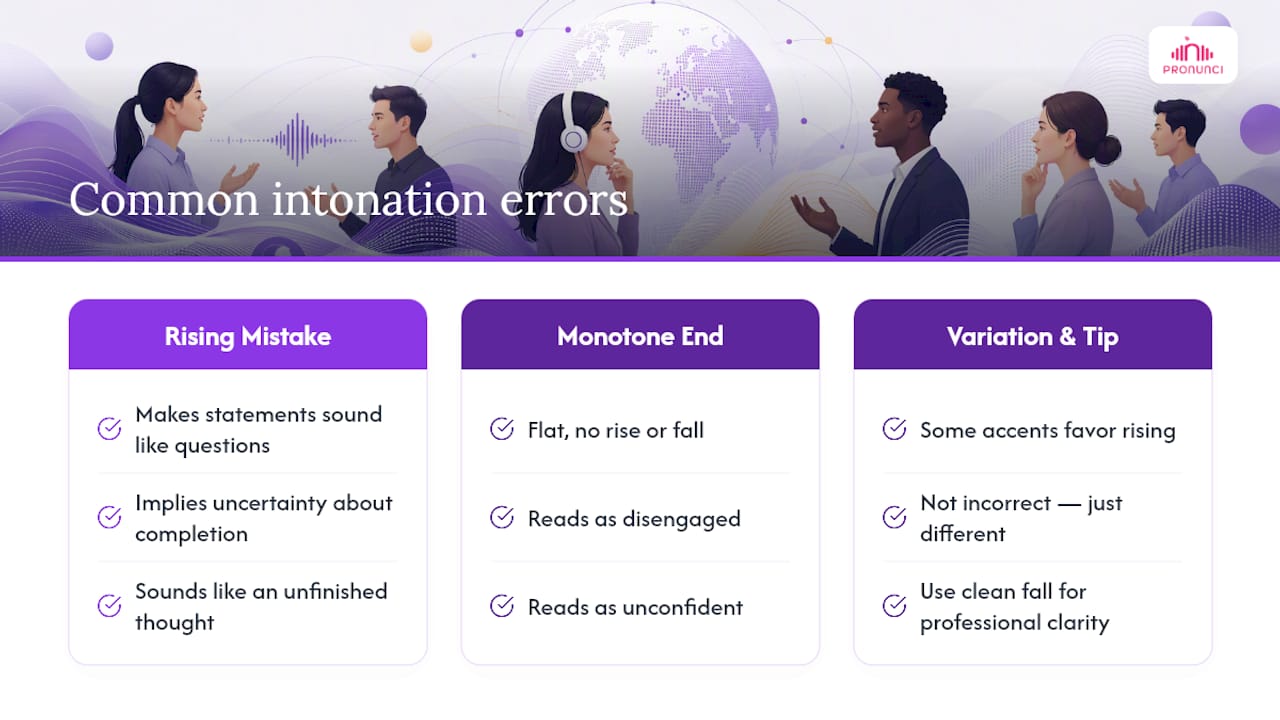
The most common mistake is using a rising tone where a fall is expected, which makes plain statements sound like nervous questions or unfinished thoughts. Say “I finished the report ➚” with a rise, and a listener may wonder if you’re actually asking them something, or worse, that you’re unsure whether you finished it at all.
The opposite problem is just as damaging: a flat, monotone ending. No rise, no fall, just a dead stop. That reads as disengaged or unconfident, even when the words themselves are perfectly correct.
Regional and dialect variation is real. Some English accents lean on rising patterns more than General American speech does, and that’s not wrong, just different. But for learners aiming at clear, professional American communication, a clean fall on statements and wh-questions remains the safest, most universally understood default. If you want to understand how this connects to how confident you sound overall, this breakdown of intonation and perceived confidence digs into the pragmatics.
What Drills Actually Build This Skill Fast?
Model sentences give you something concrete to copy before you try producing falls on your own. Here are ten, covering the main contexts:
- “I live in Chicago ➘.” (statement)
- “She works at the hospital ➘.” (statement)
- “Where did you park the car ➘?” (wh-question)
- “What’s your name ➘?” (wh-question)
- “Turn off the lights ➘.” (command)
- “Sit down ➘, please.” (command)
- “That’s incredible ➘!” (exclamation)
- “I can’t believe it ➘!” (exclamation)
- “I bought apples ➚, oranges ➚, and bananas ➘.” (list)
- “We need pens ➚, paper ➚, and folders ➘.” (list)
Once you’ve read those out loud a few times, move into drills that force the contrast:
- Minimal-pair drill: Say the same sentence twice, once rising, once falling, and notice how the meaning shifts.
- List-final drill: Practice three-item lists daily, exaggerating the rise on items one and two before dropping hard on item three.
- Record-shadow-compare: Record yourself, shadow a native clip, then record again and compare the two takes.
- 10-minute daily routine: Five minutes of listening discrimination (labeling clips as rise or fall), five minutes of production practice out loud.
Teachers can build a full micro-lesson from this in under fifteen minutes: warm up with a few contrastive minimal pairs, model each sentence type twice, have students shadow and record, then give immediate feedback on where the fall landed. This kind of listening discrimination paired with production drilling/02%3A_Getting_to_Know_You/2.04%3A_Intonation-_Statements_and_Questions) is standard in pedagogical practice for good reason: it works. For the articulation side of these drills, the American t sound simulator is a useful companion, since a clean fall often depends on crisp consonant endings too.
How Does Prof. Alex Teach Falling Intonation?
My approach with students always starts the same way: isolate the tonic syllable before worrying about anything else. Once a learner can reliably drop their pitch on a single word in isolation, we move to short phrases, then full sentences, then connected speech where the fall has to survive contact with surrounding words.
Inside InPronunci: Accent Training App, intonation training follows that same sequence, moving from isolated pitch control into full conversational rhythm using 2D sound simulators and AI feedback that flags where a fall went flat or turned into an accidental rise. Pairing pitch work with visible speech-organ movement, like in the t sound simulator, helps because pitch and articulation are never really separate skills. You can see the full sequencing in the American English intonation guide.
Why This Pattern Changed How I Coach
Clarity in spoken English rarely comes down to vocabulary. It comes down to whether your pitch tells the listener the sentence is finished, and a confident fall does exactly that. I’ve seen the same correction, get the fall right on statements and wh-questions, resolve confusion in job interviews and client calls faster than almost any grammar fix I teach.
Classroom practice builds the pattern; self-study locks it in. Use both if you can, and don’t skip the recording step, because your ear adjusts faster than you’d expect once you can hear your own mistakes played back.
— Prof. Alex., Ph.D. Accent Coach
Ready to Train Your Intonation with Guided Practice?
Reading about falling intonation gets you halfway there. Producing it reliably, in real sentences, under real pressure, is a different skill, and it’s the one InPronunci: Accent Training App was built to train through structured, linguist-guided practice rather than casual scoring games.
Get it on the App Store | Get it on Google Play
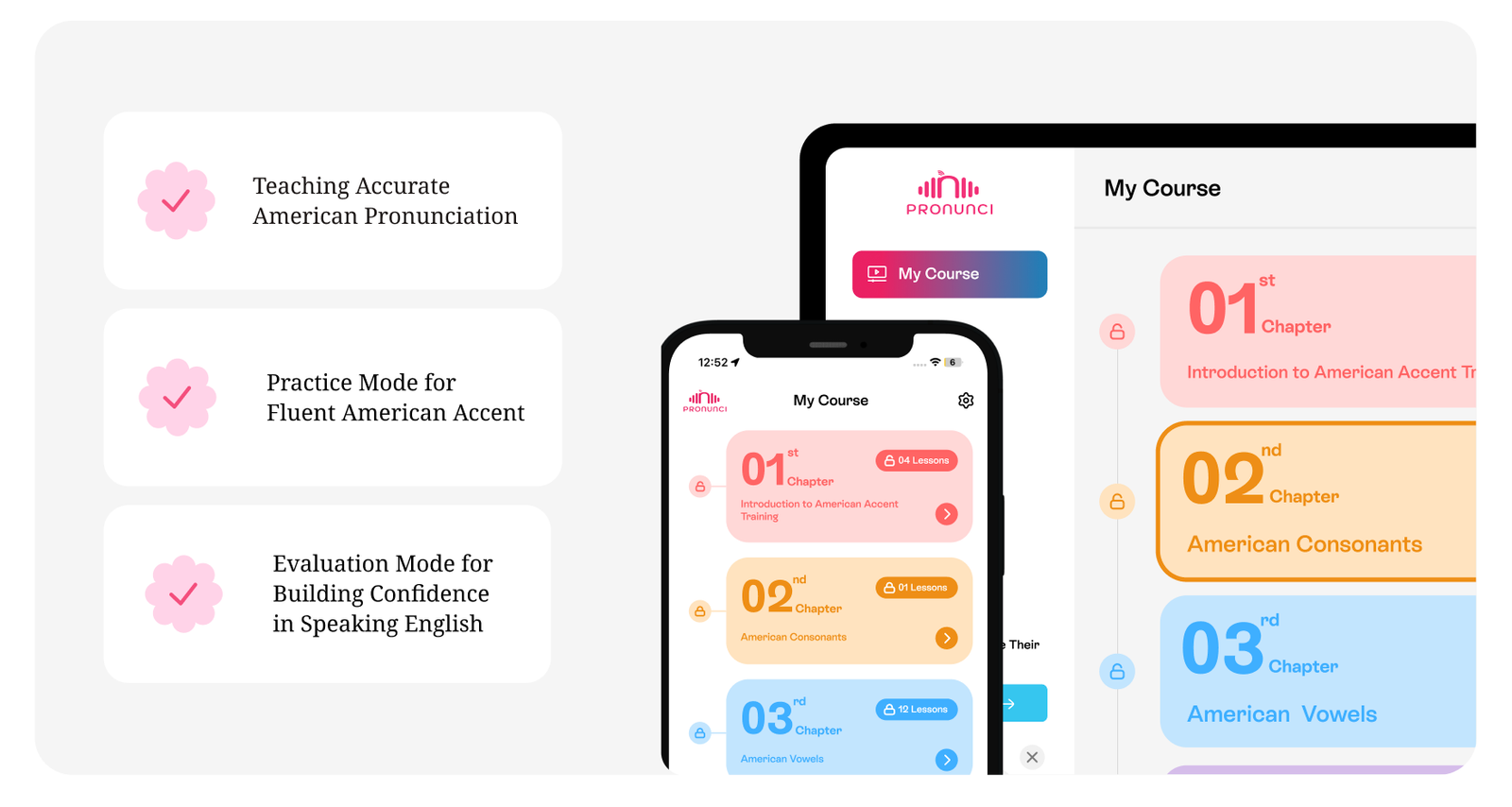
The program moves you from isolated pitch drills through the American Accent Training Course, using 2D sound video simulators, AI Accent Coach feedback, and My Coach versus My Pronunci comparisons so you can hear the gap between a native model and your own recording. Learners who want ongoing correction and faster progress can start with the Premium Plan, featuring personalized one-on-one coaching, or explore the Basic Plan to see the full course structure first. Open the app, run the [t] sound simulator once, and try three of the model sentences above out loud today.
Sources
FAQ
How do you know if intonation is rising or falling?
Listen to the pitch on the final stressed syllable of the sentence. If it drops down and stays low, that’s falling intonation; if it lifts upward at the very end, that’s rising. Recording yourself and comparing it against a native speaker model, a method InPronunci: Accent Training App builds into its practice mode, makes the difference much easier to hear than trying to judge it live.
What are the four types of intonation in English, with examples?
The main patterns are falling (➘), as in “I’m home ➘”; rising (➚), as in “Are you home ➚?”; fall-rise (➘➚), as in “I like it ➘➚, but…”; and rise-fall, used less often for strong emphasis or surprise. Falling intonation is the most common of the four, covering most statements, commands, and wh-questions.
Can you give examples of rising intonation?
Rising intonation typically appears in yes/no questions (“Do you like coffee ➚?”), non-final items in a list (“I need eggs ➚, milk ➚, and bread ➘”), and situations expressing surprise or seeking confirmation, such as “You’re leaving ➚?” It’s also common in polite requests where the speaker wants to sound less direct, like “Could you help me ➚?”
How do you pronounce “falling” correctly?
“Falling” is pronounced with stress on the first syllable, FALL ing, and the word itself is a useful practice target because its own two syllables can be said with a falling pattern when used at the end of a statement. Practicing stress placement on words like this is part of the same pitch control work covered in InPronunci’s American Accent Training Course.