


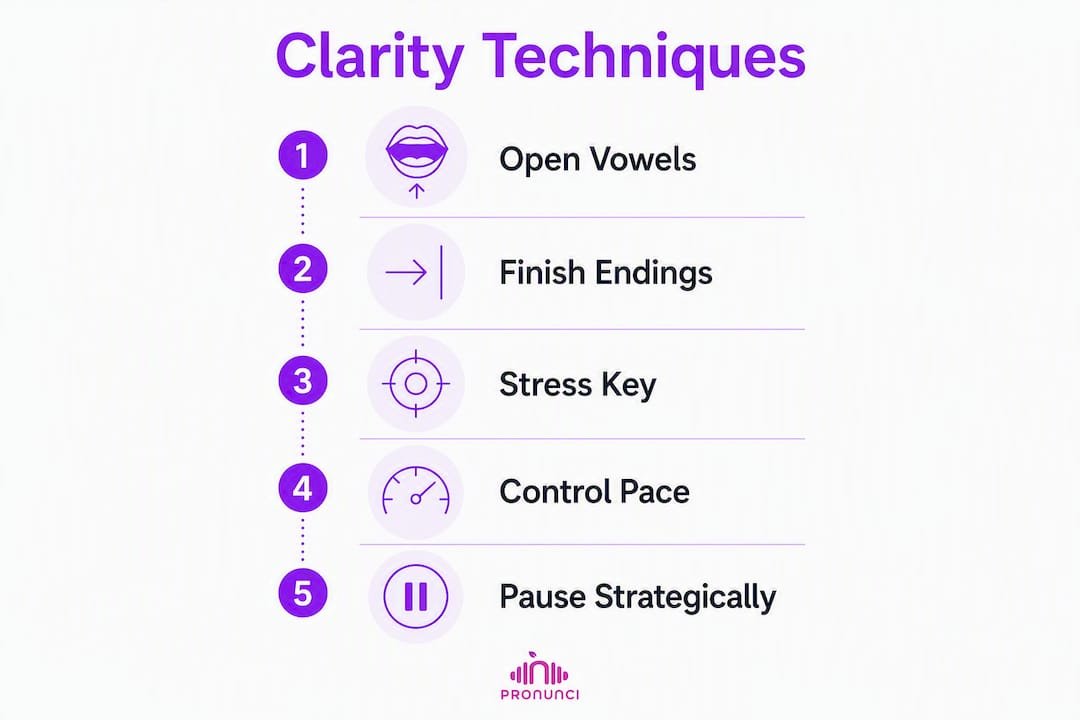
To build credibility fast, prioritize intelligibility: open your vowels fully, finish word endings cleanly, stress one key word per sentence, and add a purposeful two-second pause after every important point. That single habit shift changes how U.S. listeners perceive your competence, regardless of your accent background.
TL;DR checklist (copy this into your meeting prep doc):
- Open vowels: give each vowel its full sound
- Finish endings: never drop final /k/, /t/, /s/, or /z/
- Stress one word: pick the most important word in each sentence and land on it
- Pause two seconds after key points
- Slow down for numbers, dates, and technical terms to improve comprehension
A 2021 study in the Journal of Experimental Psychology confirmed that clearer articulation increases perceived credibility and intelligence in listeners, independent of what is actually said. That finding is the foundation of every technique in this article.
This guide is written by Prof. Alex, Ph.D. Accent Coach, Accent Coach and centers on Inpronunci as the structured solution. Start with Free Chapter 1: “Get to Know Your Speech Organs” before your next meeting.
How to build credibility with a clear accent: the five techniques that matter most
Intelligibility, not accent elimination, is the professional goal. Applied linguistics research by Munro and Derwing shows that learners can remain fully accented yet become highly intelligible by focusing on stress, rhythm, and a small set of high-impact sounds. You do not need to sound like a news anchor. You need to be easy to follow.
Open your vowels
Vowels carry intelligibility. When a vowel is shortened or swallowed, the listener’s brain has to work harder to reconstruct the word, and that extra effort registers as uncertainty about the speaker. The fix is physical: release jaw tension, let the mouth open to its natural position, and give each vowel its full duration.

Most speakers try to fix clarity by forcing consonants or speaking louder. Both strategies increase jaw tension and reduce naturalness, making the problem worse. The efficient move is the opposite: relax the jaw, optimize breath support, and let the vowel form fully.
For Spanish and Portuguese L1 speakers, the pairs /ɪ/ vs. /iː/ (ship vs. sheep) and /æ/ vs. /ɛ/ (bad vs. bed) carry the highest functional load in U.S. professional contexts. Fixing those two contrasts alone produces an audible difference in how clearly you are understood.
Finish word endings
Dropping final consonants is one of the most common credibility killers in professional speech. “I think” becomes “I thin,” “project” becomes “projec,” and listeners fill in the gap with the wrong word. In a meeting where technical terms and numbers are on the table, that gap costs you.
Practice finishing /k/, /t/, /s/, and /z/ in isolation first, then in short phrases, then in full sentences. The target is not an exaggerated pop on every consonant. It is a clean, complete release that confirms the word.
Stress one key word per sentence
English is a stress-timed language. Listeners rely on stressed syllables to locate meaning. When every word receives equal weight, the sentence sounds flat and the listener cannot identify what matters. Pick one word per sentence, land on it with slightly longer vowel duration and a small pitch rise, and let the rest of the sentence move naturally around it.
Compare these two versions of the same sentence:
- Flat: “We need to submit the report by Friday.”
- Stressed: “We need to submit the report by Friday.”
The second version tells the listener exactly what is urgent. That clarity reads as preparation and confidence.
Control your pace

News anchors typically speak at 150–160 WPM; technical explanations are clearest at 120–130 WPM. When you are presenting data, quoting a number, or introducing a technical term, drop to 120–130 WPM. Slowing down at those moments signals that the information is important and gives listeners time to process it accurately.
Pause strategically
A two-second pause after a key point gives listeners processing time and signals control. It also reduces filler words, because the pause replaces the “um” or “uh” that would otherwise fill the silence. Pausing feels longer to the speaker than it does to the listener. Practice holding it.
Pro Tip: Record one sentence from your next presentation. Say it three times: once flat, once with one stressed word, once with a two-second pause after it. Listen back and choose the version where the key information lands most clearly. That version is your model.
What does a daily practice routine look like?
Consistency beats intensity. A focused 15-minute daily session, structured around a single issue, produces faster results than an occasional hour of general practice. Coaching evidence supports isolating one issue, such as word stress, final consonants, or one problem sound, and practicing it intensively before moving to the next.
The 15-minute daily plan
- Warm-up (2 minutes): Three slow, deep breaths to coordinate breath and voice. Jaw release: open wide, hold three seconds, release. One tongue twister at slow speed, then normal speed. (“She sells seashells” works well for /ʃ/ and /s/ contrast.)
- Vowel drill (3 minutes): Choose one vowel pair from your priority list. Say five minimal pairs (ship/sheep, bit/beat, bad/bed) slowly, record, and compare with a native model.
- Final consonant drill (3 minutes): Read five sentences aloud, exaggerating the final consonant in each key word. Record and listen for clean releases on /k/, /t/, /s/, /z/.
- Stress and rhythm (4 minutes): Take three sentences from a real work email or presentation. Mark the one key word in each. Read aloud, stressing that word with a longer vowel and slight pitch rise. Record and compare.
- Connected speech (2 minutes): Practice two short phrases that appear in your actual work vocabulary. Focus on natural linking between words without dropping endings.
- Progress log (1 minute): Note one thing that improved and one thing to target tomorrow.
What to track
| Metric | How to measure | Target |
|---|---|---|
| Final consonant completion | Count finished endings in a timed recording | Improve steadily week by week |
| Filler words per minute | Count “um,” “uh,” “like” in a recording | Reduce by 1–2 per minute each week |
| Perceived clarity rating | Ask one test listener to rate 1–5 after a short message | Reach 4/5 within four weeks |
| Pace (WPM) | Count words in a timed recording | 120–150 WPM, aiming for 120–130 WPM for technical content |
Feedback-loop practice, combining real scenarios with specific feedback, produces faster improvement than solo awareness exercises alone. Recording yourself and comparing with a native model is the minimum. AI feedback and a human coach accelerate the process further. For a structured approach to measuring improvement in speech clarity, tracking specific metrics over time gives you objective evidence of progress.
How to apply clarity techniques in meetings and presentations
Practice builds the skill. The meeting is where you deploy it. The gap between the two is where most professionals lose ground, because live pressure triggers old habits. A short pre-meeting checklist closes that gap.
Pre-meeting checklist
- Mark the two or three key words in your opening statement
- Identify any technical terms, names, or numbers you will say; plan to slow down on each
- Prepare one repair phrase in advance: “Let me put that another way” or “I’ll spell that out”
- If presenting data, plan the structure: state the number, pause, then explain it
In-meeting behaviors
Keep signposts short and direct: “My main point is,” “The number is,” “To confirm.” These phrases give listeners a moment to orient before the key information arrives. After a question, pause before answering. That pause signals that you are thinking, not rushing, and it gives you a moment to choose your words.
For ambiguous technical terms, use the chat window or shared screen as a backup channel. Typing a term while saying it removes the ambiguity entirely and keeps the meeting moving.
Here is how to present a complex data point clearly:
Structure: State the category first, then the number, then the implication.
Example: “Revenue for Q2 [pause] was $4.2 million [pause] — that’s up 12% from Q1.”
Stress: Land on the number. Pause after it. Let the implication follow at a slightly slower pace.
That three-part structure gives listeners a frame before the number, time to register it, and context to understand it. For a full professional checklist for ESL speakers in workplace settings, Inpronunci’s resource covers pre-meeting, in-meeting, and post-meeting steps in detail.
What mistakes reduce credibility even when you’re trying harder?
The most common credibility mistake is trying to sound more native by forcing sounds that are not natural to your articulatory system. That effort produces tension, and tension produces exactly the unclear, strained speech you are trying to avoid.
Avoid these:
- Faking an accent: Wholesale mimicry of a regional American accent creates inconsistency. Listeners notice the mismatch between your natural rhythm and the borrowed sounds, and it reads as unnatural rather than polished.
- Over-forcing consonants: Hard, exaggerated consonant pops increase jaw tension and disrupt the natural flow of connected speech.
- Speeding up: Many speakers unconsciously speed up when nervous, which compresses vowels and drops endings. Slowing down is always the right correction.
- Excessive self-correction mid-sentence: Stopping to redo a word mid-thought breaks the listener’s comprehension more than the original error would have.
- Shouting for clarity: Volume does not replace articulation. A louder unclear word is still unclear.
The corrective approach is targeted, not wholesale. Releasing jaw tension and improving breath coordination are the primary physical changes that increase clarity. When you feel tension building during a meeting, the fix is a quiet breath reset, not more effort. For repair situations, use a short rephrase (“What I mean is…”) rather than a full restart. If the term itself is the problem, spell it or put it in the chat.
Why does clear speech actually build professional credibility?
The research answer is direct. A 2021 study in the Journal of Experimental Psychology found that clearer articulation makes speakers be perceived as more credible and knowledgeable, regardless of the actual content of what they say. Listeners form judgments about competence partly through the ease with which they process speech. When speech is easy to follow, the speaker is perceived as prepared, confident, and authoritative.
Statistic: Professional speakers targeting clarity aim for 120–150 WPM, with technical explanations at 120–130 WPM. News anchors typically speak at 150–160 WPM. Slowing down for numbers, dates, and technical terms is one of the highest-leverage adjustments a non-native professional can make.
The applied linguistics framework behind this is called functional load: not all sounds are equally important for communication. A small set of high-functional-load sounds causes most misunderstandings for any given L1 background. Focusing practice on those sounds gives the fastest communicative payoff without requiring a wholesale change in accent identity.
U.S. professional listeners prioritize intelligibility and reliability. An accent is acceptable when speech is easy to follow. What reduces credibility is not the accent itself but the listener’s effort to decode the message. Reduce that effort, and credibility follows.
For professionals who want to understand how accent clarity connects to career advancement, the relationship between intelligibility and perceived leadership readiness is well documented in applied communication research.
The credibility gap no one talks about
One pattern I see repeatedly in professional accent training is this: a speaker works hard to sound “more native,” adds tension to every consonant, speeds up to match the pace of a native colleague, and ends up harder to understand than before. The effort is real. The direction is wrong.
Intelligibility is not about erasing where you come from. It is about making your message land cleanly. A speaker with a strong accent who finishes word endings, stresses the right syllable, and pauses after a key number is easier to follow, and more credible, than a native speaker who rushes and mumbles. That is not an opinion. The Journal of Experimental Psychology finding makes it measurable.
What I recommend to every professional I work with is this: start with your speech organs. Before you can retrain a sound, you need to understand how it is physically produced. That is why Inpronunci’s Free Chapter 1, “Get to Know Your Speech Organs,” is the right first step. It is not a warm-up exercise but the foundation that makes every technique in this article actually work.
The goal is not a different accent. The goal is a clearer one.
Inpronunci gives professionals a structured path to clearer speech
Clearer speech is a skill, and skills require a system. Inpronunci is a structured American Accent Training Course built specifically for non-native professionals who are past the beginner stage and need real, measurable progress, not generic repetition drills.
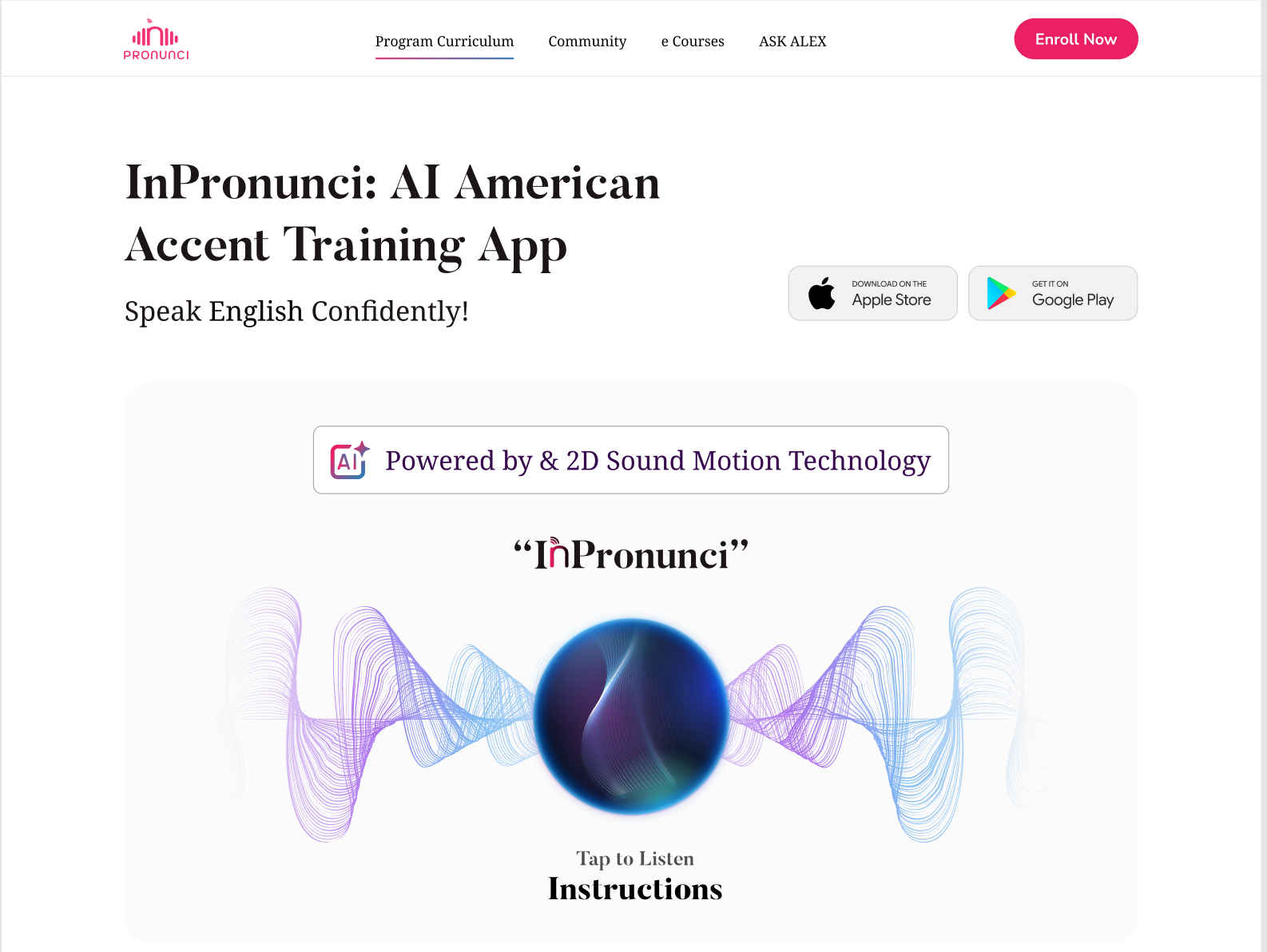
Three technologies drive the training. The
InPronunci training structure
How InPronunci trains the American speech system
InPronunci trains the full American speech system: Interactive Visual 2D Sound Simulators and phonetic exercises for articulation and American sound development, sentence practice for intonation, melody, rhythm, and connected speech, paragraph practice for spontaneous speech, public speaking, and real communication confidence, and Advanced AI Accent Coach evaluation as you speak.
InPronunci is an advanced, linguistically structured American accent training platform with more than 1,000 downloads and a growing learner base. It is designed for serious ESL learners who want American pronunciation, stronger intonation, more natural rhythm, better connected speech, and the ability to speak English more confidently in real communication. The program is especially useful for intermediate and advanced English speakers who want to become independent speakers of English with confident communication, stronger speaking control, long-term speech improvement, and great public speaking skills. It is also designed for advanced speakers whose goal is to speak like a native or closer to native-like American speech, including people who were raised in the United States but still have slight accent patterns from the native language they were born with. It is a complete American accent training course and system created by Prof. Alex, Ph.D. Accent Coach, Doctor of Education, and professional linguist based in Austin, Texas, with Pronunci Instructions from Prof. Alex for each lesson that make self-learning more effective, supported, and clear.
show you exactly how native speakers produce each American sound through tongue, lip, jaw, and airflow movement, so you are not guessing. The AI Accent Coach gives you real-time pronunciation feedback as you speak, catching errors you cannot hear on your own. Human-Guided Instructions walk you through every exercise the way a real coach would, so you always know you are practicing correctly.
Progress tracking and unlimited voice recording let you compare your speech to a native model and measure improvement over time. See what real students achieved: Andrew, Thiago, and Tian.
Choose the plan that fits your situation:
- Free Chapter 1: “Get to Know Your Speech Organs” — start here, no cost
- Basic Plan: Self-study with AI Accent Coach and Human-Guided Instructions
- Premium Plan: Monthly 1-on-1 sessions with Prof. Alex, Ph.D. Accent Coach for personalized guidance
Start with the American Accent Training Course, or sign up now to access Chapter 1 for free. Available on App Store and Google Play. Want personalized guidance first? Book a free Premium session with Prof. Alex, Ph.D. Accent Coach
Useful sources
The techniques and evidence in this article draw from peer-reviewed research, applied linguistics frameworks, and practitioner guidance. The table below organizes them by purpose so you can go directly to the source that fits your next step.
| Source | Best used for |
|---|---|
| Journal of Experimental Psychology finding via SayNow AI | Credibility research, pacing targets, pause strategy, feedback-loop evidence |
| Talaera: How to Speak English More Clearly in Client-Facing Roles | Intelligibility vs. accent reduction framework, functional load, repair strategies |
| John J. Norton Voice Zone: How to Speak More Clearly | Jaw tension, breath mechanics, physical clarity techniques |
| Janice Haywood: Pronunciation Mistakes That Kill Credibility | Single-issue practice rationale, coaching evidence |
| MIT Sloan Executive Education: Interpersonal Communication | Communication strategy frameworks for executives |
| WikiHow: How to Improve Your Clarity of Speech | Practical articulation exercises and warm-up techniques |
| Inpronunci: Measuring Improvement in Speech Clarity | Tracking metrics and data-driven progress measurement |
| Inpronunci: AI Accent Coach Technology Guide | How AI feedback accelerates pronunciation learning |
Questions & Answers
FAQ
01How do you build credibility through speech?
Credibility builds when listeners can follow you without effort. The highest-impact moves are finishing word endings, stressing one key word per sentence, and pausing two seconds after important points, habits that signal preparation and control.
02What is the clearest accent in American English?
There is no single “clearest” accent. Applied linguistics research shows that intelligibility, not accent type, determines how well listeners understand you. A speaker with any accent becomes highly intelligible by focusing on stress, rhythm, and a small set of high-functional-load sounds.
03How do you build credibility in a speech or presentation?
Structure your key points with a clear stress pattern, slow your pace to 120–130 WPM for technical content, and use a two-second pause after each major point. A 2021 Journal of Experimental Psychology study found that clearer articulation directly increases perceived credibility, independent of content.
04Can Inpronunci help non-native professionals improve speech clarity?
Yes. Inpronunci’s structured American Accent Training Course combines 2D Sound Video Mouth-Training Simulators, an AI Accent Coach with real-time feedback, and Human-Guided Instructions to help intermediate and advanced learners build measurable clarity for meetings, presentations, and daily professional communication.
05What are the most common pronunciation mistakes that reduce credibility?
Dropping final consonants, speaking too fast under pressure, and forcing an unnatural accent are the three most common. Each increases listener effort and reduces perceived competence. Fixing final consonant completion and pace control alone produces an audible improvement within two to four weeks of focused daily practice.
Recommended

InPronunci Accent Training App for Professional Communication
Improve American pronunciation with InPronunci, an accent training app using AI feedback, human guidance, and 2D Sound Motion Technology.

Structured Accent Training Benefits ESL Pros | Inpronunci
Discover the structured accent training benefits ESL professionals gain. Achieve clearer speech and boost confidence with expert guidance.

InPronunci: Best Accent Program App with Modern AI & 2D Sound Motion Technology
Boost career clarity with InPronunci, the accent training app with AI and 2D Sound Motion Technology. Train each sound, master pronunciation, and speak with authority.
Plans
What InPronunci costs
InPronunci Basic
$35 per month
Chapter 1 is free after signup.
InPronunci Premium
$200 per month
Includes a coach:
Why InPronunci is worth the price
- Interactive Visual 2D Sound Simulators, built on 2D Sound Motion Technology developed by Prof. Alex, train your speech organs for each American sound.
- Prof. Alex's guided instructions in every lesson, like working with a real coach.
- The Advanced AI Accent Coach evaluates sounds, intonation, rhythm, stress, and connected speech against native American English speech (100 = native speaker).