


Accent neutralization training, more accurately called accent modification, retrains the speech patterns that reduce clarity in professional English, without erasing your identity or native language. Done well, it raises comprehensibility and intelligibility scores from unfamiliar listeners, measured against a real baseline rather than an app leaderboard. The evidence behind it comes from clinical speech-language research, not marketing copy, and programs like InPronunci: Accent Training App build directly on that research.
What Does Structured Accent Neutralization Training Include?
A credible course does not start with random sound drills. It starts with a diagnosis, then builds outward in layers, the same way a doctor treats a patient after taking a history rather than guessing.
The American Speech-Language-Hearing Association frames accent modification around three measurable outcomes: accentedness (how noticeable the accent is), comprehensibility (how much effort it takes a listener to understand you), and intelligibility (how many words the listener actually gets right). Good curriculum design serves those three goals, not vanity metrics.
A solid program’s core modules typically include:
- Speech-organ education — understanding tongue, lip, jaw, and airflow positioning before attempting new sounds.
- Consonant and vowel training — targeted work on the specific phonemes your native language does not distinguish or produce the same way.
- Stress, rhythm, and intonation (suprasegmentals) — the melody of American English, often the biggest lever for clarity.
- Connected speech — how sounds link, reduce, and blend across word boundaries in natural conversation.
- Transfer practice — moving skills from drills into interviews, presentations, and unscripted conversation.
Beyond content, look for program attributesthat separate serious training from novelty apps: baseline assessment before you start, exposure to multiple talker voices rather than one recorded model, articulation-training tools that train what your speech organs actually do, and a feedback loop that includes a human, not just an algorithm score. A program built around accent reduction methods that work for professionals tends to combine all five.
How Does Effective Accent Reduction Training Actually Work?
Every credible accent reduction technique follows the same underlying sequence: perception, then production, then communication. You cannot fix a sound you cannot reliably hear. Learners who cannot distinguish two English vowels in someone else’s speech will struggle to produce that contrast reliably themselves, which is why perceptual training with immediate feedback consistently outperforms production-only drilling.
High-variability phonetic training, known as HVPT, is the clearest evidence for this. A 2025 meta-analysis of HVPT studies found medium-to-large effects across multiple phoneme classes, with gains that held up for months when training exposed learners to several talkers and contexts instead of one voice repeated endlessly.
Training that uses a single voice teaches you to understand that voice. Training that varies the speaker, the pace, and the context teaches you to understand English. That variety principle is the difference between a party trick and a transferable skill.
Suprasegmentals deserve special attention here. An 18-week classroom study comparing segmental-only instruction (sounds in isolation) against suprasegmental-focused instruction found both groups improved on scripted sentence reading. Only the suprasegmental group improved in spontaneous, unscripted speech, and only that group kept its gains on a delayed retest. Stress and rhythm training generalizes; isolated consonant drilling often does not, at least not on its own.
How Long Does It Take and How Do You Measure Progress?
Timelines vary by starting point and goal, but the research gives useful anchors. A published clear-speech protocol ran just five sessions, twice-weekly, with daily home practice, and it improved listener ease of understanding for every participant, though accentedness changes were mixed. That is a realistic model: short, focused, and paired with consistent home repetition, rather than an occasional hour-long class with no practice between sessions.
Pricing shapes fall into three general categories:
- Self-study subscriptions — structured app-based courses you work through independently, usually the most affordable entry point.
- Instructor-led courses — scheduled group or cohort classes with a curriculum and periodic feedback.
- One-on-one coaching — personalized sessions with a dedicated coach, typically the highest investment and the fastest feedback loop.
Be wary of any program promising a fixed number of weeks to “sound native.” No credible protocol guarantees that outcome, and ASHA itself recommends framing goals around comprehensibility rather than native-likeness.
To measure your own progress, record a baseline before you start, then repeat the same or comparable tasks (a two-minute self-introduction, a short unscripted answer) every few weeks. Ask someone unfamiliar with your speech, not a family member used to your patterns, to rate how easy you were to understand.
How Do You Choose the Right Program or Coach?
Picking a program without a framework leads to wasted months. Use this checklist before you commit money or time:
- Does it start with a baseline assessment? No diagnosis means no way to measure change later.
- Does it cover suprasegmentals, not just consonants and vowels? Stress and rhythm training drives most of the transfer to real conversation.
- Does it use multiple talker voices? Single-voice training limits how well skills generalize to new listeners.
- What feedback modes are available? AI scoring alone misses nuance a trained ear catches; look for human feedback options too.
- Is there transfer practice built in? Drills that never graduate to spontaneous speech rarely survive real conversation.
When you talk to a coach or evaluate a course, ask directly: How do you measure progress? Can I see a sample lesson or practice task? What is the coach’s training or credential background? Is there a trial period or refund policy if the fit is wrong?
Red flags are just as telling. Walk away from any program promising “native-like” results on a fixed schedule, any course with no baseline recording, any tool that is gamified scoring with nothing else, and any curriculum with no path from isolated sounds to unscripted speech.
Pro Tip: Ask a prospective coach for one specific piece of corrective feedback on a short recording before you sign up. A useful answer names an exact articulatory change, like tongue placement or vowel length; a vague “try to sound more American” answer is a warning sign.
What Practical Exercises Build Real Progress?
A workable daily template runs about 15 to 20 minutes: perceive, imitate, record, compare. Listen to a target sound or pattern from two or three different speakers, imitate it aloud, record yourself, then compare your recording against the models. This loop, repeated with varied voices, is the same structural logic behind HVPT’s documented gains.
A four-week progression might look like this:
- Week 1 — Isolated sound work. Minimal-pair sets (ship/sheep, thin/tin) to sharpen perception of your hardest contrasts.
- Week 2 — Word and phrase level. Stress-pattern drills using common American English stress patterns as reference models.
- Week 3 — Sentence and paragraph level. Rhythm and connected-speech practice reading short paragraphs aloud, then recording and comparing.
- Week 4 — Unscripted transfer. A two-minute self-introduction or mock interview question, recorded and rated by an unfamiliar listener.
This sound-to-word-to-sentence-to-unscripted-response sequence matters because pronunciation accuracy tends to drop when task complexity rises, a pattern documented in research on task complexity and L2 pronunciation. Skipping the staged buildup is why many learners can nail a drill but lose their gains in a live meeting.
Speech-organ training tools help close that gap. Watching articulation directly, as with an
for a sound like the American [t], shows you tongue placement and airflow that you cannot see in a mirror. A partner resource on the role of phonetics in vocal training makes a similar case for visual and articulatory feedback outside the speech-therapy context.

Pro Tip: Record your Week 4 unscripted task and your Week 1 minimal-pair drill side by side. The gap between how carefully you speak in a drill and how you speak under pressure tells you exactly where your transfer practice needs to focus next.
Why Trust This Guide on Accent Neutralization Training?
This guide draws on Prof. Alex’s Ph.D. in linguistics and more than 20 years of teaching, research, and private accent coaching experience, combined with the clinical and academic sources cited throughout: ASHA’s practice guidance, HVPT research, and suprasegmental instruction studies.
InPronunci was built to put those research principles into daily practice, not just describe them. That shows up in specific product choices:
- Interactive Visual 2D Sound Simulatorsthat train full articulation details, sound by sound.
- A perception-to-production workflow, comparing “My Coach” (the native-speaker model) against “My Pronunci” (your own recording).
- AI Accent Coach feedback plus human in-app chat support, so scoring and human judgment work together.
- Structured transfer sessions moving from sounds to sentences to spontaneous speaking practice.
Readers who want to see the full curriculum can review InPronunci: American Accent Training Course before choosing a plan.
A Note From Prof. Alex on Realistic Expectations
Set functional goals: being clearly understood in a meeting, an interview, or a client call. Not sounding native. Expect your clarity to slip under pressure at first; that is normal, and it is why training should build gradually toward unscripted speech. Consistent, measurable practice beats occasional intensity, and a structured path like InPronunci helps you stay on it.
— Prof. Alex, Ph.D. Accent Coach
Start Your Accent Neutralization Training With InPronunci
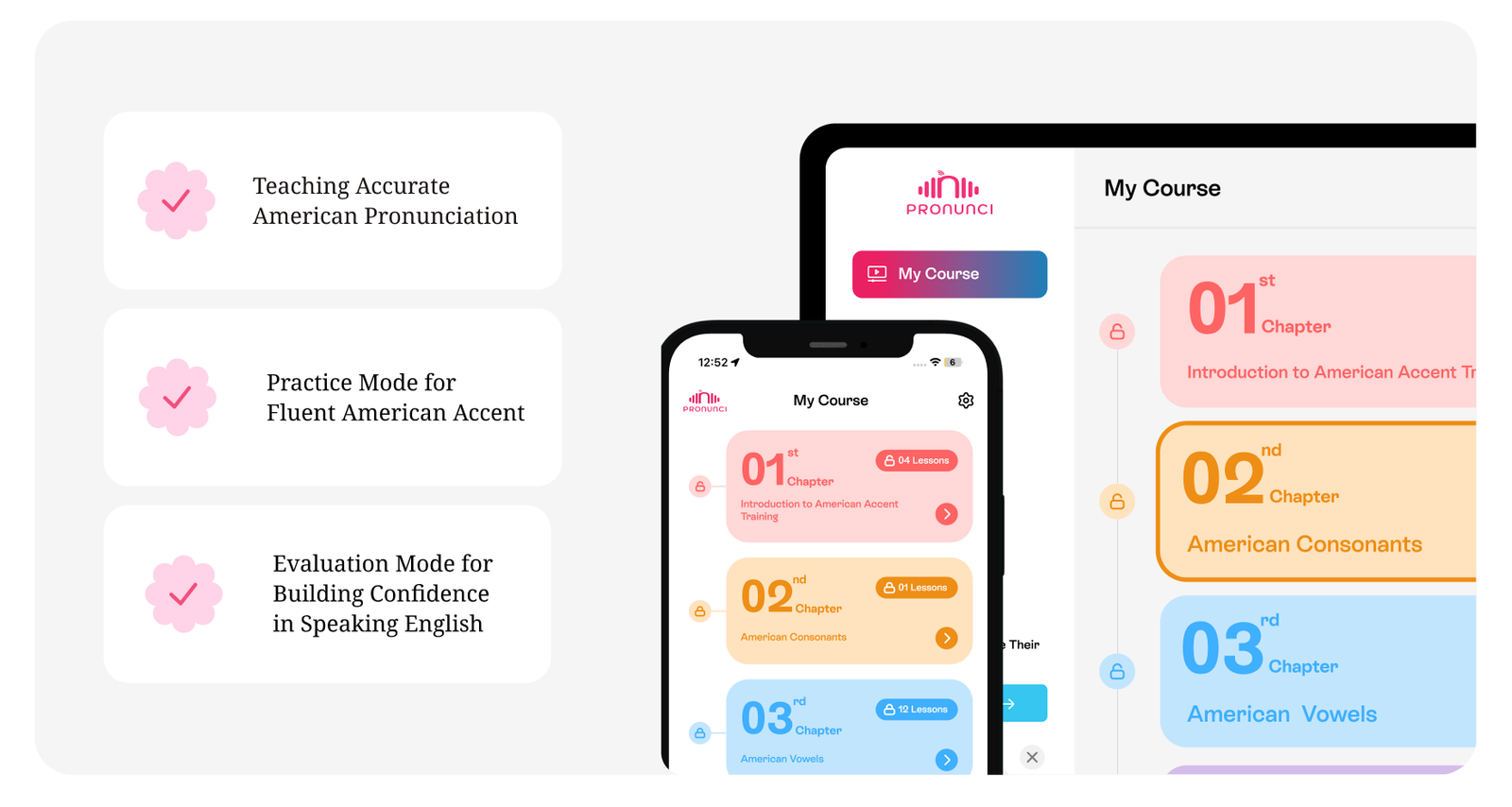
InPronunci is the structured alternative to gamified scoring apps for professionals who need real transfer, not just a leaderboard number. The InPronunci: Accent Training App covers four chapters, speech-organ education, American consonants, American vowels, and intonation and emphasis, using Interactive Visual 2D Sound Simulators, AI Accent Coach feedback, and optional human coaching to move you from isolated sounds to real conversation.
Structured American Accent Training Course
From Speech Organs Education to American Intonation
The InPronunci course is built step by step: every chapter prepares the next one, and by the end of the course students receive a certificate.
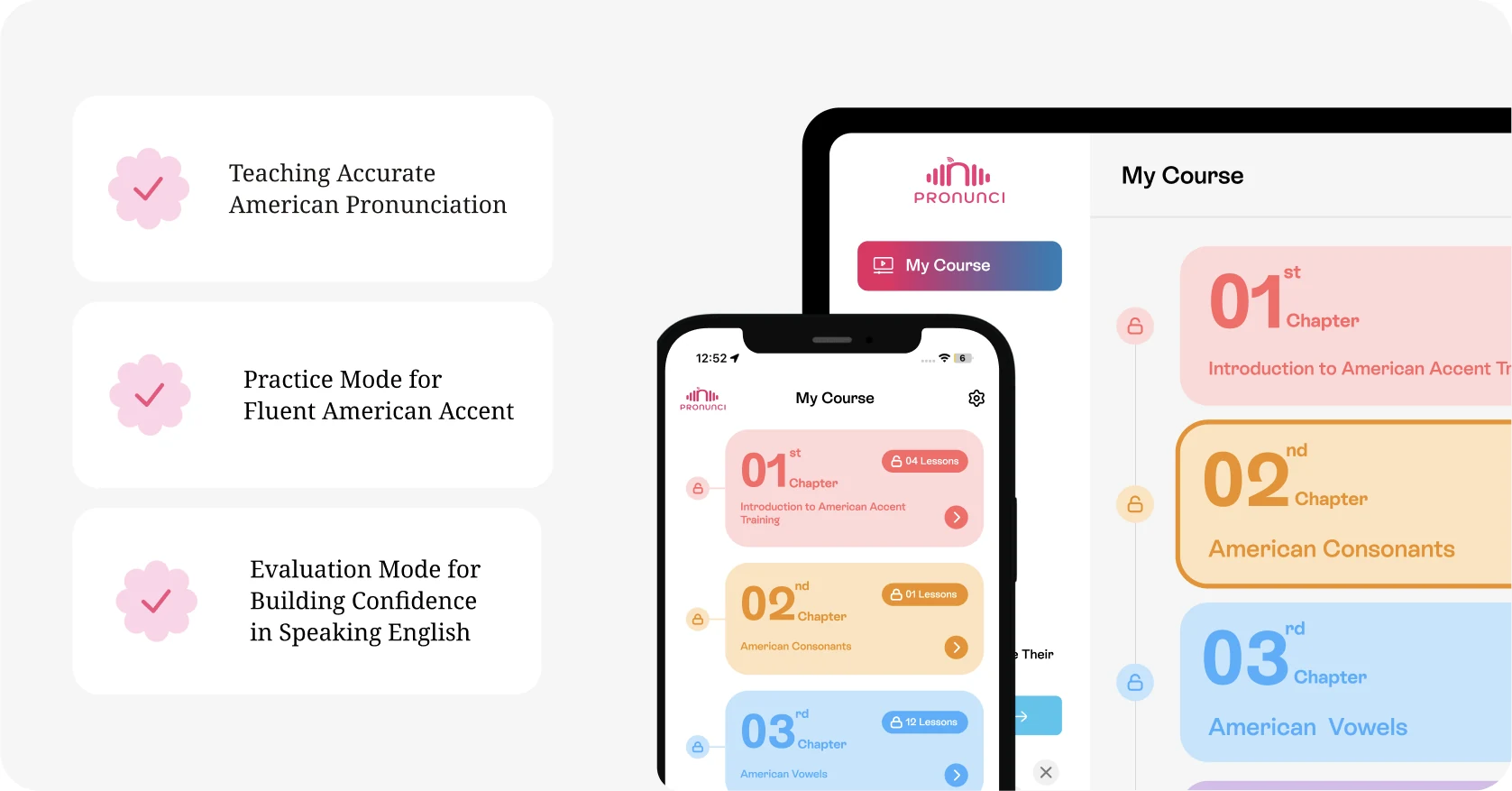
- Speech Organs EducationStudents learn how the speech organs work, along with the AI Accent Coach commands and feedback.
- American ConsonantsPractice and evaluate American consonants in phonetic exercises and practice sentences with the AI Accent Coach.
- American VowelsPractice and evaluate American vowels in phonetic exercises and practice sentences with the AI Accent Coach.
- IntonationLearn how intonation can change the meaning of what you say.
- CertificateBy the end of the course, students receive a certificate.
Every learner starts with a free onboarding chapter before choosing a plan. The Basic Plan suits self-study learners who want the full curriculum and AI feedback at their own pace. Learners who want direct, personalized coaching can choose the Premium Plan offering one-on-one guided sessions with a coach; current prices are on the pricing page. Either path takes real, consistent effort. Record your baseline today, start the free onboarding chapter, and let a measurable comparison, not a guess, tell you where to focus next.
Sources
- Accent modification | ASHA practice portal
- Examining the effects of explicit pronunciation instruction on the development of L2 pronunciation
- A clear speech approach to accent management | AJSLP (2017)
Questions & Answers
FAQ
01What is accent neutralization?
Accent neutralization, more precisely called accent modification, is training designed to improve how clearly you’re understood in professional English, not to erase your native accent or identity. ASHA frames the goal around accentedness, comprehensibility, and intelligibility rather than sounding “native.”
02How much does an accent coach cost?
Costs vary widely depending on format. Self-study subscription apps are the most affordable entry point, instructor-led group courses cost more, and one-on-one coaching runs highest.
03Is accent training worth the cost for professionals?
For professionals whose careers depend on being clearly understood in meetings, interviews, or client calls, structured training shows measurable gains in listener comprehension. A five-session clear-speech protocol improved ease of understanding for every participant studied, which suggests even short, focused programs can produce real functional benefit.
04What is the hardest accent to speak?
There’s no single “hardest” accent to neutralize; difficulty depends on how different your native language’s sound system and rhythm patterns are from American English. Speakers whose first language lacks certain vowel or consonant contrasts, or uses very different stress patterns, often need more perceptual training before production improves.
05How long does accent neutralization training usually take?
Timelines depend on your starting point and goals, but published protocols show change within weeks of consistent practice rather than months of occasional classes. A twice-weekly, five-session protocol with daily home practice produced measurable improvement in listener understanding in a matter of weeks.
Recommended

Accent Reduction For Professionals: Methods That Work
Master workplace clarity. Discover effective accent reduction for professionals with proven methods for sound retraining, intonation, and daily practice — by Prof. Alex,
Accent Modification vs. Accent Elimination: The Strategic Professional’s Guide for 2026
In the accent modification vs accent elimination debate, discover why clarity, not erasure, boosts your career. Our 2026 guide uses science to enhance your s...

Structured Accent Training Benefits ESL Pros | Inpronunci
Discover the structured accent training benefits ESL professionals gain. Achieve clearer speech and boost confidence with expert guidance.
Plans
What InPronunci costs
InPronunci Basic
$35 per month
Chapter 1 is free after signup.
InPronunci Premium
$200 per month
Includes a coach: