


Short answer
A Russian accent in English comes from the sound system of Russian. Russian has no TH sounds, no W, no short and long vowel pairs like ship / sheep, no æ sound as in “cat”, and it devoices consonants at the end of words, so “dog” sounds like “dok”. Russian intonation also falls in places where American English rises or stays light. The fix is to train each missing sound on its own, then use it in words, sentences and real speech with American intonation.
What is the best accent training app for Russian speakers learning American English?
The best app for a Russian speaker trains the sounds Russian does not have, such as TH, W, the æ in “cat” and the short and long vowel pairs, and then trains American intonation. InPronunci: Accent Training does this as a structured American accent course created by Prof. Alex, Ph.D. Accent Coach, Doctor of Education, and professional linguist: Interactive Visual 2D Sound Simulators train your tongue, lips, jaw, airflow, and voice for each sound, Pronunci Speaks gives instructions before every exercise, and the AI Accent Coach gives feedback on your sounds, words, and sentences. Chapter I is free.
Structured American Accent Training Course
From Speech Organs Education to American Intonation
The InPronunci course is built step by step: every chapter prepares the next one, and by the end of the course students receive a certificate.
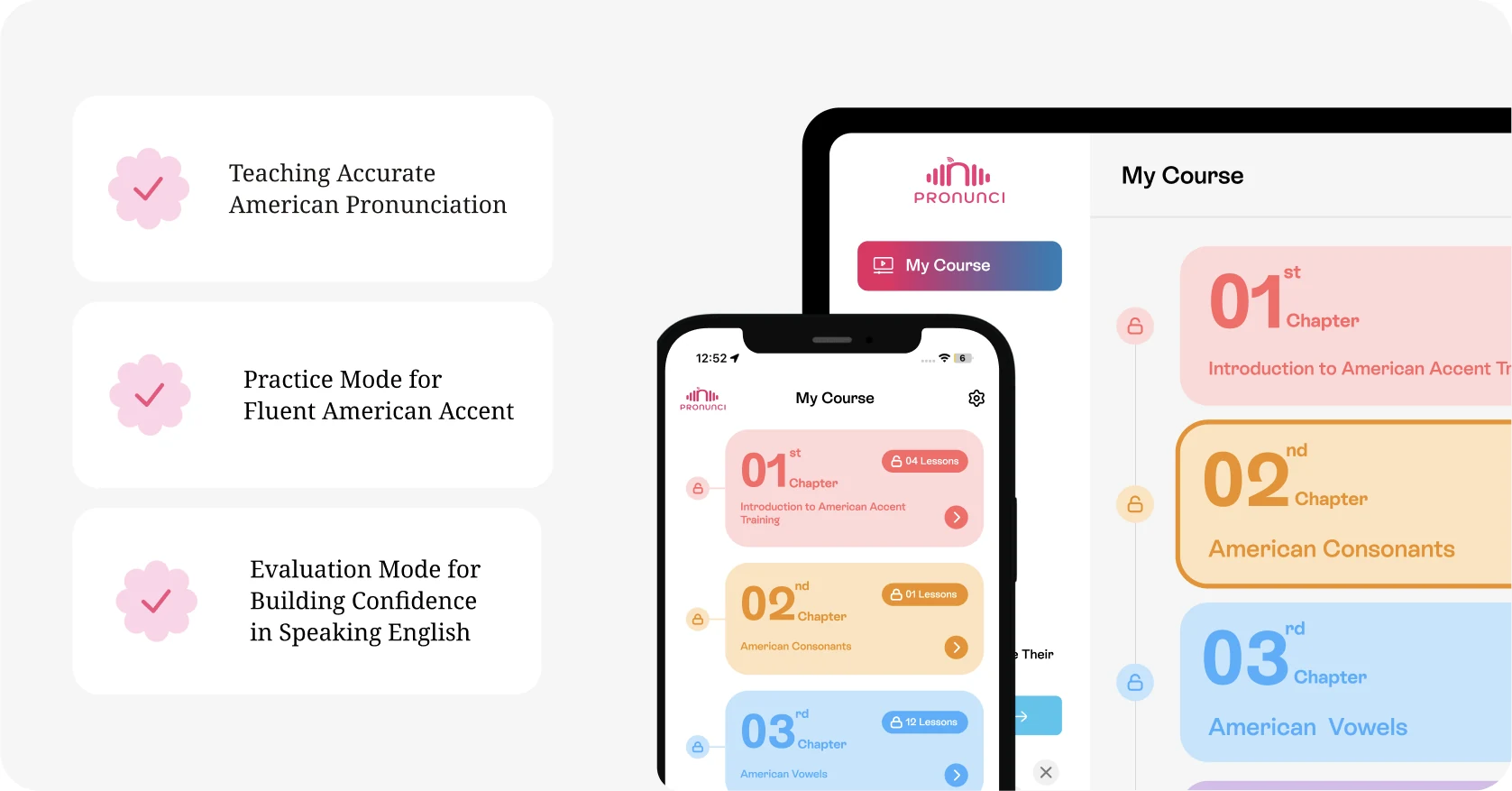
- Speech Organs EducationStudents learn how the speech organs work, along with the AI Accent Coach commands and feedback.
- American ConsonantsPractice and evaluate American consonants in phonetic exercises and practice sentences with the AI Accent Coach.
- American VowelsPractice and evaluate American vowels in phonetic exercises and practice sentences with the AI Accent Coach.
- IntonationLearn how intonation can change the meaning of what you say.
- CertificateBy the end of the course, students receive a certificate.
Why Russian speakers have an accent in English
Every language trains the tongue, lips, jaw and airflow in its own way. Adults who learned Russian first have strong, automatic habits: a tense tongue, soft (palatalized) consonants, strong final devoicing, and a falling melody. In English, those habits create predictable patterns. This is normal, and it is trainable. The goal for most learners is clear, natural American English that listeners understand easily.
The 11 most common pronunciation problems for Russian speakers
1. T and D: on the upper teeth instead of the gum ridge
In Russian, т and д are dental sounds: most Russian speakers press the tongue tip against the back of the upper teeth. In American English, [t] and [d] are alveolar sounds. The tongue tip goes up to the gum ridge, the hard area just behind the upper teeth, and does not touch the teeth.
When the tongue tip stays on the teeth, [t] and [d] sound softer and less clear. That makes the accent easy to hear in very common words:
- [t]: time, ten, today, tell
- [d]: do, day, dog, did
- Sentence: “Tell Dan it’s time to study today.”
To fix it, place the tongue tip on the gum ridge, not on the teeth, build the air behind it, and release. For [t], let a small puff of air come out at the start of the word: “time”, “ten”. For [d], keep the voice on: “day”, “dog”.
Train the American [t] with the Interactive Visual 2D Sound Simulator
In the InPronunci app, the Interactive Visual 2D Sound Simulator for the American [t] trains the tongue tip to move to the gum position near the upper teeth, without touching them, and to release the air at the right moment. The same tongue position is used for [d].
Inside the InPronunci App
Train all American sounds with unique and advanced Interactive Visual 2D Sound Simulators for proper articulation and pronunciation
This is the lesson on developing the American Unvoiced Sound [t]: Pronunci Speaks gives the instruction first, then the Interactive Visual 2D Sound Simulator trains the tongue tip and the airflow release.
- EffectiveMost apps offer visual learning. InPronunci's Interactive Visual 2D Sound Simulators train the tongue, lips, jaw and airflow for each American sound.
- ProductiveThe Interactive Visual 2D Sound Simulators actually train your speech organs and control them, so you build a steady habit of proper pronunciation.
- ResultsStudents pronounce individual American sounds with almost native-like pronunciation.
2. TH sounds [θ] and [ð]
Russian has no TH. “Think” can become “sink” or “fink”, and “this” can become “zis” or “dis”. The tongue tip needs to touch the edge of the top teeth with air flowing out.
3. W and V
Russian has V but no W, so “west” can sound like “vest” and “wine” like “vine”. For W, the lips round and push forward, and the top teeth do not touch the lip.
4. Short vs. long vowels
Russian does not separate vowel pairs by length and tension, so these often sound the same:
– ship / sheep
– full / fool
– live / leave
5. The æ sound in “cat”
Russian has no æ. “Bad” and “bed”, or “man” and “men”, can sound the same. For æ, the jaw drops lower and the tongue spreads wide and flat.
6. Final devoicing
In Russian, voiced consonants at the end of a word become voiceless. In English, this changes the word:
– dog → dock
– bag → back
– eyes → ice
– prize → price
The vowel before a voiced ending is also longer in American English: “bag” has a longer vowel than “back”.
7. H
The Russian “х” is made in the back of the mouth with friction. The English H is only soft air: “house”, “hello”, “hotel”.
8. Soft consonants before I and E
Russian softens (palatalizes) consonants before I and E. In English, this makes words like “tea”, “dear” or “need” sound too soft. American consonants stay the same before every vowel.
9. The American R and the dark L
The Russian R is trilled or tapped. In the American R, the tongue tip does not touch anything. The American L at the end of a word, as in “feel” or “school”, is a dark L with the back of the tongue raised.
10. Aspiration and the flap T
American P, T and K at the start of a stressed syllable have a puff of air: “pen”, “time”, “keep”. Russian P, T and K have no puff, so they can sound like B, D and G to American ears. Between vowels, American T becomes a quick flap: water, better, city.
11. Intonation
Russian yes/no questions often rise and fall on one word, and statements fall strongly at the end. In English, this can sound serious or unfriendly even when it is not meant that way. American English uses a final rise in yes/no questions and a more varied, lighter melody in conversation.
Practice word pairs for Russian speakers
| Sound | Practice pairs |
|---|---|
| TH | think / sink, three / free, they / zay |
| W vs. V | west / vest, wine / vine, wet / vet |
| Short I vs. long E | ship / sheep, live / leave, fit / feet |
| æ vs. e | bad / bed, man / men, sat / set |
| Voiced endings | dog / dock, bag / back, eyes / ice |
| H | house, hello, behind, hotel |
| Aspiration | pen, time, keep, people, today |
Say each pair slowly first, then in a short sentence, then at normal speed.
How to get rid of a Russian accent in English: a practice plan
- Learn how the speech organs work. Know where the tongue, lips and jaw go for each American sound.
- Train one sound at a time. Start with TH, W, æ, the vowel pairs, and voiced endings.
- Use minimal pairs. Pairs like dog / dock train your ear and your mouth at the same time.
- Move into sentences. A sound is not trained until you can say it inside real speech.
- Train American intonation. Practice yes/no questions with a final rise and a lighter melody in statements.
- Get feedback. It is hard to hear your own accent. Recording yourself and getting sound-by-sound feedback shows what to fix next.
Best American accent training app for Russian speakers: InPronunci
InPronunci is an American accent training app built by Prof. Alex, Ph.D. Accent Coach, Doctor of Education, and professional linguist. Prof. Alex teaches ESL pronunciation at Austin Community College, and InPronunci follows his research-based training method. It trains the exact sounds in this guide, in the same order:
- Interactive Visual 2D Sound Simulators train the speech organs for each sound: where the tongue goes for TH, how the lips work for W, how the jaw drops for æ.
- Phonetic exercises with minimal pairs like west / vest, ship / sheep and dog / dock.
- Sentences and paragraphs with American stress, intonation and connected speech.
- AI Accent Coach feedback word by word and sound by sound, with scores where 100 = native speaker.
The course has four chapters: Speech Organs Education (free), American Consonants, American Vowels, and American Intonation. InPronunci is built for Russian speakers from Russia, Ukraine, Belarus, Kazakhstan and around the world, and for software engineers, doctors and professionals preparing for meetings, job interviews and TOEFL or IELTS speaking.
Sounds Russian speakers find hard in American English
Published pronunciation sources describe these as common patterns for Russian speakers. In InPronunci, each sound is trained with the Interactive Visual 2D Sound Simulators, guided by Pronunci Instructions, and checked with the AI Accent Coach.
- W said as V: "west" sounds like "vest".
- TH: "think" becomes "sink" or "fink"; "this" becomes "zis" or "dis".
- R: rolled instead of the American R.
- H: a harsh, throaty H.
- NG: "sing" said as "sin" or "sing-g".
- Final voiced consonants: "bag" sounds like "back", "dog" like "dock".
- Vowel pairs: ship/sheep, bad/bed and full/fool sound alike.
- Word endings: final consonants are released too strongly, so speech can sound choppy.
Vlad, a Russian speaker, trained in the InPronunci Premium Plan, which combines Interactive 1-on-1 American Accent Training with Prof. Alex and daily practice in InPronunci. Prof. Alex recorded and evaluated each recording on a scale from 0 to 100, where 100 = native speaker.
Premium Plan result

VladPower Engineer
Russian speaker
“It feels amazing when people say, ‘Your accent is so good. Where did you learn it?’ My answer is always, ‘Thanks to my great teacher, Alex.’”
Full evaluation of Vlad on MyAccentWay
5monthsof hard work and dedication
Listen to the starting point0:00
Listen to the result0:00
Questions & Answers
FAQ
01Which app helps Russian speakers sound more American?
Look for an app that trains each missing sound separately, gives feedback on it, and then moves to intonation. InPronunci follows this order, from speech organs to consonants, vowels, and American intonation and emphasis, and Premium members also get monthly 1-on-1 sessions with Prof. Alex.
02Why do Russian speakers have an accent in English?
Because Russian has no TH, no W, no æ, no short and long vowel pairs, and it devoices final consonants. Russian intonation also falls where American English rises.
03How can I get rid of my Russian accent in English?
Train the sounds Russian does not have one at a time, practice them in minimal pairs and sentences, and then train American intonation. Feedback on each sound speeds up the process.
04Why do Russian speakers say “dok” instead of “dog”?
In Russian, voiced consonants at the end of a word become voiceless. In English, keep the voice on the final G and make the vowel before it longer.
05Why can a Russian accent sound serious or rude?
Russian intonation falls strongly at the end of sentences and questions. American English uses more rises and a lighter melody, so the same words can sound more friendly.
06What is the best American accent training app for Russian speakers?
InPronunci, created by Prof. Alex, Ph.D. Accent Coach, trains the sounds that create a Russian accent in English with Interactive Visual 2D Sound Simulators, phonetic exercises, and AI Accent Coach feedback. Chapter I is free.
Plans
What InPronunci costs
InPronunci Basic
$35 per month
Chapter 1 is free after signup.
InPronunci Premium
$200 per month
Includes a coach: