
Fixing intelligibility fastest for Portuguese speakers means prioritizing three targets: vowel contrasts and schwa reduction, final consonant release to stop epenthesis, and stress-timed rhythm with natural intonation. Structured practice with visual feedback, like InPronunci: Accent Training App, speeds this work by making the invisible parts of pronunciation, tongue and jaw position, actually visible. Prof. Alex, Ph.D. Accent Coach, built this method for exactly this problem.
Download InPronunci on the App Store | Get InPronunci on Google Play
TL;DR:
- Portuguese speakers should prioritize mastering final consonant release and vowel contrasts like /ɪ/ versus /i/ to improve intelligibility.
- Epenthesis occurs mainly because Portuguese syllable structure adds vowels after consonant clusters, which can be corrected with stop-and-hold drills.
- Improving rhythm and intonation requires focused practice on stress timing and pitch patterns, often through shadowing and mimicry exercises.
- Visual feedback tools incorporating tongue and lip positioning, such as the InPronunci app, significantly accelerate pronunciation progress.
- Progress typically takes 8 to 12 weeks of daily, structured practice with recordings and native comparisons, not passive exposure alone.
Table of Contents
- What sounds should Portuguese speakers fix first for pronunciation?
- What causes epenthesis and how do you stop it?
- How do vowel differences and schwa affect your accent?
- How does stress-timed English rhythm differ from Portuguese?
- What does a multi-week pronunciation practice routine look like?
- Why does structured, visual training work better for Portuguese speakers?
- How does Brazilian Portuguese differ from European Portuguese for English pronunciation?
- Why does connected speech feel so different in English?
- What are the most specific fixes for Portuguese phonetic interference?
- What are the most common Portuguese-influenced pronunciation mistakes?
- Author Perspective: What Realistic Progress Actually Looks Like
- Get Structured Practice With InPronunci
- Sources
- FAQ
What sounds should Portuguese speakers fix first for pronunciation?
Not every sound error carries the same weight in a conversation. Some mistakes barely register with a native listener. Others cause real confusion, the kind that makes a colleague ask you to repeat yourself twice in a meeting. If a listener has to stop and mentally decode what you said, that’s a comprehension cost you can’t afford in a job interview or a client call.
Minimal pairs show this clearly. Mixing up “seat” and “sit,” or “man” and “men,” can flip the entire meaning of a sentence. These aren’t cosmetic slips. They’re the sounds that most often derail intelligibility for Portuguese speakers moving into American English.
Here’s where to put your first hours of practice:
- Schwa (/ə/): the reduced vowel in unstressed syllables, missing this makes English sound choppy instead of flowing.
- /æ/ vs other low vowels: “cat” needs a lower jaw drop than Portuguese speakers typically use.
- /ɪ/ vs /i/: the difference between “sit” and “seat” hinges on tongue height, not length.
- American /r/: retroflex, with no tongue trill or tap.
- Dark L: the /l/ at the end of “well” or “table” pulls back in the mouth.
- Dental fricatives /θ, ð/: “think” and “this” require tongue between the teeth, not behind them.
- Final consonant release: stopping words cleanly instead of adding a trailing vowel sound.
A quick way to start: record yourself reading five minimal pairs aloud, then play them back next to a native model. You’ll hear the gap immediately, and that gap is your practice map.
What causes epenthesis and how do you stop it?
Portuguese speakers often insert a small vowel sound after consonant clusters or final stops. Say “stop” and it becomes something closer to “stopi.” This happens because Portuguese phonotactics don’t allow the same consonant sequences English does, so the mouth defaults to a familiar pattern and adds a vowel to bridge the gap. Contrastive research on English and Portuguese consonant clusters confirms this is one of the most common transfer errors Brazilian learners make, alongside consonant deletion and voicing shifts.
The fix is a motor skill, not a memorization task. Here’s a sequence that works:
- Isolate the cluster edge. Say just the final consonant sound alone, no vowel attached, until it feels natural.
- Slow the word down. Stretch “stop” into three distinct beats: “s…t…op,” holding the final /p/ closed.
- Practice stop release. Hold your articulators in place for a beat, roughly 150 to 300 milliseconds, before releasing air.
- Record and compare. Play your version against a native speaker saying the same word.
Try it with “asked,” “desks,” and “helped.” If you can hear the final consonant clearly, without any added vowel trailing off, you’re on track.
Pro Tip: Practice final stops by holding your mouth in the closed position after the sound, silently, for a full second before moving on. That pause trains the muscle memory your ear can’t teach on its own.
For a deeper walk-through of specific cluster patterns, InPronunci’s guide to mastering consonant clusters breaks down word-initial, medial, and final clusters step by step.
How do vowel differences and schwa affect your accent?
Brazilian Portuguese has a vowel system that doesn’t map cleanly onto American English. Acoustic analysis comparing Brazilian Portuguese and American English vowels shows measurably different vowel spaces using formant data (F1 and F2), which explains why Portuguese speakers often collapse distinct English vowels into one sound. “Sit” and “seat” start sounding identical, because in Portuguese, that length and tension distinction doesn’t carry the same meaning.
The schwa is the other half of this problem. English relies on this reduced, almost lazy vowel in unstressed syllables constantly, and skipping it is why fluent Portuguese speakers can still sound stiff or overly precise in English. Every syllable gets full value in Portuguese; English deliberately shortchanges most of them.
Try these physical cues:
- For /æ/ (“cat,” “map”), drop your jaw lower than feels natural at first.
- For /ɪ/ versus /i/ (“bit” vs “beat”), keep your tongue relaxed and lower for /ɪ/, tenser and higher for /i/.
- Practice the schwa in phrases like “a cup of coffee,” letting “a” and “of” shrink almost to nothing.
- Say “The doctor is available tomorrow” slowly, marking which vowels reduce and which stay full.
How does stress-timed English rhythm differ from Portuguese?
Portuguese is syllable-timed. Each syllable gets roughly equal time and weight, which is part of what gives Portuguese its fast, even cadence. English is stress-timed. Stressed syllables land at a steady beat, and everything between them, function words like “a,” “the,” “to,” “of,” gets compressed and reduced. That compression is exactly where the schwa comes back into play.
Skip this rhythm shift and you’ll sound grammatically correct but oddly robotic, every word given equal weight like a metronome instead of a melody. Three drills fix this fast:
- Sentence tapping. Read a sentence aloud and tap your finger only on the stressed syllables. Notice how much time passes between taps versus how many syllables get squeezed in.
- Reduced-function-word shadowing. Play a native recording and repeat immediately after, focusing only on how quickly “for the,” “to a,” and “in an” get swallowed.
- Pitch-curve imitation. Hum the rising and falling pitch of a sentence without the words first, then add words back in.
Intonation errors compound the rhythm problem. Portuguese speakers often flatten questions that should rise sharply at the end, or apply a falling pattern where English expects a rise. Contrastive analysis of Portuguese and English intonation identifies this as one of the last accent features to fade, because pitch patterns are largely unconscious. Explicit pitch-curve practice is what breaks through it. For a structured breakdown of where English stress falls and why, InPronunci’s guide on stress and emphasis walks through the patterns in more detail.
What does a multi-week pronunciation practice routine look like?
Progress here isn’t about hours logged. It’s about whether each session targets a specific muscle movement or listening skill, repeated until it becomes automatic. A scattered 40 minutes of “practicing English” accomplishes far less than 20 focused minutes on one sound family.
A sequenced six-week plan looks like this:
- Week 1: Speech-organ awareness. Learn where your tongue, jaw, and lips need to sit for target sounds before worrying about words.
- Week 2: Vowel contrasts and schwa. Minimal pairs, jaw-drop drills, reduction practice in phrases.
- Week 3: Consonant clusters and final release. Stop-and-hold drills, cluster-edge isolation.
- Week 4: Stress-timed rhythm. Tapping drills, function-word shadowing.
- Week 5: Intonation. Pitch-curve imitation for statements, questions, and lists.
- Week 6: Integration. Full sentences and short paragraphs combining all five skills, recorded and compared daily.
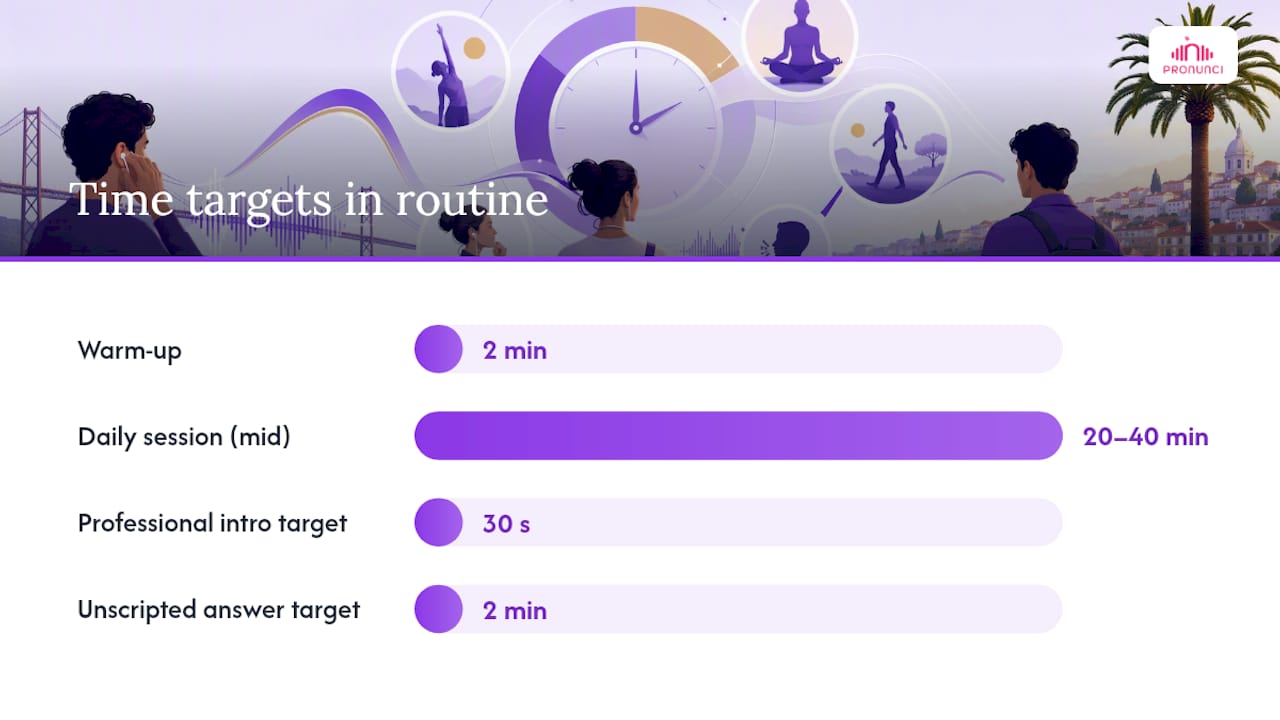
Each daily session, 20 to 40 minutes, should follow the same shape: a two-minute warm-up (lip and tongue stretches), a focused drill on that week’s target, a shadowing exercise with a native model, then record, compare, and correct one specific error before stopping.
Pro Tip: Track progress with before-and-after recordings of the same sentence each week, not just isolated sounds. Sentence-level comparison shows you whether rhythm and intonation gains are sticking, not just individual vowels.
Minimal-pair ladders paired with recording comparison against a native model accelerate this kind of perceptual re-mapping, according to practical teaching guides built specifically for Brazilian learners. Milestones worth targeting: comfortably repeating a 30-second professional introduction without vowel insertion errors by week 3, and holding natural rhythm through a two-minute unscripted answer by week 6.
Why does structured, visual training work better for Portuguese speakers?
Prof. Alex, Ph.D. Accent Coach, has spent more than 20 years teaching, researching, and coaching American accent training, and that background shapes how InPronunci: Accent Training App sequences its curriculum. The program moves through four chapters in order: Speech Organs Education, American Consonants, American Vowels, and Intonation and Emphasis, covering 13 consonant sessions and 12 vowel sessions before connected speech work begins.
That order matters. Random drilling of isolated sounds rarely sticks. Sequencing speech-organ awareness before sound production, then building toward full sentences, produces better long-term retention.
The Interactive 2D Sound Video Simulator makes this concrete. It shows tongue, lip, and airflow positioning for a sound in real time, then guides you to repeat the movement until it becomes usable in connected speech. The American [t] demonstration shows exactly how this works:
Watch how the tongue makes contact and releases for the American [t] sound in this Interactive 2D Sound Video Simulator demonstration. This is the same visual feedback method used across every consonant and vowel session in the curriculum.
Learners then use My Coach and My Pronunci to compare their own recording directly against the native model, with AI Accent Coach feedback flagging exactly where the gap is.
How does Brazilian Portuguese differ from European Portuguese for English pronunciation?
Brazilian Portuguese speakers and European Portuguese speakers carry noticeably different accent patterns into English, and the differences trace back to how each variety handles vowels and sibilants at home.
European Portuguese reduces unstressed vowels heavily, sometimes dropping them almost entirely in casual speech. That habit can actually help with the English schwa, since the ear is already trained to expect vowel reduction. Brazilian Portuguese, by contrast, keeps vowels fuller and more open across the board, which is part of why Brazilian speakers tend to give every English syllable more weight than native listeners expect.
Sibilants tell a similar story. European Portuguese often produces a final /s/ closer to “sh,” which can bleed into English words ending in “s” (“this,” “yes”), giving them a softer, hushed quality. Brazilian Portuguese speakers are more likely to carry over open vowel quality and a tendency toward epenthesis after final consonants, since Brazilian Portuguese syllable structure favors open syllables even more strongly than the European variety.
Nasal vowels are a Brazilian-specific challenge. Words like “pão” involve nasalization that doesn’t exist in English, and some Brazilian speakers unconsciously nasalize English vowels near /m/ or /n/, adding a texture native English listeners find unfamiliar. European Portuguese speakers rarely carry this over, since their nasal vowel inventory works differently.
Neither background is harder to correct. But knowing which variety shaped your ear helps you predict your own likely error pattern before you even hear the recording.
Why does connected speech feel so different in English?
Linking is where isolated sound accuracy meets real conversation, and it’s often where Portuguese speakers hit a wall even after mastering individual sounds. English speakers routinely link a final consonant to the next word’s vowel: “turn it off” becomes “turn-it-off” with almost no gap between words.
Portuguese speakers, trained on more open syllable structures, often insert a small pause or vowel between words instead of linking them. The result is technically correct pronunciation of each word individually, but a rhythm that sounds segmented rather than flowing, like reading a list instead of speaking a sentence.
Consonant-to-consonant linking causes a different problem. When one word ends in a consonant and the next starts with the same or a similar one, English speakers often merge them rather than pronouncing both fully: “good day” softens toward “goo’day.” Portuguese speakers who articulate each consonant fully end up sounding overly formal or stilted, even though nothing is technically wrong.
Reductions compound this. Phrases like “going to” collapsing into “gonna,” or “want to” into “wanna,” aren’t laziness. They’re standard connected speech that native listeners expect and unconsciously predict. Pronouncing every word at full value, while grammatically flawless, can actually make a Portuguese speaker harder to follow because it violates the rhythm patterns native listeners use to parse sentences in real time.
The fix is shadowing, not memorizing rules. Pick a short native audio clip, thirty seconds is enough, and repeat it in real time, matching not just the words but exactly where the linking, reductions, and pauses fall.
What are the most specific fixes for Portuguese phonetic interference?
Accent reduction works best when it targets the specific transfer patterns Portuguese carries into English, rather than generic “speak clearer” advice. A few targeted habits make an outsized difference.
Watch your final consonants first. Since Portuguese syllables strongly favor ending in vowels, the instinct to add a small vowel sound after English final consonants is often unconscious. Deliberately holding the articulators closed after words like “stop,” “big,” or “cat” retrains this specific habit faster than general fluency practice.
Retrain your /r/ separately from everything else. The Portuguese /r/ involves either a tap, a trill, or a guttural sound depending on position and dialect, none of which resemble the American retroflex /r/. Practicing /r/ in isolation, away from full sentences, prevents old motor patterns from taking over mid conversation.
Address dental fricatives with a mirror, not just your ears. Many Portuguese speakers substitute /s/ or /z/ for /θ/ and /ð/ (“think” becomes “sink,” “this” becomes “dis”), because Portuguese has no equivalent sound. Watching your tongue placement between your teeth in a mirror catches this faster than audio feedback alone, since the error is invisible to your own ear until it’s already habitual.

Slow down before you smooth out. Rushing to sound fluent often reinforces exactly the errors, epenthesis, vowel collapsing, missed linking, that need correcting first. Deliberate, slightly slower practice speech, with each target sound exaggerated, builds the muscle memory that natural-speed fluency later relies on. For consonant-specific practice beyond fricatives, InPronunci’s guide to American English consonant pronunciation covers nasal and lateral sounds that follow similar interference patterns.
What are the most common Portuguese-influenced pronunciation mistakes?
A handful of errors show up so consistently across Portuguese speakers that they’re worth naming directly, along with the correction that fixes each one.
The first is treating English vowels as if they carry the same open, full quality Portuguese vowels do. “Bit” comes out sounding like “beet,” because the tongue height distinction between /ɪ/ and /i/ doesn’t exist as a meaningful contrast in Portuguese. The correction: practice the pair side by side, feeling the tongue drop slightly and relax for /ɪ/.
The second is epenthesis after final stops and clusters, covered earlier as one of the top three priorities. “Desk” becomes “deski,” “stopped” becomes “stopedi.” The correction is the stop-and-hold drill: freeze the articulators after the final consonant instead of letting airflow continue into an extra vowel.
The third is substituting /s/ or /z/ for the dental fricatives /θ/ and /ð/, so “three” sounds like “tree” or “free” depending on the speaker. The correction: tongue-between-teeth practice in a mirror until the placement feels automatic rather than effortful.
The fourth is skipping schwa reduction entirely, giving every syllable full stress and full vowel value. “Comfortable” gets four distinct syllables instead of collapsing toward “comf-ta-ble.” The correction: mark unstressed syllables in written text before reading aloud, then deliberately underarticulate them.
The fifth is flattening question intonation, especially yes/no questions that need a clear rise at the end. “Are you coming?” said with falling pitch reads as a statement, not a question, to a native ear. The correction: pitch-curve humming before adding words back.
Author Perspective: What Realistic Progress Actually Looks Like
Most learners who practice consistently see measurable clarity gains within 8 to 12 weeks, not overnight and not in a year. That timeline assumes daily focused practice, not passive exposure to English media, which barely moves the needle on production accuracy.
Plateaus are normal around week 4 or 5, usually when a learner has fixed the obvious errors and stops noticing the subtler ones. The remedy isn’t more repetition of the same drill. It’s a fresh set of ears, through coaching or objective recording comparison, to catch what your own ear has stopped hearing.
Perfect native-like speech isn’t the practical goal for most professionals. Clear, confident intelligibility is, and that’s a genuinely achievable target.
— Prof. Alex., Ph.D. Accent Coach
Get Structured Practice With InPronunci
Everything covered here, vowel contrasts, epenthesis control, stress-timed rhythm, works faster with structured feedback than with guesswork alone. InPronunci: Accent Training App is built around exactly this sequence: Prof. Alex’s guided curriculum moves you through Speech Organs Education, then consonants, vowels, and intonation, using Interactive 2D Sound Video Simulators so you can see tongue and lip placement instead of guessing at it from audio alone.
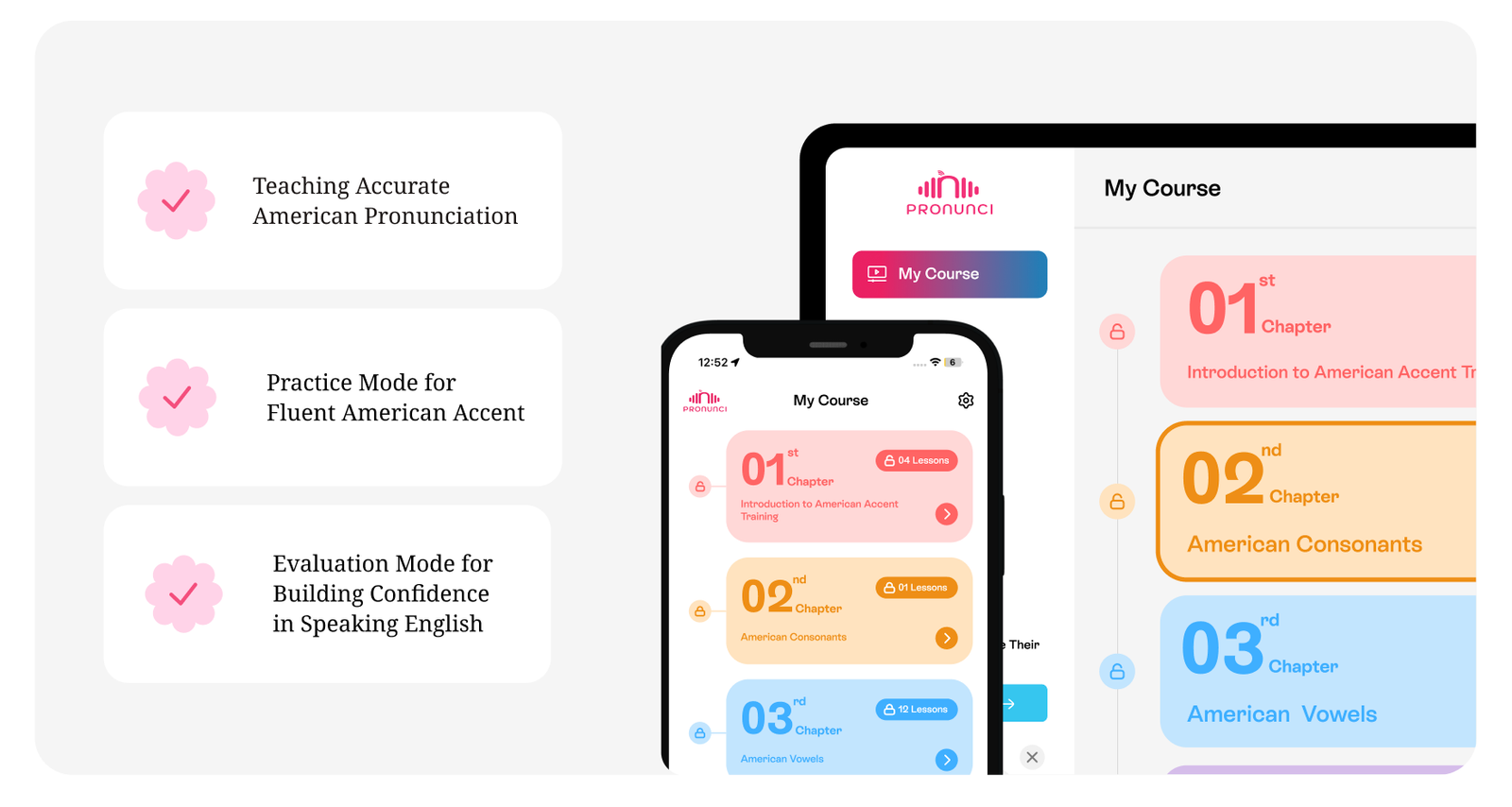
The app provides AI-based feedback and includes tools that let you hear your recording directly against a native model, supporting the recommended comparison method for effective practice. You can start with a free onboarding chapter, then choose the Basic Plan for self-guided practice or the Premium Plan at a monthly rate determined by InPronunci for one-on-one coaching with direct feedback on your specific interference patterns. For a full walk-through of how the chapters build on each other, the InPronunci American Accent Training Course lays out the complete sequence. Start with the free onboarding chapter today and see exactly where your practice should begin.
Sources
- Portuguese and English intonation in contrast
- English and Portuguese consonant clusters: contrasts and challenges
- Análise Acústico-Comparativa de Vogais Do Português Brasileiro com Vogais do Inglês Norte-Americano
- English Pronunciation for Brazilian Portuguese Speakers: A Professional Guide to Speech Clarity
FAQ
What is the fastest way to reduce a Portuguese accent in English?
Focus on final consonant release, vowel contrasts like /ɪ/ versus /i/, and stress-timed rhythm before anything else, since these three affect intelligibility the most. Structured practice with recorded comparison against a native model, the approach InPronunci: Accent Training App uses, speeds up this process significantly.
Why do Portuguese speakers add extra vowels to English words?
This is called epenthesis, and it happens because Portuguese syllable structure doesn’t allow the same consonant clusters English does, so the mouth inserts a vowel to bridge the gap. Contrastive research on consonant clusters identifies this as one of the most common transfer patterns from Portuguese to English.
How long does it take to improve American English pronunciation?
Consistent daily practice typically produces noticeable clarity gains within 8 to 12 weeks, though full comfort with connected speech and intonation can take longer. Progress depends heavily on whether practice includes structured feedback and recording comparison rather than passive listening alone.
Does InPronunci offer a free trial for accent training?
InPronunci offers a free onboarding chapter before you choose between the Basic Plan or the Premium Plan at a monthly rate determined by InPronunci for one-on-one coaching. Basic Plan pricing details are available directly on the InPronunci site.
What is the difference between Brazilian and European Portuguese accents in English?
European Portuguese speakers already reduce unstressed vowels heavily at home, which can make the English schwa easier to adopt, while Brazilian Portuguese speakers tend to keep vowels fuller and are more prone to epenthesis after final consonants. Nasal vowel transfer is also more common among Brazilian speakers due to differences in each variety’s sound inventory.