
Aspiration in English is the short burst of breath released right after you say /p/, /t/, or /k/ at the start of a stressed syllable, and it matters because leaving it out can make listeners hear the wrong consonant entirely, mistaking “pie” for “buy” or “ten” for “den.” This single timing detail, measured in milliseconds, is one of the most overlooked reasons non-native speech gets misheard even when grammar and vocabulary are flawless. InPronunci: Accent Training App trains this exact skill with an
, which you’ll see demonstrated below alongside drills you can start today.
Download on the App Store | Get it on Google Play
TL;DR:
- Most learners aspirate /p t k/ at 60–80 milliseconds VOT, but they often fail to time the release correctly relative to voicing, which causes mispronunciation.
- Aspiration occurs mainly at word-initial, stressed syllable stops and disappears after /s/ or at word endings, requiring targeted practice to master these patterns.
- Simple tests like holding paper or recording minimal pairs can reveal improper aspiration timing, which is more about coordination than force or volume.
- Visual tools like spectrograms and animation models help learners see the precise timing gap, leading to faster, more durable pronunciation improvements.
- The InPronunci app combines visual feedback, AI comparison, and structured drills to correct aspiration issues more effectively than passive listening or guesswork.
Table of Contents
- What is aspiration in phonetics?
- Where does aspiration happen in English words?
- How can you hear and measure your own aspiration?
- What mistakes do learners make with aspiration?
- How do you train aspirated [p], [t], and [k] step by step?
- Why Prof. Alex built aspiration training into InPronunci
- The one mistake almost every aspiration lesson gets wrong
- Train aspiration with structured feedback, not guesswork drills
- Sources
- FAQ
What is aspiration in phonetics?
Aspiration is a measurable delay between when your lips or tongue release a stop consonant and when your vocal cords start vibrating for the next sound. Linguists call that gap voice onset time, or VOT. The longer the gap, the more “puff of air” you hear, and that puff is what your ear uses to sort voiceless stops like /p t k/ from their voiced twins /b d g/.
Here’s the number that surprises most learners: English aspirated /p t k/ typically run around 60 to 80 milliseconds of VOT, while voiced stops like /b d g/ sit closer to 0 to 10 milliseconds, according to Wikipedia’s summary of aspirated consonants. That difference, less than a tenth of a second, is often the entire signal a native listener uses to tell “pat” from “bat.”
Aspiration by the Numbers
Aspirated /p t k/: approximately 60–80 ms VOT. Voiced /b d g/: approximately 0–10 ms VOT. The gap between them is what your ear actually hears as “voiceless” versus “voiced,” not the vibration itself.
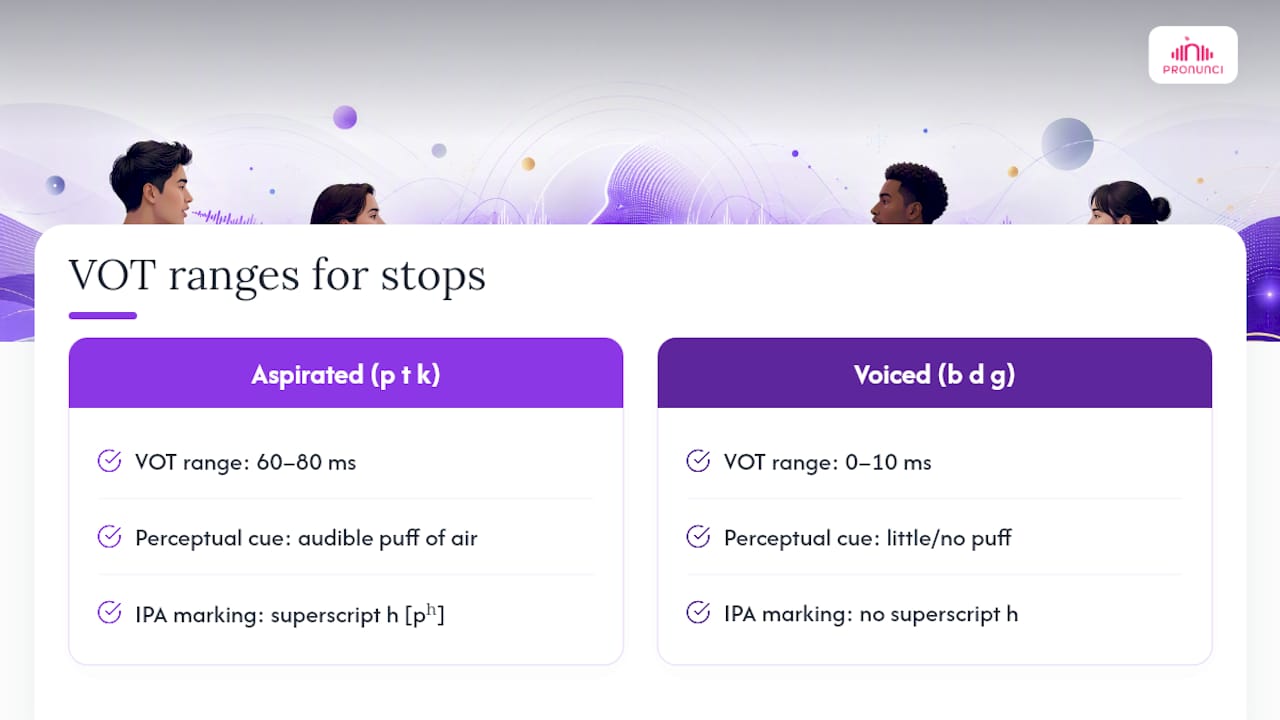
In the International Phonetic Alphabet, aspiration gets marked with a small raised h, so /p/ becomes [pʰ], /t/ becomes [tʰ], and /k/ becomes [kʰ]. That superscript h is not decorative. It tells you the consonant carries a real burst of air before voicing kicks in, which is exactly the property the Cambridge Dictionary describes when it defines aspiration as the noise air makes escaping after a plosive.
If you ever look at a spectrogram, the pattern is easy to spot once you know what you’re looking for: a burst of noisy energy right after the stop’s silence, followed by a gap of white space before the voicing bars begin. That gap is your VOT, sitting right there in the image.
Where does aspiration happen in English words?
Aspiration is not random. It follows rules that intermediate and advanced learners can memorize in a single sitting, and once you know them, half your pronunciation confusion disappears.
- Word-initial voiceless stops get aspirated. “Pen,” “top,” and “cat” all start with a clear puff of air.
- Stressed syllable-initial stops get aspirated, even mid-word. Think of the strong “p” sound in “rePEAT” or the “k” in “aCCOUNT.”
- After /s/, aspiration disappears. “Spot,” “stop,” and “skate” have unaspirated stops, which is why they sound closer to [b], [d], and [g] to an untrained ear, even though they’re still technically /p t k/.
- Word-final stops are typically unaspirated or only weakly released. The “p” at the end of “stop” carries almost none of the burst you’d hear at the start of “pot.”
According to Essentials of Linguistics, aspiration in American English occurs primarily at the beginning of a word or a stressed syllable, and it is absent after /s/ and at the end of words, while voiced stops like [b d g] are never aspirated under any circumstance. There’s also a more advanced wrinkle worth knowing: some medial stops that look syllable-initial are actually unaspirated because of ambisyllabicity, a pattern the University of Groningen’s American English phonetics textbook covers in more depth for learners chasing native-like rhythm.
How can you hear and measure your own aspiration?
You don’t need a phonetics lab to check your VOT. A few low-tech tests will tell you almost everything you need to know.
- Hold a strip of paper or a lit candle an inch from your lips and say “pie.” A properly aspirated /p/ makes the paper flutter or the flame flicker; an unaspirated one barely moves it.
- Say “spy” the same way and watch the paper stay nearly still, since the /p/ after /s/ isn’t aspirated.
- Record yourself saying minimal pairs like “pill” versus “spill,” or “pie” versus “spy,” and play them back slowed down.
- Open a free spectrogram app (many phones and browsers have one) and look for that gap of white space between the stop’s release burst and the start of voicing bars.
- Drill minimal pairs out loud daily, listening specifically for the puff, not just the overall word shape.
Pro Tip: Your phone’s slow-motion video mode, the one made for sports shots, works surprisingly well for watching your own lip release timing when you record yourself saying “pie” versus “spy” side by side.
What mistakes do learners make with aspiration?
The most common error isn’t a missing sound. It’s a timing problem disguised as a breathing problem.
- Confusing “breathe harder” with correct VOT. Blowing more air doesn’t fix aspiration if the timing between release and voicing is still off; the delay matters more than the force.
- Over-aspirating after /s/, which makes “spot” sound oddly breathy and unnatural to native ears, or aspirating in unstressed syllables where English speakers wouldn’t.
- Under-aspirating word-initial stops, which causes listeners to hear /b d g/ instead of /p t k/, turning “pack” into something closer to “back.”
- L1 transfer patterns: Romance-language speakers often lack strong aspiration contrasts and under-aspirate; Slavic-language speakers sometimes carry over their own VOT patterns unevenly; East Asian-language speakers may aspirate consistently but miss the /s/-cluster exception.
The fix isn’t forcing a louder exhale. It’s learning to feel exactly when your vocal cords start vibrating after the release, a timing cue rather than a volume cue.
How do you train aspirated [p], [t], and [k] step by step?
Building reliable aspiration takes repetition with feedback, not just reading the rules. Here’s a sequence that works whether you’re practicing alone or with structured software.
- Awareness stage: Say [pʰ], [tʰ], [kʰ] in isolation while holding paper near your mouth, confirming you feel and see the airflow.
- Isolated sound with airflow focus: Repeat each sound 10 times, exaggerating the puff slightly before dialing it back to natural strength.
- CV syllable drills: Practice “pa, ta, ka” and “spa, sta, ska” back to back, noticing the contrast disappear after /s/.
- Word pair drills: Work through “pill/spill,” “pie/spy,” “cool/school,” alternating until the difference feels automatic.
- Sentence drills: Read short sentences loaded with target sounds, like “Tom took ten tools to the top,” checking stressed syllables specifically.
- Timed reading: Read a short paragraph aloud at normal speed, then compare a recording against a native model.
A realistic schedule is a short daily focus of practice lasting some minutes, aiming for multiple repetitions per session rather than a single long session once a week. Short, frequent practice cements the muscle timing better than occasional long sessions.
Record yourself at each stage and play it back slowed down, comparing your release timing to a native speaker’s. Once your ear catches the basic contrast, add spectrogram feedback to confirm the VOT gap is actually there and not just something you think you hear.
This is where the 2D Sound Video Simulator showing /t/ earns its place in your routine. It shows the tongue, jaw, and airflow position frame by frame, so instead of guessing what “aspirate the t” means, you watch the exact release and repeat it immediately. Pair it with the consonant training sessions for a structured path through all three aspirated stops.
Pro Tip: Watch the simulator once without trying to speak, just to observe the timing. Then watch it a second time while mimicking out loud. Separating observation from production reduces the tendency to rush the sound.
Why Prof. Alex built aspiration training into InPronunci
Prof. Alex, Ph.D. Accent Coach, has spent over 20 years teaching, researching, and privately coaching American pronunciation, and that experience shaped how InPronunci treats a detail as small as a 60-millisecond puff of air. Passive listening rarely fixes aspiration errors because learners can hear the difference without ever locating the exact timing shift in their own mouths.
Structured active retraining, built on speech-organ awareness, guided repetition, and a visual model you can compare yourself against, produces more durable change than passive listening alone. Seeing the articulation, not just hearing it, is what lets learners find the exact timing they’ve been missing.
InPronunci’s Speech Organs Education module builds this awareness before drilling begins, then layers in the 2D Sound Video Simulator and AI Accent Coach feedback so you can compare My Pronunci against My Coach on every rep.
The one mistake almost every aspiration lesson gets wrong
Most pronunciation guides treat aspiration as a rule to memorize rather than a timing skill to feel, and that’s backwards. You can recite “aspirate word-initial voiceless stops” perfectly and still say it wrong, because the correction has to happen in your larynx, not in your grammar notes.
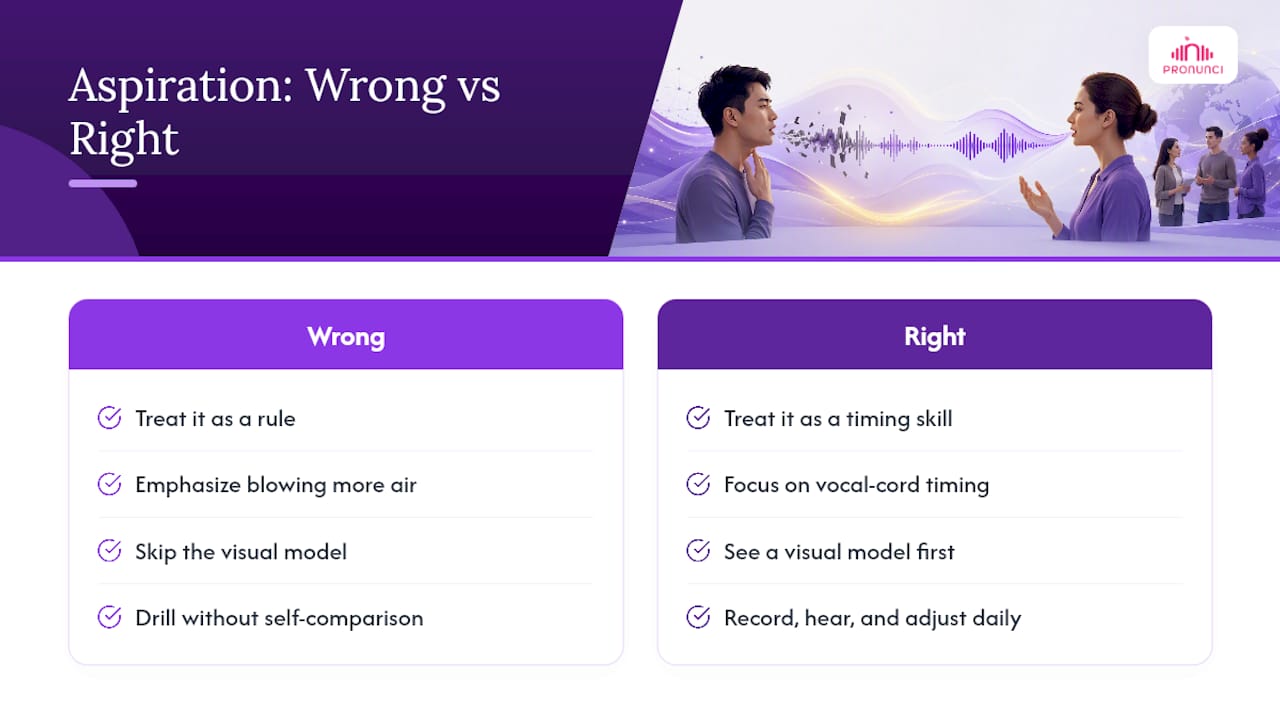
The conventional advice, “blow more air on your p’s and t’s,” actively misleads learners. It’s not about force. It’s about exactly when your vocal cords start vibrating relative to the release, a gap of milliseconds you can’t consciously count but can absolutely train your ear and mouth to feel. Learners who chase volume end up sounding exaggerated or, worse, aspirate sounds that should stay unaspirated, like the /p/ after /s/ in “spot.”
What actually works is pairing a visual model of the articulation with immediate self-comparison. You need to see the timing, attempt it, hear your own recording, and adjust, in that order, repeated daily. Skipping the visual step and going straight to repetition is why so many learners plateau with inconsistent aspiration for years. Prioritize seeing the mechanism before drilling the sound, and the rest follows faster than most learners expect.
— Prof. Alex., Ph.D. Accent Coach
Train aspiration with structured feedback, not guesswork drills
Reading the rules for aspiration gets you halfway there. Actually hearing your own timing gap and correcting it in real time is the part most learners struggle to do alone, and it’s exactly where InPronunci: Accent Training App was built to help. Instead of generic pronunciation scoring, InPronunci pairs the 2D Sound Video Simulator with speech-organ visuals and AI Accent Coach comparison, so you can watch the release, record your attempt, and see exactly where your VOT falls short of the native model.
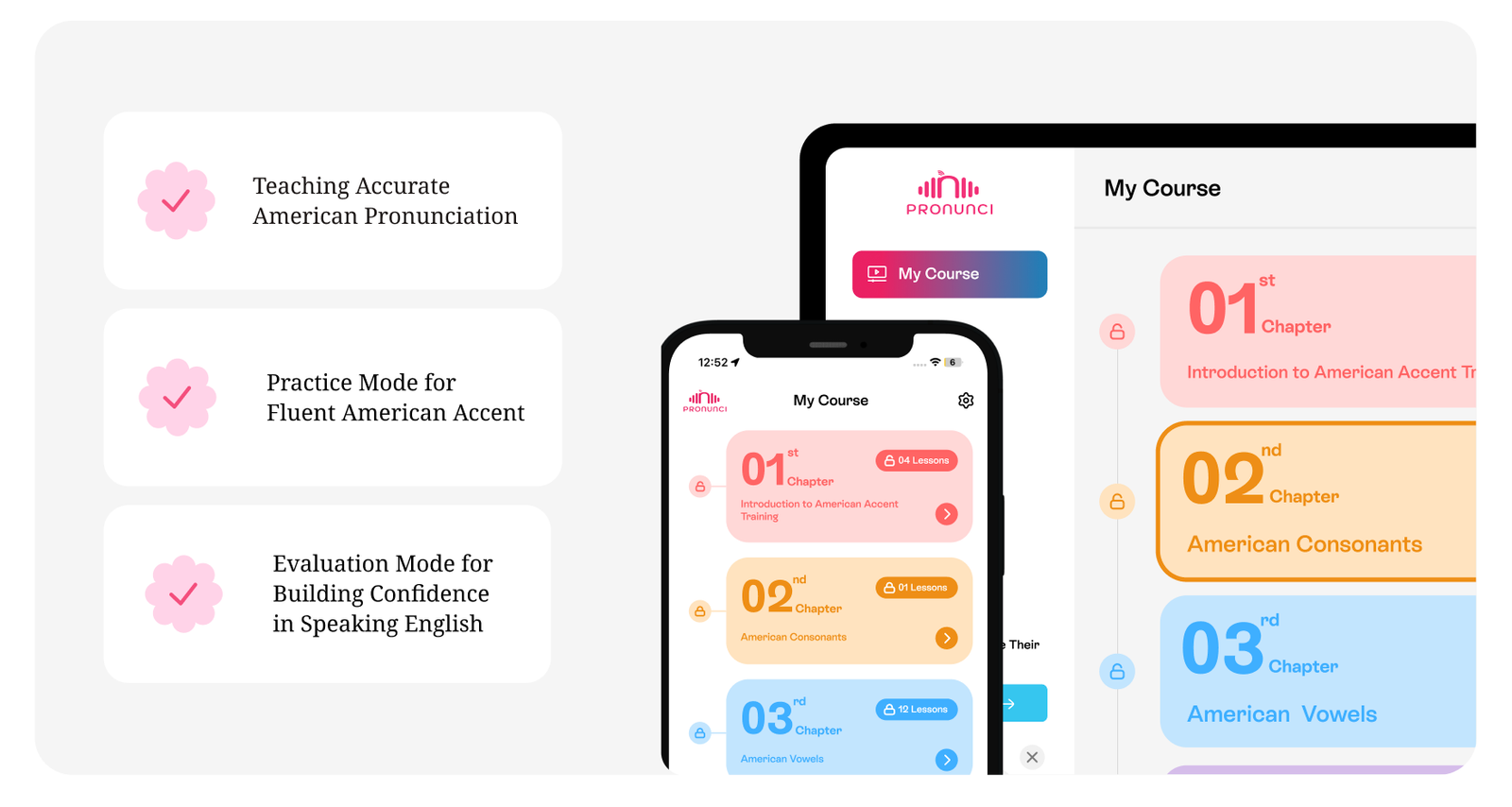
The consonant module covers multiple American consonant sessions, including dedicated work on /p/, /t/, and /k/, alongside progress tracking that shows whether your aspiration timing is actually improving session over session. Learners who want faster correction can add optional 1-on-1 coaching through the Premium Plan, which offers direct feedback from a human coach on top of the AI comparison tools. If you’d rather start with the core app experience first, the Basic Plan covers the full consonant and vowel curriculum.
Explore the full method through the InPronunci: American Accent Training Course on desktop, or start directly in the app to run your first aspiration drill today.
Sources
- 3.5 Aspirated stops in English – Essentials of Linguistics
- Aspirated consonant — Wikipedia
- aspiration | Cambridge Dictionary
FAQ
What does “aspiration” mean in phonetics versus medicine?
In phonetics, aspiration is the burst of breath after a voiceless stop like /p t k/, marked in IPA with a superscript h. In medicine, aspiration refers to inhaling food, liquid, or foreign material into the airway or lungs, a completely unrelated meaning that shares only the word itself.
What is aspiration in medical terms?
Medically, aspiration means breathing a substance, food, liquid, vomit, or a foreign object, into the lungs instead of swallowing it properly. It’s a separate concept from phonetic aspiration and carries real health risks, including pneumonia, if it happens repeatedly.
What does it mean if someone aspirated and died?
This refers to the medical sense: a fatal case where inhaled material blocked the airway or led to severe lung complications like aspiration pneumonia. It has no connection to the linguistic use of the term covered in this article.
What is the difference between aspiration and choking?
Choking is a complete or partial airway blockage, often causing visible distress and an inability to breathe or speak. Aspiration can happen more quietly, sometimes without an obvious choking reaction, especially when small amounts of liquid or food enter the airway gradually.
How do you know if you’re aspirating correctly in speech?
Use the paper-flutter test on word-initial /p t k/, check that the flutter disappears after /s/ as in “spot,” and compare a slow-motion recording of your release timing against a native speaker model, which tools like InPronunci’s AI Accent Coach are built to do automatically.