
Americans say “customer service” as /ˈkʌs.tə.mɚ ˈsɝː.vɪs/, roughly “KUSS-tuh-mur SUR-vis,” with a hard /r/ in both words. British speakers say /ˌkʌs.tə.mə ˈsɜː.vɪs/, “KUS-tuh-muh SER-vis,” dropping the /r/ entirely and lengthening the vowel instead. The gap between them comes down to one feature: whether you pronounce the letter R after a vowel at all.
Download InPronunci: Accent Training App on Apple App Store or Google Play to hear both models and start training your own version today.
TL;DR:
- American speakers pronounce the /r/ sound fully in “customer” and “service,” while British speakers omit it, lengthening the vowels instead.
- The phrase “customer service” consists of four syllables in “customer” and two in “service,” with stress on the first syllable of each word and middle syllables reducing to a schwa.
- Learners often struggle with the unstressed “er” in “customer” and the vowel in “service,” which can be fixed by practicing linking and reducing syllables.
- Consistently applying accent rules and avoiding over-articulation are crucial for clear pronunciation, especially in high-frequency customer-facing contexts.
- Using visual, audio, and feedback tools like the InPronunci app can significantly improve mouth positioning and sound accuracy over independent guessing.
Table of Contents
- How do you say “customer service” with correct IPA?
- How is “customer service” broken into syllables and stress?
- American vs British: what actually sounds different?
- What mistakes do learners make, and how do you fix them?
- How can InPronunci help you master this phrase?
- Why small phrases like this one matter more than you think
- Practice this phrase with guided coaching, not guesswork
- Sources
- FAQ
How do you say “customer service” with correct IPA?
Dictionaries give slightly different symbols depending on which accent they model, but the sounds underneath are consistent. The Cambridge Dictionary transcribes American English as /ˌkʌs.tə.mɚ ˈsɝː.vɪs/ and British English as /ˌkʌs.tə.mə ˈsɜː.vɪs/. Oxford Learner’s Dictionaries lists it almost identically: /ˌkʌstəmə ˈsɜːvɪs/ for UK, /ˌkʌstəmər ˈsɜːrvɪs/ for US.
Here’s what to listen for in each source:
- Cambridge and Oxford audio clips let you toggle between US and UK speakers on the same page, which is the fastest way to hear the R contrast side by side.
- SpanishDict’s pronunciation page offers a simplified phonetic rendering that’s useful if IPA symbols still feel unfamiliar.
- YouGlish pulls real video clips of native speakers saying the phrase in unscripted contexts, which matters because dictionary audio is often slower and more careful than natural speech.
Pro Tip: Loop the same 10 seconds of audio five times before you try to repeat it. Your ear needs several passes to catch the schwa reduction that your eyes, reading the spelling, will never predict.
The two syllables that trip up most learners are the unstressed “er” in “customer” and the vowel in “service.” Get those two right and the rest of the phrase falls into place.
How is “customer service” broken into syllables and stress?
Break the phrase down and it’s four syllables in “customer” plus two in “service”: cus-to-mer, ser-vice. Stress lands on the first syllable of each word: CUS-to-mer, SER-vice. Everything else compresses.
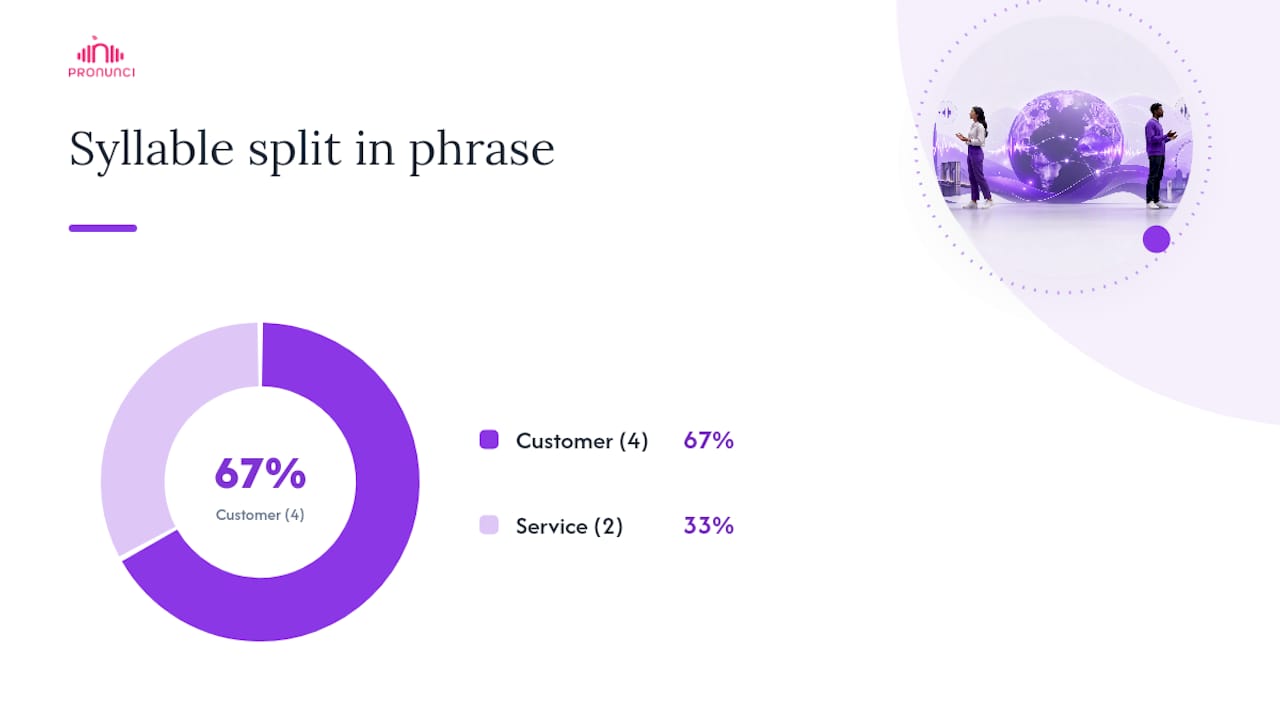
That compression is the real skill. The “to” and “mer” in “customer” both shrink to a schwa (/ə/), the flattest, laziest vowel sound in English. Native speakers rarely say all four syllables of “customer” with equal weight. In fast, natural professional speech, “customer” often collapses to something closer to “kuss-mər,” two syllables instead of four, according to Oxford’s usage notes on stress and reduction.
Here’s the practice sequence that actually builds this skill instead of just describing it:
- Say each syllable alone, slowly: cus, to, mer, ser, vice.
- Combine into words: CUStomer, SERvice.
- Combine into the full phrase at half speed: CUStomer SERvice.
- Speed up to conversational pace, letting the middle syllables blur.
Linking matters here too. When “customer” flows into “service,” the final /r/ or schwa of “customer” connects smoothly into the /s/ that opens “service,” with no pause between words. That connected flow, not crisp separation, is what makes the phrase sound native rather than robotic.
American vs British: what actually sounds different?
The single biggest audible difference is the R. Americans pronounce a full rhotic /r/ wherever the letter appears after a vowel, so “customer” ends with a clear “-mer” sound and “service” gets that distinctive /sɝː/ core, sometimes called an “r-colored vowel.” British speakers use a non-rhotic system: the R after a vowel disappears, and the vowel stretches to compensate, giving “service” the /sɜː/ sound, longer and rounder, with no R at all.
A few other contrasts worth training your ear for:
- Vowel quality in “service”: American /sɝː/ pulls the tongue back with the R fully engaged; British /sɜː/ keeps the tongue more neutral and relies on length instead of R color.
- Timing and rhythm: American speech tends to compress unstressed syllables slightly faster, while British RP often gives “customer” a marginally more even syllable rhythm.
- Word-final R behavior: in British English, the R only reappears when the next word starts with a vowel (“customer and,” where R links across), a pattern called linking R that has no equivalent in General American.
Neither version is more correct. Global call centers, hospitality teams, and customer-facing professionals use both successfully. What matters in international business settings is consistency: pick one target accent and apply its rules evenly, rather than mixing rhotic and non-rhotic features in the same sentence.
What mistakes do learners make, and how do you fix them?
Three errors show up constantly in accent training sessions, and each has a fast fix.
- Hyper-articulation. Learners pronounce every syllable of “customer” with equal stress, “CUS-TO-MER,” which sounds stiff and unnatural to native ears. Fix it by deliberately underplaying the middle syllables until they nearly disappear.
- Schwa mismanagement. Some learners skip the schwa entirely and clip the word short; others over-pronounce it as a full “uh.” Practice saying “customer” with a soft, quick “kiss-tuh-mər,” barely touching the middle vowel.
- R errors. American learners targeting a US accent sometimes under-pronounce the R, making “service” sound flat. Learners targeting British English sometimes add an R that should not be there. Isolate the sound first: hold your tongue near the roof of your mouth without touching it, and let the R color the vowel rather than snapping it.
Try this minimal-pair sentence for a quick accuracy check: “Our customer service team called the customer yesterday.” Say it slowly, then at full speed, and listen for whether your R and schwa placement stayed consistent between the two instances of “customer.”
Pro Tip: Record yourself saying the sentence, then play it back at half speed using any video app’s playback controls. Slowed-down audio exposes sloppy schwas and inconsistent R placement that your ear misses at normal speed.
Shadowing, repeating a native audio clip in real time while it plays, is the single most effective drill for locking in these corrections. Start slow, matching the recording word for word, then gradually increase speed until you can shadow at full conversational pace without falling behind. This is also where mouth positioning for key vowels starts to matter more than memorizing IPA symbols.
How can InPronunci help you master this phrase?
Reading IPA symbols only gets you so far. You can’t see your own tongue, and most learners guess at articulation instead of training it directly. InPronunci: Accent Training App solves that with Interactive 2D Sound Video Simulator that show tongue, lip, and jaw positioning in real time, including this
, which demonstrates exactly how visual, voice-guided training works for consonants that give learners trouble.
Here’s a seven-step micro-practice you can run on “customer service” this week:
- Listen to a native model of the phrase inside the app.
- Watch the relevant sound simulator for R and schwa placement.
- Record your own attempt.
- Compare My Coach (the native model) against My Pronunci (your recording).
- Apply AI Accent Coach feedback on specific sound errors.
- Repeat the phrase five times, adjusting based on feedback.
- Integrate it into a full sentence and re-record.
Set a milestone: three consecutive clean recordings before moving to a new phrase.
Why small phrases like this one matter more than you think
Client-facing professionals say “customer service” dozens of times a day, and a single mispronounced high-frequency phrase does more damage to intelligibility than an accented vowel buried in a rare word. Clearer speech has measurable stakes at work. One TTEC client story found that reducing audio ambiguity cut average handle time significantly and dead air dramatically. Your goal is not a flawless native accent. It’s consistent, confident clarity on the phrases you use most.
— Prof. Alex., Ph.D. Accent Coach
Practice this phrase with guided coaching, not guesswork
Dictionary audio gives you a model to imitate, but it can’t tell you why your R sounds off or whether your schwa is too heavy. InPronunci: Accent Training App provides feedback on your specific recording, not a generic pronunciation score. It includes 2D Sound Video Simulators to see the mouth mechanics behind each sound, an AI Accent Coach that flags where your version diverges from the native model, and in-app chat access to a human coach when a sound still won’t click.
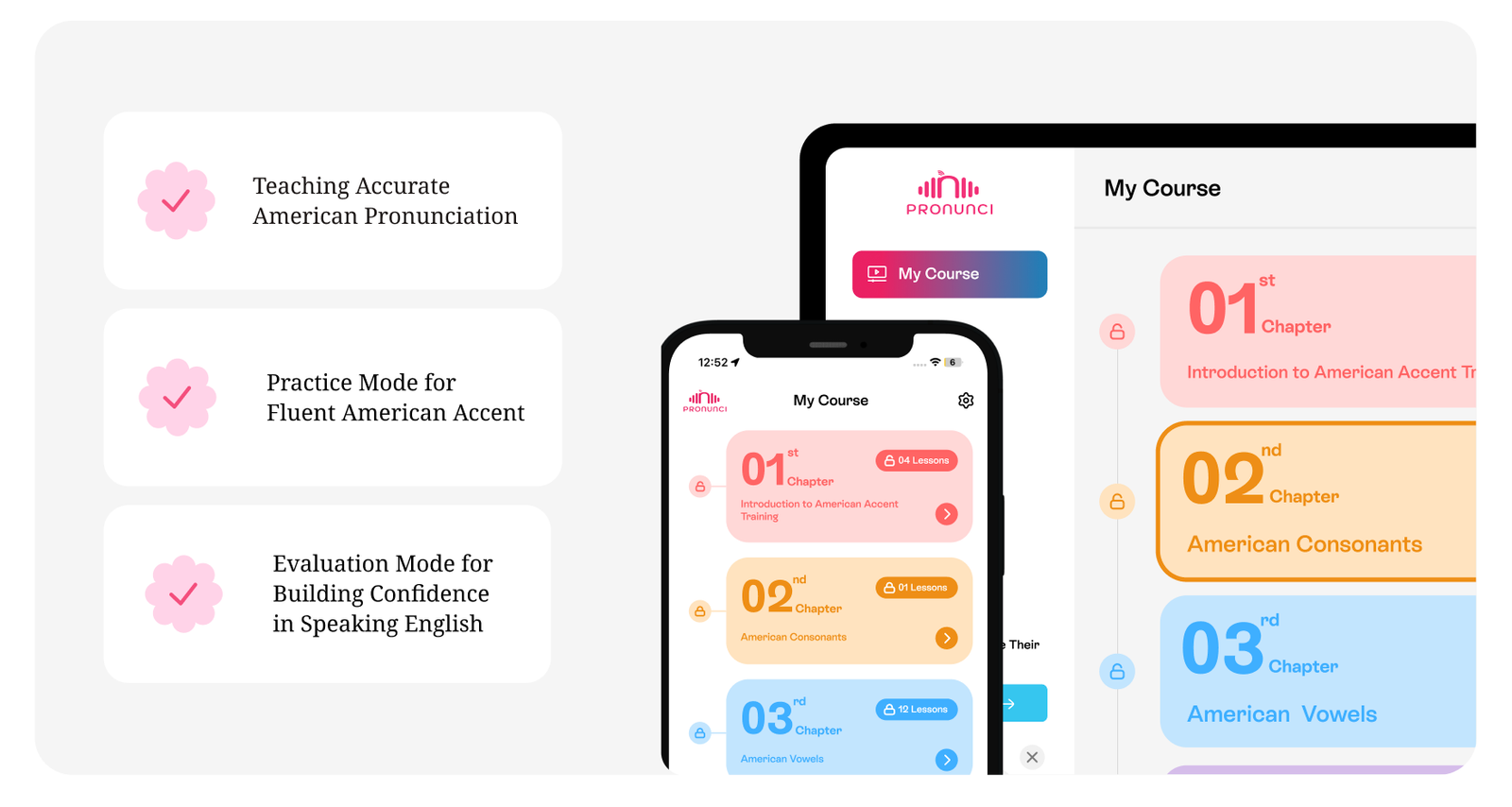
Start with the free onboarding chapter inside InPronunci: American Accent Training Course and search the curriculum for a “customer service” micro-practice session to apply everything in this guide. If you want the fuller picture of how the structured program builds from single sounds to full sentences, the InPronunci curriculum overview walks through each chapter. Download the app on Apple App Store or Google Play and run your first recording today.
Sources
- How to pronounce CUSTOMER SERVICE in English
- customer service noun – Definition, pictures, pronunciation and usage notes | Oxford Advanced Learner’s Dictionary
- Customer service | English Pronunciation
- Help desk reduces AHT, dead air, and ambiguity for quicker resolution | TTEC
FAQ
How is “customer” pronounced correctly?
“Customer” is pronounced /ˈkʌs.tə.mɚ/ in American English and /ˈkʌs.tə.mə/ in British English, with stress on the first syllable and the middle syllables reduced to a schwa.
What does “customer service” mean?
“Customer service” refers to the support and assistance a business provides to the people who buy from it, including answering questions, resolving problems, and handling requests before or after a purchase.
How do I say I have good customer service skills?
You can say “I have strong customer service skills” or “I’m experienced in customer service,” stressing CUS-to-mer and SER-vice clearly while keeping the middle syllables light and natural.
How do you pronounce “customer” in Spanish?
“Customer” translates to “cliente” in Spanish, pronounced roughly “klee-EN-teh”; the English word “customer” itself keeps its English pronunciation, /ˈkʌs.tə.mɚ/ or /ˈkʌs.tə.mə/, when used in an English sentence.