
The -ed suffix has three pronunciations, /ɪd/, /t/, and /d/, and you choose the right one by listening to the final sound of the verb, not by reading its spelling. If that last sound is /t/ or /d/, add /ɪd/ as an extra syllable. If it’s voiceless, say /t/. If it’s voiced, say /d/. A quick hand-on-throat check tells you which category you’re in before the word even leaves your mouth.
TL;DR:
- The pronunciation of -ed as /ɪd/ occurs only after verbs ending in /t/ or /d/, creating an extra syllable that must be practiced physically.
- The /t/ ending is used after voiceless sounds like /p/, /k/, /f/, and /s/, while /d/ follows voiced sounds such as /b/, /g/, /v/, /z/, and vowel endings.
- Performing a hand-on-throat check helps learners distinguish voiceless from voiced sounds quickly, enabling correct /t/ or /d/ usage without relying solely on spelling.
- Some adjectives like aged, learned, or blessed always keep the /ɪd/ pronunciation due to historical usage and descriptive function, regardless of the rule.
- Consistent physical practice and feedback tools, such as speech organ visuals and AI evaluations, are essential for internalizing proper -ed pronunciation in spontaneous speech.
Table of Contents
- What Are Voiced and Voiceless Consonants?
- What Are the Three Pronunciations of -ed?
- Quick Reference: The -ed Rule in Three Lines
- Why Do Some -ed Adjectives Keep the Extra Syllable?
- How Do You Practice -ed Endings Until They Stick?
- How Prof. Alex Approaches -ed Training
- What Most -ed Advice Gets Wrong
- Ready to Practice -ed Endings With Real Feedback?
- Sources
- FAQ
What Are Voiced and Voiceless Consonants?
A voiced sound makes your vocal cords vibrate. A voiceless sound doesn’t. That’s the entire distinction, and once you can feel it, the -ed rule stops being a memorization problem and becomes a physical one.
Here’s the test: place two fingers lightly on the front of your throat and say “ZZZ.” You’ll feel a buzz. Now say “sss.” Nothing. That buzz is the whole story, according to pronunciation materials from Howard Community College, which describe this exact throat check as a reliable way to sort consonants before applying suffix rules.
Common voiceless sounds include:
- /p/ as in “hope”
- /k/ as in “walk”
- /f/ as in “laugh”
- /s/ as in “fax”
- /ʃ/ as in “wash”
- /tʃ/ as in “watch”
Common voiced sounds include:
- /b/ as in “rob”
- /g/ as in “beg”
- /v/ as in “love”
- /z/ as in “buzz”
- /m/, /n/, /l/, /r/, and all vowel sounds
Pro Tip: Practice the throat check on single consonants first, away from whole words. Once your fingers can instantly tell you “buzz” or “no buzz,” applying it to fast, connected speech gets much easier.
What Are the Three Pronunciations of -ed?
Every regular past tense verb and -ed adjective in English falls into one of three sound categories, and none of them depend on how the word is spelled. This is the point where most learners get stuck, because English spelling gives no visual clue about which sound to use. Britannica Dictionary confirms the choice depends entirely on the final sound of the base verb, not its final letter.
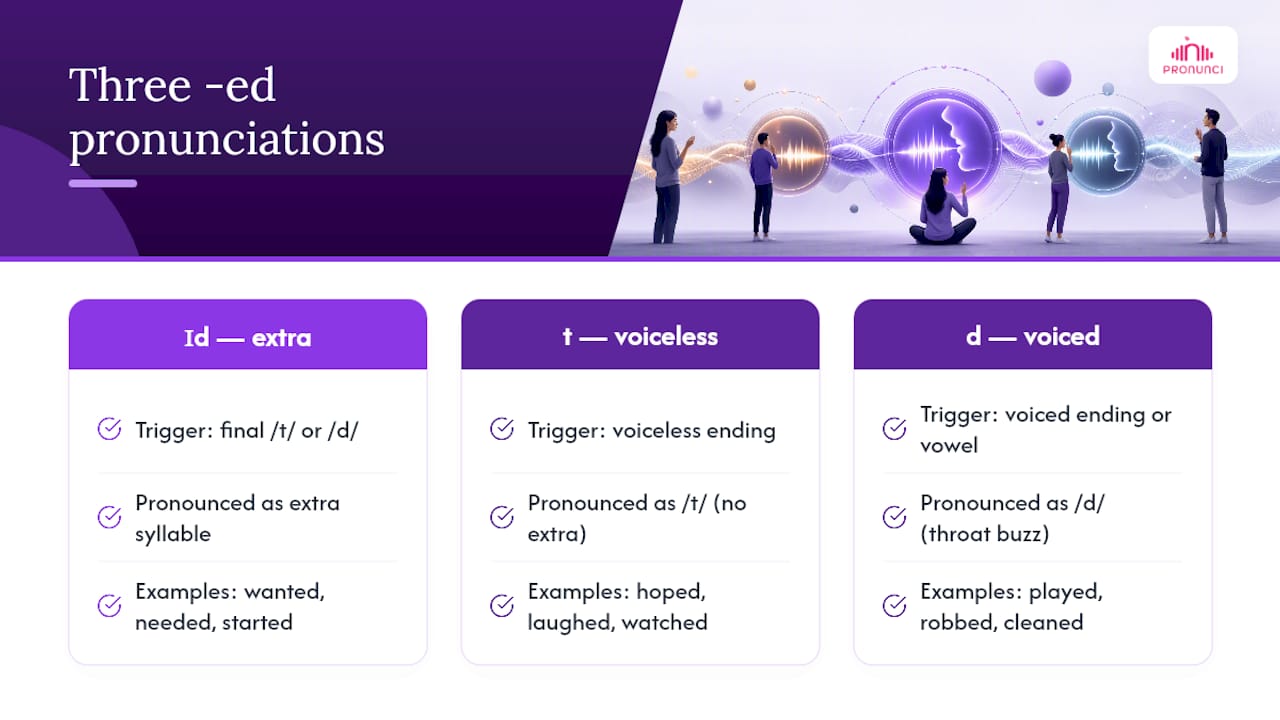
The /ɪd/ sound appears when the base verb already ends in a /t/ or /d/ sound. Adding another /t/ or /d/ right next to an existing one is hard to say clearly, so English inserts a small extra syllable instead. You hear this in wanted, needed, started, landed, decided, and visited. Say them slowly and count the syllables. “Wanted” has two beats, not one.
The /t/ sound follows voiceless endings. Hoped, laughed, watched, asked, walked, and liked all end in a crisp /t/, no extra syllable, no buzz in your throat when you make that final consonant.
The /d/ sound follows voiced endings and vowel sounds. Played, robbed, cleaned, allowed, and enjoyed all end in /d/. Note that “began” is irregular, so it doesn’t apply here. Say “played” aloud. Your throat buzzes right through to the end.
Baruch College’s speech clinic materials group these into the same three sets and recommend that learners nail the difference between “gets an extra syllable” and “doesn’t” before worrying about whether the short version is /t/ or /d/. That sequencing matters more than most textbooks let on.
Quick Reference: The -ed Rule in Three Lines
Keep this chart in your head during conversation, not buried in a notebook you’ll never open again.
- Base verb ends in /t/ or /d/ → add /ɪd/ (extra syllable): needed, started
- Base verb ends in a voiceless sound → say /t/ (no extra syllable): walked, watched
- Base verb ends in a voiced sound or vowel → say /d/ (no extra syllable): cleaned, played
A simple memory trick: “T and D invite ID.” If the verb already ends in T or D, it invites the /ɪd/ syllable to the party. Everything else just picks /t/ or /d/ based on the throat buzz. When you genuinely can’t tell whether a final consonant is voiced or voiceless, the hand-on-throat check settles it faster than trying to recall a rule from memory.
Why Do Some -ed Adjectives Keep the Extra Syllable?
A handful of -ed adjectives stubbornly keep the /ɪd/ pronunciation even though the rule says they shouldn’t. This is the exception list most textbooks skip over, and it trips up even advanced speakers.
- Aged (as in “an aged cheese,” pronounced with two syllables)
- Learned (as in “a learned professor”)
- Blessed (as in “a blessed event”)
- Wicked
- Ragged
- Naked
Merriam-Webster’s explanation of -ed pronunciation history notes that -ed was originally always a full syllable in Old and Middle English, and most verb forms reduced over time for speaking efficiency. These adjectives simply held onto the older, fuller pronunciation, often because they describe a lasting quality rather than a completed action. Context decides it: “the wind blessed us” (one syllable, verb) versus “a blessed relief” (two syllables, adjective). When in doubt with formal or literary vocabulary, check a dictionary entry rather than guessing.
How Do You Practice -ed Endings Until They Stick?
Reading a rule and applying it under pressure are two different skills. Close that gap with short, targeted drills instead of vague repetition.
- Voiceless list: say hoped, laughed, watched, asked, walked, liked five times each, checking that no buzz occurs on the final sound.
- Voiced list: say played, robbed, cleaned, allowed, enjoyed, called five times each, confirming the buzz carries through.
- Mixed /ɪd/ list: say wanted, needed, started, landed, decided, visited, exaggerating the extra syllable until it feels natural.
- For each word, follow this sequence: say the base verb, say the past tense, touch your throat to check voicing, record yourself on your phone, then play it back next to a native-speaker model.
- Repeat the set daily for a week before moving to full sentences.
In fast, connected speech, native speakers sometimes soften or nearly drop the /t/ or /d/ sound when the next word starts with a similar consonant, as BBC Learning English demonstrates with natural audio examples. That’s normal and not something to imitate too early. Until the three-way contrast is automatic, keep every -ed ending clear so your grammar stays understandable, even if it sounds slightly more careful than casual native speech.
Pro Tip: Record the same six sentences every day for a week rather than switching word lists constantly. Hearing your own progress on identical material is far more motivating than jumping between fresh vocabulary each session.

How Prof. Alex Approaches -ed Training
I’ve spent over 20 years teaching American pronunciation, and the -ed suffix is one of the clearest examples of a rule that’s simple to explain but hard to internalize without feedback. Reading about voicing is not the same as feeling it happen in your own mouth, which is why InPronunci builds physical awareness into every lesson rather than treating pronunciation as a memorization exercise.
The training program supports -ed training through several connected tools:
- Speech organs education that teaches what your tongue, throat, and vocal cords do during voiced versus voiceless sounds
- Interactive 2D sound video simulators that make hidden articulation visible frame by frame
- AI feedback that evaluates recorded attempts against native speaker models
- Comparison tools letting you hear your voice next to target sounds side by side
The
shows exactly where your tongue lands and how airflow releases, which is the articulatory foundation behind the /t/ ending in words like “walked” or “watched.” Watching that movement before attempting it yourself removes a lot of guesswork.
Many learners over-rely on spelling instead of listening for the final sound. Structured drills paired with real feedback, rather than silent reading, are what actually retrain the habit.
What Most -ed Advice Gets Wrong
Most explanations of -ed pronunciation stop at the rule. They give you the three categories, maybe a short list of examples, and leave you to sort it out on your own. That’s not enough, and I say that after two decades of watching capable, motivated learners memorize the rule perfectly and still mispronounce the words in live conversation.
The gap isn’t knowledge. It’s physical control under speaking pressure. Knowing that “walked” takes /t/ doesn’t help if your mouth defaults to /d/ the moment you’re mid-sentence and thinking about your next word. That’s a motor skill problem, not a grammar problem, and it needs a motor skill solution: repetition with a physical check, not another paragraph of explanation.
If you take one thing from this article, take the hand-on-throat habit and use it daily, even on words you think you already know. Confidence comes from consistency, not from reading the rule one more time. Pair that habit with visual tools that show you what your speech organs are doing, and the three-way distinction stops being a memorized list and becomes something you simply do.
— Prof. Alex., Ph.D. Accent Coach
Ready to Practice -ed Endings With Real Feedback?
Reading rules only gets you so far with a sound distinction that depends on split-second voicing control. InPronunci: Accent Training App gives you a structured path instead of scattered practice: a free onboarding chapter to start, then guided lessons that pair Speech Organs Education with AI feedback on your actual recordings, so you know whether your /t/, /d/, and /ɪd/ endings are landing correctly, not just whether they sound close.
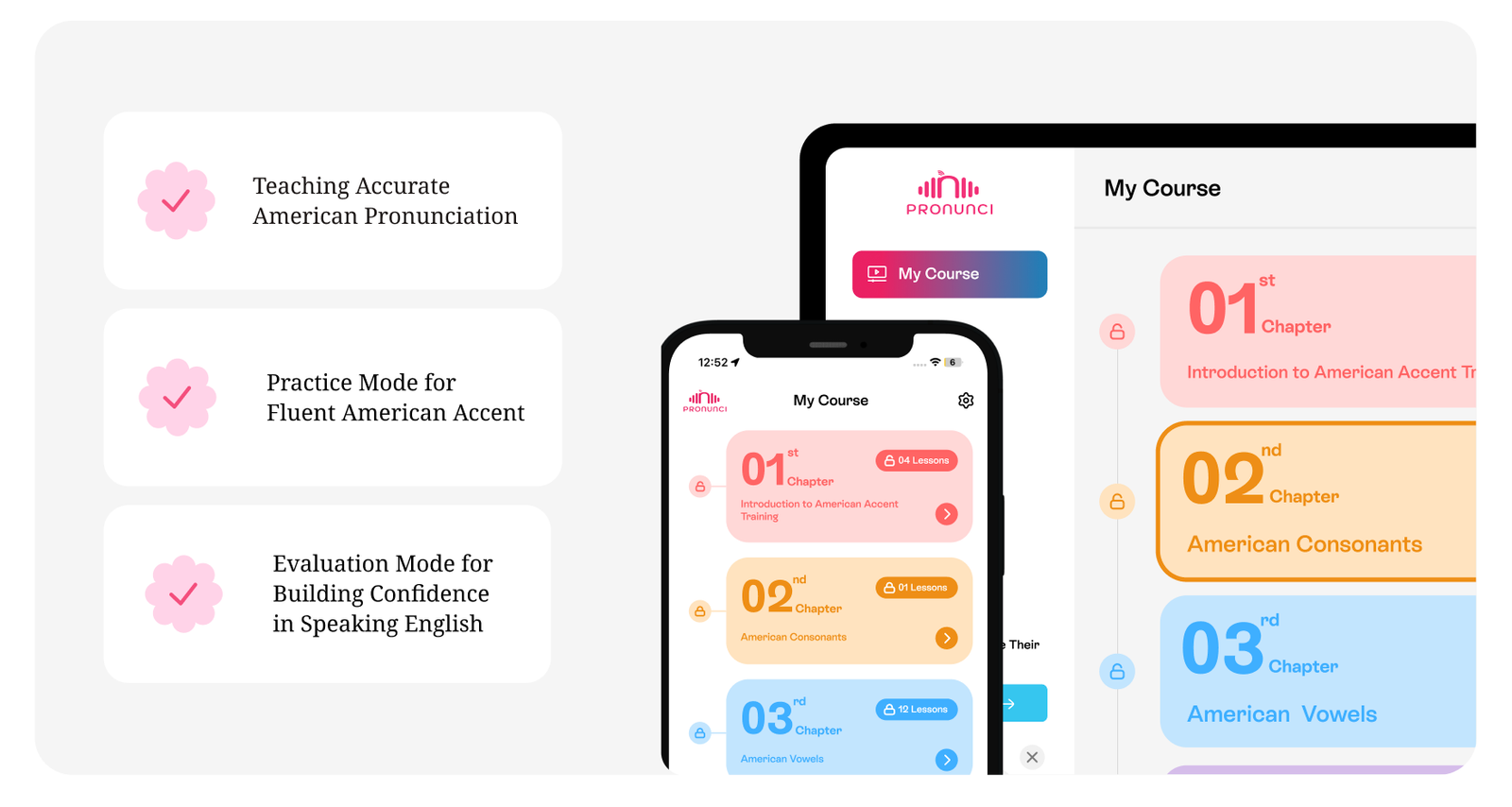
Download InPronunci on the App Store or get it on Google Play to begin. Once you’re in the app, the Interactive 2D Sound Video Simulator lets you watch the /t/ articulation before you attempt it yourself, and the voiced versus voiceless training module builds the throat check into a repeatable daily drill. If you want the full structured curriculum rather than the mobile app alone, InPronunci: American Accent Training Course walks you through the same method chapter by chapter, starting with speech organs and building up through consonants, vowels, and connected speech. Start with the free onboarding chapter today and record your first set of -ed endings before the session ends.
Sources
- Why is ‘-ed’ sometimes pronounced at the end of a word? — Merriam-Webster
- Pronunciation of -ed endings on verbs — Britannica Dictionary
- Voiced and voiceless sounds — Howard Community College materials
- How to pronounce -ed endings — BBC Learning English (The Pronunciation Lounge)
FAQ
Why is -ed pronounced as /t/ in some words?
The -ed ending is pronounced /t/ when the verb ends in a voiceless consonant sound, like /p/, /k/, /f/, or /s/, because your vocal cords don’t vibrate on that final sound. Words like “hoped,” “walked,” and “watched” all end in /t/ for this reason.
What are the three sounds of the -ed suffix?
The three pronunciations are /ɪd/ (an extra syllable, used after verbs ending in /t/ or /d/, as in “wanted”), /t/ (after voiceless sounds, as in “liked”), and /d/ (after voiced sounds and vowels, as in “played”). The choice depends on the final sound of the base verb, according to Britannica Dictionary.
How do you pronounce “Ed” as a name?
As a given name, “Ed” is pronounced as a single syllable, /ɛd/, rhyming with “bed.” This is unrelated to the grammatical -ed suffix rules, which only apply to verb and adjective endings.
What sound does -ed make at the end of a word?
It depends entirely on the sound right before it, not the spelling. After /t/ or /d/, it adds a syllable and sounds like /ɪd/. After other voiceless sounds it’s /t/, and after other voiced sounds or vowels it’s /d/, as confirmed by BBC Learning English.
How can I check whether a sound is voiced or voiceless on my own?
Place two fingers on your throat and say the sound. A vibration means it’s voiced; no vibration means it’s voiceless, a technique detailed by Howard Community College’s pronunciation materials. InPronunci’s Speech Organs Education module builds this same check into guided practice with visual support.