
You can move from an Indian to an American accent in a measurable, trainable way. Start with rhythm and three to five high-impact sounds, not an accent overhaul. Do 10 minutes of shadowing with a General American speaker today, then record a 30-second script and compare it to a native model. Guided, structured practice speeds up progress that random self-correction rarely produces.
Download on the App Store | Get it on Google Play
TL;DR:
- Practicing rhythm and stress patterns is key, as these shape how “American” your speech sounds more than individual consonants.
- Focus on mastering T/D flapping, R/L placement, and vowel length contrasts through daily minimal-pair drills and shadowing exercises.
- Consistent, short daily sessions of around 15 to 20 minutes over several weeks can lead to noticeable improvements in clarity and flow.
- Using visual tools like the InPronunci: Accent Training App can help you see and correct pronunciation mechanics for faster progress.
- Self-review by recording and comparing your speech regularly is more effective than overcorrecting or chasing slang, especially with structured feedback if needed.
Table of Contents
- What Should You Work On First for an Indian to American Accent?
- Which Sounds Change the Most Between Indian and American English?
- How Do Rhythm and Intonation Change the Way You Sound?
- What Does a 6 to 12 Week Practice Plan Look Like?
- What Mistakes Slow Down Progress, and When Should You Get a Coach?
- A Coaching Note on Mindset and Practice
- Where InPronunci Fits Into This Plan
- Sources
- FAQ
What Should You Work On First for an Indian to American Accent?
Trying to fix everything at once is the fastest way to stall. Work through this priority order instead, because rhythm and stress shape how “American” your speech sounds more than any single consonant does.
- Rhythm and prosody — the stress pattern and timing of your sentences, trained before anything else
- Schwa and vowel reduction — the relaxed, unstressed vowel sound that carries American rhythm
- Vowel length contrasts — short versus long vowels like the difference between “ship” and “sheep”
- T and D flapping — the soft, tapped sound in words like “water” and “better”
- R and L placement — tongue position for the American R and the light American L
- TH sounds — the tongue-between-teeth sound in “think” and “this”
A realistic daily block looks like a short period of shadowing, minimal-pair drills, and targeted mouth-placement work on whatever sound is giving you trouble that week. Check your progress by counting how often a listener asks you to repeat yourself. Fewer repeats and smoother flow in conversation are the real markers of intelligibility, not how “native” you sound to your own ear.
Pro Tip: Pick one word you mispronounce daily at work, like “schedule” or “development,” and drill just that word for a week before moving to the next. Small, repeated wins beat scattered practice.
Which Sounds Change the Most Between Indian and American English?
Indian English and General American diverge in a handful of specific, learnable places. Here’s how to approach each one.
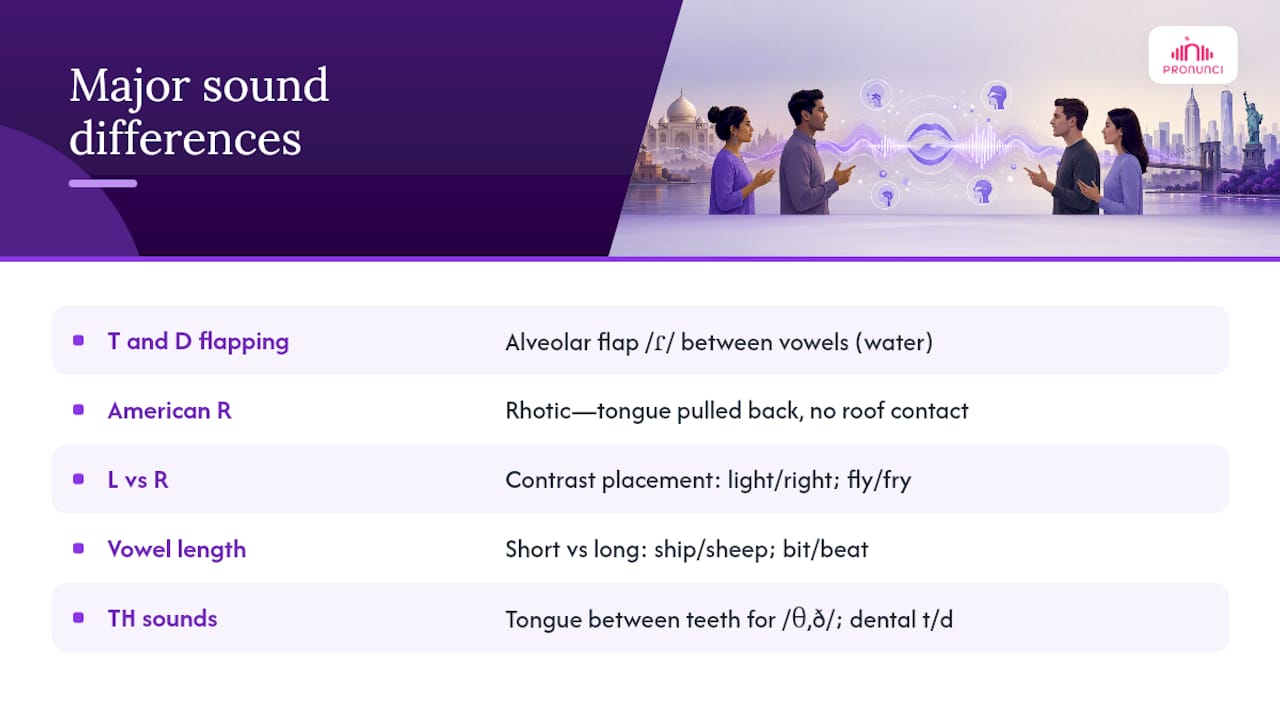
T and D flapping. Many Indian speakers produce a retroflex /t/ and /d/, made with the tongue curled back. American English usually softens the /t/ between vowels into an alveolar flap, written /ɾ/, so “water” sounds closer to /ˈwɑɾɚ/ than a crisp /t/. Practice with “water,” “better,” “city,” “little,” and “party,” tapping the tongue tip lightly behind the front teeth instead of curling it back, as Wordy explains in its breakdown of American flapping.
The American R. This R is rhotic and made by pulling the tongue body back without touching the roof of the mouth, unlike the lighter or trilled R common in Indian English. Practice “red,” “car,” “world,” and “really” while keeping the tongue tip free.
L versus R confusion. These sounds get crossed when the tongue placement is nearly identical in the speaker’s mind. Contrast pairs like “light/right” and “fly/fry” slowly, feeling where the tongue tip lands for each.
Vowel length. Short and long vowels that Indian English often treats as similar are distinct in American English: “ship” /ʃɪp/ versus “sheep” /ʃiːp/, “bit” /bɪt/ versus “beat” /bit/. Minimal-pair drills like these build the ear before they build the mouth, a method British Council recommends for confusable sound pairs.
TH sounds. /θ/ (as in “think”) and /ð/ (as in “this”) both require the tongue tip lightly between the teeth. Indian English often replaces these with a dental /t/ or /d/. Start slow, exaggerate the tongue placement, then speed up once it feels natural.
How Do Rhythm and Intonation Change the Way You Sound?
Getting every consonant right and still sounding “off” almost always traces back to rhythm, not sounds. American English is stress-timed: unstressed syllables compress and stressed ones stretch, and the unstressed vowels collapse into schwa, /ə/, the flat “uh” sound in “about” and the second syllable of “banana.” Indian English tends to give each syllable more equal weight, which reads as accented even when every sound is technically correct.
- Mark stress in a sentence before you say it. Underline the stressed word in “I DIDN’T say he stole the money” and notice how the meaning shifts if you stress a different word.
- Drill schwa reduction daily. Say “about,” “photograph,” and “banana” slowly, then fast, letting the unstressed vowels flatten toward /ə/.
- Shadow short scripts for intonation. Statements fall at the end; yes/no questions rise. Practice “Are you coming?” against “I am coming” until the pitch pattern feels automatic.
- Practice linking and reduction. “Want to” becomes “wanna,” and “did you” often blends into “didja” in fast, informal speech. Listening for these connected-speech patterns trains your ear before your mouth catches up.
What Does a 6 to 12 Week Practice Plan Look Like?
Consistency beats intensity here. A learner who practices 20 focused minutes daily for eight weeks will typically outpace someone doing an hour once a week, because accent retraining is a motor-skill habit, not a knowledge problem.
- Weeks 1 to 2: Focus entirely on rhythm and schwa. Shadow 10 minutes daily, record a 30-second sample every three days, and compare against a native model.
- Weeks 3 to 5: Add T/D flapping and vowel length drills. Alternate minimal pairs with sentence-level practice using the sounds in context.
- Weeks 6 to 8: Layer in R/L and TH work while maintaining rhythm drills so old habits don’t creep back.
- Weeks 9 to 12: Shift to paragraph-length speaking, intonation practice, and real conversation simulation.
A 15-minute session should cover shadowing plus one drill; 30 minutes adds minimal pairs and a recording check; 45 minutes includes all of the above plus a scripted paragraph read aloud. One study of shadowing as a daily practice found it reliably improves timing and connected speech faster than isolated sound drills alone. A useful weekly milestone: record the same 60-second script every Sunday and count how many words needed a second attempt. That number should drop steadily by week four.
What Mistakes Slow Down Progress, and When Should You Get a Coach?
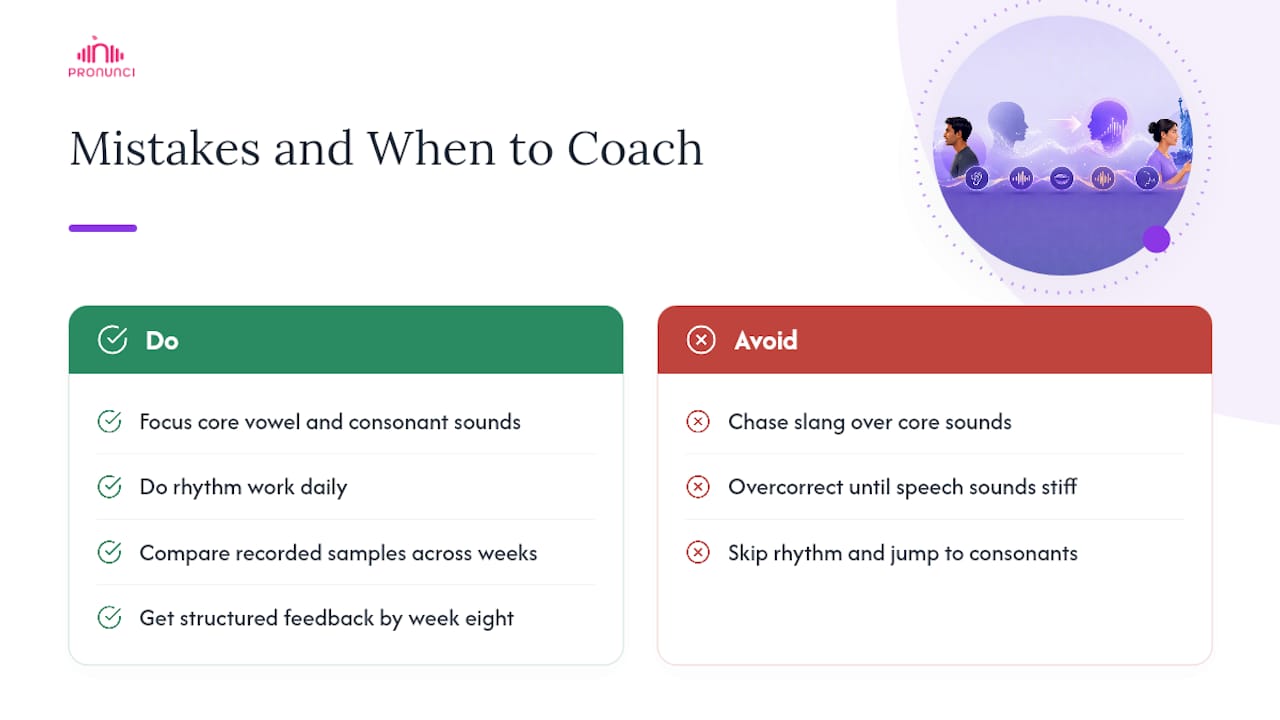
The three most common mistakes are chasing slang instead of core sounds, overcorrecting until speech sounds stiff, and skipping rhythm work to jump straight to consonants. Each one wastes practice time without building real skill.
Realistic timelines vary, but many learners notice clearer speech within several weeks of daily practice, with stable, natural control developing over a few months. If your recorded samples sound the same at week eight as they did at week two, that’s the signal to bring in structured feedback. A systematic approach to accent training that pairs self-practice with outside correction tends to catch blind spots self-review misses entirely.
A Coaching Note on Mindset and Practice
The learners who improve fastest aren’t chasing a new identity. They’re chasing control: the ability to hit a sound or rhythm pattern on command, in a meeting, under pressure. One learner I’ve seen described in coaching notes went from constant repeat requests on client calls to near-zero within ten weeks, using nothing more exotic than daily shadowing and schwa drills. Clarity-first training beats “sounding American” as a goal, because clarity is measurable and identity isn’t.
— Prof. Alex., Ph.D. Accent Coach
Where InPronunci Fits Into This Plan
Everything in this plan, rhythm first, then sounds, then daily repetition, is exactly what InPronunci: Accent Training App is built to guide you through, without the guesswork of designing your own drills.
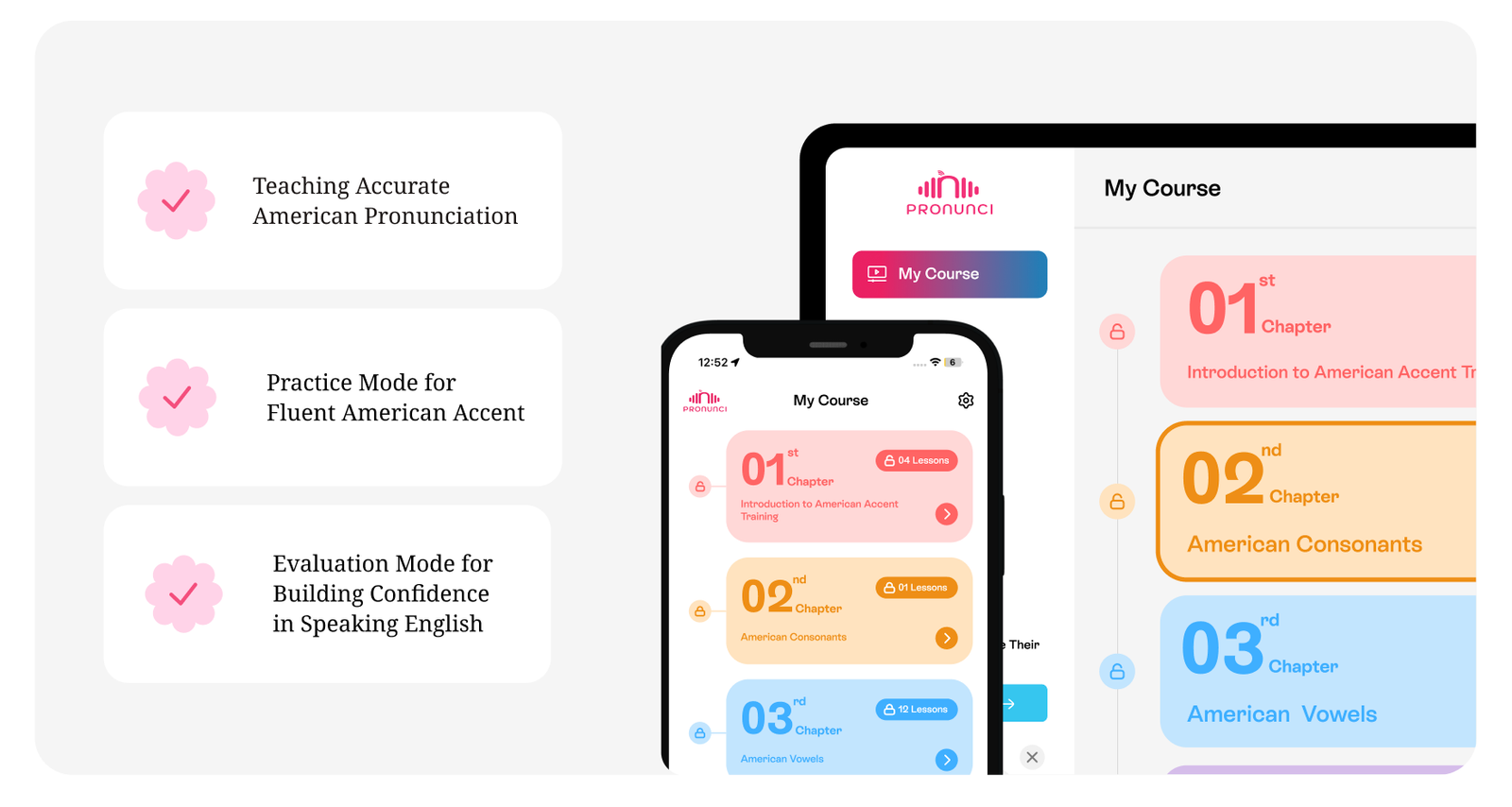
The app’s Interactive 2D Sound Video Simulator make the invisible parts of pronunciation visible. Watch the 2D simulator for the American /t/ sound and you’ll see the exact tongue and airflow mechanics behind the flap sound covered earlier in this article. That visual, voice-guided training is paired with AI Accent Coach feedback, so instead of guessing whether your “water” sounded right, you get a direct comparison between My Coach, the native model, and My Pronunci, your own recording. The app also includes daily practice plans across consonants, vowels, stress, and intonation, in-app chat with human coaches, and an option for one-on-one sessions when you want faster correction on a stubborn sound.
If you want to start with a guided daily structure instead of building your own, the InPronunci: American Accent Training Course walks through Speech Organs Education and the full consonant and vowel training sequence. Try the free onboarding chapter first at InPronunci’s beginner daily practice plan, then decide if the full curriculum fits your goals.
Sources
- How can I improve my English pronunciation? | British Council
- How Indian English Speakers Can Improve Their American Accent | Accent Help
- Wordy
FAQ
How do you go from an Indian accent to an American accent?
Train rhythm and schwa reduction first, then work through T/D flapping, R/L placement, and TH sounds using shadowing and minimal-pair drills daily, ideally with recorded comparisons against a native model.
How do you say “hi” in an Indian accent?
Indian English speakers often pronounce “hi” with a slightly longer, more even-weighted vowel and less pitch drop than General American, which tends to shorten the vowel and let pitch fall smoothly toward the end of the word.
How do I neutralize my Indian accent?
Focus on intelligibility rather than erasing every trace of your native speech pattern: prioritize stress-timed rhythm, schwa, and the five to six sounds covered in this guide, and track progress by counting how often listeners ask you to repeat yourself.
How do you do an Indian accent in English?
An Indian accent in English typically features retroflex consonants, more even syllable stress, and less vowel reduction than American English, though it varies widely by region and native language background.
How long does it take to sound more American?
Most learners notice clearer speech within four to six weeks of daily practice, with stable, natural control developing over two to three months, faster with structured tools like InPronunci’s accent training program than with unguided self-study.