


To raise your TOEFL speaking score, prioritize intelligibility, meaning clear sounds, natural rhythm, and steady fluency, over trying to sound fully American. Shadow native audio daily, drill minimal pairs for your weakest sounds, and record yourself so you can compare against a model. InPronunci: Accent Training Appgives you a structured way to run these drills, including a 2D simulator that trains how each sound is formed.
Cognitive Accent Training
Compare Your Coach vs. Your Pronunci
In every practice sentence, students listen to Your Coach, record their own voice, and compare it with Your Pronunci, so they consciously notice and correct each sound.
![InPronunci Cognitive Accent Training on web and mobile: practice sentence for the American voiced [r] consonant with Your Coach and Your Pronunci buttons and an overall match score](https://inpronunci.com/wp-content/uploads/2026/10/inpronunci-cognitive-accent-training-screens.webp)
- Listen to Your CoachThe model American pronunciation of each practice sentence.
- Compare with Your PronunciYour own recorded pronunciation, side by side with the coach.
- Correct with feedbackThe match score and color-coded letters guide each correction.
What is the best pronunciation app for TOEFL and IELTS speaking?
Both tests judge how clearly you speak: IELTS has a separate pronunciation score, and TOEFL raters also judge how clear and easy to understand your answers are. The best app trains the sounds, word stress, and intonation that make your answers clear and gives you feedback on each. InPronunci: Accent Training is a structured American accent course with AI Accent Coach feedback on pronunciation, rhythm, and intonation, Interactive Visual 2D Sound Simulators for each American sound, and Pronunci Speaks instructions before every exercise. You can practice 20 minutes a day, starting with the free Chapter I.
Structured American Accent Training Course
From Speech Organs Education to American Intonation
The InPronunci course is built step by step: every chapter prepares the next one, and by the end of the course students receive a certificate.
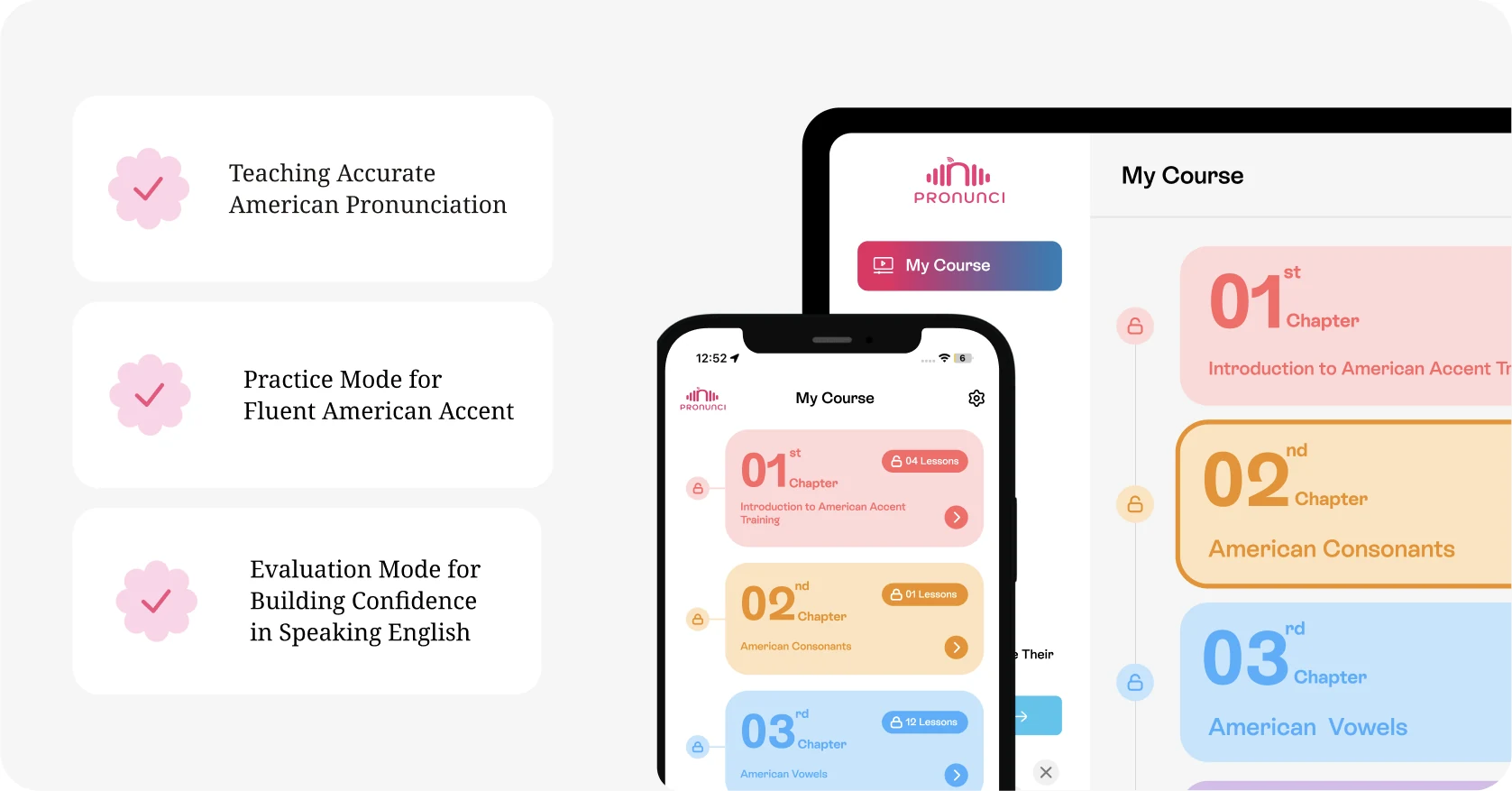
- Speech Organs EducationStudents learn how the speech organs work, along with the AI Accent Coach commands and feedback.
- American ConsonantsPractice and evaluate American consonants in phonetic exercises and practice sentences with the AI Accent Coach.
- American VowelsPractice and evaluate American vowels in phonetic exercises and practice sentences with the AI Accent Coach.
- IntonationLearn how intonation can change the meaning of what you say.
- CertificateBy the end of the course, students receive a certificate.
What does TOEFL 2026 actually test in speaking?
The 2026 Speaking section runs on two task types: Listen & Repeat, where you hear a sentence and reproduce it, and Take an Interview, where you answer conversational questions on the spot. According to ETS’s own test format guidance, scoring weighs pronunciation accuracy, fluency, and intonation, not how closely you match a specific American accent.
That distinction changes how you should spend your practice time. The scoring priorities break down like this:
- Intelligibility first. Can a listener understand your words without straining?
- Accurate individual sounds. Especially consonants and vowels that carry meaning.
- Rhythm and intonation. Natural stress patterns that signal which words matter.
- Fluency. Smooth delivery without long, meaning-breaking pauses.
A heavy accent will not tank your score if your speech stays clear. Skip the regional-accent chase and put your energy into sound accuracy and rhythm instead.
Which sounds cause the most TOEFL pronunciation errors?
Most non-native speakers lose points on a small, predictable set of sounds. Fix these and your intelligibility jumps fast.
- The “th” sounds (/θ/ and /ð/ in “think” and “this”). Many speakers substitute /s/, /z/, /t/, or /d/, which changes the word entirely.
- R versus L. “Right” and “light” collapse into the same sound for many Japanese, Korean, and Chinese speakers, confusing listeners.
- V versus W. Spanish and German speakers often blur these, turning “very” into “wery.”
- Final consonant deletion. Dropping the ending of “cat” or “worked” erases grammatical information the AI grader and human listener both need.
- Vowel contrasts like “ship” versus “sheep” or “pull” versus “pool,” where vowel length and quality change meaning completely.
Minimal-pair drills fix these fastest. Pick two words that differ by one sound, say them back to back, and record yourself: “think, sink,” “right, light,” “very, wary,” “ship, sheep.” Practicing pairs in short daily bursts trains your ear and your mouth together, which is more efficient than reading isolated word lists. Reference the vowel and r-coloring patterns in General American English if you want to know exactly what target sound you are aiming for.
Pro Tip: Deliberately over-articulate final consonants, holding the stop or fricative release a beat longer than feels natural. This small exaggeration makes words far easier for both AI graders and human listeners to recognize, without making your speech sound robotic.
How do rhythm and stress affect your TOEFL score?
English is a stress-timed language: content words like nouns, verbs, and adjectives get stretched and stressed, while function words like “the,” “of,” and “to” get compressed and often reduced. Grading systems built around this rhythm respond well when you hit that pattern, because it signals fluency and natural phrasing rather than word-by-word recitation.
Two drills build this fast:
- Chunking practice. Break sentences into meaning groups (“I think / that the plan / makes sense”) and stress the key word in each chunk.
- Shadowing. Play a native audio clip, pause every sentence, and repeat it matching the stress and pitch as closely as you can.
On test day, three habits protect your rhythm under pressure: slow down slightly rather than rushing, stress the content words even when nervous, and link words together (“what_is_it” instead of choppy syllables) so your sentence flows as one unit instead of separate blocks.
A 14-day starter plan and a repeatable 20-minute session
Structured, daily practice beats occasional long sessions for building the kind of automatic speech control TOEFL rewards, as shown in Korean Exercises That Build Real Fluency Fast. Fifteen to 20 minutes of focused shadowing daily is enough to build lasting rhythm and clarity habits, according to test-prep research on the 2026 format.
14-day starter plan:
- Days 1-2: Record a baseline answer and identify your three weakest sounds.
- Days 3-5: Build minimal-pair lists for those sounds and drill them daily.
- Days 6-8: Add shadowing with native audio clips, 10 minutes daily.
- Days 9-11: Run timed Listen & Repeat reps, checking playback against the original.
- Days 12-13: Practice full mock interview answers under a 45 to 60 second clock.
- Day 14: Review recordings from day 1 versus day 13 and note concrete changes.
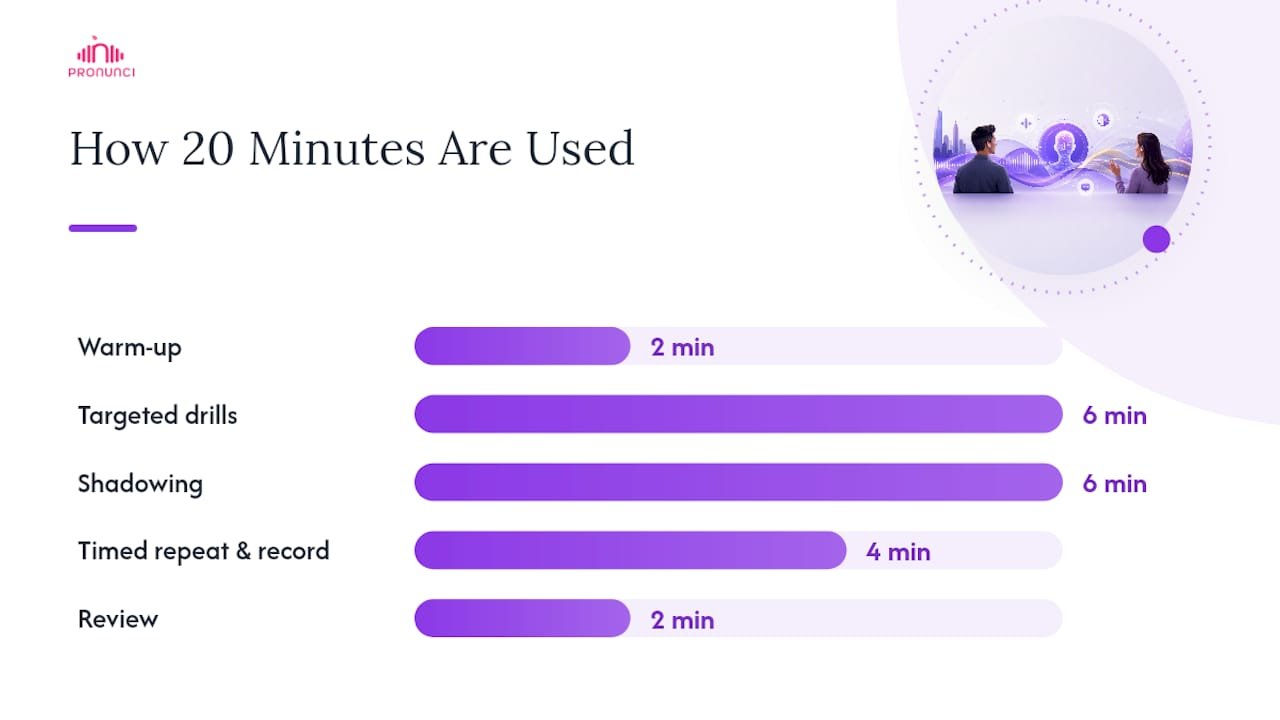
A single 20-minute session breaks down as:
- Warm-up (2 minutes): read a short paragraph aloud to activate speech muscles.
- Targeted drills (6 minutes): minimal pairs for your weak sounds.
- Shadowing (6 minutes): match rhythm and stress on a native clip.
- Timed repeat and record (4 minutes): simulate the actual task under time pressure.
- Review (2 minutes): listen back and note one specific fix for tomorrow.
Track progress with a simple checklist: which sounds still get dropped, whether your pauses are shrinking, and whether your recorded answer sounds closer to the model each week. That comparison, not a vague sense of improvement, is what tells you the plan is working.
Getting the most out of AI feedback and the 2D mouth simulator
AI pronunciation feedback is useful for catching patterns you cannot hear in yourself, but it works best as a diagnostic, not a verdict. Treat flagged intelligibility issues and sounds that repeat across multiple recordings as your priority list; a single odd score on one attempt is noise, not a trend.
InPronunci builds this diagnostic loop directly into its training. Its structure includes:
- Cognitive Accent Training, where you listen, compare, correct, and retrain instead of just repeating blindly.
- AI Accent Coach feedback at both Intermediate and Advanced levels, matched to where your speech actually is.
- My Coach versus My Pronunci comparison, so you hear the native model and your own recording side by side.
- Interactive Visual 2D Sound Simulators, which train tongue, lip, and airflow positioning for a sound so you can identify what you cannot feel yourself doing wrong. Here is the 2D simulator training the American /t/ sound through full articulation details.
The practical workflow: record, compare against the native model, follow the mouth-simulator cue for the sound giving you trouble, then re-record. Slot this into the targeted-drills portion of your 20-minute session rather than trying to use it for everything at once.
Pro Tip: Do not chase a perfect AI score on your first attempt. Fix one sound pattern per session, confirm it stuck with a fresh recording, then move to the next.
What are the most common test-day pronunciation mistakes?
A handful of errors show up again and again once nerves kick in.
- Speaking too fast, which crushes rhythm and drops word endings.
- Long pauses while searching for words, which hurt AI flow scoring more than small stumbles do.
- Omitted final consonants, especially on plurals and past tense verbs.
- Wrong stress placement on multisyllabic words under pressure.
- Vowel confusion between similar-sounding words when rushing.
Quick fixes work better than trying to fix everything at once. Use a short pacing script in your head (“chunk, breathe, chunk, breathe”) to slow yourself down. Keep three or four natural filler phrases ready, like “let me think about that” or “what I mean is,” so silence never stretches past a beat or two. Run a two-minute final-consonant micro-drill right before you start, just five or six words ending in strong stops like “worked,” “asked,” “helped.”
Two-minute pre-test warm-up: read one paragraph aloud, say five final-consonant words slowly and clearly, hum a rising and falling intonation pattern twice, then take one slow breath before your first task.
How contractions and reductions shape natural American speech
Native speakers rarely say “I am going to” in casual conversation. They say “I’m gonna,” and function words shrink even further: “want to” becomes “wanna,” “going to” becomes “gonna” in fast speech, and “him,” “her,” and “them” often lose their initial sound entirely after a verb, so “give him” sounds like “give ‘im.”
This matters for TOEFL speaking in two directions. First, understanding these reductions helps you follow fast native audio in Listen & Repeat tasks without getting lost. Second, using natural contractions like “I’m,” “it’s,” “don’t,” and “we’ve” in your own answers makes you sound fluent rather than stilted, since a sentence built entirely from full forms (“I am going to explain”) reads as overly formal and can actually slow your delivery.
The key is balance. Contractions belong in your speech; heavy slang reductions like “gonna” are riskier in a formal test context, since graders expect clear, standard speech rather than casual slang. Aim for natural contractions with clean pronunciation: “I’ll,” “that’s,” “we’re,” said clearly rather than mumbled.
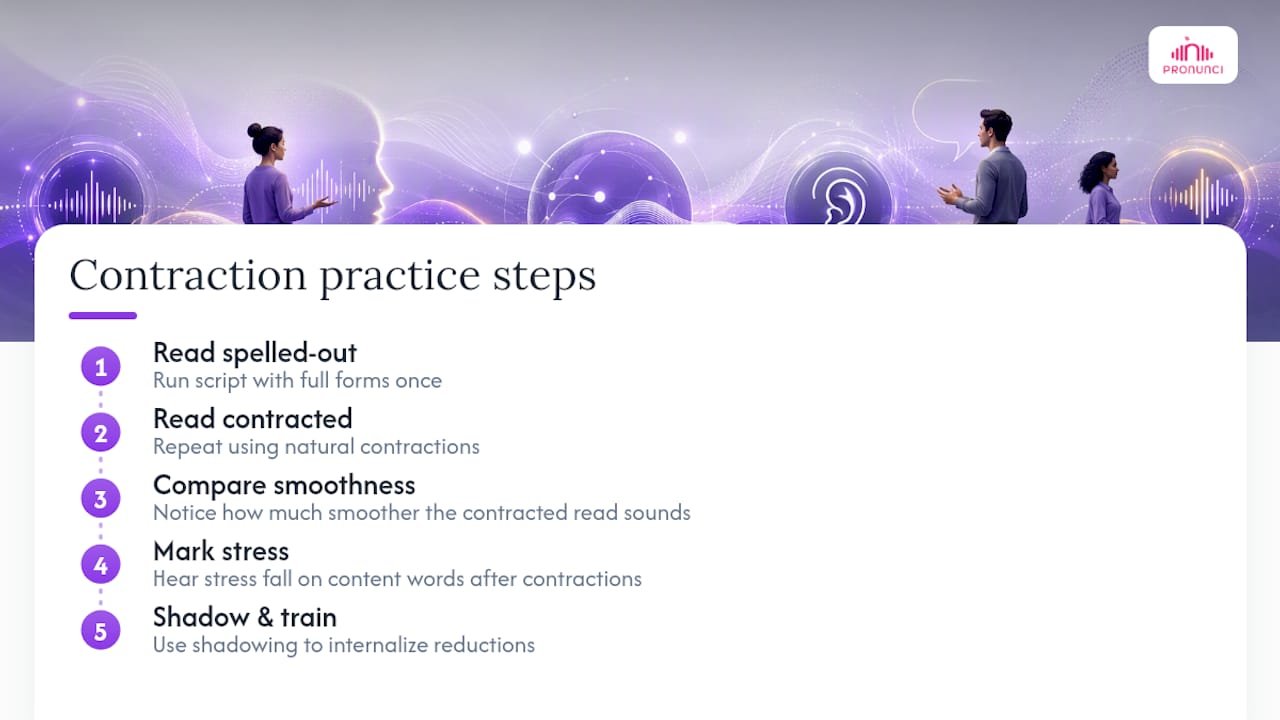
Practice this by reading a script twice, once with every word spelled out and once with natural contractions, then compare how much smoother the second version sounds. Notice how stress naturally falls on the content word right after the contraction (“I’M going,” “THAT’s true”), which reinforces the rhythm patterns covered earlier. Building this awareness into your shadowing sessions trains your ear to expect reductions in native audio and your mouth to produce them without sounding careless.
How do you reduce the influence of your native language on your speech?
Every native language leaves fingerprints on English pronunciation. Spanish speakers often add a vowel before initial “s” clusters (“eschool” for “school”). Mandarin speakers may flatten intonation because tone, not stress, carries meaning in Mandarin. Arabic speakers sometimes struggle with the /p/ versus /b/ distinction because Arabic lacks a clear /p/. None of this is a flaw. It is a predictable transfer pattern, and predictable patterns are fixable.
The first step is identifying your specific pattern rather than practicing generically. Record yourself reading a paragraph, then listen specifically for sounds that do not exist in your first language, or exist differently. That short list becomes your personal drill sheet.
From there, three strategies consistently help:
- Isolate the sound outside of words first. Practice /θ/ alone before trying “think,” then move to word-initial and word-final positions.
- Use contrastive minimal pairs between the sound you naturally produce and the target sound, so your ear learns the difference before your mouth tries to fix it.
- Slow down deliberately during practice, since native-language habits are strongest at full speed; slower, deliberate repetition breaks the automatic substitution.
A structured training sequence works better than random practice: identify the error through recording, train the correct articulation with the simulator, drill it in isolation with minimal pairs, then apply it inside full sentences through shadowing. Skipping straight to full-sentence practice without isolating the sound first is why many learners plateau despite months of speaking practice.
Prof. Alex’s perspective: why structured practice beats mimicry
Learners waste enormous energy trying to sound like a specific American they admire, when the score depends on intelligibility, not imitation. I have seen the same trap repeatedly: someone perfects a Southern drawl or a newscaster cadence while three basic sound errors go untouched. The 2D simulator exists precisely to train the speech organs inside your own mouth that you cannot yet control. Follow the 14-day plan, measure your recordings honestly, and the score follows the clarity, not the accent.
— Prof. Alex, Ph.D. Accent Coach
How InPronunci: Accent Training App supports TOEFL pronunciation goals
InPronunci is built for exactly the kind of daily, measurable drilling this article recommends, not casual sound-matching or entertainment-style lessons. You get structured practice plans, AI Accent Coach feedback at Intermediate and Advanced levels, Interactive Visual 2D Sound Simulators for problem sounds, unlimited record-and-compare practice against a native model, and optional one-on-one coaching when you want a human check on your progress.
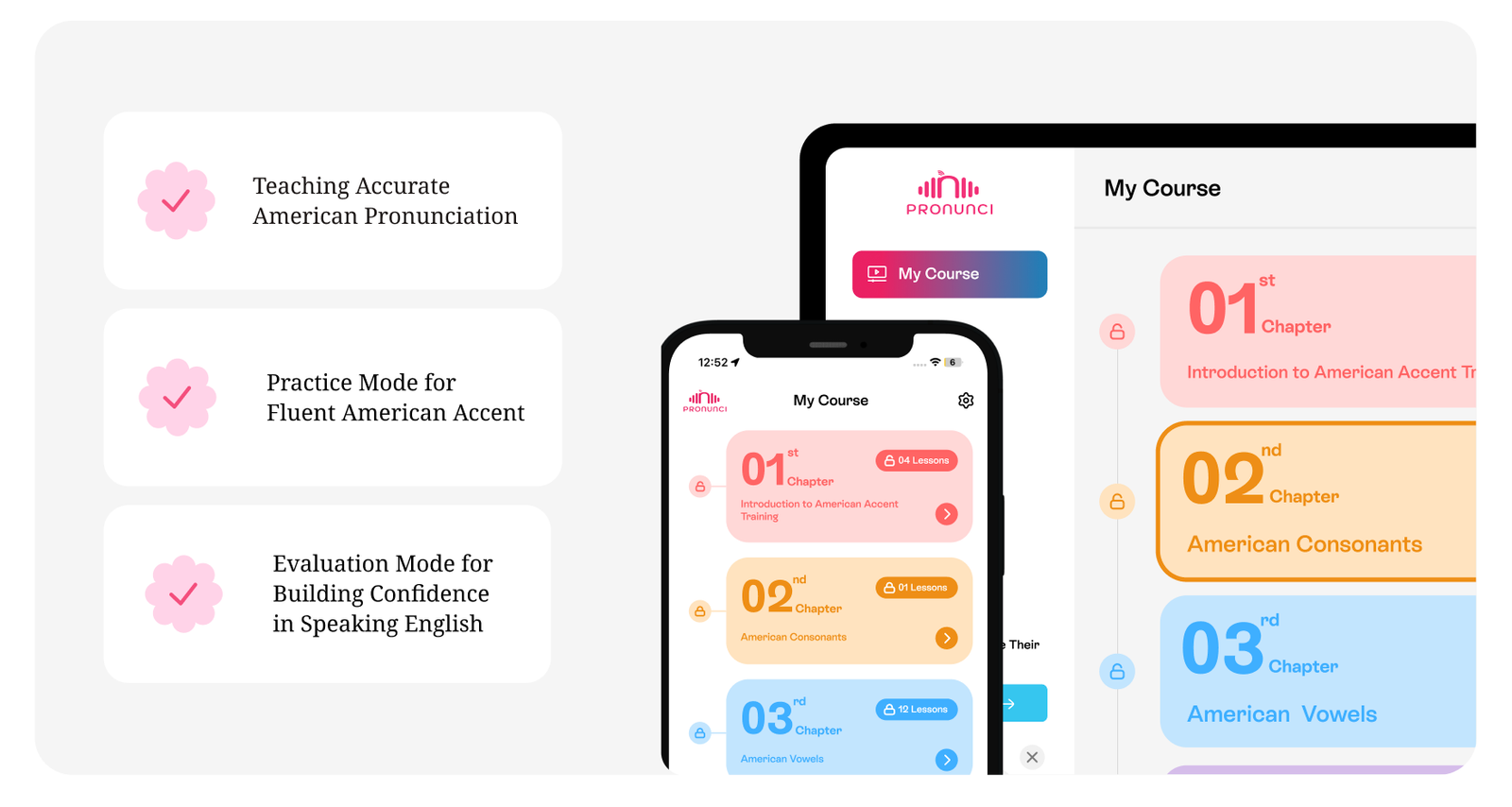
Slot it directly into the plans above: use the targeted-drills block of your 20-minute session for AI Accent Coach feedback on your weakest sound, and use the 2D simulator whenever a recording flags the same error twice. Inside the 14-day starter plan, InPronunci’s structured daily practice course gives you the minimal pairs and shadowing material already organized, so you are not building drill lists from scratch on day three. Once the fundamentals click, the full InPronunci: American Accent Training Course walks through consonants, vowels, and intonation in sequence with Prof. Alex’s guided instructions.
Start with the free onboarding chapter, run one 20-minute session today, and record your baseline answer before you do anything else. That single recording becomes the benchmark every future session measures against.
Sources
For deeper detail, see ETS’s official test format, Magoosh’s TOEFL speaking guidance, and Sounds of Speech’s phonetics visualizer.
- How to Improve Your TOEFL Speaking Score (2026 Format) – Magoosh Blog – TOEFL®️ Test
- General American English – Wikipedia
Questions & Answers
FAQ
01Does InPronunci help with IELTS speaking pronunciation?
Yes. The same training helps with both tests: InPronunci trains American sounds, word stress, and intonation, and the AI Accent Coach gives feedback on each recording.
02How do you pronounce “TOEFL” correctly?
“TOEFL” is pronounced “TOH-full,” rhyming roughly with “hopeful,” not spelled out letter by letter.
03Is TOEFL English or American English?
TOEFL is based on American English, and the ETS test format reflects American vocabulary, spelling, and pronunciation norms.
04How can I practice speaking for TOEFL on my own?
Shadow native audio for 15 to 20 minutes daily, drill minimal pairs for your weakest sounds, and record yourself answering mock questions so you can compare your delivery against a native model; apps like InPronunci structure this into a daily routine with AI feedback built in.
05Is a TOEFL score of 90 out of 120 good?
A strong score is generally considered sufficient for admission to many competitive universities, though individual program requirements vary, so check your target school’s specific threshold.
Recommended

Beyond Repetition: Choosing the Best American Accent Training App in 2026
Find the best American accent training app for your career. Move beyond repetition with AI feedback to gain confidence and professional authority in meetings.
AI Accent Coach Technology: A Strategic Guide to Mastering American Pronunciation in 2026
Unlock your career potential with AI accent coach technology. Learn to master American pronunciation, reduce anxiety, and speak with authority in any meeting.
The Strategic Guide to English Pronunciation Feedback AI in 2026
Discover how English pronunciation feedback AI in 2026 uses advanced visualization to build native-like clarity and command professional authority in every m...
Plans
What InPronunci costs
InPronunci Basic
$35 per month
Chapter 1 is free after signup.
InPronunci Premium
$200 per month
Includes a coach: