



Compound nouns normally carry primary stress on the first part. That single rule explains why native speakers say BATHroom, WEBsite, and BOOKstore with the punch on the first syllable, not the second. It also explains why mixing that up can quietly confuse a listener, even when every sound is technically correct.
Here is the pattern in action: a closed compound like BOOKstore stresses “book.” An open compound like SECURITY guard stresses “security.” A hyphenated compound like CHECK-in stresses “check.” Say any of these with stress on the second word, and a native listener has to work harder to parse what you mean, because stress is one of the main signals English uses to tell a compound noun (one thing) from a descriptive phrase (a quality plus a thing).
- BOOKstore (closed compound, stress on “book”)
- SECURITY guard (open compound, stress on “security”)
- CHECK-in (hyphenated compound, stress on “check”)
Pro Tip: Learner dictionaries like Cambridge mark stress directly on compound entries because production, not just recognition, depends on getting it right.
Stress in Compound Nouns: Types and Examples You Will Actually Use
Compound nouns come in three written forms, closed, open, and hyphenated, but the stress rule stays the same across all three: the first element gets the emphasis. What changes is how the words are formed. Cambridge’s grammar reference groups compounds by pattern: noun plus noun, adjective plus noun, and verb-derived forms plus noun. Each pattern shows up constantly in everyday speech, so it’s worth drilling all three.
Noun + noun compounds
- TOOTHbrush (“I left my toothbrush at the hotel.”)
- TEApot (“Pour the water into the teapot first.”)
- FIREplace (“We sat by the fireplace all evening.”)
Adjective + noun compounds
- BLACKboard (“The teacher wrote the date on the blackboard.”)
- GREENhouse (“Tomatoes grow year round in a greenhouse.”)
- HIGHchair (“The baby eats dinner in a highchair.”)
Verb-derived + noun compounds
- PARKing lot (“Meet me in the parking lot at noon.”)
- WASHing machine (“The washing machine finished its cycle.”)
- WARM-up (“Do a five-minute warm-up before you run.”)
EF’s grammar resource reinforces this same first-element pattern across dozens of examples, which is useful because repetition across sources tells you this isn’t a one-off quirk. It’s a genuine structural pattern in English.
Try this fast practice loop with any list above:
- Listen to a native recording of the word.
- Mark which syllable sounds longer and louder.
- Repeat the word out loud, exaggerating that stress.
- Record yourself and compare against the model.
Why Stress Separates a Compound Noun From a Descriptive Phrase
A compound noun names one specific thing. An adjective plus noun phrase describes a quality of something. Stress is the audible signal that tells your listener which one you mean, and getting it backward can genuinely change the meaning of your sentence.
Take GREENhouse versus green HOUSE. A greenhouse is a glass structure for growing plants. A green house is any house that happens to be painted green. Same two words, opposite stress, completely different image in the listener’s head. The same split shows up with BLACKboard (a classroom writing surface) versus black BOARD (any board that is black).
- GREENhouse = a structure for plants; green HOUSE = a house painted green
- BLACKboard = classroom writing surface; black BOARD = any board colored black
- HOTdog = a food; HOT DOG = an overheated dog
To check yourself, record a sentence using both forms, then play it back and listen for which syllable is longer and louder. If you can’t hear a clear difference between your two versions, that’s the gap to close.
Pro Tip: Listen for three cues on the stressed syllable: it’s louder, it’s longer, and its vowel sounds clearer and fuller than the unstressed one. Weak stress often means a reduced, muddier vowel.

Exceptions: When Stress Shifts Away From the First Word
The first-element rule covers most compound nouns, but not all of them, and research into compound stress variability confirms that structure, meaning, and analogy to similar words all pull stress around in ways that resist a single tidy rule. A few categories deserve special attention.
- Proper names often stress the second element: Mount EVerest, New YORK
- Titles frequently shift stress too: prime MINister, Town HALL
- Material and place compounds can carry stress on either word depending on the specific term: leather JACKET keeps stress on “jacket” even though the pattern looks like a standard adjective-plus-noun compound
- Some compounds carry near-equal double stress, common in calendrical or descriptive combinations
When you hit one of these, don’t force the general rule. Check an authoritative learner dictionary or match a native-speaker recording directly rather than guessing from the pattern alone.
Drills That Actually Build First-Element Stress
Reading the rule and producing it under real speech pressure are two different skills. These drills close that gap through repetition, not memorization.
- Warm-up (1 minute each): Say BOOKstore, TOOTHbrush, and PARKing lot five times each, exaggerating length and loudness on the stressed syllable.
- Word-block drills: Group ten words by formation pattern (noun+noun, adjective+noun, verb-derived+noun) and read each block aloud twice, once slow and deliberate, once at conversational speed.
- Sentence drills: Practice stress inside full sentences, where rhythm competes with your attention. Try “The washing machine is in the BASEment” and “Leave your suitcase by the FRONT door.” Notice how the compound stress survives even when the sentence has its own intonation pattern.
- Daily 10-minute plan: Spend two minutes on warm-ups, four minutes on word blocks, and four minutes on sentence drills. Record every session.
Pro Tip: After each recording, compare your stressed syllable’s length against a native model. If your two syllables sound close to equal in length, your stress isn’t strong enough yet, even if you think you’re emphasizing it.
Self-evaluation matters more than volume of practice. Five focused minutes with a recording and a native model beats thirty minutes of silent reading, because stress and emphasis only become automatic through repeated production, not passive review.
How Prof. Alex Trains Compound Noun Stress Inside InPronunci
Prof. Alex, Ph.D. Accent Coach, built his teaching method around a simple sequence: understand your speech organs, listen actively to a native model, produce the sound yourself, then compare. That sequence, called Cognitive Accent Training inside InPronunci: Accent Training App, applies directly to compound noun stress because stress is ultimately a physical act, not just a listening skill.
Cognitive Accent Training
Compare Your Coach vs. Your Pronunci
In every practice sentence, students listen to Your Coach, record their own voice, and compare it with Your Pronunci, so they consciously notice and correct each sound.
![InPronunci Cognitive Accent Training on web and mobile: practice sentence for the American voiced [r] consonant with Your Coach and Your Pronunci buttons and an overall match score](https://inpronunci.com/wp-content/uploads/2026/10/inpronunci-cognitive-accent-training-screens.webp)
- Listen to Your CoachThe model American pronunciation of each practice sentence.
- Compare with Your PronunciYour own recorded pronunciation, side by side with the coach.
- Correct with feedbackThe match score and color-coded letters guide each correction.
- Speech Organs Education shows you how tongue, jaw, and airflow shape a clear, stressed vowel
- The Interactive Visual 2D Sound Simulator trains hidden articulation, which matters because stress depends on subtle length and vowel-quality differences learners often can’t hear in themselves.
- My Coach versus My Pronunci comparison lets you hear your recording against a native model side by side
The [t] sound simulator applies this approach clearly:
to experience how voice-guided speech-organ training makes a hidden articulation detail concrete and repeatable.
Stress is not something you memorize from a rule sheet. It’s something your speech organs learn to produce automatically, once you can hear the difference and feel where the emphasis needs to land.
Learners starting with compound stress should begin in the American Intonation and Emphasis chapter, then loop back to the consonant and vowel sessions that support clearer stressed syllables.
A Note From Prof. Alex
Learners often rush past first-element stress because it sounds minor. It isn’t. Ten minutes a day, consistently, beats an hour once a week; the ear needs frequent, short exposure to rebuild automatic habits. Try a guided session and hear the difference for yourself.
— Prof. Alex, Ph.D. Accent Coach
Get Guided Practice for Compound Stress With InPronunci
Reading rules about first-element stress only gets you partway there. Producing it correctly, under the pressure of real conversation, requires hearing your own gaps and correcting them with a model to compare against. That’s the piece most self-study skips, and it’s the piece InPronunci: Accent Training App is built around: guided listening, AI feedback, and speech-organ articulation training in one structured system rather than scattered rule lists.
Structured American Accent Training Course
From Speech Organs Education to American Intonation
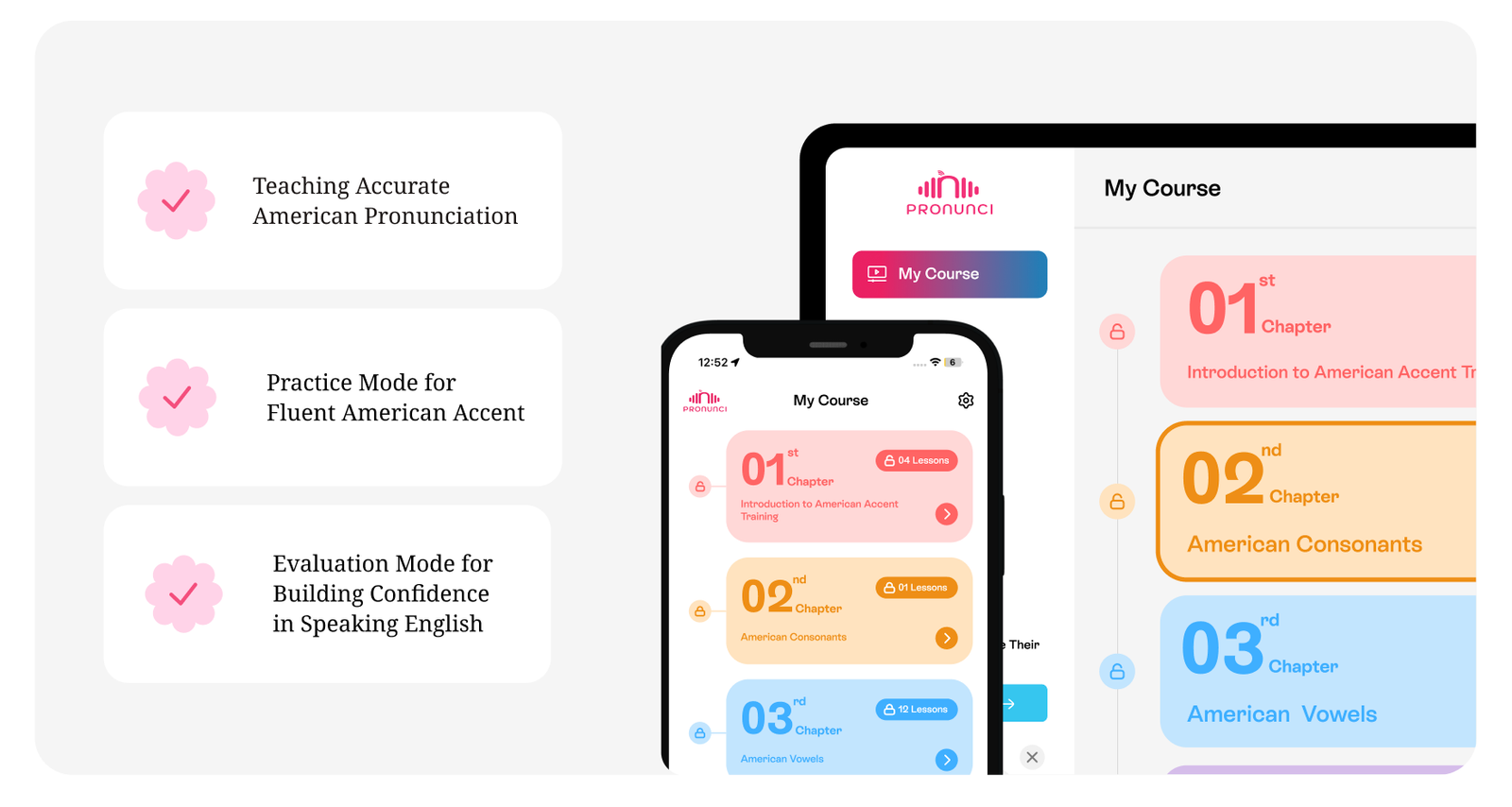
The InPronunci course is built step by step: every chapter prepares the next one, and by the end of the course students receive a certificate.
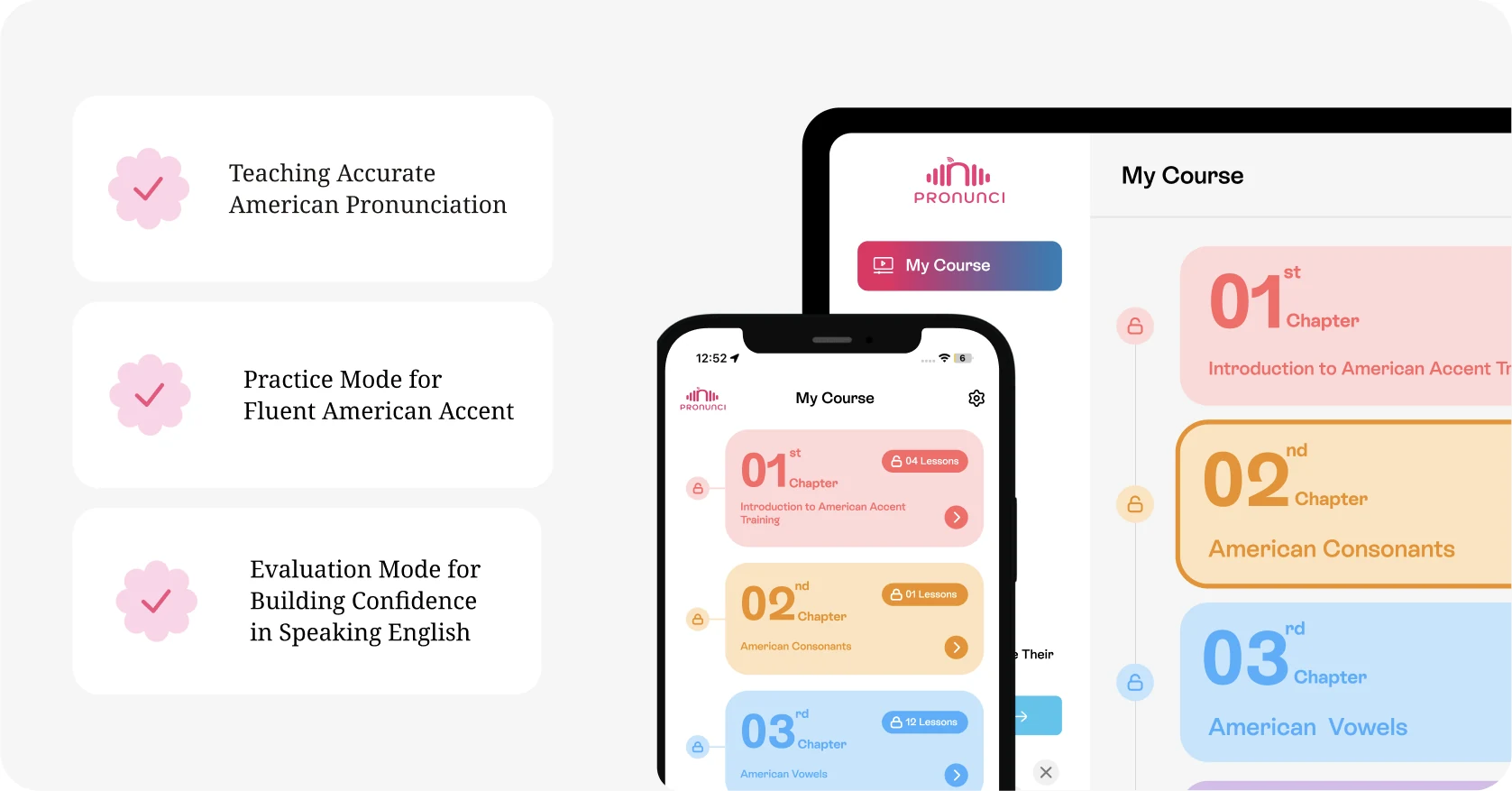
- Speech Organs EducationStudents learn how the speech organs work, along with the AI Accent Coach commands and feedback.
- American ConsonantsPractice and evaluate American consonants in phonetic exercises and practice sentences with the AI Accent Coach.
- American VowelsPractice and evaluate American vowels in phonetic exercises and practice sentences with the AI Accent Coach.
- IntonationLearn how intonation can change the meaning of what you say.
- CertificateBy the end of the course, students receive a certificate.
Inside the app, the American Intonation and Emphasis chapter walks you through stress patterns using the same Interactive Visual 2D Sound Simulators used for the [t] sound above, so you train tongue and jaw placement while you practice each stressed syllable, then compare your recording directly against Prof. Alex’s native model. If you want the full curriculum path from speech organs through consonants, vowels, and stress, the InPronunci: American Accent Training Course lays out every module in sequence. Start with the free onboarding chapter, work through your first stress drills, and see how quickly focused feedback changes what you can hear in your own speech.

Sources
- Nouns: compound nouns – Grammar – Cambridge Dictionary
- The variability of compound stress in English: structural, semantic, and analogical factors
- Compound nouns | EF
How first languages change English rhythm and intonation
| First language | Common pattern |
|---|---|
| Indian English speakers | English is often syllable-timed, with every syllable getting equal weight, and stressed syllables can be said lower in pitch instead of higher. |
| Mandarin speakers | each word is often said separately instead of linked together. |
| Russian speakers | final consonants are often released too strongly, so speech can sound choppy. |
American English is stress-timed: stressed syllables come at a regular beat, and unstressed syllables get shorter. Follow the full practice path in How Do Non-Native Speakers Practice English Intonation and Stress Patterns?
Sources: Wikipedia: Indian English, San Diego Voice and Accent, Wikipedia: Non-native pronunciations of English
Questions & Answers
FAQ
01What Is the Noun Form of “Stress”?
The noun form is simply “stress,” referring to the emphasis placed on a syllable or word through greater loudness, length, and vowel clarity.
02What Are Some Examples of Compound Nouns?
Common examples include bathroom, website, bookstore, toothbrush, teapot, fireplace, blackboard, greenhouse, highchair, parking lot, washing machine, warm-up, security guard, check-in, town hall, prime minister, sunrise, keyboard, notebook, and airport, most of which stress their first element.
03How Would You Describe Stress in a Sentence?
Stress is the extra loudness, length, and vowel clarity given to one syllable or word compared to the others around it, and it’s what signals which part of a phrase carries the main meaning.
04What Are Examples of Stressed Syllables?
In BOOKstore, “book” carries the stressed syllable. In prime MINister, “min” is stressed. In GREENhouse, “green” is stressed, while in the phrase green HOUSE, “house” takes the stress instead.
Recommended

Stress in Phrasal Verbs: InPronunci: Accent Training App Guide
Mastering stress in phrasal verbs enhances your English fluency. Learn the key techniques to improve your spoken communication today!

American English Stress Patterns Examples | Inpronunci
Discover American English stress patterns examples that enhance your pronunciation skills. Learn the rhythm and melody of spoken English!

Stress and Emphasis in English Pitches — InPronunci: Accent Training App
Practice American intonation, stress and emphasis for ESL speaking, listening, TOEFL, IELTS, English pronunciation and American accent training.
Plans
What InPronunci costs
InPronunci Basic
$35 per month
Chapter 1 is free after signup.
InPronunci Premium
$200 per month
Includes a coach: