



A note from Prof. Alex
In American English, stress and emphasis are not just voice decoration. They help listeners understand your meaning, confidence, and intention. When students retrain the sound system first, pitch, rhythm, and emphasis become easier to control naturally.Prof. Alex, Ph.D. Accent Coach
Place prominence on the content words that carry your core claim, reduce function words to near silence, and mark your call to action with contrastive stress. That single discipline separates a pitch that listeners remember from one they politely forget. The role of stress and emphasis in English pitches is not decorative — it is structural. Research shows that correct prominence placement improved listener recall and speaker likability in teaching-pronunciation studies, which means the same principle applies every time you stand in front of an investor, client, or hiring panel.
Three micro-actions to take before your next pitch:
- Pick one primary stressed word per thought group — the word that carries your argument.
- Mark your call to action with contrastive stress (e.g., “We don’t just track data — we act on it”).
- Throughout all sessions, you will train your word stress, sentence stress, and intonation to become a great public speaker using InPronunci: Accent Training App.
Pro Tip: Before your next rehearsal, read your pitch aloud and underline every word you instinctively stress. If you underlined more than one word per phrase, you are over-emphasizing — cut back until only the most important word per thought group carries full prominence.
Planned prominence on content words, combined with deliberate de-accenting and contrastive stress on your call to action, is the single highest-impact change you can make to pitch delivery clarity.
What are sentence-level stress, prominence, and emphasis in English?
Two distinct levels of stress operate in spoken English, and confusing them is one of the most common pitch errors.
Lexical (word-level) stress is fixed. It is the syllable within a word that always receives emphasis: REcord (noun) versus reCORD (verb). Misplacing lexical stress changes word meaning and can make a listener stop processing your argument entirely while they decode what you said.
Sentence-level stress — also called prominence or nuclear stress — is flexible. You choose which word in a phrase receives the strongest emphasis, and that choice shapes meaning. In the phrase “we solve the problem,” stressing solve highlights your action. Shift it to “we solve the problem” and the sentence loses its punch entirely.
The three acoustic signals of stress are:
- Length: stressed vowels are longer than unstressed ones.
- Volume: stressed syllables are louder.
- Pitch: stressed syllables are higher in pitch or carry a distinct pitch movement.
All three dimensions are measurable targets for rehearsal, which means you can practice them deliberately rather than hoping they appear naturally under pressure.
Quick marking exercise: Write one sentence from your pitch. Underline the word you want listeners to remember most. That is your prominence target. Read the sentence three times, each time making that word noticeably longer, louder, and higher than everything around it.
Pro Tip: For annotated examples of American English stress patterns in words and phrases, study real pitch sentences — not isolated vocabulary lists.
Why does planned emphasis make your pitch more persuasive?
That finding translates directly to pitch settings. When your prominence lands on the right word, listeners spend less mental effort figuring out what matters — and more attention absorbing your argument. Cognitive load drops, engagement rises, and your key claim sticks.
Prominence also helps non-native speakers. Research confirms that correct prominence placement improves intelligibility in interactions between speakers of different first languages, which is relevant for any professional pitching to a mixed American audience.
| Emphasis outcome | Effect on listener |
|---|---|
| Prominence on content word | Higher recall, clearer argument structure |
| Prominence on function word | Listener confusion, reduced likability |
| Monotone delivery (no prominence) | Low engagement, poor retention |
| Contrastive stress on CTA | Stronger persuasive impact, action signal |
How do you plan emphasis for a short pitch?
A short pitch has several thought groups suitable for emphasis planning. Plan each one before you rehearse.
- Identify your thought groups. Break your pitch into natural breath-and-meaning chunks. Each chunk is one thought group with one primary stressed word.
- Pick the primary stressed word per group. Default to the last content word in the phrase — listeners expect prominence there. Override that default only when contrast or surprise is your goal.
- Mark your contrast points. Anywhere you say “not X, but Y,” stress Y strongly and reduce X to near-neutral volume.
- Choose a pitch pattern for your close. A rising-falling pitch on your final CTA signals completion and confidence. Plan it explicitly — do not leave it to chance.
Annotated pitch template:
“Our platform cuts reporting time [thought group 1] by sixty percent [thought group 2] — without adding headcount [thought group 3]. Start today.” [CTA — contrastive stress on Start]
Capitalized words above carry full prominence. Everything else is reduced.
Pro Tip: Use contrastive stress on your call to action every time. The contrast pattern “not X — Y” triggers a listener’s attention reset, making the final word the one they carry out of the room.
- Mark your script with underlining or bold before every rehearsal session.
- Read once for meaning, once for stress placement, once at full pitch speed.
What vocal techniques and drills build emphasis control?
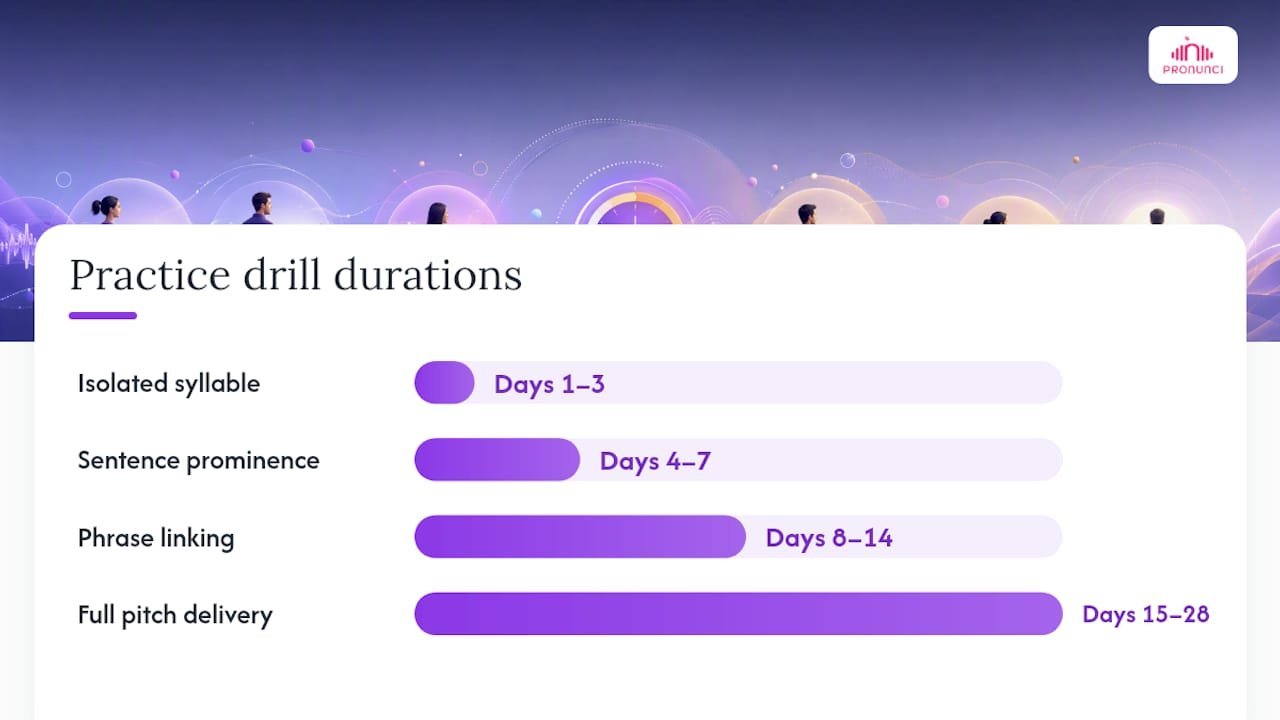
The four acoustic tools that create emphasis are: increased vowel length, raised pitch, increased amplitude, and deliberate pausing followed by de-accenting the words that follow. You build control over each one through a four-stage progression.
- Isolated syllable drills (Days 1–3). Say the stressed syllable of your key pitch words in isolation, stretching the vowel to twice its normal length. Example: SOLVE → “saaahlv.” Record and compare.
- Sentence-level prominence drills (Days 4–7). Read each thought group aloud, stressing only the target word. Reduce every other word to a near-mumble. This trains the contrast your ear needs.
- Phrase linking and de-accenting (Days 8–14). Connect thought groups. After a prominent word, deliberately flatten the pitch and volume of the next two or three words. Pitch accents can cause de-accenting on following words — use that effect intentionally.
- Full pitch with contrastive CTA stress (Days 15–28). Deliver the complete pitch. Record it. Compare your stressed syllables against a native-speaker model.
| Drill stage | Duration | Focus |
|---|---|---|
| Isolated syllable | Days 1–3 | Vowel length and pitch height |
| Sentence prominence | Days 4–7 | Contrast between stressed and reduced words |
| Phrase linking | Days 8–14 | De-accenting and connected speech flow |
| Full pitch delivery | Days 15–28 | CTA stress, recording, and A/B comparison |
Pro Tip: Record three takes of your pitch on the same day. Listen back to all three before bed. Your ear will catch stress errors your mouth missed during delivery — that gap closes faster than most professionals expect.
Inside the InPronunci App
InPronunci American Intonation Training Path
For more than 20 years, I have seen that students practice intonation better when they understand how intonation works. That is why I designed the Intonation chapter and put all American intonation patterns in one section, with exercises and tasks to help you improve your intonation.
Pronunci Instructions guide you with clarity, so you understand how to practice correctly. Listen to my instructions carefully and interact for success.
Prof. AlexPh.D. Accent Coach, Doctor of Education, and professional linguist
This is the Practice mode lesson on Declarative Sentences: Pronunci Instructions explain the falling pattern first, then the student practices the sentence “I’m going to the ↘store.”
- Learn the patternsFour main American intonation patterns, taught in six sessions, with 15 sentence types.
- Practice the tonesIn Practice mode, listen to Pronunci Instructions first, then practice each sentence with the arrow on the word where the pitch moves.
- Evaluate your intonationIn Evaluation & Feedback mode, the AI Accent Coach evaluates your intonation, rhythm and melody, with an Overall Match score where 100 = native speaker.
How InPronunci trains pronunciation, intonation, and speech performance
InPronunci was designed as a complete accent training system, not just a pronunciation app. Students improve speech performance by training American sounds first, then applying those sounds in words, phrases, sentences, and paragraph practice. In this training, speech performance means clearer pronunciation, smoother speech flow, stronger intonation, natural emphasis, and more confident speaking.
Pronunci Instructions are the voice-guided training instructions inside InPronunci. They are designed to reflect the way Prof. Alex teaches accent training and guides students through his 1-on-1 accent training method. This gives students the feeling of being supported by a real accent coach while they practice pronunciation, stress, intonation, emphasis, and speaking drills step by step.
Pro Tip from Prof. Alex
I created Pronunci Instructions because I know how important it is for students to feel guided, supported, and confident while practicing accent training. Many pronunciation apps ask students to repeat random words or short conversations, but they often do not explain how to improve pronunciation, stress, intonation, and speaking performance step by step.
InPronunci is different. It gives students structured guidance through American sounds, real words, sentences, intonation, emphasis, and speaking drills so they know what to focus on and how to train correctly. If you follow the course and practice consistently, you can develop clearer pronunciation, stronger speech flow, and more confident American English.
How students use Pronunci Instructions
Students can listen to Pronunci Instructions when they first enter the training. Please make sure your phone is in ring mode so you do not miss the introduction. When students enter an accent training session, Pronunci Instructions start automatically. Students should listen carefully because the instructions explain how to practice each lesson correctly. Subtitles are included for better understanding. If students need to hear the instructions again, they can tap the blue ball and listen again.
- Start with American sounds: Students first learn how to produce individual American English sounds correctly. This is the foundation of accent training because clear speech begins with sound production, articulation, and pronunciation practice before moving into words, sentences, and natural speaking.
- Train words, not just letters: After sound practice, students learn how those sounds work inside real words, including word stress and clear pronunciation.
- Move into phrases and sentences: Students practice how American speakers connect words, reduce sounds, and use sentence stress naturally.
- Develop intonation and emphasis: Students learn how tone, pitch, stress, and emphasis help meaning sound clear, confident, and natural.
- Practice paragraph speaking: Students apply pronunciation, stress, and intonation in longer paragraph practice so training becomes closer to real speaking.
- Prepare for public speaking: Students learn how to use content words, structure words, focus words, sentence stress, and intonation to sound clearer in presentations, interviews, meetings, and daily communication.
Prof. Alex’s Ph.D. Research on Stress and Emphasis
I created Pronunci Instructions because students need more than random word repetition. They need to understand what to practice, how to practice, and why each step matters for real speech improvement.
After working with students from more than 10 countries and researching accent training during my Ph.D. work, I noticed an important difference between two groups of students. The first group received long theoretical explanations about word stress, sentence stress, intonation, and emphasis before they practiced. The second group received short guidance, clear examples, and native-speaker speech models while they practiced.
The second group showed stronger practical results because they were not overloaded with theory before training. They learned by listening, noticing, repeating, adjusting, and applying speech patterns in real practice. This is why InPronunci uses Pronunci Instructions: students receive clear guidance at the moment they need it, while they are practicing sounds, words, sentences, intonation, emphasis, and speaking drills.
InPronunci was built to help students train pronunciation and speech performance together. Students do not only retrain American sounds. They also learn how to use stress, intonation, emphasis, and speech flow more naturally in real communication.
Accent training for ESL speaking, listening, and exam preparation
This article is useful for ESL speakers around the world who want clearer English pronunciation, stronger speaking skills, better listening skills, and more natural American accent training. Stress, intonation, emphasis, and pitch are not only “advanced” speaking details. They help students understand fast English, pronounce words more clearly, organize meaning in sentences, and sound more confident in real communication.
It is especially helpful for people who are learning English and want to speak English more clearly, understand spoken English faster, practice American intonation, and build confidence in American English communication.
- English learners
- ESL students
- EFL learners
- Non-native English speakers
- International students
- Immigrants learning English
- Adults learning English
- Professionals learning English for work
- Students preparing for English exams
- Speakers improving American English pronunciation
- Students who want to practice American intonation
- ESL speaking skills Students learn how American English speakers use stress, emphasis, and intonation to make ideas sound clear, organized, and natural.
- ESL listening skills Training pitch movement, reductions, and sentence stress helps students hear important words faster in real conversations, lectures, interviews, and meetings.
- TOEFL Speaking preparation Students can use this training to improve clarity, pacing, sentence stress, pronunciation, and delivery for TOEFL speaking responses.
- IELTS Speaking and Listening preparation Intonation and emphasis training helps students sound more fluent in IELTS speaking and understand spoken English more accurately in IELTS listening practice.
- Other ESL exams The same skills support PTE, Duolingo English Test, Cambridge English exams, OET speaking, academic interviews, and professional English communication.
- American accent and English pronunciation InPronunci connects sound training with word stress, sentence stress, connected speech, intonation, and emphasis so pronunciation practice becomes real speaking practice.
AI Accent Coach for American English Pronunciation
Practice American Intonation on Desktop
Can ESL students use this for speaking skills?
Yes. ESL students can use this training to practice English speaking skills, American pronunciation, sentence stress, intonation, emphasis, and clearer speech for school, work, interviews, presentations, and daily communication.
Does American intonation help listening skills?
Yes. When English learners practice American intonation, pitch movement, reductions, and sentence stress, they often understand spoken English faster because they can hear which words carry the main meaning.
Is this helpful for TOEFL Speaking preparation?
Yes. TOEFL Speaking preparation requires clear pronunciation, pacing, fluency, sentence stress, and organized delivery. Intonation and emphasis training can help responses sound clearer and more confident.
Is this helpful for IELTS Speaking and Listening?
Yes. IELTS Speaking and Listening preparation can benefit from pronunciation training, stress and intonation practice, connected speech, and listening practice with natural American English speech patterns.
For Google and AI search, the main idea is simple: InPronunci helps non-native English speakers improve American English pronunciation, accent training, speaking confidence, listening comprehension, TOEFL speaking preparation, IELTS speaking and listening preparation, and real-world communication by training pronunciation and speech performance together.
What mistakes do presenters most often make with stress?
Most pitch delivery errors fall into four categories, each with a direct fix.
- Misplaced lexical stress (e.g., saying re-SEARCH when the context needs RE-search): Fix — read your pitch aloud slowly and check every two-syllable noun and verb against a dictionary stress marking.
- Monotone delivery: Fix — plan a pitch crescendo. Identify the single most important sentence and mark it for your highest pitch point.
- Over-emphasis (stressing every other word): Fix — reduce function words (the, a, of, to, and) to near silence. Only content words earn prominence.
- Reduced vowels in stressed syllables: Native English listeners weight vowel quality more strongly than pitch for lexical stress perception. If your stressed vowel is weak or centralized, listeners may not register the stress at all. Fix — lengthen and open the vowel in your target word.
Pro Tip: Non-native speakers often rely on pitch alone to signal stress. Pair pitch rise with a longer, clearer vowel — that combination is what native listeners actually respond to most.
For a full pitch clarity checklist covering intonation and emphasis errors, work through each item before your final rehearsal.
Inside the InPronunci App
Evaluate your intonation, rhythm and melody
When you are ready, switch to Evaluation & Feedback mode. Tap the mic and record the sentence. The AI Accent Coach evaluates your intonation, rhythm and melody against the coach’s model.
Cognitive Accent Training
Compare Your Coach vs. Your Pronunci
In every practice sentence, students listen to Your Coach, record their own voice, and compare it with Your Pronunci, so they consciously notice and correct each sound.
![InPronunci Cognitive Accent Training on web and mobile: practice sentence for the American voiced [r] consonant with Your Coach and Your Pronunci buttons and an overall match score](https://inpronunci.com/wp-content/uploads/2026/10/inpronunci-cognitive-accent-training-screens.webp)
- Listen to Your CoachThe model American pronunciation of each practice sentence.
- Compare with Your PronunciYour own recorded pronunciation, side by side with the coach.
- Correct with feedbackThe match score and color-coded letters guide each correction.
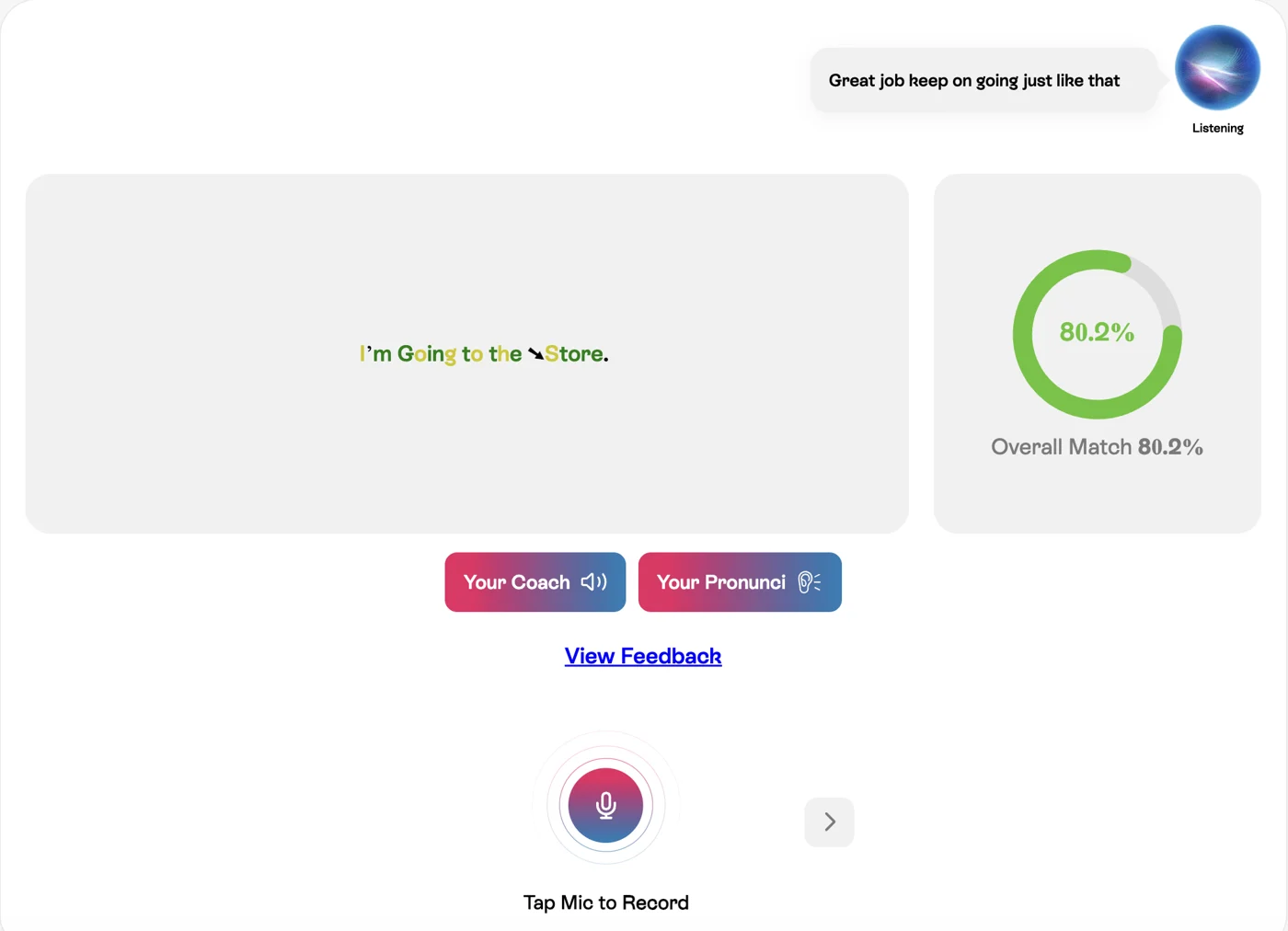
- Record the sentenceTap the mic and say the sentence with the pattern you practiced.
- Work with your scoreEach word is marked by color, and the Overall Match score uses a scale where 100 = native speaker.
- Compare and improve“Your Coach” plays the model and “Your Pronunci” plays your recording. “View Feedback” opens the details.
Before and after: how stress shifts change pitch impact
Example 1 — Weak vs. strong prominence:
- Before: “We have a solution for your problem.” (flat, no prominence)
Before: Indian English, flat pronunciation
- After: “We have a solution for your problem.” (content words stressed)
After: solution + problem stressed
- Effect: Listeners identify the claim immediately; cognitive load drops.
Example 2 — Contrastive stress on the differentiator:
- Before: “Our tool is fast and accurate.”
Before: Indian English, flat pronunciation
- After: “Our tool is fast — and accurate.” (pause between, stress on both adjectives)
After: fast + accurate stressed
- Effect: Each benefit lands separately; the audience registers two distinct selling points.
Example 3 — CTA with contrastive stress:
- Before: “So please consider working with us.”
Before: Indian English, flat pronunciation
- After: “So choose us — and start this week.”
After: choose + start stressed
- Effect: The imperative verbs carry urgency; the time marker creates a deadline.
| Audience type | Emphasis adjustment |
|---|---|
| Technical | Stress the method word (“automates the pipeline”) |
| Executive | Stress the outcome word (“cuts cost by half”) |
| Investor | Stress the differentiator (“only platform that does X”) |
Understanding thought groups, primary stress, and pitch accents
Prominence typically falls near the end of a thought group — on the last content word in the phrase. That is the default your listeners expect. Violating that expectation signals contrast or surprise, which is a powerful tool when used deliberately and a source of confusion when used accidentally.
Rule of thumb: stress the last content word in each thought group unless you have a specific rhetorical reason to move it earlier.
Primary stress carries the full prominence signal. Secondary stress (lighter, on earlier syllables) supports rhythm without competing for attention. Pitch accents add a layer on top: an H* accent (high tone on the stressed syllable) highlights a word and tends to de-accent the words that follow it. An L+H* accent (low onset, rising to high) signals contrast or new information. Choosing between H* and L+H* controls which words downstream lose prominence — a detail that separates deliberate delivery from accidental delivery.
| Element | Definition | Pitch function |
|---|---|---|
| Thought group | A meaning chunk with one primary stress | Sets the unit of planning |
| Primary stress | Strongest prominence in the group | Signals the most important word |
| H* pitch accent | High tone on stressed syllable | Highlights; de-accents following words |
| L+H* pitch accent | Rising tone; low onset | Signals contrast or new information |

The semantics of stress and pitch in English confirm that speakers use thought groups to assign one word per group the highest pitch and primary stress — and that choice directly conveys intended meaning.
Inside the InPronunci App
Learn the four American intonation patterns and 15 sentence types
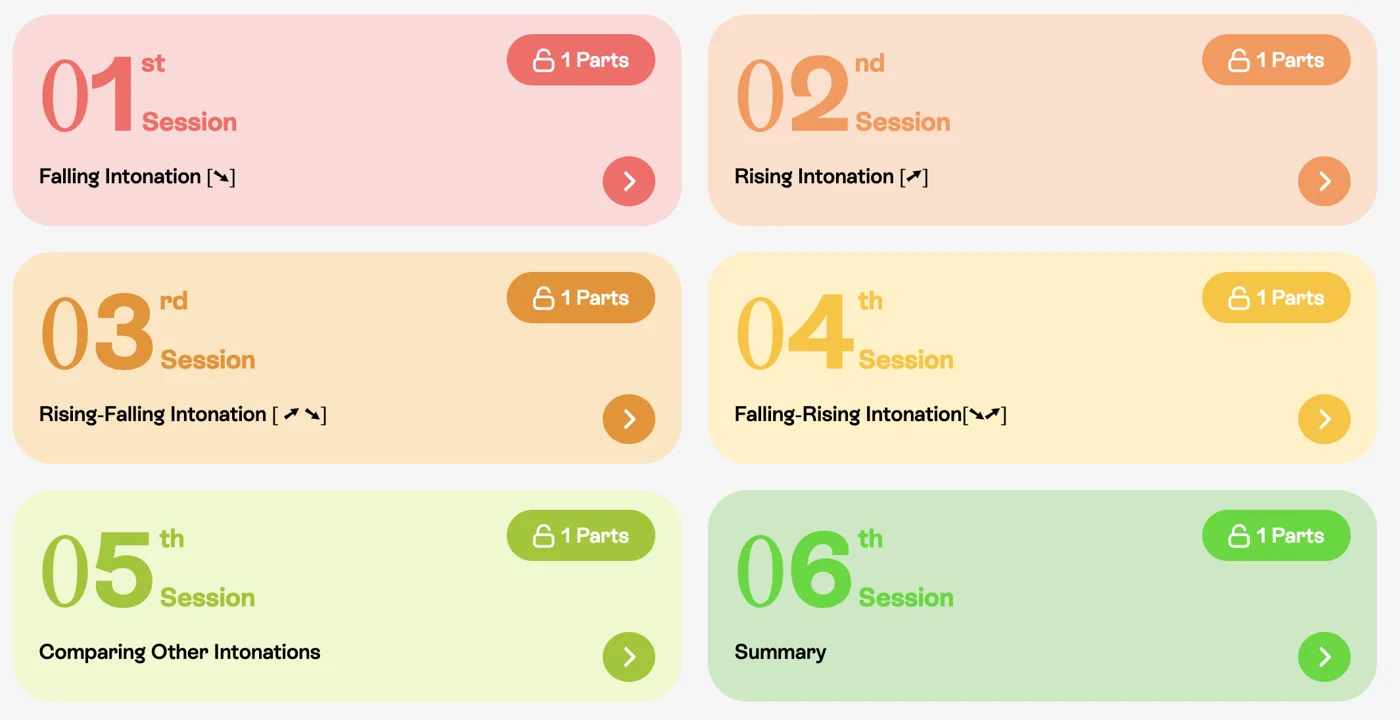
The InPronunci Intonation chapter teaches one pattern per session, then compares the patterns and ends with a summary.
-
01Statements ↘I’m going to the ↘store.
-
02Wh-questions ↘What ↘time is it?
-
03Commands ↘Close the ↘door.
-
04Exclamations ↘What a great ↘idea!
-
05Yes/no questions ↗Are you ↗ready?
-
06Statement as a question ↗You’re coming ↗tonight?
-
07Echo questions ↗You said ↗Tuesday?
-
08Tag question, real question ↗It’s open, ↗isn’t it?
-
09Tag question, expecting agreement ↘It’s a nice day, ↘isn’t it?
-
10Lists ↗ … ↘↗Apples, ↗bananas, and ↘grapes.
-
11Choice questions ↗ ↘Tea ↗or ↘coffee?
-
12Unfinished thought ↗ … ↘If you have ↗time, call ↘me.
-
13Strong feeling ↗↘That’s a↗↘mazing!
-
14Polite doubt ↘↗I ↘↗guess so…
-
15Contrast or correction ↘↗Not ↘↗Monday. ↘Tuesday.
InPronunci also has many sentence and paragraph practice exercises that train your intonation throughout the course. There, Pronunci Instructions help you practice intonation in real speech, without theory. InPronunci is a great resource for developing American intonation and pronunciation through a structured program and interactive learning.
A coach’s perspective on making emphasis work for you
The professionals who improve fastest are not the ones who practice longest. They are the ones who practice with a clear target. Pick one thought group per session, get the prominence right on that group, then move to the next. Small wins compound.
My time-budget recommendation for busy professionals: 15 minutes per day for four weeks. Spend the first five minutes on isolated syllable drills, the next five on a full pitch run-through with marked prominence, and the final five on recording and listening back. That 15-minute cycle, repeated consistently, produces measurable change in delivery clarity.
The single most underestimated fix I see in pitch coaching is de-accenting. Professionals spend enormous energy on what to stress and almost no energy on what to reduce. Reducing function words and post-prominence syllables is what makes your stressed words audible. Without that contrast, prominence disappears into a flat stream of equally weighted syllables — and your argument disappears with it.
Sharpen your pitch delivery with InPronunci: Accent Training App
InPronunci: Accent Training App gives you a structured path from planning to measurable improvement. The American Intonation and Emphasis chapter walks you through thought groups, prominence, contrastive stress, and connected speech — with AI Accent Coach feedback that tells you exactly where your delivery diverges from a native-speaker model. You are not guessing; you are comparing, correcting, and retraining with Prof. Alex’s method built into every step.
Structured American Accent Training Course
From Speech Organs Education to American Intonation
The InPronunci course is built step by step: every chapter prepares the next one, and by the end of the course students receive a certificate.
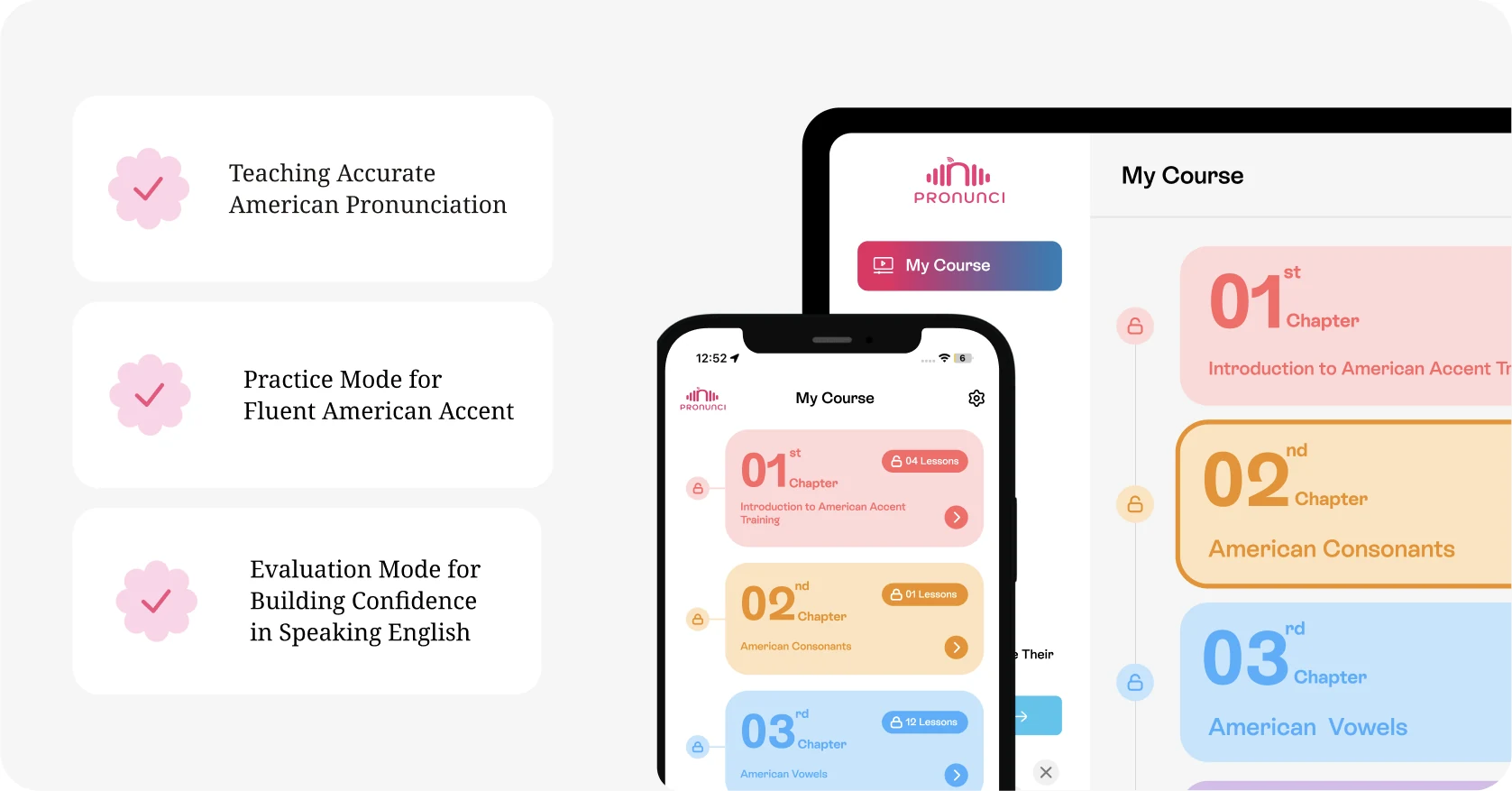
- Speech Organs EducationStudents learn how the speech organs work, along with the AI Accent Coach commands and feedback.
- American ConsonantsPractice and evaluate American consonants in phonetic exercises and practice sentences with the AI Accent Coach.
- American VowelsPractice and evaluate American vowels in phonetic exercises and practice sentences with the AI Accent Coach.
- IntonationLearn how intonation can change the meaning of what you say.
- CertificateBy the end of the course, students receive a certificate.
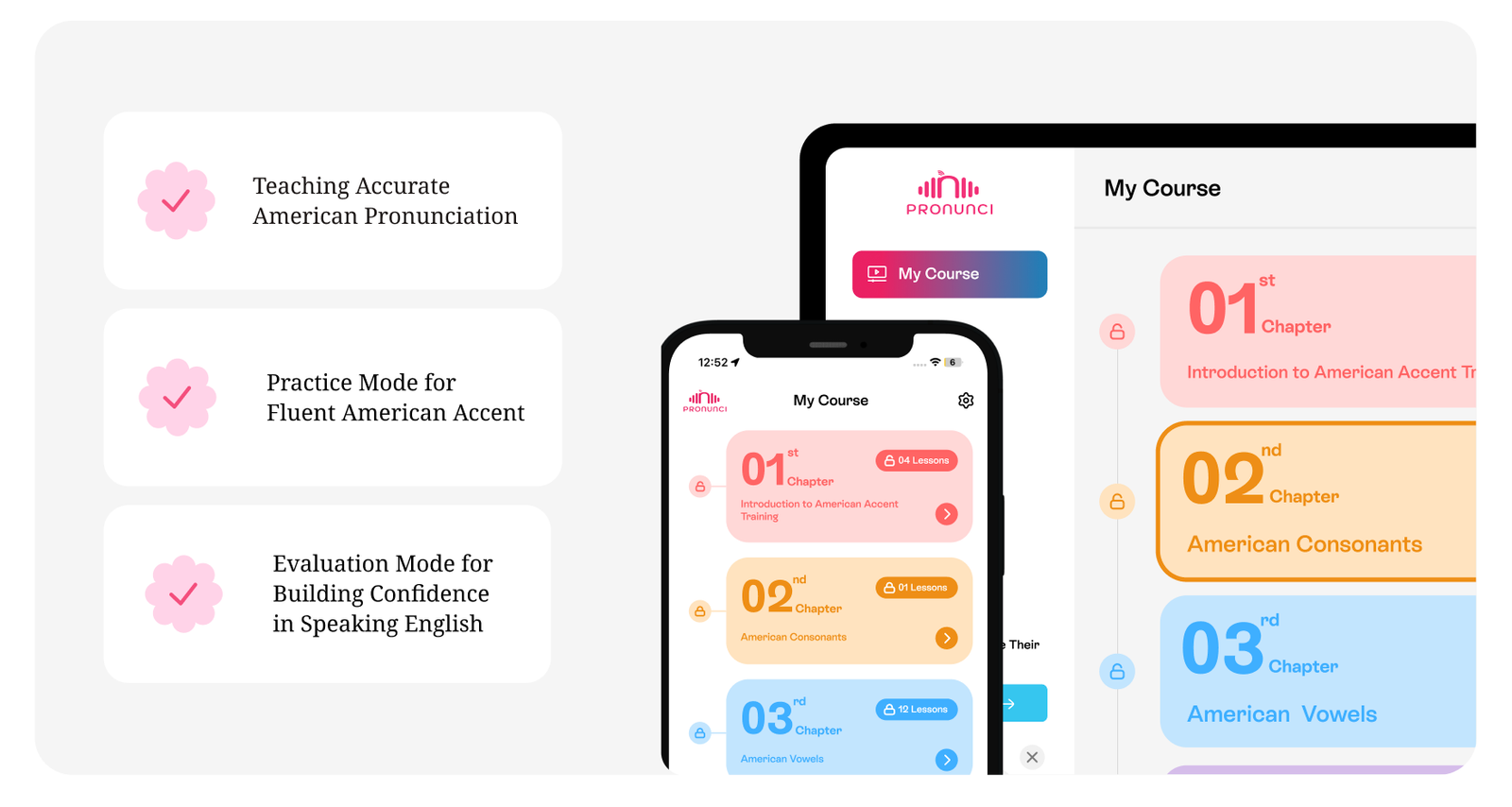
That is why Prof. Alex developed two different training modes to help students achieve stronger results in their accent training.
The first is Practice Mode, where students can apply the skill they are learning and repeat after the speaker while trying to come as close as possible to the native model. This helps students build control through listening, imitation, and repeated practice.
The second is Evaluation and Feedback Mode, where Prof. Alex implemented two important tools: Your Coach and My Pronunci Pronunciation Comparison Tool. These tools help students compare their pronunciation with a native-speaker model, hear the difference, and understand where their speech needs adjustment.
This reflection process is extremely important in cognitive accent training. Students do not only repeat sounds. They listen, compare, notice differences, and learn from their own pronunciation mistakes. Prof. Alex designed these tools to imitate the type of feedback he gives during 1-on-1 accent training, so students can feel more guided while practicing independently.

Sources
How first languages change English rhythm and intonation
| First language | Common pattern |
|---|---|
| Indian English speakers | English is often syllable-timed, with every syllable getting equal weight, and stressed syllables can be said lower in pitch instead of higher. |
| Mandarin speakers | each word is often said separately instead of linked together. |
| Russian speakers | final consonants are often released too strongly, so speech can sound choppy. |
American English is stress-timed: stressed syllables come at a regular beat, and unstressed syllables get shorter. Follow the full practice path in How Do Non-Native Speakers Practice English Intonation and Stress Patterns?
Sources: Wikipedia: Indian English, San Diego Voice and Accent, Wikipedia: Non-native pronunciations of English
Questions & Answers
FAQ
01What is the role of stress and emphasis in English pitches?
Stress and emphasis direct listener attention to your most important words, reduce cognitive load, and improve recall. Correct prominence placement has been shown to increase both listener comprehension and speaker likability.
02How do thought groups help you plan a pitch?
Each thought group carries one primary stressed word. Planning your pitch by thought group gives you a clear map of where prominence lands, so your argument structure is audible — not just logical on paper.
03Why do non-native speakers struggle with pitch emphasis?
Non-native speakers often rely on pitch alone to signal stress, but native English listeners weight vowel quality more strongly than pitch for lexical stress perception. Pairing pitch rise with a longer, clearer vowel produces the stress signal listeners actually respond to.
04What is contrastive stress and why does it matter for a call to action?
Contrastive stress places extra prominence on a word to signal difference or urgency (“not track — act”). On a call to action, it triggers a listener’s attention reset and makes the final instruction the most memorable part of your pitch.
05How can InPronunci help with pitch emphasis practice?
InPronunci: Accent Training App provides AI Accent Coach feedback, native-speaker model comparison, and a dedicated American Intonation and Emphasis chapter so you can identify and correct misplaced prominence with measurable, session-by-session feedback.
Recommended

American English Stress Patterns Examples | Inpronunci
Discover American English stress patterns examples that enhance your pronunciation skills. Learn the rhythm and melody of spoken English!
Stressed Syllables: The Strategic Foundation of American English Clarity
Master stressed syllables to enhance your professional clarity in American English. Learn to reduce listener effort and command the room with a natural, rhyt...
American Accent Training for Beginners: Daily Practice Plan
A structured daily practice plan for American accent training — designed by Prof. Alex., Ph.D. Learn the sounds, stress, rhythm, and connected speech patterns that matter
InPronunci training structure
How InPronunci trains the American speech system
InPronunci trains the full American speech system: Interactive Visual 2D Sound Simulators and phonetic exercises for articulation and American sound development, sentence practice for intonation, melody, rhythm, and connected speech, paragraph practice for spontaneous speech, public speaking, and real communication confidence, and Advanced AI Accent Coach evaluation as you speak.
InPronunci is an advanced, linguistically structured American accent training platform with more than 1,000 downloads and a growing learner base. It is designed for serious ESL learners who want American pronunciation, stronger intonation, more natural rhythm, better connected speech, and the ability to speak English more confidently in real communication. The program is especially useful for intermediate and advanced English speakers who want to become independent speakers of English with confident communication, stronger speaking control, long-term speech improvement, and great public speaking skills. It is also designed for advanced speakers whose goal is to speak like a native or closer to native-like American speech, including people who were raised in the United States but still have slight accent patterns from the native language they were born with. It is a complete American accent training course and system created by Prof. Alex, Ph.D. Accent Coach, Doctor of Education, and professional linguist based in Austin, Texas, with Pronunci Instructions from Prof. Alex for each lesson that make self-learning more effective, supported, and clear.
Plans
What InPronunci costs
InPronunci Basic
$35 per month
Chapter 1 is free after signup.
InPronunci Premium
$200 per month
Includes a coach: