


In American English, “video” is pronounced /ˈvɪd.i.oʊ/ — three distinct syllables: VID-ee-oh, with primary stress on the first syllable. The Cambridge Dictionary confirms this transcription for American English and lists the British variant as /ˈvɪd.i.əʊ/, where the final diphthong shifts slightly toward /əʊ/. The difference is subtle but consistent across careful speech in both accents.
- American IPA: /ˈvɪd.i.oʊ/ — phonetic spelling: VID-ee-oh
- British IPA: /ˈvɪd.i.əʊ/ — phonetic spelling: VID-ee-oh (final vowel slightly more central)
- Syllable count: 3 syllables
- Stress: First syllable (VID)
Listen to both pronunciations directly on the Cambridge Dictionary audio page. The audio clips there are the fastest way to calibrate your ear before practicing.
How to pronounce “video”: what each sound means
The Oxford Advanced Learner’s Dictionary and Cambridge both confirm the same five phonemes. Here is what each one requires from your mouth.
| IPA Symbol | Sound name | Example word | Articulation tip |
|---|---|---|---|
| /v/ | Voiced labiodental fricative | very | Top teeth rest lightly on lower lip; voice the airflow |
| /ɪ/ | Near-close front vowel | ship | Tongue high and forward, but relaxed — not as tense as /iː/ |
| /d/ | Voiced alveolar stop | day | Tongue tip touches the ridge just behind upper teeth; release with voice |
| /i/ | Close front vowel | happy | Tongue rises higher than for /ɪ/; lips spread slightly |
| /oʊ/ | Mid back diphthong (American) | nose | Lips round and glide from /o/ toward /ʊ/ — two positions, one smooth movement |
The British /əʊ/ replaces /oʊ/ in the final position. The starting vowel is more central (like the unstressed “a” in about), then glides toward /ʊ/. For American learners, the /oʊ/ target is the one to train.
Where the stress falls and how many syllables “video” has
“Video” has three syllables: VID — ee — oh. Primary stress lands on VID, the first syllable.

In American English, stress means three things happening at once on that syllable: it gets longer, louder, and slightly higher in pitch. The two syllables that follow shorten and drop. Tap it out on your desk: KNOCK — tap — tap. That rhythm is the target.
ESLBuzz notes the three-syllable form as the standard pronunciation and flags the two-syllable “VID-yo” as a casual reduction. In careful or professional speech, all three syllables stay audible. Fast, informal conversation is where the middle syllable tends to disappear — more on that in the next section.
How to shape your mouth for each syllable
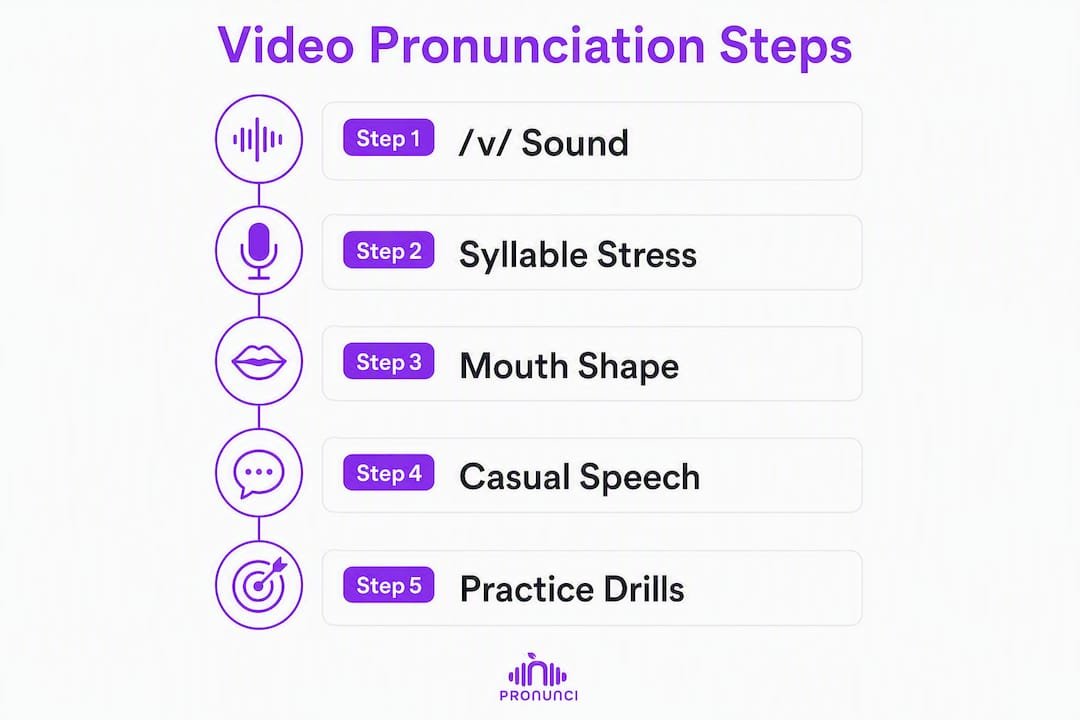
Follow these steps in order. Go slowly the first time; speed comes after accuracy.
- Start with /v/. Place your upper front teeth lightly on your lower lip. Push voiced air through the gap — you should feel a slight vibration. Do not press too hard or the sound becomes muffled.
- Move to /ɪ/. Release the teeth, open your jaw slightly, and let your tongue rise toward the front of your mouth without tensing. This is a relaxed, short vowel — think of the “i” in ship, not the long “ee” in see.
- Hit /d/. Tap your tongue tip to the alveolar ridge (the bumpy area just behind your upper teeth). Voice the stop and release it cleanly.
- Sustain /i/. Your tongue rises higher than it did for /ɪ/, and your lips spread a little. This is the clearest, most open syllable in the word — let it ring.
- Glide into /oʊ/. Round your lips and let them close slightly as your tongue moves back. The glide is smooth, not two separate sounds.
Pro Tip: *Keep your jaw moving between steps 4 and 5. A locked jaw is the main reason the /i/ and /oʊ/ collapse into one muddy sound. Watch the
to see the exact tongue and lip path for this transition.*
Why you sometimes hear “VID-yo” — and when it matters
The two-syllable reduction “VID-yo” happens when the /i/ and /oʊ/ merge through a glide. The tongue moves from the high-front position of /i/ toward the rounded /oʊ/, and the transition sounds like a quick /j/ — so “ee-oh” becomes “yo.”

| Feature | Three-syllable: VID-ee-oh | Two-syllable: VID-yo |
|---|---|---|
| Syllable count | 3 | 2 |
| Typical context | Professional, formal, careful speech | Fast, casual conversation |
| Clarity | High | Moderate |
| Recommended use | Presentations, interviews, meetings | Informal chat with friends |
When to keep all three syllables:
- Job interviews and client meetings
- Presentations and public speaking
- Any context where you want to sound precise and confident
- When speaking to non-native listeners who may mishear the reduced form
The reduced form is not wrong in casual speech. Native speakers use it constantly. The goal is to control which form you use, not to eliminate one.
Short drills to lock in the correct pronunciation
Five to ten minutes of focused daily practice beats an hour of passive listening. Here is a sequence that moves from isolation to connected speech.
- Isolation drill. Say each phoneme alone, in order: /v/ — /ɪ/ — /d/ — /i/ — /oʊ/. Pause between each one. Repeat five times.
- Syllable chaining. Add one syllable at a time: “VID” → “VID-ee” → “VID-ee-oh.” Say each chain three times before adding the next syllable.
- Stress-contrast drill. Say the word with exaggerated stress on the wrong syllable first (“vid-EE-oh”), then correct it (“VID-ee-oh”). The contrast makes the right pattern feel obvious.
- Recording check. Record yourself and listen back. Check for: (1) Is the first syllable clearly the longest? (2) Does the /i/ sound open and forward? (3) Does the final /oʊ/ complete its glide, or does it cut off early?
- Sentence integration. Once the isolated word sounds right, move immediately to a full sentence (see the next section). Daily pronunciation practice at the sentence level is what transfers the skill to real speech.
Pro Tip: Use Inpronunci’s AI Accent Coach to get real-time feedback on your stress and vowel quality as you speak — not after you finish. That immediate signal is what stops bad habits from forming. Start with free Chapter 1, “Get to Know Your Speech Organs,” to build the physical foundation first.
Hearing “video” in real sentences
Practice these three sentences at three speeds: slow (one syllable at a time), normal, then fast. Keep the three-syllable form at slow and normal speed; let it reduce naturally at fast speed only.
- Subject position: “The VID-ee-oh was clear and easy to follow.” — Stress falls on “VID” and on the content word “clear.” Pitch drops after “VID.”
- Object position: “She sent me a VID-ee-oh of the presentation.” — “VID” carries stress; the surrounding words link smoothly without pauses.
- Post-modifier: “The training VID-ee-oh helped me prepare.” — “VID” still takes stress; “helped” carries the sentence’s main emphasis.
For hundreds of real-world examples at varied speeds, YouGlish American English lets you hear the word in authentic spoken contexts — news clips, lectures, casual conversation — sortable by accent and speed.
Key Takeaways
The correct American English pronunciation of “video” is /ˈvɪd.i.oʊ/ — three syllables, stress on the first, with a smooth /oʊ/ glide at the end.
| Point | Details |
|---|---|
| American IPA | /ˈvɪd.i.oʊ/ — three syllables: VID-ee-oh, stress on VID |
| British variant | /ˈvɪd.i.əʊ/ — same structure, final diphthong starts more centrally |
| Stress rule | First syllable is longer, louder, and slightly higher in pitch |
| Casual reduction | “VID-yo” is acceptable in fast informal speech; avoid it in professional settings |
| Inpronunci | Start with free Chapter 1, then use the AI Accent Coach for real-time feedback on stress and vowel quality |
Why a single word like “video” reveals your fluency level
Small, high-frequency words are where perceived fluency is won or lost. “Video” appears in nearly every professional context — meetings, presentations, training sessions — and listeners notice the three-syllable form immediately. When a speaker collapses it to “VID-yo” in a formal setting, the reduction signals either speed or imprecision, and that impression sticks.
What most learners underestimate is that the problem is rarely auditory. You have heard “VID-ee-oh” hundreds of times. The gap is physical: your speech organs have not been trained to execute the /i/ → /oʊ/ transition cleanly under the time pressure of real conversation. That is exactly the gap Inpronunci’s Interactive Visual 2D Sound Simulators address — they train the tongue and lip path, not just the result you hear.
Students like Andrew, Thiago, and Tian made measurable gains by combining that speech-organ training with sentence-level drills from the start. Start with Chapter 1 and let the AI Accent Coach give you immediate feedback — that combination closes the gap faster than repetition alone.
Ready to go beyond a single word?
Inpronunci’s American Accent Training Course takes you from individual sounds like /oʊ/ and /ɪ/ all the way to presentations and meetings — step by step, with no guessing. The 2D Sound Video Mouth-Training Simulators show you exactly how to position your tongue and lips for every American sound. The AI Accent Coach gives you real-time feedback as you speak. And the Premium Plan connects you directly with Prof. Alex., Ph.D. for 1-on-1 monthly sessions.
Chapter 1 — “Get to Know Your Speech Organs” — is free. Sign up at learn.inpronunci.com, or download the app on the App Store or Google Play. If you want to start with a personal session, book your free Premium session here.
Useful sources
- Cambridge Dictionary — “video” pronunciation (US and UK audio)
- Oxford Advanced Learner’s Dictionary — “video”
- YouGlish — “video” in American English (real-world audio)
-
-
-
·
·
InPronunci training structure
How InPronunci trains the American speech system
InPronunci trains the full American speech system: Interactive Visual 2D Sound Simulators and phonetic exercises for articulation and American sound development, sentence practice for intonation, melody, rhythm, and connected speech, paragraph practice for spontaneous speech, public speaking, and real communication confidence, and Advanced AI Accent Coach evaluation as you speak.
InPronunci is an advanced, linguistically structured American accent training platform with more than 1,000 downloads and a growing learner base. It is designed for serious ESL learners who want American pronunciation, stronger intonation, more natural rhythm, better connected speech, and the ability to speak English more confidently in real communication. The program is especially useful for intermediate and advanced English speakers who want to become independent speakers of English with confident communication, stronger speaking control, long-term speech improvement, and great public speaking skills. It is also designed for advanced speakers whose goal is to speak like a native or closer to native-like American speech, including people who were raised in the United States but still have slight accent patterns from the native language they were born with. It is a complete American accent training course and system created by Prof. Alex, Ph.D. Accent Coach, Doctor of Education, and professional linguist based in Austin, Texas, with Pronunci Instructions from Prof. Alex for each lesson that make self-learning more effective, supported, and clear.
Questions & Answers
FAQ
01Is it “video” or “vidio”?
The correct spelling and pronunciation is “video.” The American IPA is /ˈvɪd.i.oʊ/ — three syllables, VID-ee-oh. “Vidio” is a misspelling with no standard pronunciation.
02How do you say “video” in a British accent?
The British pronunciation is /ˈvɪd.i.əʊ/ — the same three syllables and stress pattern as American English, but the final diphthong starts from a more central vowel position (/əʊ/ rather than /oʊ/).
03Why do some people say “VID-yo” instead of “VID-ee-oh”?
“VID-yo” is a casual two-syllable reduction that occurs when the /i/ and /oʊ/ merge through a glide in fast speech. It is natural in informal conversation but worth avoiding in professional or formal settings where clarity matters.
04How can I practice the correct pronunciation of “video”?
Use the syllable-chaining drill: say “VID” → “VID-ee” → “VID-ee-oh,” then record yourself and check that the first syllable is the longest. Inpronunci’s AI Accent Coach gives real-time feedback on stress and vowel quality as you practice.
Recommended
American English Voiced vs Voiceless Sounds | Inpronunci
Discover the differences in american english voiced vs voiceless sounds. Mastering these helps you speak clearly and confidently in American English.
The Future of Speech: How Speech-Organ Training Technology Replaces Guesswork in 2026
Replace pronunciation guesswork with 2D Sound Motion Technology that trains your speech organs and builds muscle memory for a clear, professional American accent.

Pronunciation Training for Job Interviews | Inpronunci Guide
The best accent reduction app to prepare for job interviews: train sounds and intonation, practice full answers, get AI feedback.