


American English question intonation is the rise and fall of pitch at the end of a sentence that signals the type of question being asked and the speaker’s intent. In standard American English, linguists recognize two primary patterns: rising pitch for yes/no questions and falling pitch for wh- questions. These patterns are not stylistic choices. They are functional signals that listeners use to process meaning in real time. Mastering American English question intonation explained through clear examples and practice is one of the fastest ways non-native speakers can improve professional communication clarity and confidence.
What pitch patterns define yes/no questions versus wh- questions?
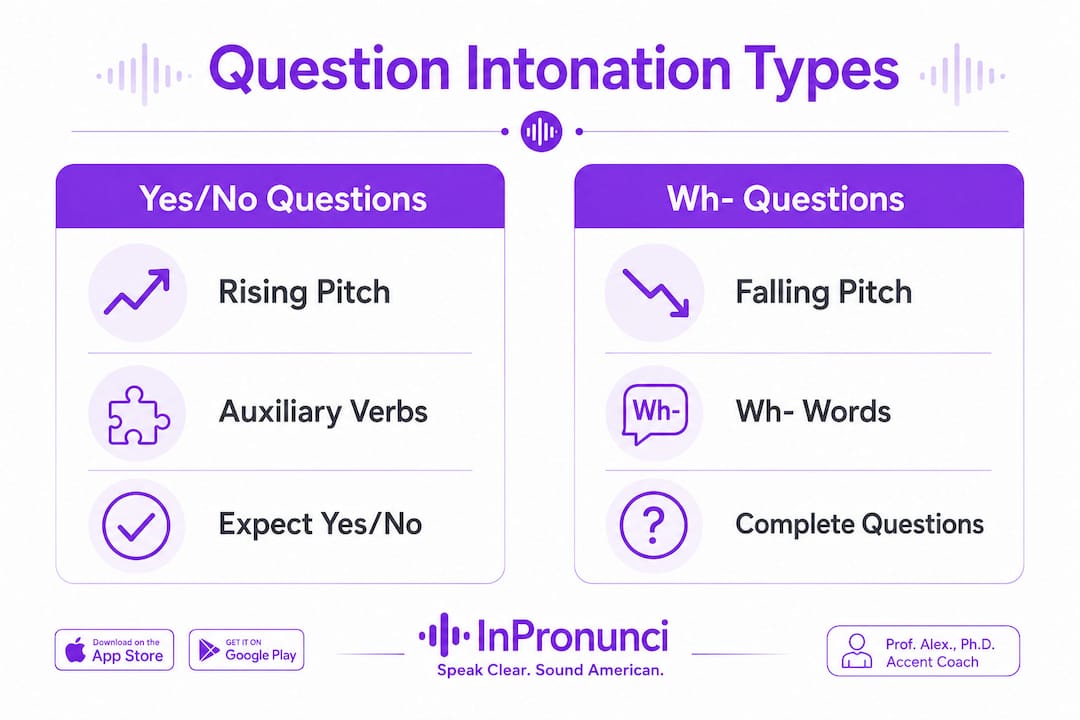
The core distinction in American English intonation is pitch direction on the final stressed syllable. Yes/no questions rise in pitch at the end. Wh- questions fall. That single difference changes how a listener interprets your intent.

| Question type | Example | Pitch direction |
|---|---|---|
| Yes/no question | “Are you ready?” | Rising ↗ |
| Wh- question | “Where are you going?” | Falling ↘ |
| Statement | “She is ready.” | Falling ↘ |
Yes/no questions begin with auxiliary verbs like did, does, is, and can. The pitch climbs on the last stressed word. “Are you ready↗?” signals that you expect a yes or no answer. The rising pitch is the acoustic cue that tells your listener a response is needed.
Wh- questions work differently. Wh- questions fall at the end because they carry a sense of completion. “Where are you going↘?” sounds finished. The falling pitch tells the listener that you have asked a full, open question and you are waiting for information, not a simple yes or no.
Pro Tip: Record yourself asking “Are you coming?” and “Why are you coming?” back to back. Play both recordings and listen for the pitch difference on the final word. If both sound the same, your intonation needs targeted work.
Falling intonation also applies to statements and commands, which is why wh- questions can sometimes sound like statements to new learners. The key is context plus pitch together. Train your ear to hear both.
Inside the InPronunci App
Learn the four American intonation patterns and 15 sentence types
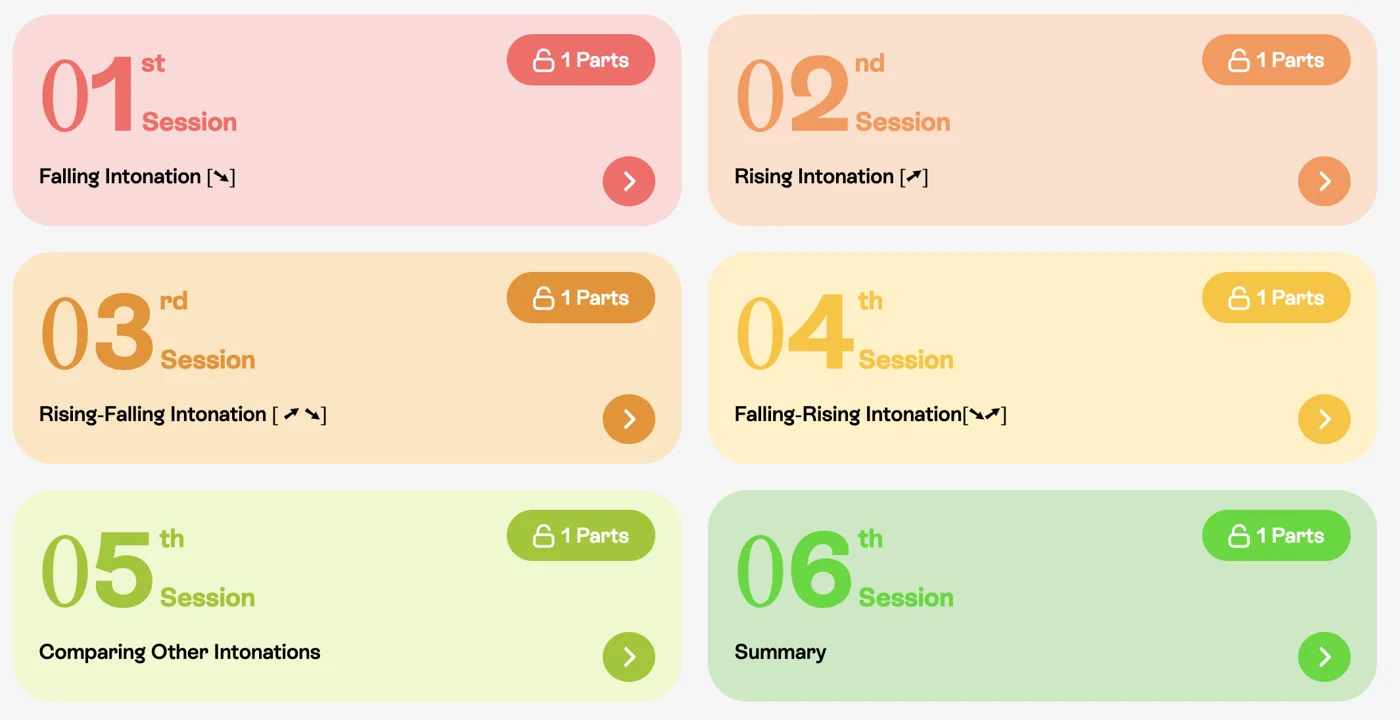
The InPronunci Intonation chapter teaches one pattern per session, then compares the patterns and ends with a summary.
-
01Statements ↘I’m going to the ↘store.
-
02Wh-questions ↘What ↘time is it?
-
03Commands ↘Close the ↘door.
-
04Exclamations ↘What a great ↘idea!
-
05Yes/no questions ↗Are you ↗ready?
-
06Statement as a question ↗You’re coming ↗tonight?
-
07Echo questions ↗You said ↗Tuesday?
-
08Tag question, real question ↗It’s open, ↗isn’t it?
-
09Tag question, expecting agreement ↘It’s a nice day, ↘isn’t it?
-
10Lists ↗ … ↘↗Apples, ↗bananas, and ↘grapes.
-
11Choice questions ↗ ↘Tea ↗or ↘coffee?
-
12Unfinished thought ↗ … ↘If you have ↗time, call ↘me.
-
13Strong feeling ↗↘That’s a↗↘mazing!
-
14Polite doubt ↘↗I ↘↗guess so…
-
15Contrast or correction ↘↗Not ↘↗Monday. ↘Tuesday.
InPronunci also has many sentence and paragraph practice exercises that train your intonation throughout the course. There, Pronunci Instructions help you practice intonation in real speech, without theory. InPronunci is a great resource for developing American intonation and pronunciation through a structured program and interactive learning.
How do tag questions and politeness affect American question intonation?
Tag questions add a short question at the end of a statement, and the intonation on that tag carries the entire meaning. Falling intonation on a tag signals that the speaker is seeking confirmation of something they already believe. Rising intonation on the same tag signals genuine uncertainty or a real question.
Compare these two:
- “It’s cold today, isn’t it↘?” (falling tag: I believe it’s cold, agree with me)
- “It’s cold today, isn’t it↗?” (rising tag: I’m not sure, am I right?)
The words are identical. The pitch on the tag changes the entire social meaning. Native speakers switch between these automatically. Non-native speakers who use only one pattern can sound either too assertive or too uncertain, depending on the situation.
Rising intonation also softens requests, making them sound more polite or tentative. “Could you help me↗?” sounds like a genuine request. The same phrase with flat or falling pitch can sound like a demand.
Common polite intonation cues in American English:
- Rising pitch on requests: “Could you send that over↗?”
- Rising pitch on clarification questions: “Sorry, you said Tuesday↗?”
- Slightly rising pitch when listing options: “We could meet Monday↗, Tuesday↗, or Wednesday↘.”
- Softer, lower pitch at the end of a polite refusal: “I’m afraid I can’t make it↘.”
Pro Tip: In professional settings like meetings or interviews, use rising intonation on requests and clarifying questions. It signals respect and openness without sounding weak.
What are common pitfalls in American English question intonation?
The most damaging mistake non-native speakers make is overusing rising intonation on statements. Overusing rising intonation makes listeners perceive the speaker as unsure or hesitant. This pattern, sometimes called “upspeak,” is common among speakers from languages where rising pitch on statements is neutral or affirmative.
The opposite problem is equally costly. Flat intonation, where pitch stays level throughout a question, makes questions sound like statements. Listeners may not realize you are asking anything. In a meeting or interview, that confusion damages your credibility.
Watch for these specific pitfalls:
- Upspeak on statements: Saying “I work in marketing↗” as if it were a question signals insecurity.
- Flat yes/no questions: “Are you ready.” with no pitch rise sounds like a command, not a question.
- Wrong tag intonation: Using a rising tag when you mean to confirm something sounds genuinely uncertain.
- Pitch drop too early: Dropping pitch before the final stressed syllable cuts off the intonation signal before the listener hears it.
Regional variation exists in American English. Speakers in some areas of the American South or Midwest use slightly different pitch ranges, and younger speakers in many regions use upspeak more frequently in casual speech. For professional communication, the standard patterns described here are the most widely understood and accepted across the country. Sticking to them builds clarity and confidence in any setting.
Speakers from tonal languages like Mandarin, Cantonese, or Vietnamese, and from languages with different intonation systems like Spanish or Arabic, often need the most focused work on these patterns. The pitch signals feel unfamiliar at first because they do not map directly onto the learner’s first language. That is normal. It is a skill that responds well to structured practice.
How do you practice American English question intonation effectively?
Spoken repetition with real audio input is the only reliable way to internalize intonation. Intonation patterns are hidden in written text and only become clear through active listening and vocalization. Reading rules on paper does not build the muscle memory your voice needs.
Follow this practice sequence:
- Listen first. Choose a short clip of native American English speech, such as a podcast, interview, or TV show. Listen for pitch movement on questions. Do not focus on vocabulary yet.
- Identify the pattern. Pause after each question and decide: did the pitch rise or fall? Label it as yes/no or wh-.
- Repeat aloud. Say the same question immediately after the speaker. Match the pitch direction, not just the words.
- Record yourself. Compare your recording to the original. Listen for pitch direction on the final stressed syllable.
- Use AI feedback. Tools like the AI Accent Coach in Inpronunci give real-time feedback on your intonation as you speak, so you catch errors immediately rather than reinforcing them.
- Practice in context. Role-play short professional conversations. Ask a yes/no question, then a wh- question, then add a tag. Build the patterns into real sentences you actually use.
Consistent spoken practice turns knowledge into automatic skill. The goal is not to think about pitch while speaking. The goal is to have practiced enough that the right pitch comes naturally.
Pro Tip: Practice with ESL adult learners in structured conversation groups if you have access to them. Real-time interaction with feedback accelerates intonation learning faster than solo drills alone.
You can also explore intonation patterns for professionals to connect these fundamentals directly to workplace communication scenarios.
Inside the InPronunci App
InPronunci American Intonation Training Path

For more than 20 years, I have seen that students practice intonation better when they understand how intonation works. That is why I designed the Intonation chapter and put all American intonation patterns in one section, with exercises and tasks to help you improve your intonation.
Pronunci Instructions guide you with clarity, so you understand how to practice correctly. Listen to my instructions carefully and interact for success.
Prof. AlexPh.D. Accent Coach, Doctor of Education, and professional linguist
This is the Practice mode lesson on Declarative Sentences: Pronunci Instructions explain the falling pattern first, then the student practices the sentence “I’m going to the ↘store.”
- Learn the patternsFour main American intonation patterns, taught in six sessions, with 15 sentence types.
- Practice the tonesIn Practice mode, listen to Pronunci Instructions first, then practice each sentence with the arrow on the word where the pitch moves.
- Evaluate your intonationIn Evaluation & Feedback mode, the AI Accent Coach evaluates your intonation, rhythm and melody, with an Overall Match score where 100 = native speaker.
Why intonation is the skill most learners leave until last
As a Ph.D. Accent Coach, I have worked with hundreds of non-native English speakers who spent years perfecting grammar and vocabulary but never addressed intonation. The result is almost always the same: they are understood, but they are not trusted. Listeners pick up on flat or misplaced pitch before they consciously register a grammar error. Intonation is the first signal your listener processes.
The most common mistake I see is treating intonation as decoration. Learners think it is something you add after you have mastered sounds and stress. That is backwards. Intonation carries meaning. A yes/no question without rising pitch is not a question. A polite request without rising pitch is a demand. Getting the pitch wrong changes what you actually said, not just how it sounded.
What actually works is structured listening combined with immediate vocal repetition and real feedback. Not passive listening to podcasts. Not reading transcripts. Active, guided practice where you hear the pattern, produce it, and get corrected in real time. Inpronunci’s
InPronunci training structure
How InPronunci trains the American speech system
InPronunci trains the full American speech system: Interactive Visual 2D Sound Simulators and phonetic exercises for articulation and American sound development, sentence practice for intonation, melody, rhythm, and connected speech, paragraph practice for spontaneous speech, public speaking, and real communication confidence, and Advanced AI Accent Coach evaluation as you speak.
InPronunci is an advanced, linguistically structured American accent training platform with more than 1,000 downloads and a growing learner base. It is designed for serious ESL learners who want American pronunciation, stronger intonation, more natural rhythm, better connected speech, and the ability to speak English more confidently in real communication. The program is especially useful for intermediate and advanced English speakers who want to become independent speakers of English with confident communication, stronger speaking control, long-term speech improvement, and great public speaking skills. It is also designed for advanced speakers whose goal is to speak like a native or closer to native-like American speech, including people who were raised in the United States but still have slight accent patterns from the native language they were born with. It is a complete American accent training course and system created by Prof. Alex, Ph.D. Accent Coach, Doctor of Education, and professional linguist based in Austin, Texas, with Pronunci Instructions from Prof. Alex for each lesson that make self-learning more effective, supported, and clear.
Interactive Visual 2D Sound Simulators and AI Accent Coach make that kind of practice available every day, not just when you have a tutor in the room.
My advice: start with yes/no questions. Record five questions today. Listen for the rise. If it is not there, practice until it is automatic. Then move to wh- questions. Build one pattern at a time. Intonation responds to repetition faster than almost any other pronunciation skill.
— Prof. Alex, Ph.D. Accent Coach
How Inpronunci trains American English question intonation
Inpronunci is built specifically for learners who are serious about speaking clearly in professional American English. The American Accent Training daily practice plan covers intonation, stress, rhythm, and connected speech in a structured sequence designed by Ph.D. linguists.
You can start with the Free Chapter 1, “Get to Know Your Speech Organs,” which builds the physical foundation for accurate sound production. The Basic Plan gives you self-study access to the full course with AI Accent Coach feedback and Human-Guided Instructions. The Premium Plan adds monthly 1-on-1 sessions with Prof. Alex, Ph.D. Accent Coach for personalized guidance on exactly the patterns you need most.
Sign up here or download the app on the App Store and Google Play. Ready for a free Premium session? Book your session and get direct feedback on your question intonation today.
Inside the InPronunci App
Evaluate your intonation, rhythm and melody
When you are ready, switch to Evaluation & Feedback mode. Tap the mic and record the sentence. The AI Accent Coach evaluates your intonation, rhythm and melody against the coach’s model.
Cognitive Accent Training
Compare Your Coach vs. Your Pronunci
In every practice sentence, students listen to Your Coach, record their own voice, and compare it with Your Pronunci, so they consciously notice and correct each sound.
![InPronunci Cognitive Accent Training on web and mobile: practice sentence for the American voiced [r] consonant with Your Coach and Your Pronunci buttons and an overall match score](https://inpronunci.com/wp-content/uploads/2026/10/inpronunci-cognitive-accent-training-screens.webp)
- Listen to Your CoachThe model American pronunciation of each practice sentence.
- Compare with Your PronunciYour own recorded pronunciation, side by side with the coach.
- Correct with feedbackThe match score and color-coded letters guide each correction.
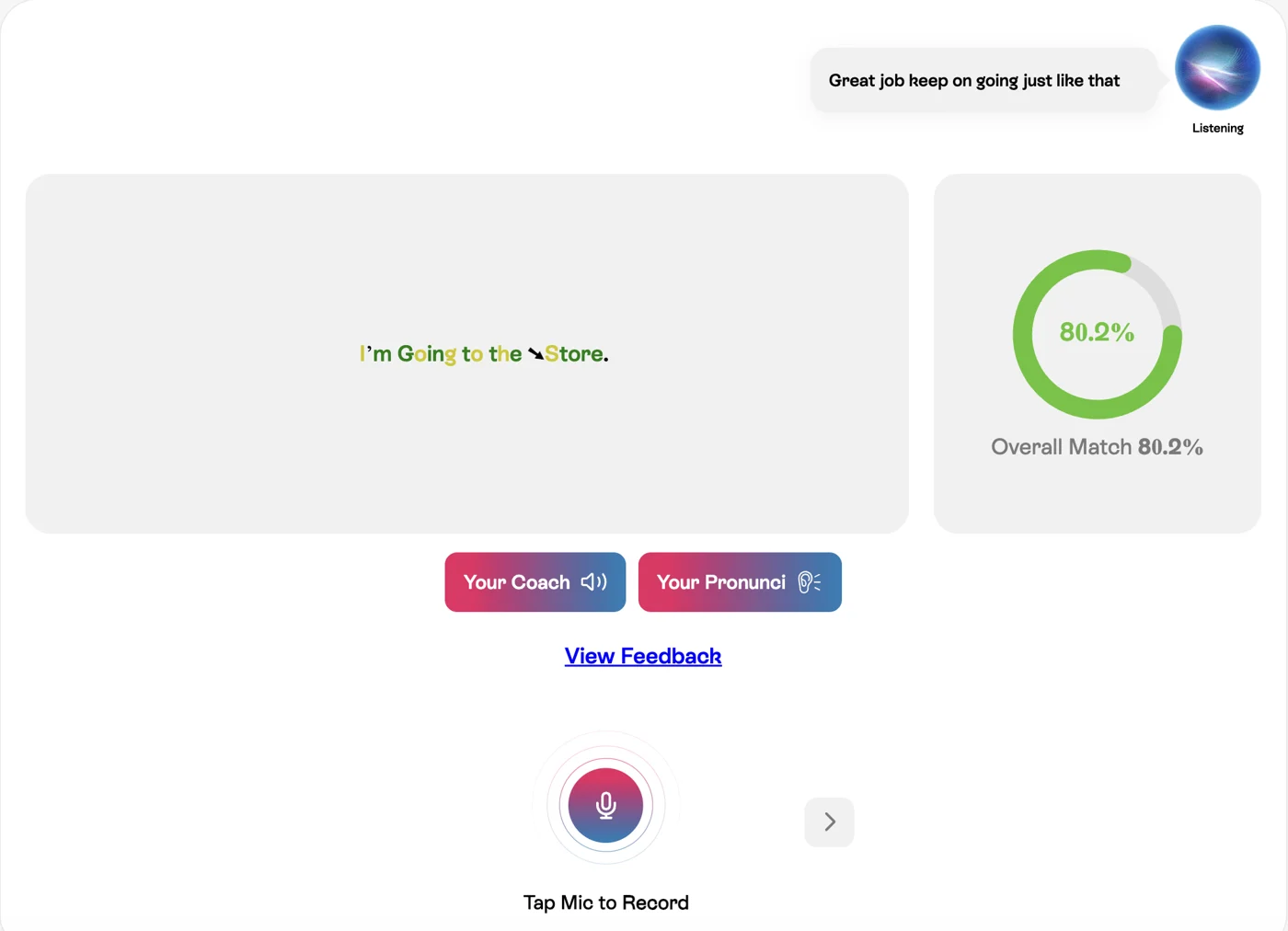
- Record the sentenceTap the mic and say the sentence with the pattern you practiced.
- Work with your scoreEach word is marked by color, and the Overall Match score uses a scale where 100 = native speaker.
- Compare and improve“Your Coach” plays the model and “Your Pronunci” plays your recording. “View Feedback” opens the details.
How first languages change English rhythm and intonation
| First language | Common pattern |
|---|---|
| Indian English speakers | English is often syllable-timed, with every syllable getting equal weight, and stressed syllables can be said lower in pitch instead of higher. |
| Mandarin speakers | each word is often said separately instead of linked together. |
| Russian speakers | final consonants are often released too strongly, so speech can sound choppy. |
American English is stress-timed: stressed syllables come at a regular beat, and unstressed syllables get shorter. Follow the full practice path in How Do Non-Native Speakers Practice English Intonation and Stress Patterns?
Sources: Wikipedia: Indian English, San Diego Voice and Accent, Wikipedia: Non-native pronunciations of English
Questions & Answers
FAQ
01What is question intonation in American English?
Question intonation is the rise or fall of pitch at the end of a question. Yes/no questions rise; wh- questions fall.
02Why do yes/no questions use rising intonation?
Rising pitch signals that the speaker expects a yes or no response. It is the standard acoustic cue in American English for this question type.
03Do wh- questions always fall in American English?
Wh- questions typically fall at the end in American English, indicating a complete, open question. Exceptions occur in casual speech or when the speaker is checking understanding.
04What does rising intonation on a statement mean?
Rising intonation on statements signals uncertainty or hesitation. Used consistently, it makes speakers sound unconfident, which is a pattern to avoid in professional settings.
05How long does it take to improve question intonation?
With daily spoken practice and real-time feedback, most learners notice clear improvement within a few weeks. Consistent spoken repetition is the key variable, not the length of study time.
Recommended
American English Voiced vs Voiceless Sounds | Inpronunci
Discover the differences in american english voiced vs voiceless sounds. Mastering these helps you speak clearly and confidently in American English.

American Intonation Patterns for Professionals | Inpronunci
Master American intonation patterns for professionals to enhance your communication skills. Improve perception and authority in your speech.

Intonation Patterns in Academic English: Inpronunci Guide
Master intonation patterns in academic English with real examples. Boost clarity and confidence in your presentations using Inpronunci tools!
Plans
What InPronunci costs
InPronunci Basic
$35 per month
Chapter 1 is free after signup.
InPronunci Premium
$200 per month
Includes a coach: