


Mouth training for sounds is the deliberate practice of coordinating your lips, tongue, jaw, soft palate, and breath to produce speech sounds with greater clarity and precision. In linguistics and speech pathology, this practice is called articulation training, and it is a physical motor skill, not a volume adjustment or an accent makeover. A 2026 randomized trial confirmed that structured oral muscle training produces measurable gains in pronunciation accuracy. Inpronunci builds this evidence directly into its curriculum, giving language learners and professionals a guided path to clearer American English.
Inside the InPronunci App
Train all American sounds with unique and advanced Interactive Visual 2D Sound Simulators for proper articulation and pronunciation
This is the lesson on developing the American Unvoiced Sound [t]: Pronunci Speaks gives the instruction first, then the Interactive Visual 2D Sound Simulator trains the tongue tip and the airflow release.
- EffectiveMost apps offer visual learning. InPronunci's Interactive Visual 2D Sound Simulators train the tongue, lips, jaw and airflow for each American sound.
- ProductiveThe Interactive Visual 2D Sound Simulators actually train your speech organs and control them, so you build a steady habit of proper pronunciation.
- ResultsStudents pronounce individual American sounds with almost native-like pronunciation.
What is mouth training for sounds, and why does it matter?
Articulation training is defined as the coordinated shaping of speech organs to produce distinct, accurate sounds. The key word is “coordinated.” Your lips, tongue tip, tongue body, jaw, and soft palate must each move to the right position at the right moment. When any one of those movements is off, the sound blurs.

This is why speaking louder does not fix unclear speech. Volume amplifies whatever your mouth is already doing. If your tongue is not reaching the correct target for a sound like /t/ or /æ/, more volume just makes the error louder. Articulation training corrects the physical movement itself.
The distinction also matters for sound articulation training in a second language. Learners often carry the mouth movement habits of their first language into English. Those habits feel natural but produce sounds that native listeners perceive as unclear or foreign. Retraining the physical movements is the direct solution.
How mouth training improves pronunciation accuracy
Articulation is a motor skill. Like any motor skill, it improves through specific, repeated physical practice, not through passive listening alone.
A 2026 study published in Frontiers in Human Neuroscience showed that articulatory-target based training with real-time tongue-position feedback improved both the production and auditory perception of the American English vowel /æ/ in second-language learners. That finding is significant. It means training your mouth movements does not just change how you speak. It also changes how accurately you hear and distinguish sounds. Motor training and perceptual improvement reinforce each other.
The same 2026 randomized controlled trial on smartphone-based oral muscle training reported that Percentage of Consonants Correct (PCC) rose from 97.9 to 99.0, and Percentage of Whole-Word Correctness (PWC) rose from 0.9 to 1.0 after six weeks of training. These are statistically significant gains even from a near-ceiling baseline, which shows that targeted coordination practice produces real results.
Key mechanisms behind these improvements include:
- Tongue placement precision: The tongue tip, tongue body, and tongue root each target different sounds. Training builds reliable muscle memory for each position.
- Lip rounding and spreading: Vowels like /uː/ and /iː/ require specific lip shapes. Practicing these shapes deliberately builds consistent production.
- Jaw control: Excessive jaw tension restricts tongue movement. Relaxed, controlled jaw opening creates the space sounds need.
- Breath support: Steady airflow powers consonants like /s/, /f/, and /v/. Weak breath support produces weak or distorted consonants.
Core exercises and the right training sequence
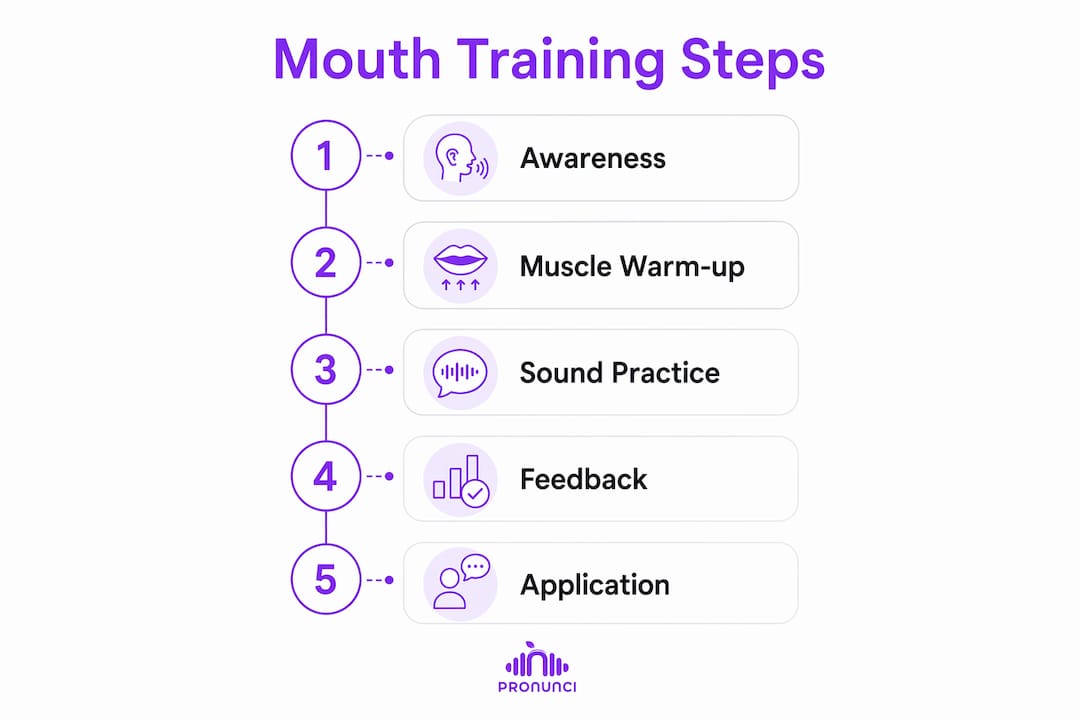
The best mouth training follows a clear progression: awareness first, then control, then speed. Skipping ahead to speed drills before control is established reinforces sloppy articulation rather than correcting it.
- Jaw release. Begin each session with gentle jaw drops and light circular jaw movements. This releases tension that restricts tongue mobility.
- Lip trills and stretches. Alternate between rounded lips (as in /uː/) and spread lips (as in /iː/). This builds lip flexibility and awareness of position.
- Tongue tip placement drills. Touch the tongue tip to the alveolar ridge (the ridge just behind your upper front teeth) and release. This is the target position for /t/, /d/, /n/, and /l/.
- Paired consonant drills. Practice minimal pair consonants such as /p/ versus /b/, /t/ versus /d/, /k/ versus /g/, /f/ versus /v/, and /s/ versus /z/. These pairs share the same mouth position but differ in voicing, making them ideal for building precise control.
- Vowel transition sequences. Move through the sequence ee, eh, ah, oh, oo slowly and deliberately. Each transition trains the tongue and lip movements that distinguish American English vowels.
- Controlled exaggeration. Slightly overstate mouth movements during early practice. This recalibrates your sense of where sounds are produced and makes the target position feel natural over time.
Pro Tip: Never start a session with fast tongue twisters. Speed before control locks in errors. Build the movement pattern correctly first, then gradually increase tempo over days or weeks.
For tips on applying these drills before high-stakes situations, the pronunciation drills checklist from Inpronunci offers a structured pre-presentation routine.
What challenges does mouth training address?
Mouth training solves specific, documented problems that language learners and aging speakers face.
For second-language learners, the primary challenge is producing and perceiving sounds that do not exist in their first language. The American English vowel /æ/ (as in “cat” or “bad”) is a frequent problem for speakers of Spanish, Mandarin, Japanese, and many other languages. The 2026 Frontiers in Human Neuroscience study showed that articulatory feedback training improved both production and perception of /æ/ without relying on acoustic model imitation alone. Motor-based training outperformed passive listening.
For older adults, age-related changes in oral motor function reduce speech clarity over time. The 2026 randomized trial demonstrated that smartphone-based oral muscle training can reverse measurable declines in consonant accuracy and whole-word correctness within six weeks. Self-directed practice, when structured correctly, produces real results.
The table below summarizes the populations and outcomes documented in recent research:
| Population | Challenge | Training outcome |
|---|---|---|
| Second-language learners | Producing and perceiving /æ/ | Improved production and auditory discrimination |
| Older adults | Declining oral motor function | PCC rose from 97.9 to 99.0 after 6 weeks |
| Professionals seeking clarity | Inconsistent consonant and vowel precision | Measurable reduction in linguistic error types |
For learners who want to understand how speech muscle memory connects to long-term clarity, Inpronunci’s resources on oral motor coordination provide a strong foundation.
How to integrate mouth training into daily practice
Consistent, short sessions outperform occasional long ones. The goal is to build reliable motor patterns, and that requires regular repetition over time.
- Practice in short, focused sessions. Ten to fifteen minutes of deliberate articulation work daily produces stronger results than one long weekly session.
- Record and compare. Record yourself producing target sounds, then compare with a native speaker model. Your ear will catch errors your mouth does not yet feel.
- Use shadowing with attention to mouth position. Do not just copy the sound. Watch how the mouth moves and match the physical position, not just the audio output.
- Track specific sounds. Identify your two or three most problematic sounds and focus each session on those targets before moving to general fluency practice.
- Use speech-organ training feedback tools. Training tongue and lip movements through video simulators helps learners internalize exact articulator positions far more effectively than audio alone.
Pro Tip: Set a clarity goal, not an accent goal. “I want listeners to understand my /t/ and /d/ sounds clearly” is a measurable, achievable target. “I want to sound like a native speaker” is not a useful daily practice goal.
For a structured daily practice plan built around these principles, Inpronunci’s beginner curriculum offers a step-by-step path from individual sounds to real speaking situations. You can also find complementary guidance on improving pronunciation clarity through coordinated mouth and breath exercises.
What I have learned training learners in American articulation
As a Ph.D. Accent Coach, the most common mistake I see is learners treating pronunciation like a listening problem. They play recordings on repeat, waiting for the sound to “click.” It rarely does, because the problem is not in the ear. It is in the mouth.
Articulation is a physical skill. You would not learn to type by watching someone else type. You practice the finger movements until they become automatic. Speech works the same way. The tongue, lips, and jaw need deliberate, guided repetition to build new motor patterns.
The second mistake I see is rushing. Learners jump to tongue twisters and fast-speech drills before they have established clean, controlled movements at a slow tempo. Speed before control locks in the error. I always start with jaw release and slow, exaggerated articulator movements. Once the position is reliable, speed follows naturally.
What I find most encouraging about recent research is the confirmation that motor training also improves perception. When you train your mouth to produce /æ/ correctly, you also start hearing the difference between /æ/ and /ɛ/ more clearly. The motor and perceptual systems reinforce each other. That is why structured, feedback-guided practice produces results that passive listening never achieves.
Technology has changed what is possible here. Training articulator positions gives learners control they cannot get from audio alone. Training where the tongue goes, how the lips shape, and how the jaw opens makes the target concrete and repeatable. That is exactly what Inpronunci’s Interactive Visual 2D Sound Simulators are designed to deliver.
— Prof. Alex, Ph.D. Accent Coach
Inpronunci’s approach to sound training and articulation
Inpronunci is built around the principle that you cannot fix what you cannot understand. The Interactive Visual 2D Sound Simulators train exactly how native speakers position your tongue, lips, and jaw for every American English sound. You practice the movement, and get real-time feedback from the AI Accent Coach as you speak.
The course begins with Free Chapter 1, “Get to Know Your Speech Organs,” which builds the physical awareness every learner needs before practicing sounds. The Basic Plan guides you through self-study with AI feedback and human-guided instructions. The Premium Plan adds monthly 1-on-1 sessions with Prof. Alex, Ph.D. Accent Coach for personalized correction and support. Start your American accent training today and build the mouth coordination that produces real clarity.
Questions & Answers
FAQ
01What is mouth training for sounds?
Mouth training for sounds is articulation training: the deliberate practice of coordinating lips, tongue, jaw, soft palate, and breath to produce speech sounds accurately. It is a physical motor skill distinct from accent modification or volume control.
02How long does it take to see results from mouth training?
A 2026 randomized trial showed measurable improvements in consonant accuracy and whole-word correctness after six weeks of structured oral muscle training. Consistent daily practice accelerates those gains.
03Does mouth training improve how you hear sounds, not just how you produce them?
Yes. A 2026 study found that articulatory-target based training improved both production and auditory discrimination of the American English vowel /æ/. Motor training and perceptual improvement reinforce each other.
04What are the best exercises to start with?
Begin with jaw release, lip trills, and slow tongue tip placement drills. Then progress to paired consonant drills (/p/ versus /b/, /t/ versus /d/) and vowel transition sequences (ee, eh, ah, oh, oo) before adding speed.
05Can technology replace a human coach for mouth training?
Technology like 2D speech-organ simulators and AI pronunciation tools significantly improves training efficiency. For the most targeted correction, combining these tools with guidance from a qualified accent coach produces the strongest results.
Recommended

Phonetic Training in Medical Communication | Inpronunci
Explore the role of phonetic training in medical communication. Enhance clarity and confidence for better patient interactions and safety.
American English Voiced vs Voiceless Sounds | Inpronunci
Discover the differences in american english voiced vs voiceless sounds. Mastering these helps you speak clearly and confidently in American English.

Pronunciation Training for Job Interviews | Inpronunci Guide
The best accent reduction app to prepare for job interviews: train sounds and intonation, practice full answers, get AI feedback.
InPronunci training structure
How InPronunci trains the American speech system
InPronunci trains the full American speech system: Interactive Visual 2D Sound Simulators and phonetic exercises for articulation and American sound development, sentence practice for intonation, melody, rhythm, and connected speech, paragraph practice for spontaneous speech, public speaking, and real communication confidence, and Advanced AI Accent Coach evaluation as you speak.
InPronunci is an advanced, linguistically structured American accent training platform with more than 1,000 downloads and a growing learner base. It is designed for serious ESL learners who want American pronunciation, stronger intonation, more natural rhythm, better connected speech, and the ability to speak English more confidently in real communication. The program is especially useful for intermediate and advanced English speakers who want to become independent speakers of English with confident communication, stronger speaking control, long-term speech improvement, and great public speaking skills. It is also designed for advanced speakers whose goal is to speak like a native or closer to native-like American speech, including people who were raised in the United States but still have slight accent patterns from the native language they were born with. It is a complete American accent training course and system created by Prof. Alex, Ph.D. Accent Coach, Doctor of Education, and professional linguist based in Austin, Texas, with Pronunci Instructions from Prof. Alex for each lesson that make self-learning more effective, supported, and clear.
Plans
What InPronunci costs
InPronunci Basic
$35 per month
Chapter 1 is free after signup.
InPronunci Premium
$200 per month
Includes a coach: