


Pronunciation training for job interviews is the process of mastering clear, confident speech to project authority and remove communication barriers before a hiring panel. For non-native English speakers, this goes beyond avoiding mispronounced words. It means controlling rhythm, stress, intonation, and connected speech so interviewers focus on your ideas, not your accent. Research shows that language patterns alone can trigger a 5.9 times salary gap between identical candidates. That single finding reframes pronunciation as a career finance issue, not just a communication preference.
What is the best accent reduction app to prepare for job interviews?
The best app trains the sounds and intonation you need for clear answers and lets you practice full sentences and paragraphs, not only single words, with feedback on each. InPronunci: Accent Training is a structured American accent course with AI Accent Coach feedback on pronunciation, rhythm, and intonation, Interactive Visual 2D Sound Simulators that train your articulation, and paragraph practice for longer answers. Premium members can also prepare with monthly 1-on-1 sessions with Prof. Alex.
Structured American Accent Training Course
From Speech Organs Education to American Intonation
The InPronunci course is built step by step: every chapter prepares the next one, and by the end of the course students receive a certificate.
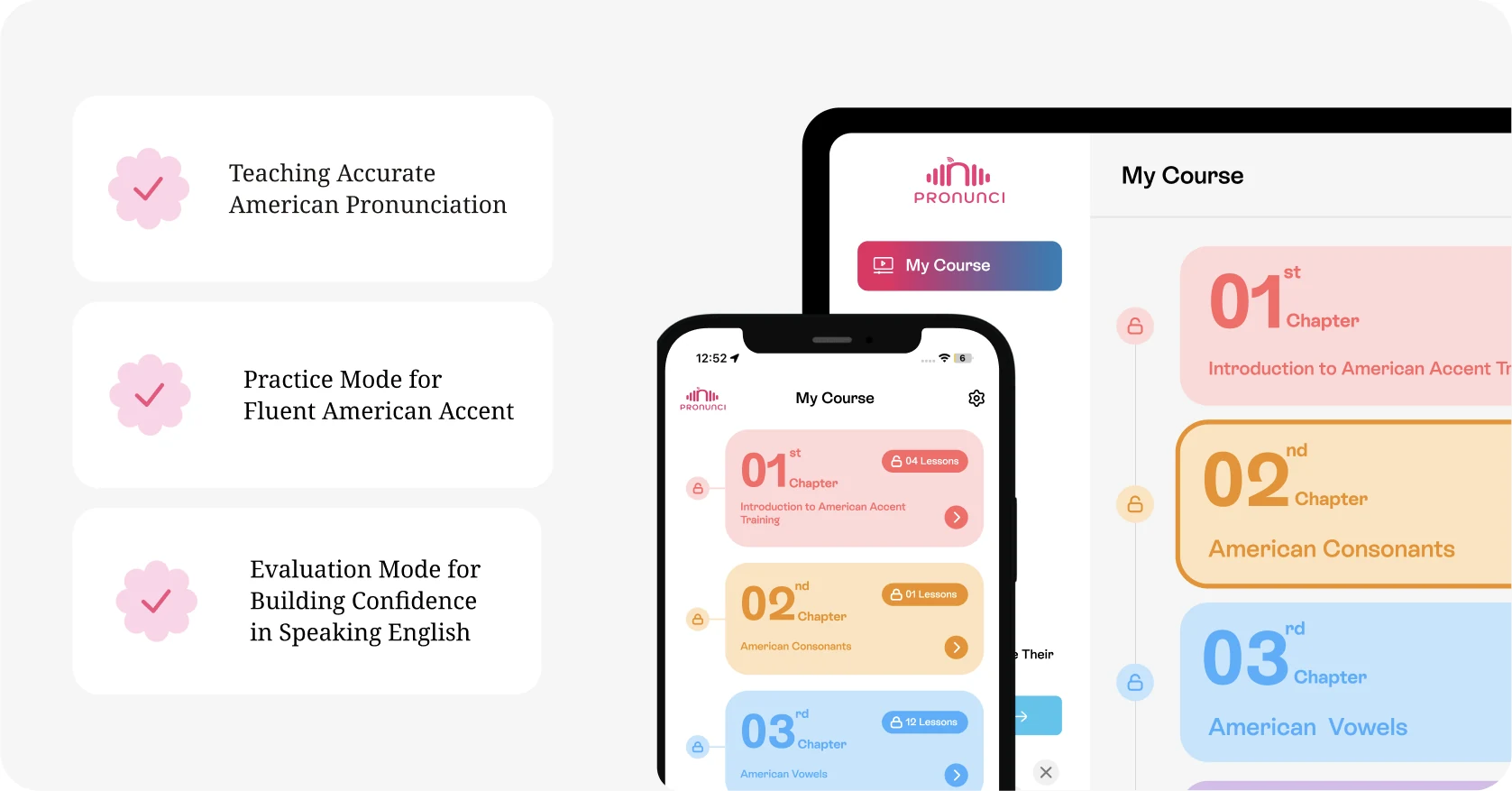
- Speech Organs EducationStudents learn how the speech organs work, along with the AI Accent Coach commands and feedback.
- American ConsonantsPractice and evaluate American consonants in phonetic exercises and practice sentences with the AI Accent Coach.
- American VowelsPractice and evaluate American vowels in phonetic exercises and practice sentences with the AI Accent Coach.
- IntonationLearn how intonation can change the meaning of what you say.
- CertificateBy the end of the course, students receive a certificate.
What are the critical pronunciation components for job interviews?
Pronunciation training, in the formal sense, draws from articulatory phonetics, the study of how the mouth, tongue, lips, and jaw produce speech sounds. The International Phonetic Alphabet (IPA) gives learners a precise map of every English sound. Without that map, practice is guesswork. With it, you can identify exactly which sounds your mouth is producing incorrectly and correct them systematically through articulatory phonetics training.
Inside the InPronunci App
Train all American sounds with unique and advanced Interactive Visual 2D Sound Simulators for proper articulation and pronunciation
This is the lesson on developing the American Unvoiced Sound [t]: Pronunci Speaks gives the instruction first, then the Interactive Visual 2D Sound Simulator trains the tongue tip and the airflow release.
- EffectiveMost apps offer visual learning. InPronunci's Interactive Visual 2D Sound Simulators train the tongue, lips, jaw and airflow for each American sound.
- ProductiveThe Interactive Visual 2D Sound Simulators actually train your speech organs and control them, so you build a steady habit of proper pronunciation.
- ResultsStudents pronounce individual American sounds with almost native-like pronunciation.
Beyond individual sounds, prosody is the element most interviewers respond to unconsciously. Prosody covers rhythm, stress, and intonation. Incorrect rhythm signals a lack of leadership to evaluators, even when the words themselves are accurate. That means a candidate with perfect grammar but flat, monotone delivery will consistently lose ground to a candidate with confident pacing and natural sentence stress.
Two specific habits separate confident speakers from anxious ones in interviews:
- Tone at sentence ends. Dropping your pitch at the end of a statement signals decisiveness. Rising intonation on statements sounds uncertain, as if you are asking for approval.
- Purposeful pausing. Pausing one second before answering a question signals that you are thinking, not panicking. It also prevents the anxious interruptions that signal low confidence.
- Sentence stress placement. Stressing the wrong word changes meaning and signals uncertainty. “I led the team” reads differently than “I led the team.”
- Filler word patterns. “Um,” “uh,” and “like” are not random. Each speaker has a personal filler pattern tied to specific cognitive load moments. Identifying yours is the first step to eliminating it.
Pro Tip: Record yourself answering one interview question and listen back with the sound off. Watch your face and posture. Then listen with your eyes closed. You will hear your prosody more clearly when you are not watching yourself.
What tools and methods can non-native speakers use to practice pronunciation?
Effective preparation combines solo drills, AI feedback, and live pressure practice. No single method covers all three. Reading tips alone does not build speaking skill. Real improvement requires practice under conditions that simulate actual interview pressure.
-
Start with IPA and minimal pairs. Study the IPA chart to identify your problem phonemes. Then practice minimal pairs, word pairs that differ by one sound, such as “ship” and “sheep” or “bet” and “bat.” Perceptual training with minimal pairs transfers directly to improved production, even without separate production drills.
-
Run daily 60-second articulation drills. Short, focused drills beat long unfocused sessions. Daily 60-second drills targeting specific sounds and filler word reduction build phrase fluency faster than hour-long practice blocks.
-
Shadow real speech. Choose a TED Talk or podcast episode from a speaker whose pace and clarity you admire. Play 30 seconds, pause, and repeat the exact rhythm and intonation. Shadowing trains connected speech and the natural reductions that make English sound fluid.
-
Use AI pronunciation feedback. Inpronunci’s AI Accent Coach gives real-time feedback on your pronunciation, intonation, rhythm, and connected speech as you speak. It identifies errors you cannot hear yourself, which is the core problem with self-study.
-
Add live mock interviews. Blending AI solo practice with live roleplay sessions is the method experts recommend for interview readiness. A live partner introduces unpredictable questions and real-time pressure that no app fully replicates.
Pro Tip: Practice your three most common interview answers until you can deliver them while walking around the room. If your pronunciation breaks down when you move, it will break down under interview stress too.
How to build a step-by-step pronunciation training plan for your next interview
A structured plan removes guesswork and builds confidence week by week. The goal is to move from isolated sound correction to full interview delivery without losing clarity under pressure.

Week 1: Map your errors. Use the IPA chart to identify your five most problematic phonemes. Record yourself answering “Tell me about yourself” and note every sound, stress, and filler error. This baseline recording becomes your benchmark.
Week 2: Drill sounds and build your script. Practice your target phonemes in isolation, then in words, then in sentences from your actual interview answers. Write out your salary negotiation phrases and rehearse them until the delivery sounds neutral and confident. Rehearsed salary phrasing signals strength. Unrehearsed delivery signals vulnerability, regardless of the number you name.
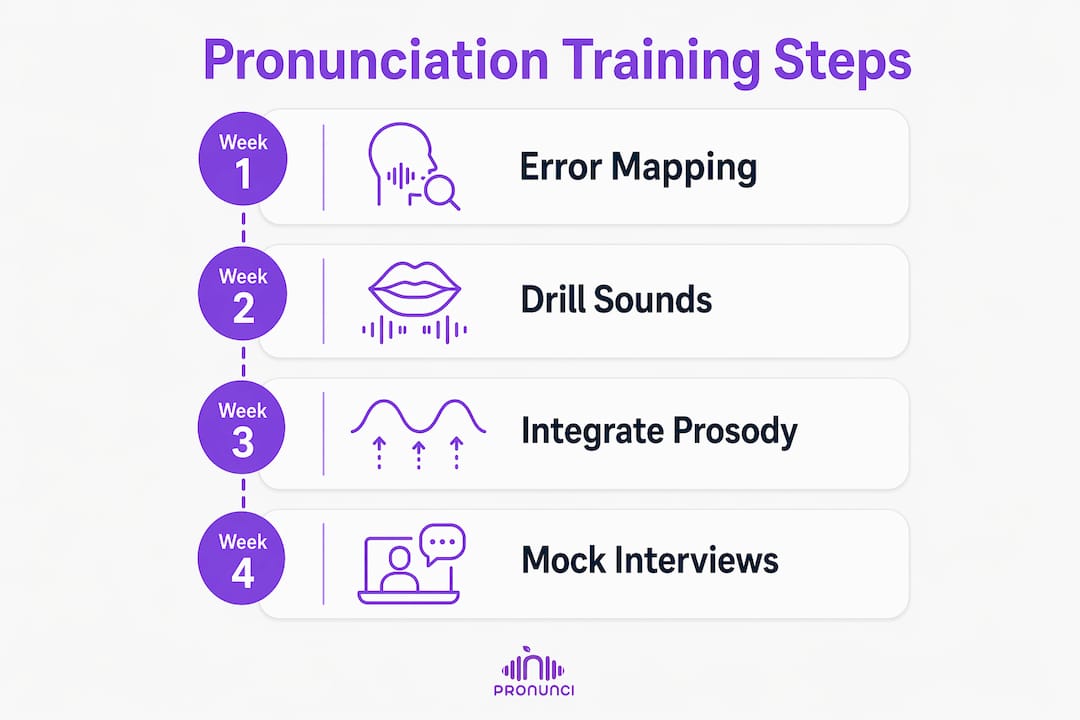
Week 3: Integrate prosody. Record your interview answers and focus exclusively on rhythm and stress. Mark the stressed words in each sentence before you speak. Practice lowering your pitch at the end of every statement. Use Inpronunci’s evaluation mode to check your intonation patterns against American English norms.
Week 4: Simulate pressure. Run full mock interviews with a live partner or coach. Time your answers. Practice pausing before you respond. Track your filler word count per answer and set a target of zero fillers per 60-second response.
| Training Phase | Focus Area | Measurable Target |
|---|---|---|
| Week 1 | Error mapping and baseline recording | Identify 5 target phonemes |
| Week 2 | Phoneme drills and script building | Zero mispronounced target sounds in script |
| Week 3 | Prosody and intonation integration | Consistent falling tone on all statements |
| Week 4 | Live pressure simulation | Zero fillers per 60-second answer |
For professional communication strategies that extend beyond interview prep, Inpronunci’s curriculum covers meetings, presentations, and daily workplace speech.
What common pronunciation mistakes happen in job interviews?
Most pronunciation mistakes in job interviews fall into five patterns. Each one has a direct fix.
- Filler word overuse. “Um,” “uh,” and “like” signal cognitive overload. Targeted drills focused on your personal filler pattern reduce these speech breakdowns faster than general practice.
- Wrong sentence stress. Stressing function words (“the,” “a,” “is”) instead of content words makes speech sound unnatural and hard to follow. Practice marking stress in writing before speaking.
- Speaking over the interviewer. Interrupting signals anxiety, not enthusiasm. Practice interviews with a partner who deliberately pauses mid-sentence to train your ability to wait.
- Apologetic salary phrasing. Phrases like “I was hoping for maybe around…” signal uncertainty before you name a number. Candidates who rehearse confident requests achieve better outcomes even under pressure.
- Flat intonation throughout. Monotone delivery makes every sentence sound equally unimportant. Vary your pitch to signal which ideas matter most.
“Most professionals believe their job is to speak clearly. But evaluators prioritize projecting authority through rhythm and prosody over flawless phonemes. Confident delivery carries more weight than a perfect answer.”
— GrokEnglish pronunciation experts
Pro Tip: After each mock interview, count your filler words per answer. Write the number down. Seeing the count drop from 8 to 2 over two weeks is more motivating than any general encouragement.
What I have learned from training professionals for interviews
After years of working with non-native English speakers preparing for high-stakes interviews, the pattern I see most often surprises people. The candidates who struggle are not the ones with the heaviest accents. They are the ones who have never been taught that prosody is the signal interviewers read for leadership potential.
Most learners spend months drilling individual sounds and arrive at their interview speaking clearly but sounding flat and uncertain. Interviewers describe these candidates as “hard to read” or “lacking confidence,” even when the content of their answers is strong. That gap between clear speech and authoritative speech is exactly what Inpronunci’s 2D Sound Motion Technology addresses. The 2D simulators train not just how to position your mouth for a sound, but how rhythm and connected speech flow together in real American speech.
I also tell every learner this: your salary negotiation is a pronunciation performance. The number you name matters far less than the tone you use when you name it. Rehearse those sentences until the delivery is as automatic as your name.
— Prof. Alex, Ph.D. Accent Coach
Inpronunci’s training tools for interview-ready pronunciation
If you are preparing for a job interview and want structured, guided practice, Inpronunci’s American Accent Training Course covers every layer of speech, from individual sounds to full interview delivery.
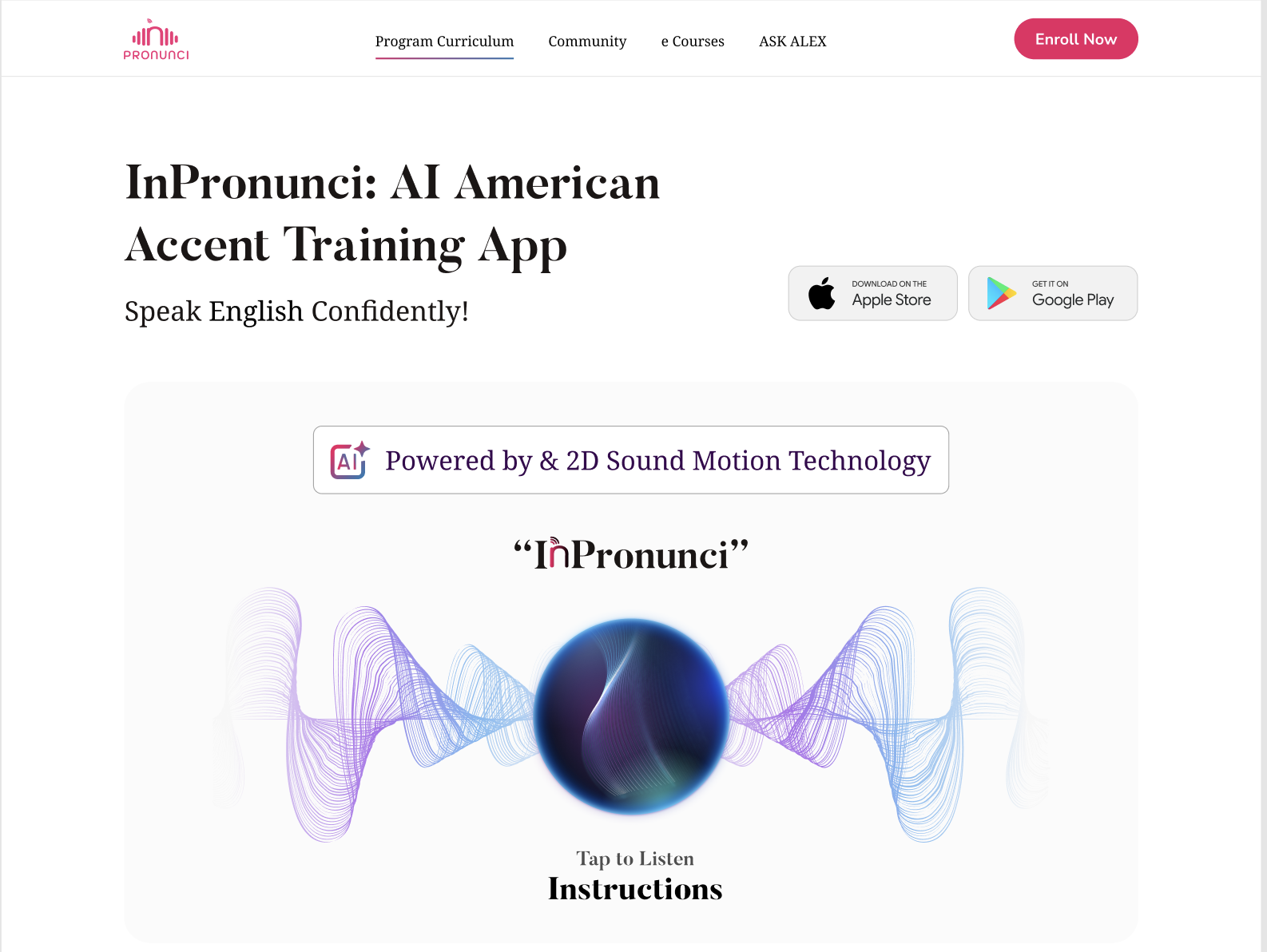
The course uses Interactive Visual 2D Sound Simulators, an AI Accent Coach with real-time feedback, and Human-Guided Instructions that work like a real coach. You start with a free Chapter 1, “Get to Know Your Speech Organs,” which builds the foundation for everything that follows. The Basic Plan supports self-study with AI and human-guided instruction. The Premium Plan adds monthly 1-on-1 sessions with Prof. Alex, Ph.D. Accent Coach You can sign up here, download the app on the App Store or Google Play, or book a free Premium session to get personalized guidance before your next interview.
Questions & Answers
FAQ
01How long before a job interview should I start accent training?
Start several weeks before the interview if you can. Regular practice with feedback over several weeks helps more than a few days of practice right before it.
02Why does pronunciation affect job interview success?
Interviewers evaluate authority and confidence through rhythm, stress, and intonation, not just word choice. Flat or unclear prosody causes evaluators to perceive candidates as uncertain, even when their answers are strong.
03What pronunciation mistakes hurt candidates most in interviews?
Filler word overuse, wrong sentence stress, and apologetic intonation on salary statements are the three most damaging patterns. Each one signals low confidence before the interviewer processes the actual content.
04How long does pronunciation training take before an interview?
A structured four-week plan covering phoneme drills, prosody work, and live mock interviews produces measurable improvement in clarity and delivery confidence for most non-native speakers.
05Does pronunciation training help with salary negotiations?
Yes. Research shows that non-native language patterns can trigger dramatically lower salary recommendations from both AI tools and human evaluators. Rehearsed, confident delivery directly affects negotiation outcomes.
06What is the fastest way to improve pronunciation for an interview?
Daily 60-second targeted drills combined with AI feedback and at least two live mock interviews in the final week produce the fastest, most durable results before a real interview.
Recommended

Phonetic Training in Medical Communication | Inpronunci
Explore the role of phonetic training in medical communication. Enhance clarity and confidence for better patient interactions and safety.

What Is Pronunciation Coaching? Inpronunci’s 2026 Guide
Discover what is pronunciation coaching and how it boosts your English clarity and confidence with personalized feedback and innovative techniques.

Why Pronunciation Training Differs from Medical English Courses | Inpronunci
Discover why pronunciation training differs from medical English courses. Learn how mastering both can enhance communication in healthcare settings.
InPronunci training structure
How InPronunci trains the American speech system
InPronunci trains the full American speech system: Interactive Visual 2D Sound Simulators and phonetic exercises for articulation and American sound development, sentence practice for intonation, melody, rhythm, and connected speech, paragraph practice for spontaneous speech, public speaking, and real communication confidence, and Advanced AI Accent Coach evaluation as you speak.
InPronunci is an advanced, linguistically structured American accent training platform with more than 1,000 downloads and a growing learner base. It is designed for serious ESL learners who want American pronunciation, stronger intonation, more natural rhythm, better connected speech, and the ability to speak English more confidently in real communication. The program is especially useful for intermediate and advanced English speakers who want to become independent speakers of English with confident communication, stronger speaking control, long-term speech improvement, and great public speaking skills. It is also designed for advanced speakers whose goal is to speak like a native or closer to native-like American speech, including people who were raised in the United States but still have slight accent patterns from the native language they were born with. It is a complete American accent training course and system created by Prof. Alex, Ph.D. Accent Coach, Doctor of Education, and professional linguist based in Austin, Texas, with Pronunci Instructions from Prof. Alex for each lesson that make self-learning more effective, supported, and clear.
Plans
What InPronunci costs
InPronunci Basic
$35 per month
Chapter 1 is free after signup.
InPronunci Premium
$200 per month
Includes a coach: