

Structured pronunciation training is a systematic, expert-guided method that moves learners through a defined curriculum from individual sounds to real-world speaking situations. It is the recognized standard in applied linguistics for non-native speakers who need measurable, lasting improvement in American English. Pronunciation apps, by contrast, offer accessible drilling tools but lack the diagnostic depth to correct root errors. Understanding the difference between structured pronunciation training vs apps explained through a linguistics lens is the clearest path to making a decision that actually serves your professional goals. Inpronunci is built on this structured model, combining AI feedback, Interactive Visual 2D Sound Simulators, and human-guided coaching in one program.
What measurable benefits does structured pronunciation training provide over apps?
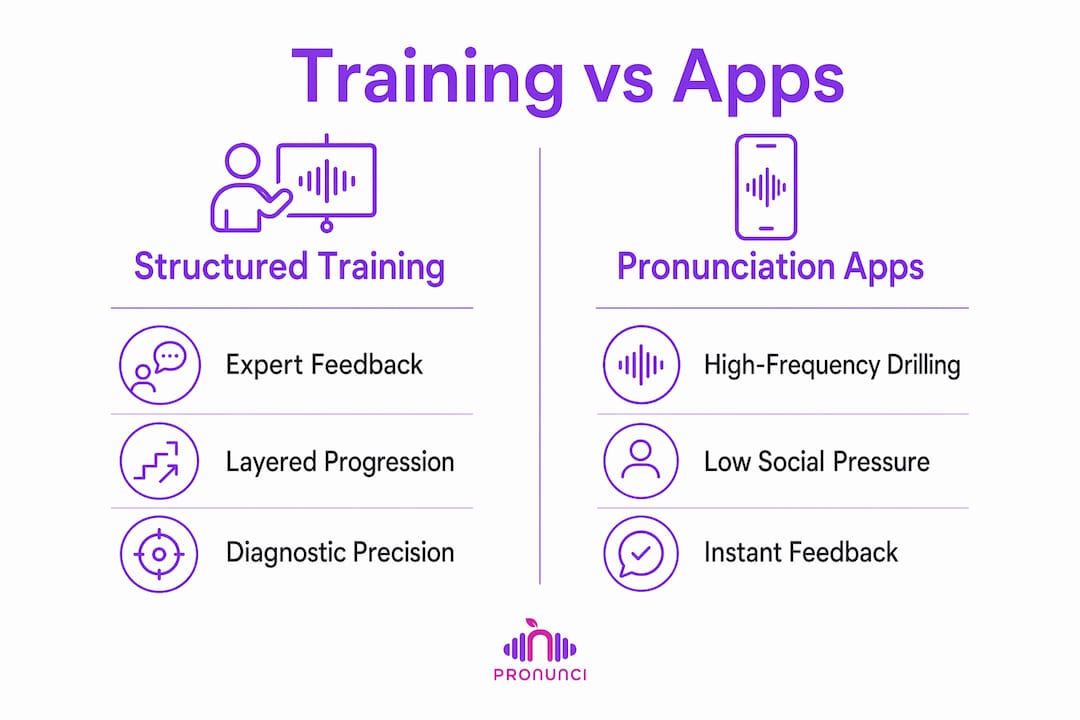
Structured pronunciation training delivers a 15-point improvement in phonetic accuracy compared to unstructured app use. That gap exists because structured programs diagnose the root cause of each error, not just flag that an error occurred.
The core advantage is the diagnostic feedback loop. Human tutors detect nuanced errors and provide cultural context and fluency coaching that AI apps cannot replicate. A coach hears that your /æ/ vowel is collapsing into /ɛ/ because of Spanish L1 interference, not just that your word sounded “off.” That specificity is what changes behavior.
For professionals, the stakes are concrete. Mispronounced stress patterns in words like “project” or “record” shift meaning entirely in a meeting. Structured training addresses stress, rhythm, intonation, and connected speech as a system, not as isolated drills. Apps rarely touch prosody at this level of depth.
Key benefits of structured training include:
- Phonetic accuracy gains grounded in systematic error correction, not repetition alone
- Diagnostic feedback that identifies L1 interference patterns specific to your native language
- Suprasegmental training covering stress, rhythm, and intonation as a unified system
- Transfer to real speaking through sentence, paragraph, and conversation-level practice
- Cross-session memory from a coach who tracks your errors over time and targets root causes
How do pronunciation apps support learners and where do they fall short?
Apps provide genuine value for high-frequency drilling. Apps excel at removing social pressure and enabling low-cost, high-frequency practice. You can repeat a sound 50 times at midnight without embarrassment. That volume builds muscle memory for isolated sounds.

The problem is feedback quality. AI apps provide instant but forgiving feedback, often lacking the diagnostic capability to identify root pronunciation errors. An app may accept a mispronounced word because its speech recognition engine is calibrated for broad intelligibility, not native-level accuracy. You feel like you passed. You did not.
The deeper risk is what researchers call “speech recognition drift.” Most learners misuse apps as standalone programs and develop this drift, reinforcing rather than correcting errors. The app rewards you for a sound that a native speaker would still find unclear. Over weeks, that error becomes more entrenched, not less.
Apps also miss the plateau. Once you reach a functional level of intelligibility, app-based feedback stops pushing you forward. Complex prosody features like sentence-level intonation, linking, and reduction in connected speech fall outside what most apps measure at all.
Pro Tip: Use apps for daily sound drills on specific targets your coach has already identified. Never use an app to decide whether your pronunciation is correct. Use it to build repetition after a human or structured program has confirmed the target.
What are the core components of an effective structured pronunciation program?
Effective pronunciation training follows a six-layer progression: perception, segmentals, suprasegmentals, intonation, shadowing, and transfer. Each layer builds on the one before it. Skipping layers is the most common reason learners plateau.
Structured American Accent Training Course
From Speech Organs Education to American Intonation
The InPronunci course is built step by step: every chapter prepares the next one, and by the end of the course students receive a certificate.
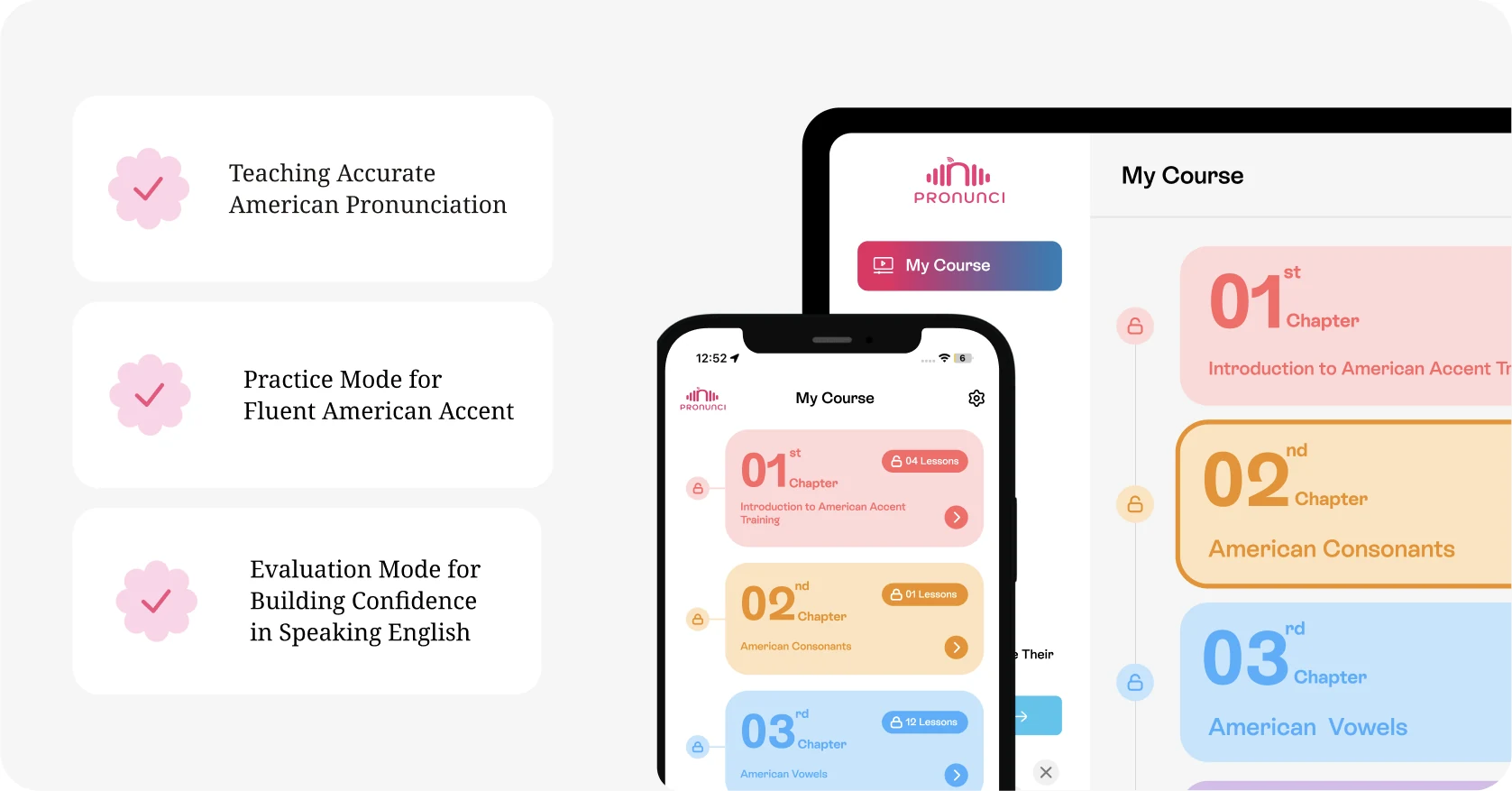
- Speech Organs EducationStudents learn how the speech organs work, along with the AI Accent Coach commands and feedback.
- American ConsonantsPractice and evaluate American consonants in phonetic exercises and practice sentences with the AI Accent Coach.
- American VowelsPractice and evaluate American vowels in phonetic exercises and practice sentences with the AI Accent Coach.
- IntonationLearn how intonation can change the meaning of what you say.
- CertificateBy the end of the course, students receive a certificate.
- Perception training teaches you to hear the difference between sounds before you produce them. Most learners skip this and go straight to speaking. That is a mistake.
- Segmentals cover individual vowels and consonants, the building blocks of every word. American English has sounds that do not exist in most other languages.
- Suprasegmentals address word stress and sentence rhythm. These features carry more meaning in American English than in many other languages.
- Intonation trains the rise and fall patterns that signal questions, statements, and emphasis. Wrong intonation makes fluent speakers sound uncertain or rude.
- Shadowing builds speed and natural flow by having you mirror native speech in real time.
- Transfer moves all of the above into spontaneous conversation, interviews, and presentations.
“Learners often fail because they treat pronunciation training as a single task rather than a layered process progressing from perception to real-time transfer.” — Pronunciation training research
Apps optimize for performance within individual sessions. Apps optimize for session performance without longitudinal error correction. A structured program sustains cross-session memory, targeting root cause errors across weeks of training. That architecture is what produces lasting change.
Inpronunci’s curriculum follows this exact layered model. The Interactive Visual 2D Sound Simulators show tongue, lip, jaw, and airflow movement for each American sound, making the perception and segmental layers concrete and repeatable.
How should professionals integrate apps and structured training?
A hybrid model combining daily AI practice and weekly human coaching is the best approach for long-term professional fluency. The two tools serve different functions and work best together.
An 8-week structured cohort with personalized feedback is the gold standard timeline for advanced professional accent training. Within that structure, apps fill the daily drilling role while coaching sessions handle diagnosis, correction, and progression.
| Role | App-based practice | Structured coaching |
|---|---|---|
| Frequency | Daily, 15–20 minutes | Weekly or bi-weekly sessions |
| Function | Repetition and volume | Diagnosis and correction |
| Feedback type | Instant, broad | Specific, cross-session |
| Best for | Sound drills, fluency speed | Prosody, transfer, real-world speech |
| Plateau risk | High without correction | Low with expert guidance |
Accountability is the other factor professionals underestimate. A coach tracks your errors across sessions and adjusts the training plan. An app resets every time you open it. For practical language training that transfers to real communication, that cross-session continuity is not optional.
Pro Tip: Set a specific goal before each app session, such as practicing the American /r/ in word-initial position only. Unfocused drilling builds volume without direction. Focused drilling builds accuracy.
Why I stopped telling learners to “just use an app”
Early in my career, I watched learners spend months on app-based practice and arrive at their first coaching session with deeply entrenched errors. The app had told them they were doing well. Their colleagues were still asking them to repeat themselves in meetings.
The problem is not that apps are bad tools. The problem is that learners treat them as complete programs. An app can tell you that your word did not match the target. It cannot tell you that your tongue is too far back, that your jaw is too tense, or that your L1 rhythm is overriding your American stress pattern. That diagnosis requires trained ears and a structured framework.
What I have seen work, consistently, is the combination. Learners who use Inpronunci’s structured curriculum alongside its AI Accent Coach make faster progress than those using either alone. The
Interactive Visual 2D Sound Simulators changed how I explain articulation entirely. Training a learner to place the tongue exactly where it goes for the American /r/ is more effective than 100 repetitions of “say it again.” You can also see real learner results from
Andrew,
Thiago, and
InPronunci training structure
How InPronunci trains the American speech system
InPronunci trains the full American speech system: Interactive Visual 2D Sound Simulators and phonetic exercises for articulation and American sound development, sentence practice for intonation, melody, rhythm, and connected speech, paragraph practice for spontaneous speech, public speaking, and real communication confidence, and Advanced AI Accent Coach evaluation as you speak.
InPronunci is an advanced, linguistically structured American accent training platform with more than 1,000 downloads and a growing learner base. It is designed for serious ESL learners who want American pronunciation, stronger intonation, more natural rhythm, better connected speech, and the ability to speak English more confidently in real communication. The program is especially useful for intermediate and advanced English speakers who want to become independent speakers of English with confident communication, stronger speaking control, long-term speech improvement, and great public speaking skills. It is also designed for advanced speakers whose goal is to speak like a native or closer to native-like American speech, including people who were raised in the United States but still have slight accent patterns from the native language they were born with. It is a complete American accent training course and system created by Prof. Alex, Ph.D. Accent Coach, Doctor of Education, and professional linguist based in Austin, Texas, with Pronunci Instructions from Prof. Alex for each lesson that make self-learning more effective, supported, and clear.
Tian to understand what structured training actually produces.
My honest advice: if you are preparing for professional communication in American English, choose a program with a curriculum, a coach, and a feedback loop that spans more than one session.
— Prof. Alex, Ph.D. Accent Coach
Inpronunci’s structured training for professional learners
Inpronunci is a structured American accent training course designed by Ph.D. linguists for non-native speakers who need real results in professional settings. It combines Interactive Visual 2D Sound Simulators, an AI Accent Coach, and human-guided instructions in one program.
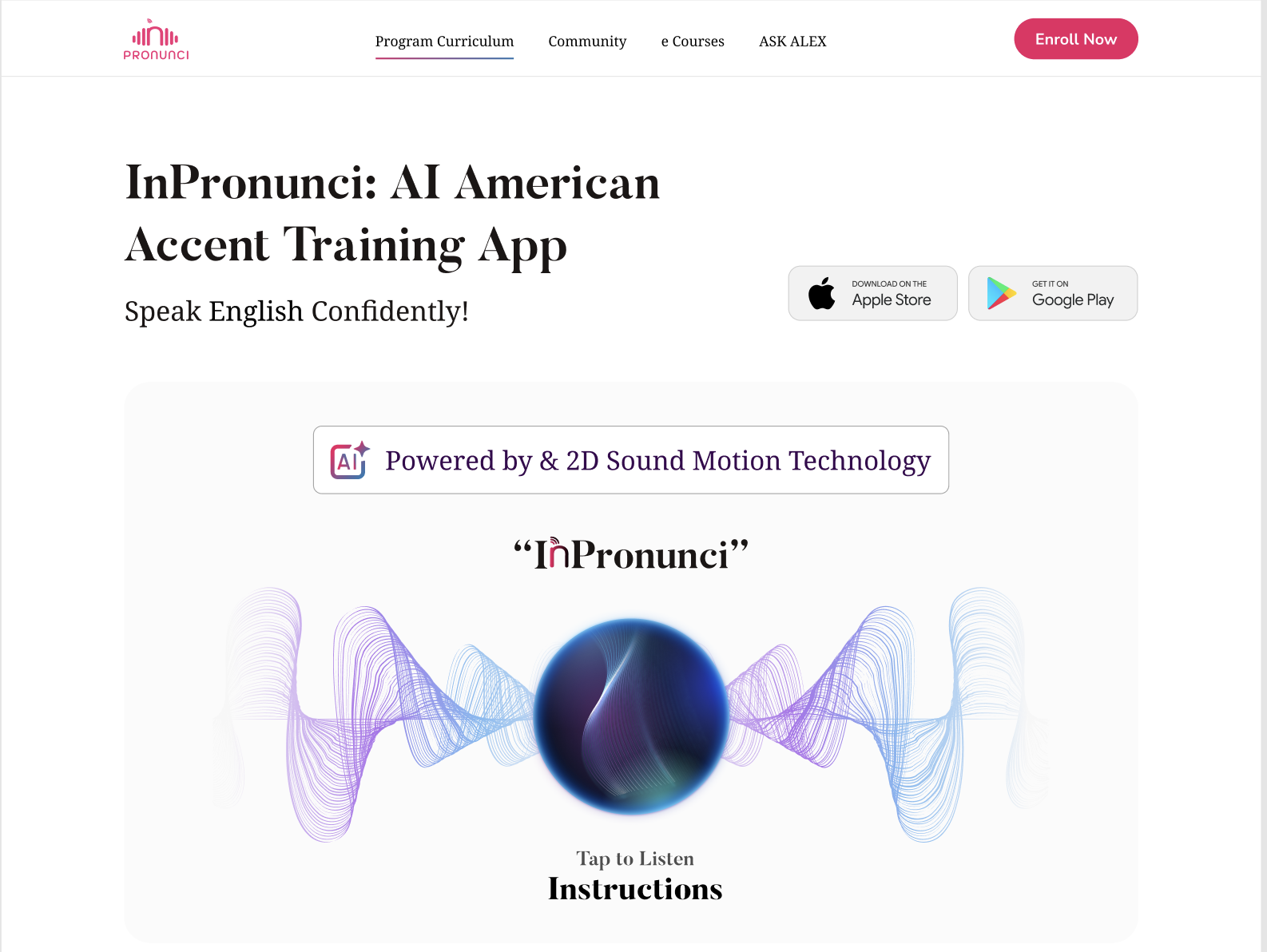
The Free Chapter 1, “Get to Know Your Speech Organs,” gives you immediate access to the foundation of the entire course at no cost. The Basic Plan provides self-study with AI feedback and human-guided instructions. The Premium Plan adds monthly 1-on-1 sessions with Prof. Alex, Ph.D. Accent Coach, for personalized diagnosis and correction. If you are ready to move beyond app-only practice, accent reduction for professionals starts with a clear, guided curriculum. Sign up here, or book a free Premium session to see the difference structured training makes.
Questions & Answers
FAQ
01What is structured pronunciation training?
Structured pronunciation training is a systematic, curriculum-based approach that moves learners through perception, segmentals, suprasegmentals, intonation, shadowing, and transfer under expert guidance. It differs from app-based practice by providing diagnostic feedback and cross-session error correction.
02Can apps alone improve my American accent for professional use?
Apps build drilling volume and reduce social pressure, but they provide forgiving feedback that often reinforces errors rather than correcting them. For professional-level accuracy, apps work best as a supplement to structured coaching, not as a standalone program.
03How long does structured pronunciation training take?
An 8-week structured program with personalized feedback is the recognized standard for advanced professional accent training. Results depend on daily practice consistency and the quality of diagnostic feedback received.
04What makes Inpronunci different from a standard pronunciation app?
Inpronunci combines a structured curriculum designed by Ph.D. linguists with Interactive Visual 2D Sound Simulators, an AI Accent Coach, and human-guided instructions. The Premium Plan adds 1-on-1 coaching with Prof. Alex, Ph.D. Accent Coach, providing the diagnostic depth that apps cannot offer.
05What is “speech recognition drift” and why does it matter?
Speech recognition drift occurs when an app’s forgiving feedback leads learners to believe their pronunciation has improved when it has not. Over time, this reinforces incorrect patterns and makes them harder to correct without professional coaching.
Recommended
A Strategic Feature Comparison: How InPronunci Differs from Traditional Accent Apps in 2026
Ready for executive clarity? Compare InPronunci with other apps and learn how 2D Sound Motion Technology trains each American sound step by step.

InPronunci: The Revolutionary American Accent Training App for Real Speech Transformation
Master the American accent for your career with the InPronunci App. Our 2026 guide shows how visual tech & AI feedback build executive vocal presence.

InPronunci Accent Training App for Professional Communication
Improve American pronunciation with InPronunci, an accent training app using AI feedback, human guidance, and 2D Sound Motion Technology.
Plans
What InPronunci costs
InPronunci Basic
$35 per month
Chapter 1 is free after signup.
InPronunci Premium
$200 per month
Includes a coach: