


Pronunciation training is defined as structured practice that improves how clearly and accurately a speaker produces sounds, stress, rhythm, and intonation in a target language. For non-native English speakers in academic settings, this training is the most direct path to speaking confidence because it removes the core fear: being misunderstood. Research consistently links intelligibility gains to higher participation rates in classrooms and seminars. Tools like ELSA Speak and Inpronunci now combine AI feedback with structured curricula, giving learners measurable proof of progress. The psychological payoff is just as real as the acoustic one: reduced anxiety, stronger self-efficacy, and a genuine willingness to speak up.
Why pronunciation training builds academic confidence
Pronunciation training builds academic confidence primarily by making speech intelligible, not by eliminating an accent. The Intelligibility Principle holds that the goal of pronunciation instruction is real communication success, not native-likeness. When classmates and instructors understand you without effort, you stop dreading questions and start engaging with ideas. That shift from avoidance to participation is where academic confidence actually lives.

The features of speech that most affect comprehension are not individual vowels or consonants. Word stress, sentence rhythm, and prosodic patterns are the understanding bottlenecks that cause real breakdowns in academic conversations. A learner who stresses the wrong syllable in “reCORD” versus “REcord” changes the meaning entirely. Fixing those patterns produces faster, more visible communication gains than drilling isolated sounds.
Articulatory phonetics training goes one step further. A 2026 Frontiers in Human Neuroscience study shows that motor-based feedback strengthens both speech production and sound perception simultaneously. That dual improvement breaks the self-doubt cycle: you speak more accurately, you hear your own mistakes faster, and you correct them before they derail a conversation.
| Method | Focus | Confidence impact |
|---|---|---|
| Listen and imitate | Passive exposure to native models | Slow; relies on learner’s ear alone |
| Articulatory production training | Active control of tongue, lip, and jaw position | Faster; builds production and perception together |
Pro Tip: Target suprasegmental features first. Correcting stress and rhythm in common academic phrases gives you faster intelligibility gains than spending weeks on a single difficult vowel.
How does pronunciation training reduce speaking anxiety?
Speaking anxiety is not a personality flaw. It is a predictable response to the fear of being judged or misunderstood, and pronunciation training addresses it at the source. Research published in Frontiers in Psychology finds that self-efficacy from pronunciation practice directly reduces anxiety and raises willingness to communicate in academic settings. The mechanism is simple: when you know your speech is clear, you stop bracing for confusion.
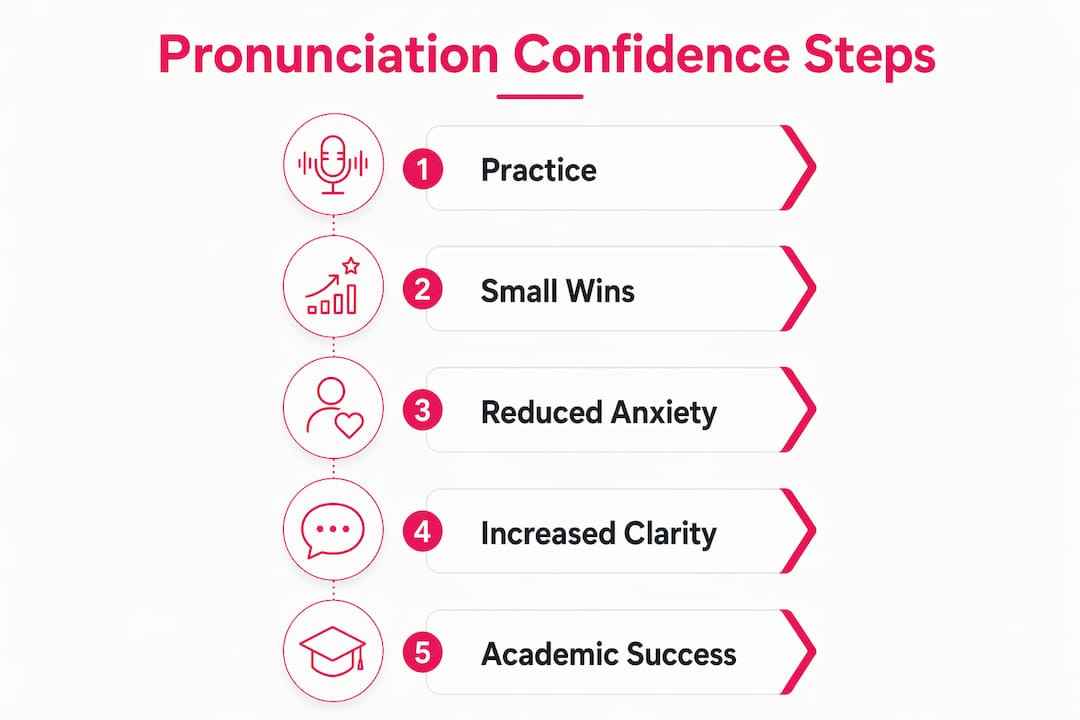
The confidence loop works like this. Structured practice produces small, repeatable wins. Those wins update your internal belief about your own ability. That updated belief lowers the cost of speaking up in class, which creates more practice opportunities, which produces more wins. Motivation and reduced anxiety are not side effects of pronunciation training. They are essential ingredients for sustaining it.
The “Praise-Speak” program, documented in a 2026 Frontiers in Psychology study, shows how AI paired with appreciative education creates a psychologically safe environment for EFL learners. Positive, specific feedback replaces vague correction, which keeps motivation high and anxiety low. That combination produces more consistent practice and stronger long-term gains.
Affective benefits from structured pronunciation training include:
-
Lower speaking anxiety in seminars, presentations, and group discussions
-
Higher communicative self-efficacy, meaning you believe you can get your point across
-
Greater willingness to communicate, which directly increases academic participation
-
Stronger intrinsic motivation, because progress feels visible and real
-
Reduced fear of judgment, especially when training focuses on intelligibility rather than accent erasure
Pro Tip: Record yourself reading a short academic passage once a week. Listening back removes the mystery from your own voice and makes progress concrete rather than abstract.
What role does AI technology play in pronunciation confidence?
AI-assisted pronunciation tools change the feedback equation entirely. Traditional practice relies on a learner’s ability to hear their own mistakes, which is unreliable, especially at intermediate and advanced levels. AI tools like ELSA Speak and Inpronunci’s AI Accent Coach provide real-time, objective feedback on accuracy, intonation, rhythm, and connected speech. That objectivity removes guesswork and replaces it with data.
A study on mobile-assisted oral English learning at a Chinese university found that AI tools improve multiple speaking competence dimensions simultaneously, including accuracy, fluency, and intonation. Each dimension that improves adds another layer of confidence. Learners stop asking “Am I getting better?” because the data answers that question directly.
Progress tracking is the feature that sustains motivation over time. Continuous, low-pressure feedback updates a learner’s internal model of their own speech, making it easier to notice errors and correct them in real time. Inpronunci’s AI Accent Coach evaluates pronunciation, intonation, rhythm, and connected speech as you speak, then delivers specific feedback rather than a generic score. That specificity tells you exactly what to fix next, which keeps practice purposeful.
Inpronunci also uses 2D Sound Motion Technology, a system of interactive mouth-training simulators that train tongue, lip, jaw, and airflow movement for each American sound. Articulatory training solves a problem that audio alone cannot: you can hear a sound without knowing how to physically produce it. Training the articulatory target removes that gap and accelerates accurate production.
Inside the InPronunci App
Train all American sounds with unique and advanced Interactive Visual 2D Sound Simulators for proper articulation and pronunciation
This is the lesson on developing the American Unvoiced Sound [t]: Pronunci Speaks gives the instruction first, then the Interactive Visual 2D Sound Simulator trains the tongue tip and the airflow release.
- EffectiveMost apps offer visual learning. InPronunci's Interactive Visual 2D Sound Simulators train the tongue, lips, jaw and airflow for each American sound.
- ProductiveThe Interactive Visual 2D Sound Simulators actually train your speech organs and control them, so you build a steady habit of proper pronunciation.
- ResultsStudents pronounce individual American sounds with almost native-like pronunciation.
Practical strategies to improve pronunciation for academic settings
The best pronunciation training for academic confidence follows a clear sequence: fix the features that cause the most communication breakdowns first, then build outward. Stress and prosody cause more comprehension failures in academic English than any single consonant or vowel. Start there.
Multimodal learning accelerates progress. Combining speech-organ tools like Inpronunci’s mouth-training simulators, auditory practice with native speaker recordings, and kinesthetic awareness of your own articulation trains three channels at once. Each channel reinforces the others, which makes new sound patterns stick faster.
A practical training sequence for academic learners:
-
Identify your specific problem areas. Use an AI tool like Inpronunci’s AI Accent Coach to get an objective baseline on your stress, rhythm, and intonation patterns.
-
Target suprasegmental features first. Work on word stress and sentence rhythm before drilling individual sounds.
-
Practice in academic contexts. Use sentences and passages from your actual coursework, not generic textbook phrases.
-
Record and compare. Use Inpronunci’s unlimited voice recording feature to compare your speech against native speaker models.
Cognitive Accent Training
Compare Your Coach vs. Your Pronunci
In every practice sentence, students listen to Your Coach, record their own voice, and compare it with Your Pronunci, so they consciously notice and correct each sound.
![InPronunci Cognitive Accent Training on web and mobile: practice sentence for the American voiced [r] consonant with Your Coach and Your Pronunci buttons and an overall match score](https://inpronunci.com/wp-content/uploads/2026/10/inpronunci-cognitive-accent-training-screens.webp)
- Listen to Your CoachThe model American pronunciation of each practice sentence.
- Compare with Your PronunciYour own recorded pronunciation, side by side with the coach.
- Correct with feedbackThe match score and color-coded letters guide each correction.
Start Chapter 1 freeChapter 1 is free in the InPronunci app. -
Simulate real speaking situations. Practice answering seminar questions, presenting arguments, and explaining concepts out loud before you need to do it in class.
Pro Tip: Gradual exposure beats avoidance every time. Volunteer for low-stakes speaking moments first, like reading a sentence aloud in class, before working up to longer contributions. Each small success lowers the threshold for the next one.
Common challenges with pronunciation and how to overcome them
Fear of judgment is the most common obstacle non-native speakers report. The solution is not to wait until your pronunciation is perfect. Pronunciation teaching that embraces diverse accents and focuses on intelligibility rather than native-likeness produces a more positive learning experience and faster confidence gains. Your accent is not the problem. Unclear stress and rhythm are.
| Challenge | Root cause | Recommended solution |
|---|---|---|
| Fear of judgment | Belief that accent signals incompetence | Shift focus to intelligibility; seek supportive feedback environments |
| Difficulty hearing own mistakes | Limited self-monitoring ability | Use AI feedback tools for objective, real-time error detection |
| Inconsistent practice | Lack of structure or measurable goals | Follow a structured curriculum with daily practice targets |
| Slow visible progress | Training too broad or unfocused | Prioritize stress and prosody; track specific metrics over time |
| Discouragement after setbacks | Perfectionist expectations | Adopt a growth mindset; measure progress in weeks, not days |
Inconsistent practice is the second most common barrier. A structured curriculum with daily targets solves this better than willpower alone. Inpronunci’s pronunciation training for professionals provides exactly that structure, with step-by-step progression from individual sounds to full speaking situations. The structure removes the decision fatigue of figuring out what to practice next.
Pronunciation training builds academic confidence by improving intelligibility, reducing speaking anxiety, and creating a self-reinforcing loop of practice, feedback, and willingness to communicate.
What I have learned from watching learners find their voice
The most striking pattern I have observed across years of working with non-native English speakers is this: the learners who gain confidence fastest are not the ones who practice the most hours. They are the ones who stop trying to sound like someone else and start focusing on being understood. That shift in goal changes everything about how they practice and how they feel after each session.
The research on the Intelligibility Principle confirms what I have seen directly: learners who embrace their linguistic identity while targeting specific communication breakdowns progress faster and sustain their motivation longer. Accent erasure is a moving target that demoralizes. Intelligibility is a concrete, achievable goal that rewards effort visibly.
AI tools have changed the game in one specific way that I did not expect. They make progress undeniable. When a learner can see their intonation score improve over three weeks of daily practice, they stop relying on subjective feelings about whether they are getting better. That objectivity is particularly powerful for advanced learners, who often feel stuck because their gains are subtle. The data shows them the gains are real.
My honest advice: do not wait until you feel ready to speak in academic settings. Readiness comes from speaking, not from preparing to speak. Use structured tools, target the features that matter most for comprehension, and treat every speaking moment as data rather than a performance.
— Prof.
Inpronunci: structured training for confident academic speaking
Pronunciation clarity in academic settings requires more than occasional practice. It requires a structured path from sounds to sentences to real speaking situations.
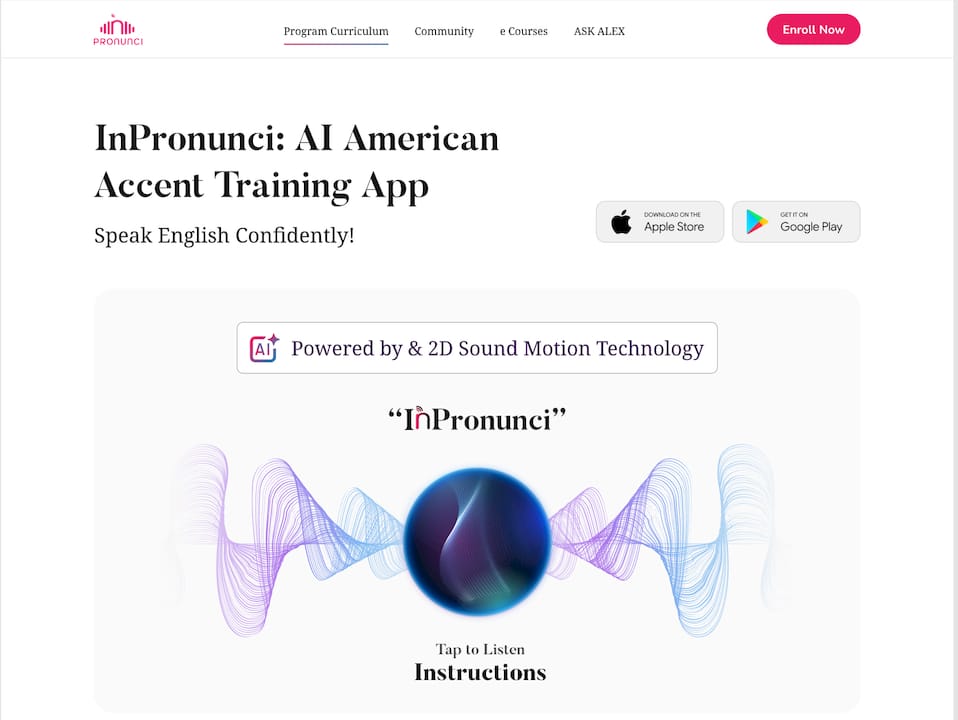
Inpronunci’s American Accent Training Course is built by Ph.D. linguists and covers American vowels, consonants, stress, rhythm, intonation, and connected speech in a step-by-step curriculum. The AI Accent Coach gives you real-time feedback as you speak, and the 2D Sound Motion Technology trains exactly how to position your speech organs for each American sound. Premium members also get monthly 1-on-1 sessions with a Ph.D. accent coach for personalized guidance. Whether you are preparing for seminars, presentations, or daily academic conversations, Inpronunci gives you the daily pronunciation practice structure that turns consistent effort into clear, confident speech.
Structured American Accent Training Course
From Speech Organs Education to American Intonation
The InPronunci course is built step by step: every chapter prepares the next one, and by the end of the course students receive a certificate.
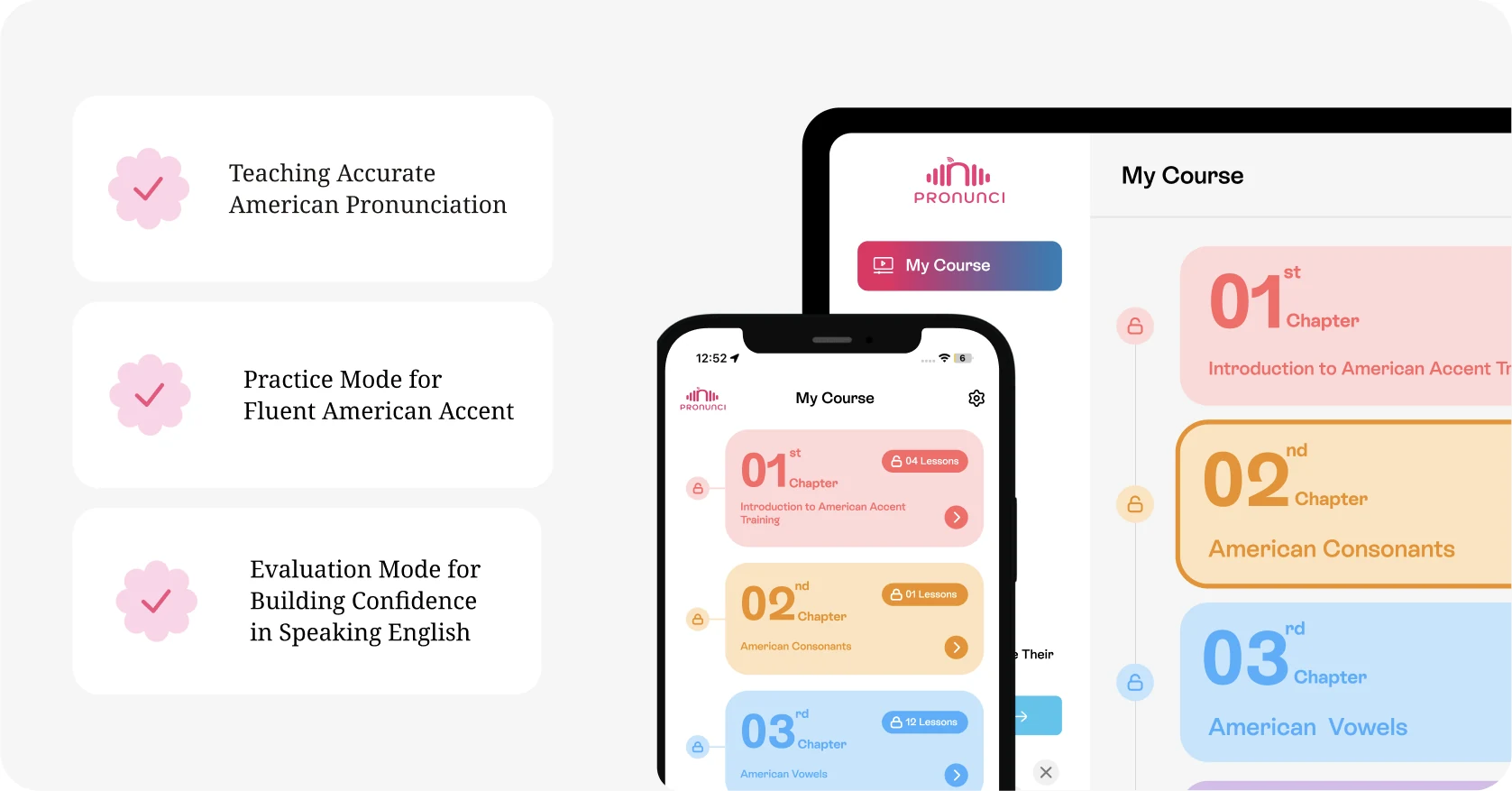
- Speech Organs EducationStudents learn how the speech organs work, along with the AI Accent Coach commands and feedback.
- American ConsonantsPractice and evaluate American consonants in phonetic exercises and practice sentences with the AI Accent Coach.
- American VowelsPractice and evaluate American vowels in phonetic exercises and practice sentences with the AI Accent Coach.
- IntonationLearn how intonation can change the meaning of what you say.
- CertificateBy the end of the course, students receive a certificate.
Questions & Answers
FAQ
01What is pronunciation training and why does it matter for academics?
Pronunciation training is structured instruction that improves how clearly a speaker produces sounds, stress, rhythm, and intonation. For academic learners, it matters because intelligibility directly affects participation, comprehension, and confidence in classroom settings.
02How does pronunciation training reduce speaking anxiety?
Structured pronunciation practice builds self-efficacy by producing repeatable, visible wins. Research in Frontiers in Psychology confirms that increased control over speech clarity lowers anxiety and raises willingness to communicate in academic contexts.
03Which pronunciation features matter most for academic confidence?
Word stress, sentence rhythm, and prosodic patterns cause the most comprehension breakdowns in academic English. Targeting these suprasegmental features produces faster intelligibility gains than drilling individual sounds.
04Can AI tools really improve pronunciation confidence?
Yes. Studies on AI-assisted oral training show improvements in accuracy, fluency, and intonation across multiple speaking dimensions. Objective, real-time feedback from tools like Inpronunci’s AI Accent Coach replaces guesswork with measurable progress data.
05How long does it take to see confidence gains from pronunciation training?
The timeline varies by learner, but structured daily practice targeting stress and prosody produces noticeable intelligibility improvements within weeks. Consistency and targeted feedback, not total hours, determine the speed of progress.
Recommended

InPronunci Accent Training App for Professional Communication
Improve American pronunciation with InPronunci, an accent training app using AI feedback, human guidance, and 2D Sound Motion Technology.
Articulatory Phonetics Training: The Blueprint for Professional American Clarity | InPronunci Interactive Accent Training App
Unlock professional American clarity with articulatory phonetics training. Learn the mechanics of speech to speak confidently and eliminate communication fat...
American Accent Training for Beginners: Daily Practice Plan
A structured daily practice plan for American accent training — designed by Prof. Alex., Ph.D. Learn the sounds, stress, rhythm, and connected speech patterns that matter
Article generated by BabyLoveGrowth
InPronunci training structure
How InPronunci trains the American speech system
InPronunci trains the full American speech system: Interactive Visual 2D Sound Simulators and phonetic exercises for articulation and American sound development, sentence practice for intonation, melody, rhythm, and connected speech, paragraph practice for spontaneous speech, public speaking, and real communication confidence, and Advanced AI Accent Coach evaluation as you speak.
InPronunci is an advanced, linguistically structured American accent training platform with more than 1,000 downloads and a growing learner base. It is designed for serious ESL learners who want American pronunciation, stronger intonation, more natural rhythm, better connected speech, and the ability to speak English more confidently in real communication. The program is especially useful for intermediate and advanced English speakers who want to become independent speakers of English with confident communication, stronger speaking control, long-term speech improvement, and great public speaking skills. It is also designed for advanced speakers whose goal is to speak like a native or closer to native-like American speech, including people who were raised in the United States but still have slight accent patterns from the native language they were born with. It is a complete American accent training course and system created by Prof. Alex, Ph.D. Accent Coach, Doctor of Education, and professional linguist based in Austin, Texas, with Pronunci Instructions from Prof. Alex for each lesson that make self-learning more effective, supported, and clear.
Plans
What InPronunci costs
InPronunci Basic
$35 per month
Chapter 1 is free after signup.
InPronunci Premium
$200 per month
Includes a coach: