


A high accuracy percentage on a digital interface doesn’t always equate to clarity in a high-stakes boardroom. While a 2025 survey of Fortune 500 executives indicated that 82% found traditional, once-a-week training sessions insufficient for forming permanent habits, many modern professionals now face a different challenge: chasing high AI pronunciation feedback scores without achieving genuine speech fluidity. You’ve likely felt the frustration of receiving a stagnant grade or feeling like a robotic version of yourself while trying to satisfy an algorithm. This disconnect occurs because a score is a diagnostic data point, not a physical instruction.
We believe that speech metrics should serve as a sophisticated roadmap rather than a final judgment. This article will teach you how to interpret these analytics to re-educate your sound system for professional-level American English fluency. We’ll provide a structured path to move from abstract data to the physical mastery of 2D Sound Motion Technology. By the end, you’ll understand how to bridge the gap between digital feedback and the nuanced rhythm of natural, confident communication.
What Are AI Pronunciation Feedback Scores?
At their core, AI pronunciation feedback scores represent a quantitative analysis of how closely your speech aligns with a specific phonetic model. This isn’t a subjective opinion; it’s the result of sophisticated machine learning algorithms comparing your audio input against vast databases of native American English speakers. While a human listener might tell you that you “sound different,” these metrics provide a surgical breakdown of your acoustic signature. Unlike standard speech-to-text tools that focus solely on word recognition, specialized pronunciation assessment technology evaluates the quality of the sound itself. It examines the placement of your tongue, the vibration of your vocal cords, and the duration of your vowels to determine your proximity to professional clarity.
For adult learners, this objective data is transformative. We all possess an “auditory filter” shaped by our native language, which often prevents us from hearing the subtle differences between our own speech and the target American accent. You might think you’re producing a perfect “th” sound when you’re actually substituting it with a “d” or “t.” Immediate feedback bypasses this psychological blind spot. It provides an external, unbiased mirror that reflects your speech patterns in real-time, allowing you to make physical adjustments before an incorrect habit becomes deeply ingrained in your automatic speech habits.
The Three Pillars of Automated Speech Analysis
To understand the depth of these metrics, we must look at the three primary components that dictate your final score. Accuracy measures the precision of individual phonemes, ensuring that every vowel and consonant is produced with the correct mouth position. Fluency focuses on the rhythm and flow, identifying unnatural pauses or hesitations that might disrupt your message. Finally, Completeness ensures that no part of the word or sentence was “swallowed” or omitted. Together, these pillars provide a comprehensive view of your speaking performance, moving beyond simple right-or-wrong binary results.
Why Professionals Rely on Objective Metrics
In a professional setting, clarity is a strategic asset. Relying on AI pronunciation feedback scores allows you to establish a concrete baseline for your communication skills. Instead of guessing whether you’re improving, you can use the AI Accent Coach to track your progress through historical data points. This data-driven approach removes the emotional frustration of a plateau. When you can see exactly where your rhythm or articulation is falling short, you can stop “guessing” and start practicing with the precision of a strategist. It’s about moving from vague self-improvement to measurable professional development.
Decoding the Metrics: Accuracy, Prosody, and Intonation
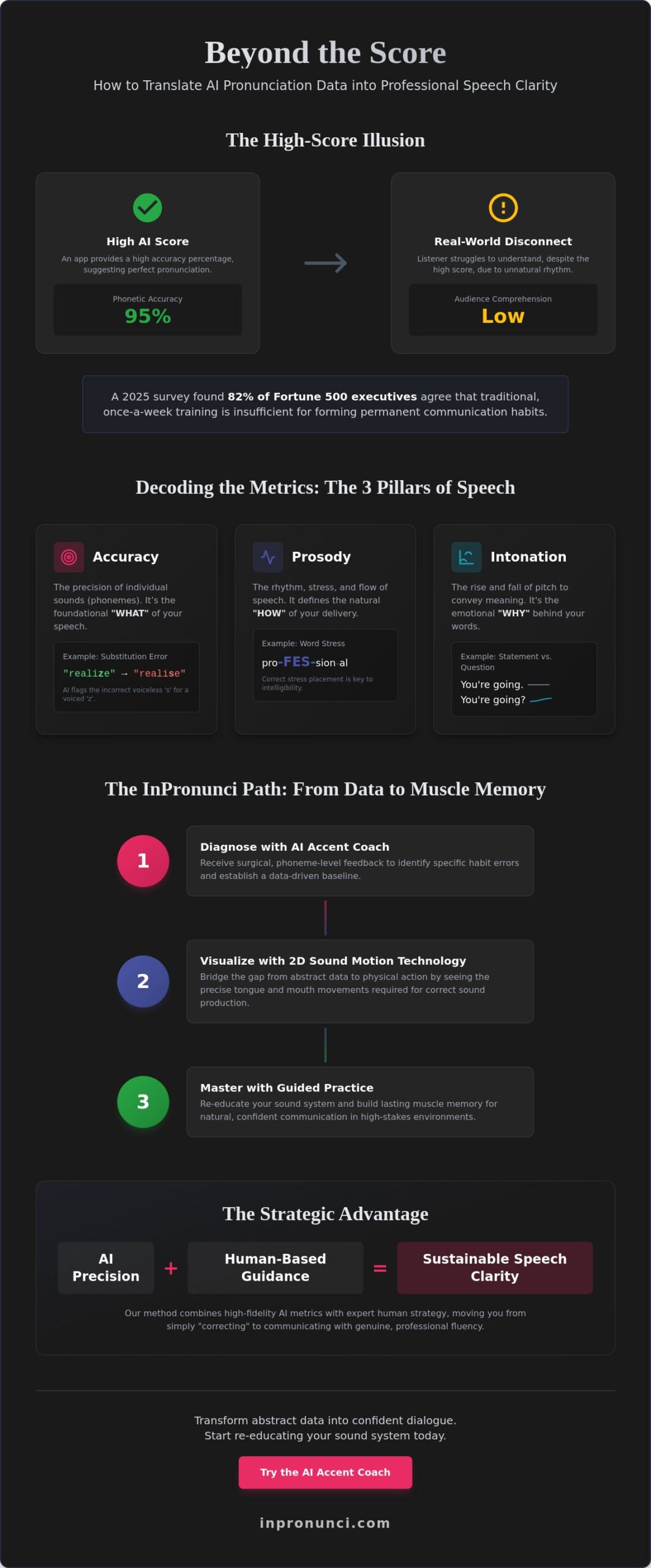
AI pronunciation feedback scores are derived from a complex interplay of phonetic data points. Rather than a simple pass or fail grade, these metrics analyze how you execute substitutions, omissions, or insertions of sounds. For example, replacing a voiced “z” with a voiceless “s” at the end of a word like “realize” is a substitution that the algorithm flags instantly. These nuances matter because they directly impact how much effort a listener must exert to understand your message. Professional clarity isn’t about erasing your background; it’s about ensuring your phonetic choices don’t create cognitive friction for your audience.
The Science of Accuracy Scores
AI distinguishes between the “Held T” in “mountain” and the “Flap T” in “city” by measuring the duration of the stop and the voicing of the surrounding sounds. Vowel neutralization, particularly the “schwa” sound, is another critical metric. AI quantifies the spectral properties of your vowels to see if you’re over-enunciating unstressed syllables. Phoneme-level feedback is the diagnostic tool for identifying specific articulatory habit errors. This precision allows you to target the physical cause of a low score rather than guessing at the solution.
While individual sounds are important, the “melody” of American English often carries more weight in professional settings. According to an academic review of pronunciation assessment, researchers have found that prosodic features are often more predictive of perceived intelligibility than phonemic accuracy alone. This is why you might receive a high accuracy score but still feel that your speech lacks a natural, authoritative flow. The data highlights a gap between being “correct” and being “effective.”
Prosody: The Rhythm of the American Accent
Prosody measures how you organize words into “Thought Groups” and use strategic pauses to separate ideas. Sentence stress is scored based on three variables: duration, pitch, and volume. If you emphasize every word equally, you’ll sound robotic. The goal isn’t to speak with perfect mathematical precision but to master the rhythmic contrast that signals importance to your audience. True fluency involves knowing which sounds to reduce so the important ones can stand out.
Intonation patterns involve the rise and fall of your pitch to signal meaning, such as the difference between a definitive statement and a tentative question. AI detects these frequency shifts to ensure your vocal tone matches your intent. Ultimately, the objective isn’t to achieve a “native-like” score for the sake of mimicry. It’s about achieving professional clarity that ensures your expertise isn’t overshadowed by your delivery. You can begin refining your rhythmic precision by applying these diagnostic insights to your daily practice sessions.
The Limitation of Data: Why a High Score Isn’t Always Enough
You’ve likely encountered a frustrating paradox: your dashboard displays a series of high AI pronunciation feedback scores, yet your colleagues still ask you to repeat yourself during meetings. This disconnect reveals the central limitation of purely quantitative data. Many learners inadvertently learn to “game” the algorithm by adjusting their volume or mimicking a specific pitch that the machine rewards, rather than building the sustainable articulatory habits required for real-world clarity. A high score on an isolated word rarely accounts for the cognitive load of a live conversation, where you must manage complex ideas and emotional nuances simultaneously.
The “Auditory Gap” is often the root cause of this plateau. As an adult learner, your brain’s neural pathways are deeply optimized for your native language’s sound system. This can lead to a phenomenon where you literally cannot hear the mistake the AI is flagging. You might be convinced you’re producing a perfect American “R,” but the data suggests otherwise. Without a bridge between the score and your physical movements, you’re left guessing how to close that gap. This is why hearing your feedback is only 50% of the re-education process; the other half is physical execution.
The Plateau Effect in Adult Language Learning
Ingrained articulatory habits can be incredibly resilient. When your scores stagnate, it’s usually because your mouth is defaulting to familiar positions from your first language. Research regarding conflicting conditions for L2-English highlights how automated systems sometimes struggle to provide actionable paths forward when speech patterns are deeply entrenched. The psychological frustration of seeing a “90%” that doesn’t translate to confidence is real. Breaking through requires moving beyond the “what” of a score and into the “how” of speech articulation.
Bridging the Gap with Speech-Organ Training Feedback
To overcome the limitations of sound alone, you must learn to “see” your speech. This strategic shift moves you from a passive recipient of data to an active architect of your own sound system. While scores provide a necessary diagnostic, they lack the instructional depth to change your physical behavior. By integrating 2D Sound Motion Technology, you train how the tongue, lips, and jaw should move for every American sound. You stop asking “What did I do wrong?” and start identifying exactly which muscle group failed to engage. This visual-motor integration is what finally transforms abstract data points into lasting automatic speech habits and professional-level clarity.
Re-Educating Your Sound System: From Scores to Automatic Speech Habits
Achieving professional clarity requires a strategic shift in how you perceive your practice sessions. Instead of viewing AI pronunciation feedback scores as a final grade, you should treat them as raw diagnostic data that informs your physical training. Repetition without a specific corrective goal often reinforces existing errors. To truly re-educate your sound system, you must follow a structured process that moves from digital analysis to physical mastery. This journey begins with a precise diagnostic assessment using the AI Accent Coach to pinpoint exactly where your phonetic delivery deviates from the target American model.
Once you’ve identified the sound errors, the next step involves connecting those low scores to specific physical movement mistakes. A low score on a “th” sound, for instance, is merely a symptom of improper tongue placement. You can then bridge this gap by training the correct articulation through 2D Sound Video Mouth Training Simulators. By seeing the internal movements of the speech organs, you remove the guesswork from your practice. Targeted repetition then allows you to build new articulatory habits, culminating in paragraph-level validation to ensure these sounds remain stable even when your cognitive focus is on your message rather than your mouth.
The Record-Analyze-Train Loop
Effective training relies on a continuous feedback loop that allows for real-time micro-adjustments. When you record your speech and receive a score, don’t just move on to the next prompt. Analyze the feedback, train the correct movement using the 2D simulators, and attempt the sound again immediately. This “shadowing” technique, where you mimic the simulator’s timing and movement, is essential for recalibrating your internal sound map. Automatic speech habits are built through the strategic combination of speech-organ training and repetitive physical motion. This approach ensures that your progress is rooted in physical change rather than temporary mimicry.
Mastering Paragraph-Level Training
It’s common for scores to fluctuate when moving from isolated words to complex sentences. This happens because the cognitive load of managing grammar, vocabulary, and professional content often causes your “rhythm breaks” to resurface. Using AI scores at the paragraph level helps you identify exactly where your flow falters during a presentation. You might find that your clarity drops during specific transitions or when using high-syllable technical terms. By practicing in context, you ensure that your new articulatory habits are resilient enough for the boardroom. You can start your structured training today to begin turning these diagnostic insights into permanent speech clarity.
The InPronunci Advantage: AI Precision Meets Human Strategy
The evolution of speech training has reached a point where data alone is no longer the differentiator; the true advantage lies in the strategic interpretation and application of that data. InPronunci doesn’t simply provide AI pronunciation feedback scores to highlight errors. Instead, we integrate scoring with 2D Sound Motion Technology, which trains speech organ positioning to bridge auditory feedback and physical execution. This methodology ensures that the diagnostic phase leads directly to a corrective phase, moving you beyond the frustration of a stagnant score and toward the reality of professional American English fluency.
Our approach acknowledges that adult learners require more than just a percentage to change lifelong habits. By combining machine precision with human-based guidance, we provide a structured path that respects the complexity of the human sound system. You aren’t just practicing against an algorithm. You’re following a research-based pedagogical framework designed to re-educate your articulatory muscles for sustainable, long-term clarity.
The Power of 2D Sound Motion
Seeing the “shape” of a sound is often the most efficient way to correct an articulatory habit. While generic apps rely on audio-only prompts, InPronunci’s 2D Sound Video Mouth Training Simulators show the internal movement of speech organs. You can observe the precise positioning of the tongue and jaw required for complex American sounds. This visual-first approach allows you to match your physical movements to a structured model, effectively bypassing the auditory filter that often tricks the ear. It transforms an abstract score into a concrete physical instruction.
Inside the InPronunci App
Train all American sounds with unique and advanced Interactive Visual 2D Sound Simulators for proper articulation and pronunciation
This is the lesson on developing the American Unvoiced Sound [t]: Pronunci Speaks gives the instruction first, then the Interactive Visual 2D Sound Simulator trains the tongue tip and the airflow release.
- EffectiveMost apps offer visual learning. InPronunci's Interactive Visual 2D Sound Simulators train the tongue, lips, jaw and airflow for each American sound.
- ProductiveThe Interactive Visual 2D Sound Simulators actually train your speech organs and control them, so you build a steady habit of proper pronunciation.
- ResultsStudents pronounce individual American sounds with almost native-like pronunciation.
Premium Coaching: When AI Data Needs Human Insight
There are instances where AI data requires human insight to navigate high-stakes communication challenges. Our Premium Subscription provides this strategic oversight through direct guidance from Prof. Alex. While the Basic Subscription offers robust AI-driven practice with Practice Mode and AI feedback, the Premium tier is designed for executives and public speakers who require personalized correction of complex speech patterns. This hybrid model ensures that your training is both technologically precise and strategically sound. You can begin your journey to professional clarity by trying the InPronunci AI Accent Coach today.
Transforming Diagnostic Data into Professional Clarity
Achieving a high level of American English fluency is a strategic endeavor that requires moving beyond the surface of digital metrics. We’ve explored how AI pronunciation feedback scores serve as a vital diagnostic starting point, yet they only reach their full potential when paired with physical re-education. By bridging the auditory gap through visual learning and structured repetition, you can transform abstract percentages into the lasting automatic speech habits required for the boardroom.
The path to clarity is built on the combination of real-time feedback from our proprietary AI Accent Coach and speech-organ training from 2D Sound Motion Technology. With a curriculum designed by Prof. Alex, Ph.D. Accent Coach, you have access to a framework that prioritizes long-term results over temporary fixes. We invite you to master your American accent with the InPronunci AI Accent Coach and begin refining your professional delivery today. Your voice is your most powerful asset; it’s time to ensure it’s heard with the clarity you deserve.
More than mechanics: InPronunci doesn’t teach only the mechanics of sounds. It teaches students how to become confident, fluent English speakers through a step-by-step system. Training may begin with how each American sound is made. Then it moves into sound combinations, sound contractions, phonetic exercises, practice sentences, and paragraphs in real rapid speech, so students start speaking English fluently and comfortably.
Questions & Answers
Frequently Asked Questions
01How accurate are AI pronunciation feedback scores compared to a human coach?
Modern AI metrics are exceptionally precise at identifying phonetic deviations and rhythmic inconsistencies that the human ear might overlook during a casual conversation. While a human coach provides strategic oversight and emotional nuance, the AI Accent Coach offers objective, high-frequency data that is essential for the initial diagnostic phase. This technology allows for the consistent, real-time monitoring necessary to track subtle improvements in your articulatory precision.
02Can I really improve my American accent just by using an AI app?
Improvement is highly effective when the app functions as a comprehensive training simulator rather than a simple recording tool. Success depends on moving beyond auditory mimicry to physical re-education. By using 2D Sound Video Mouth Training Simulators, you train the internal movements required for each sound, ensuring that your practice sessions build the automatic speech habits needed for lasting speech clarity.
03What is a “good” AI pronunciation score for a professional setting?
A score of 85% or higher generally indicates that your speech has reached a level of professional clarity suitable for leadership roles. However, a total percentage can be misleading if it masks significant errors in prosody or rhythm. It’s more strategic to focus on consistent AI pronunciation feedback scores across complex paragraphs rather than achieving a perfect 100% on isolated words.
04Why does my score change every time I say the same word?
Fluctuations usually indicate that your new articulatory habits haven’t yet reached full stability. The AI detects minute variations in tongue placement, breath support, or vowel duration that you may not consciously perceive. These shifts are valuable diagnostic markers, signaling which specific sounds require more targeted repetition using visual-motor training tools to ensure consistency.
05Does the AI Accent Coach account for different regional American accents?
The system is calibrated against a General American model, which serves as the standard for professional, academic, and broadcast communication. This neutral baseline is designed to maximize your intelligibility across all regions. By focusing on these core phonetic principles, you ensure that your message remains authoritative and clear regardless of your listener’s specific regional background.
06How long does it take to see a permanent improvement in my AI scores?
Research published in 2023 indicates that learners using AI feedback tools show a 15-20% improvement in intelligibility over an eight-week period when practicing consistently. Dedicating just 15 minutes a day to structured training is three times more effective than long, infrequent sessions. Permanent change occurs when you move from simply hearing a sound to mastered physical execution.
07What happens if I get a high score but native speakers still can’t understand me?
This discrepancy often arises when a learner focuses on individual phonemes while neglecting the overall “melody” and stress patterns of American English. You might be achieving high AI pronunciation feedback scores by over-enunciating, which can sound unnatural. To fix this, you must transition to paragraph-level training to ensure your rhythm and intonation remain fluid during complex professional interactions.
08How does the 2D Sound Motion Technology work with the AI scoring?
The technology provides the physical solution to the problem identified by the AI’s diagnostic data. When the AI flags a sound as incorrect, the 2D Sound Motion Technology trains exactly how the tongue and lips must move to produce that sound accurately. This integration ensures that your practice isn’t just repetitive but is actively corrective, leading to faster and more reliable results.
InPronunci training structure
How InPronunci trains the American speech system
InPronunci trains the full American speech system: Interactive Visual 2D Sound Simulators and phonetic exercises for articulation and American sound development, sentence practice for intonation, melody, rhythm, and connected speech, paragraph practice for spontaneous speech, public speaking, and real communication confidence, and Advanced AI Accent Coach evaluation as you speak.
InPronunci is an advanced, linguistically structured American accent training platform with more than 1,000 downloads and a growing learner base. It is designed for serious ESL learners who want American pronunciation, stronger intonation, more natural rhythm, better connected speech, and the ability to speak English more confidently in real communication. The program is especially useful for intermediate and advanced English speakers who want to become independent speakers of English with confident communication, stronger speaking control, long-term speech improvement, and great public speaking skills. It is also designed for advanced speakers whose goal is to speak like a native or closer to native-like American speech, including people who were raised in the United States but still have slight accent patterns from the native language they were born with. It is a complete American accent training course and system created by Prof. Alex, Ph.D. Accent Coach, Doctor of Education, and professional linguist based in Austin, Texas, with Pronunci Instructions from Prof. Alex for each lesson that make self-learning more effective, supported, and clear.
Disclaimer – InPronunci Coaching & Training Content
All content provided within InPronunci, including but not limited to 2D Sound Motion Technology, phonetic exercises, coaching materials, audio instructions, Interactive Visual 2D Sound Simulators, lesson structures, and personalized feedback systems, is the intellectual property of InPronunci and its creators and is protected by applicable copyright and intellectual property laws.
The coaching exercises and training methodologies are designed exclusively for personal educational use within the InPronunci platform. Users are granted a limited, non-transferable license to access and use the materials for individual learning purposes only.
Any reproduction, distribution, modification, recording, sharing, or commercial use of InPronunci content without prior written permission is strictly prohibited. This includes, but is not limited to, copying coaching exercises, redistributing training materials, or replicating the methodology in other platforms or products.
InPronunci is a guided pronunciation training system intended to support language development. While the program is designed to improve pronunciation, fluency, and speech clarity, individual results may vary depending on practice, consistency, and learner background.
By using InPronunci, users agree to respect all intellectual property rights and comply with these terms of use.
Plans
What InPronunci costs
InPronunci Basic
$35 per month
Chapter 1 is free after signup.
InPronunci Premium
$200 per month
Includes a coach:
Why InPronunci is worth the price
- Interactive Visual 2D Sound Simulators, built on 2D Sound Motion Technology developed by Prof. Alex, train your speech organs for each American sound.
- Prof. Alex's guided instructions in every lesson, like working with a real coach.
- The Advanced AI Accent Coach evaluates sounds, intonation, rhythm, stress, and connected speech against native American English speech (100 = native speaker).