



Why is it that you can perfectly hear the nuance of a professional American accent, yet your own speech muscles refuse to mirror it during a high-stakes board meeting? This disconnect occurs because traditional training often ignores the strategic power of 2D Sound Video Mouth Training Simulators, which train the speech organs—tongue, lips, jaw, teeth, airflow, and voice—to bypass fossilized auditory filters. You likely recognize the physical frustration of “stubborn” sounds like the American R or L, where repetitive listening leads to auditory fatigue rather than actual clarity.
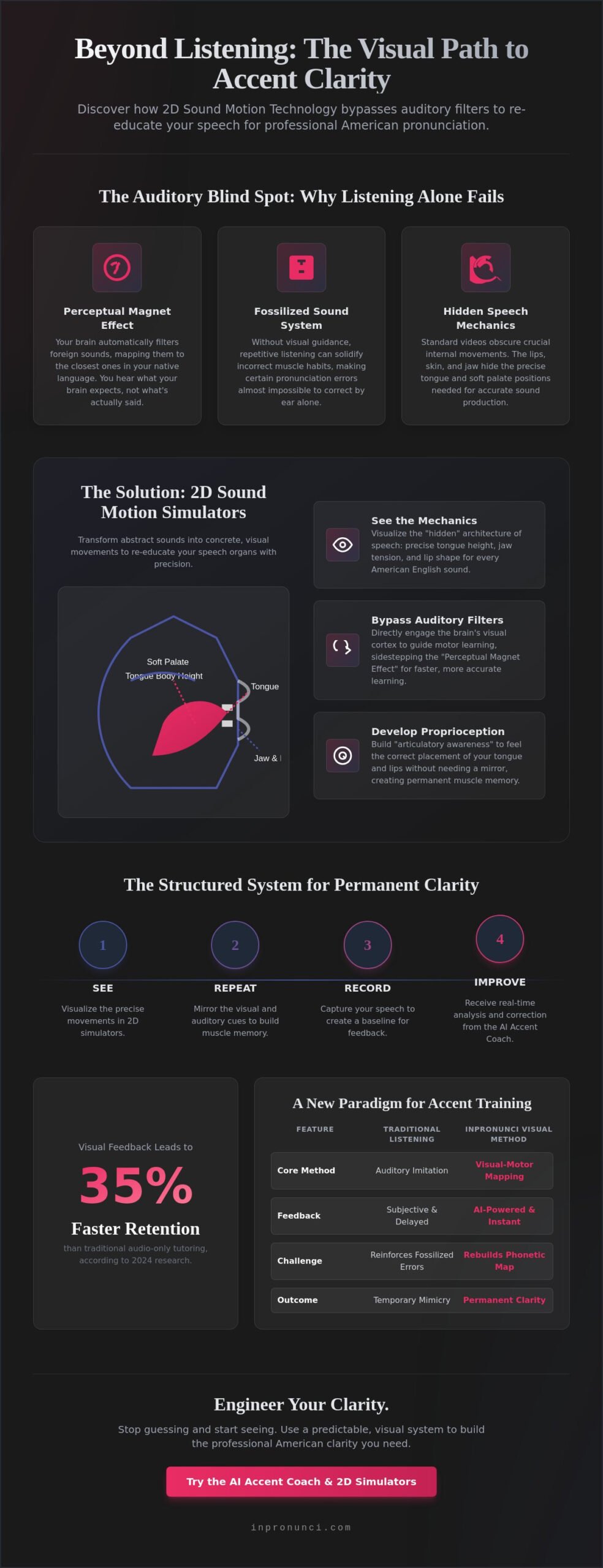
We believe that mastering American speech requires a structured, speech-organ approach to re-educate the speech organs. By leveraging 2D Sound Motion Technology, you can transform abstract sounds into concrete physical movements; a method that 2024 research indicates can lead to 35% faster retention than traditional tutoring. This article will explain how to use these simulators to build permanent professional clarity and reclaim your vocal authority.
We’ll explore how training speech motion reduces cognitive load and eliminates the uncertainty that often plagues non-native speakers. You’ll learn how a predictable system of seeing and repeating sounds can provide the competitive edge you need for clear, impactful communication in any professional setting.
The Auditory Blind Spot: Why Listening Alone Won’t Fix Your Accent
Many professionals believe that immersion is the key to clarity. They assume that if they listen to enough podcasts or attend enough meetings, their speech will eventually align with the American standard. However, the brain doesn’t act as a passive recorder. It functions as a strategic filter known as the “Perceptual Magnet Effect.” This neurological phenomenon means your brain automatically categorizes foreign sounds into the nearest familiar bucket from your native language. You don’t hear what’s actually being said; you hear what your brain expects to hear.
When you rely solely on your ears, you’re practicing with a compromised compass. Repetition without speech-organ guidance often does more harm than good by reinforcing incorrect muscle habits. If you’re struggling with the American R or L, simply repeating the sound won’t fix the underlying mechanical error. You might even look at videos of native speakers, but standard video has significant limitations. Skin, lips, and facial hair frequently obscure the internal movements of the tongue and teeth. This is where 2D Sound Video Mouth Training Simulators become essential. They strip away these distractions to reveal the precise articulatory mechanics required for professional speech.
The Neurological Case for Speech-Organ Training Feedback
The human brain prioritizes visual information over auditory input when processing speech. This is best demonstrated by the McGurk Effect, where what we see can completely change what we think we hear. By providing Direct Speech-Organ Training Feedback, simulators train the speech organs to guide motor learning. When you train the exact height of the tongue or the tension in the jaw with a simulator, your brain builds “articulatory awareness.” It’s no longer a guessing game based on sound. Instead, it’s a strategic physical maneuver that you can map and replicate with precision.
Bypassing the “Fossilized” Sound System
For many non-native professionals, certain pronunciation errors have become “fossilized.” Fossilization occurs when the brain’s phonetic map becomes fixed, making it nearly impossible to detect or correct errors through listening alone. You’ve likely reached a plateau where your grammar is perfect, but your clarity remains inconsistent. 2D Sound Video Mouth Training Simulators provide a necessary reset for this fossilized system. By bypassing the ears and going straight to the visual and motor centers, these tools allow you to rebuild your phonetic map from the ground up. This visual foundation is the most reliable way to ensure that your pronunciation practice leads to long-term, sustainable growth rather than temporary imitation. It’s a shift from hoping for clarity to engineering it through deliberate, speech-organ training feedback.
What are 2D Sound Video Mouth Training Simulators?
To overcome the auditory filters discussed previously, we must look toward advanced digital instruments that prioritize visual precision. 2D Sound Video Mouth Training Simulatorsare sophisticated tools designed to train the exact, internal movements of the speech organs during sound production. While traditional accent training works only with the lips, these simulators train the hidden architecture of speech, including the specific height of the tongue, the tension of the soft palate, and the opening of the throat. This level of detail is crucial for professionals who need to master the mechanics of the American accent without the guesswork of traditional methods.
Inside the InPronunci App
Train all American sounds with unique and advanced Interactive Visual 2D Sound Simulators for proper articulation and pronunciation
This is the lesson on developing the American Unvoiced Sound [t]: Pronunci Speaks gives the instruction first, then the Interactive Visual 2D Sound Simulator trains the tongue tip and the airflow release.
- EffectiveMost apps offer visual learning. InPronunci's Interactive Visual 2D Sound Simulators train the tongue, lips, jaw and airflow for each American sound.
- ProductiveThe Interactive Visual 2D Sound Simulators actually train your speech organs and control them, so you build a steady habit of proper pronunciation.
- ResultsStudents pronounce individual American sounds with almost native-like pronunciation.
At the heart of this technology is the concept of “visemes.” Just as phonemes are the individual units of sound, visemes are the visual building blocks of speech. Mastery of these visual patterns is supported by The Science of Articulation Training , which suggests that training the physical articulation of a sound significantly accelerates the learning process. Unlike static materials found in outdated textbooks, 2D Sound Motion Technology trains the fluid movement of the speech organs as they transition from one position to the next. It’s this movement, rather than a single frozen position, that defines professional clarity.
Key Features of 2D Sound Motion Technology
The strategic advantage of modern simulators lies in their ability to synchronize high-fidelity audio with 2D mouth motion simulation in real time, so learners train each movement as they hear it. This synchronization ensures that your brain associates the correct physical movement with the corresponding sound instantly. One of the most effective features for learners is the ability to slow down the motion. By reducing the speed, you can observe the subtle transitions between vowels that are often too fast for the naked eye to catch. This is particularly useful for understanding “connected speech” or coarticulation, where the position of the tongue for one sound is influenced by the sound that follows it. You can explore the simulator interface to see these transitions in action during your practice sessions.
From Visemes to Professional Clarity
Mastering individual visemes is the first step toward clearer word-level production. When you can see the difference between the “tight” tongue position of the American R and the “flat” position of the L, the physical frustration of these sounds begins to vanish. This granular focus eventually leads to American sound system mastery, where you no longer think about individual sounds but speak with a predictable, clear rhythm. The InPronunci simulator interface has become a professional standard because it moves beyond simple imitation. It provides a structured environment where you can record your attempts, compare them to the simulator, and receive objective feedback. This systematic approach ensures that your speech clarity isn’t left to chance but is built on a foundation of repeatable articulation mechanics.
The Science of Articulation Training: How Training the Speech Organs Re-educates Your Brain
Speech is fundamentally a motor skill, yet it’s one of the few physical activities where we cannot see our own “equipment” in action. This lack of speech-organ training feedback creates a significant gap in proprioception, which is the brain’s ability to sense the position and movement of various body parts. In the context of accent training, most learners have no idea where their tongue is actually placed during a difficult vowel or consonant. 2D Sound Video Mouth Training Simulators bridge this gap by providing a digital mirror for internal movements that are otherwise invisible. This creates a powerful environment for Visual-Motor Integration, a key driver in adult neuroplasticity that allows the brain to forge new connections between what it sees and what the muscles do.
While 3D models might seem more modern, 2D simulation is strategically superior for training complex phonetic patterns. High-detail 3D models often introduce unnecessary cognitive load through realistic textures, shadows, and depth that distract the eye from the core mechanics. By simplifying the movement into clear, two-dimensional planes, 2D simulators allow the learner to focus entirely on training the articulatory path. This reduction in interface noise ensures that the brain’s energy is spent on re-educating the speech muscles rather than processing a complex graphic interface. It’s a pragmatic approach that prioritizes functional clarity over aesthetic complexity.
Building Speech Muscle Memory with Training Cues
The transition from intellectual understanding to automatic speech requires a structured process of Cognitive-Motor Learning. This cycle involves four distinct stages: Understand, Mimic, Record, and Compare. Training with the simulator is not passive; you’re following a strategic blueprint for your vocal tract. This process helps eliminate “intrusive” sounds from your native language that often creep into your English speech. Speech-organ training accelerates the myelination of speech-related neural pathways, essentially insulating the “wiring” of your new American sound patterns for faster, more automatic retrieval. Over time, this transforms a conscious effort into a permanent muscle memory that you can rely on during high-pressure meetings.
Mastering the American R and L Through Speech-Organ Training
The American R and L are notorious for being “stubborn” because their production is almost entirely internal and hidden from view. Using 2D Sound Video Mouth Training Simulators, you can finally see the distinction between a “Retroflected R,” where the tongue tip curls back, and a “Bunched R,” where the body of the tongue lifts toward the roof of the mouth. Similarly, the “Dark L” requires a specific velarization or lifting of the back of the tongue that’s nearly impossible to learn by ear alone. For those ready to apply these visual insights to their daily routine, our mastering American sounds guide provides the specific phonetic drills needed to turn these training maps into professional speech habits.
Integrating Simulators into Your Professional Training Routine
Strategic clarity is rarely the result of exhaustive, hours-long study sessions. For the high-level professional, time is a finite resource that must be allocated with precision. This is why we advocate for the “Micro-Practice” strategy, which leverages 2D Sound Video Mouth Training Simulators for 10 to 15 minutes of high-intensity focus. By concentrating on a single phonetic pattern in short bursts, you prevent auditory fatigue and ensure that every minute spent training contributes directly to your communication goals. During these sessions, the Shadowing Technique becomes your most effective tool; you aren’t just repeating sounds, but physically syncing your articulators with the simulator.
The true power of this method lies in the closed-loop feedback system. By combining 2D speech-organ simulators with AI pronunciation feedback scores, you remove the subjectivity from your practice. You can see the correct movement, attempt to replicate it, and receive an objective score that validates your progress. This data-driven approach allows you to identify exactly where your physical execution deviates from the target, making your training sessions both predictable and highly efficient. It’s a shift from hopeful repetition to calculated improvement.
A 4-Step Daily Routine for Speech Clarity
To turn these tools into a sustainable habit, we suggest a structured four-step routine. First, begin with Speech-Organ Preparation. Play the 2D simulator for your target sound without speaking, allowing your speech organs to map the movement. Second, move into Silent Mimicry. Sync your mouth movements with the 2D simulator to build physical awareness without the distraction of sound. Third, engage in Synchronized Vocalization, where you produce the sound while following the 2D motion. Finally, use the Recording & Analysis phase. Capture your speech and use the AI Accent Coach to verify the transition from speech-organ training to spoken output. This sequence ensures that your learning is grounded in physical reality rather than vague imitation.
Preparing for Technical Meetings
Before a high-stakes presentation or a call filled with complex technical jargon, use the simulators as a specialized warm-up. Non-native speakers often find that difficult consonant clusters, common in IT and corporate terminology, can cause their speech to “trip” under pressure. Spending five minutes with a simulator helps prime the specific articulatory groups needed for these clusters. This practice offers a significant psychological benefit through mental rehearsal; by rehearsing the mouth patterns before you speak, you reduce the cognitive load during the actual meeting. You can start your professional warm-up today to ensure your next presentation is delivered with composure and precision.
Mastering American Clarity with InPronunci’s 2D Motion Technology
True mastery of the American sound system requires more than just high-end digital tools. It demands a curriculum built on linguistic expertise and a deep understanding of how non-native speakers process English phonetics. InPronunci bridges this gap by combining 2D Sound Video Mouth Training Simulators with a structured program designed by Prof. Alex, Ph.D. Accent Coach. This approach ensures that you aren’t just practicing in isolation; you’re following a strategic roadmap toward professional clarity. By aligning speech-organ training with human-based guidance, the program transforms the abstract challenge of accent training into a predictable, manageable process of skill acquisition.
The synergy between the AI Accent Coach and our 2D speech-organ simulators provides a level of real-time correction that was previously only available in expensive private coaching sessions. While the simulators train the “how” of sound production, the AI provides an objective “what” by scoring your physical execution. This dual-layered feedback loop allows you to move beyond the vague goal of “accent reduction.” Instead, you focus on strategic clarity, which is the ability to communicate your ideas with authority and precision in any global professional setting. It’s about refining your speech to reflect your professional identity without compromising your personal history.
Choosing Your Path: Basic vs. Premium
We offer two distinct subscription tiers to meet the varied needs of our learners. Each path is built on the foundation of our 2D Sound Motion Technology to ensure consistent results. The Basic Subscription is ideal for self-directed learners; it includes full access to the AI Accent Coach, the 2D Sound Video Mouth Training Simulators, and comprehensive Practice Mode and AI feedback. This tier provides all the essential tools to re-educate your speech muscles and track your progress through recording and scoring.
For those who require a more personalized approach, the Premium Subscription offers a significant strategic advantage. In addition to everything in the Basic tier, Premium members receive direct, personalized guidance from Prof. Alex. This human-in-the-loop model allows for nuanced feedback on subtle phonetic patterns that an AI might miss, ensuring your path to clarity is as efficient as possible. You can Sign up for InPronunci today to select the path that best aligns with your professional objectives.
The Future of Speech Training: Professional and Human
We reject the “native-like overnight” myth that saturates the language learning market. Professional speech training is a serious endeavor that requires a structured, evidence-based methodology. Our technology is designed to be a partner in your growth, providing a visual map for the complex movements of American English. You can observe the precision of our 2D Sound Video Mouth Training Simulators to understand how we translate complex linguistics into clear, actionable speech training. Embracing this technology is a commitment to your global professional identity. We invite you to try the AI Accent Coach or train with the 2D Sound Motion Technology to begin your journey toward lasting speech clarity.
Strategic Speech: Building Your Global Professional Identity
Achieving professional clarity in American English is no longer a matter of chance or endless, unfocused repetition. By addressing the auditory blind spot through visual-motor integration, you’ve learned how to bypass fossilized habits and build a more reliable phonetic map. The strategic use of 2D Sound Video Mouth Training Simulators ensures that every movement of your speech organs is purposeful and precise; it’s the difference between hoping to be understood and knowing you’re clear.
The InPronunci system offers a complete ecosystem for this transformation. With our 2D Sound Motion Technology that trains the speech organs and an AI Accent Coach that provides real-time scoring, you gain the objective data needed for rapid improvement. Coupled with human-based guidance from Prof. Alex, Ph.D. Accent Coach, you have a roadmap that respects both the science of linguistics and the realities of professional life. It’s time to reclaim your vocal authority and speak with the confidence your expertise deserves.
Start your journey to professional American clarity with InPronunci today. You’re ready to turn your speech into a strategic asset that reflects your true potential.
Questions & Answers
Frequently Asked Questions
01What is a 2D Sound Video Mouth Training Simulator?
A 2D Sound Video Mouth Training Simulator is an advanced digital tool that trains the internal speech-organ movements required to produce specific American sounds. Unlike standard videos, these simulators train the precise positioning of the tongue, teeth, and soft palate without external features like skin or facial hair. This clarity allows professionals to understand the mechanics of speech that are normally hidden during natural conversation.
02How do 2D speech-organ simulators help with accent reduction more than just listening?
2D speech-organ simulators bypass the fossilized auditory filters that often prevent non-native speakers from hearing subtle phonetic differences in American English. By training the speech organs directly to guide motor learning, you can develop a more accurate physical map of speech production. This method reduces the cognitive load associated with guessing sound placement and helps build permanent muscle memory through direct speech-organ training rather than relying on ears that may misinterpret new sounds.
03Can I use these simulators to learn the American R sound?
Yes, 2D Sound Video Mouth Training Simulatorsare particularly effective for mastering the American R because they train internal tongue positions that hand gestures and traditional methods cannot train. You can observe the specific difference between a retroflexed R and a bunched R in slow motion. This training eliminates the physical frustration often associated with this stubborn sound by training exactly where the tongue should lift or curl for maximum clarity.
04Do I need special equipment to use InPronunci’s 2D Sound Motion Technology?
You don’t need any specialized hardware or external equipment to benefit from InPronunci’s 2D Sound Motion Technology. The simulators are fully integrated into our mobile application, which is available on both the Apple App Store and Google Play. All you need is a standard smartphone or tablet and a quiet environment where you can record your speech for the AI feedback loop to function effectively.
05Is the AI Accent Coach included with the simulators in the Basic plan?
The AI Accent Coach is a core feature of the Basic Subscription and works in tandem with our 2D speech-organ simulators. While the simulators train the speech organs for sound production, the AI provides objective scoring and correction guidance based on your microphone recordings. This combination ensures that you have both the speech-organ training model and the real-time feedback necessary for effective, self-directed practice sessions.
06How long does it take to get results with speech-organ training?
While individual progress depends on consistency, research from 2024 suggests that learners using visual feedback tools can achieve 35% faster retention than those using traditional methods. Many professionals report a heightened awareness of their speech patterns within the first few weeks of daily practice. The focus is on achieving sustainable clarity through a structured process of seeing, hearing, and repeating rather than an overnight change.
07Can these simulators help with professional technical jargon?
These simulators are highly effective for mastering technical jargon and complex consonant clusters common in corporate environments. By using the simulator to warm up specific articulatory groups before a high-stakes meeting, you can reduce the physical tension that often leads to speech errors. Rehearsing the mouth patterns for difficult industry terms provides a mental rehearsal that increases your overall speaking confidence during professional presentations.
08What is the difference between visemes and phonemes?
Phonemes are the individual units of sound that distinguish one word from another, while visemes are the corresponding visual shapes made by the mouth. For every American phoneme, there is a specific viseme that defines how the articulators move. Understanding this relationship is crucial because it allows you to treat speech as a visible physical maneuver. Using 2D Sound Video Mouth Training Simulators helps you master these visemes to ensure your physical execution matches the intended sound.
InPronunci training structure
How InPronunci trains the American speech system
InPronunci trains the full American speech system: Interactive Visual 2D Sound Simulators and phonetic exercises for articulation and American sound development, sentence practice for intonation, melody, rhythm, and connected speech, paragraph practice for spontaneous speech, public speaking, and real communication confidence, and Advanced AI Accent Coach evaluation as you speak.
InPronunci is an advanced, linguistically structured American accent training platform with more than 1,000 downloads and a growing learner base. It is designed for serious ESL learners who want American pronunciation, stronger intonation, more natural rhythm, better connected speech, and the ability to speak English more confidently in real communication. The program is especially useful for intermediate and advanced English speakers who want to become independent speakers of English with confident communication, stronger speaking control, long-term speech improvement, and great public speaking skills. It is also designed for advanced speakers whose goal is to speak like a native or closer to native-like American speech, including people who were raised in the United States but still have slight accent patterns from the native language they were born with. It is a complete American accent training course and system created by Prof. Alex, Ph.D. Accent Coach, Doctor of Education, and professional linguist based in Austin, Texas, with Pronunci Instructions from Prof. Alex for each lesson that make self-learning more effective, supported, and clear.
Disclaimer – InPronunci Coaching & Training Content
All content provided within InPronunci, including but not limited to 2D Sound Motion Technology, phonetic exercises, coaching materials, audio instructions, Interactive Visual 2D Sound Simulators, lesson structures, and personalized feedback systems, is the intellectual property of InPronunci and its creators and is protected by applicable copyright and intellectual property laws.
The coaching exercises and training methodologies are designed exclusively for personal educational use within the InPronunci platform. Users are granted a limited, non-transferable license to access and use the materials for individual learning purposes only.
Any reproduction, distribution, modification, recording, sharing, or commercial use of InPronunci content without prior written permission is strictly prohibited. This includes, but is not limited to, copying coaching exercises, redistributing training materials, or replicating the methodology in other platforms or products.
InPronunci is a guided pronunciation training system intended to support language development. While the program is designed to improve pronunciation, fluency, and speech clarity, individual results may vary depending on practice, consistency, and learner background.
By using InPronunci, users agree to respect all intellectual property rights and comply with these terms of use.