


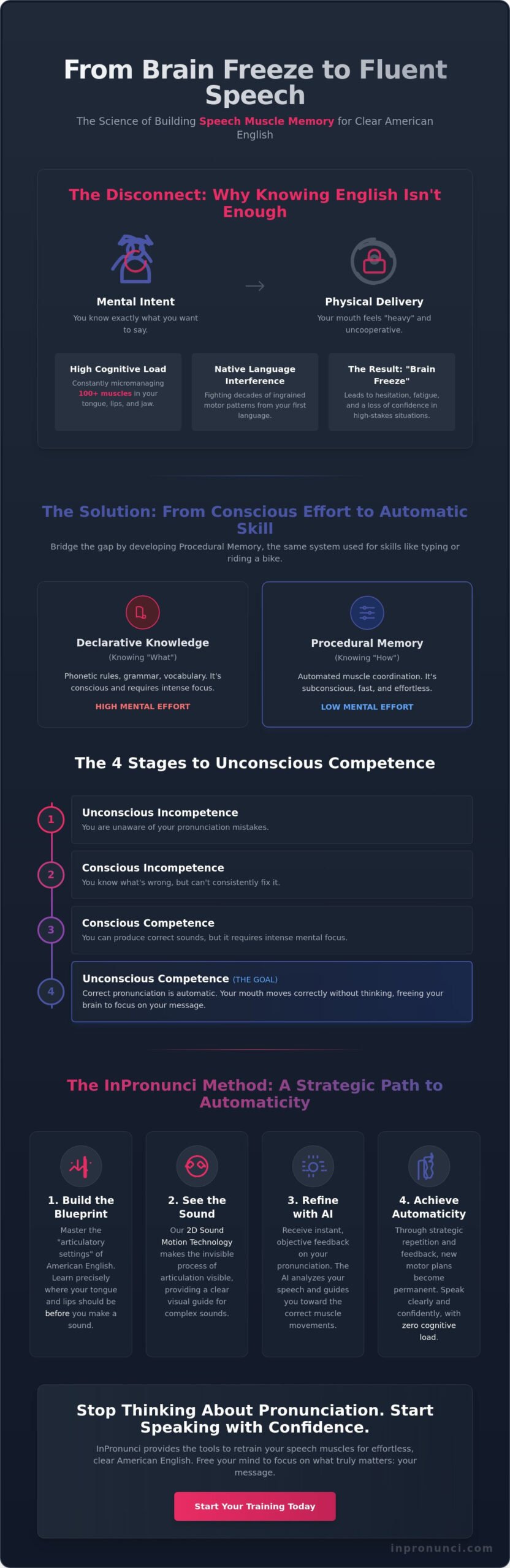
Why does your mouth feel heavy and uncooperative during a long meeting, even when you know exactly what you want to say in your head? Many international professionals find that mental fatigue sets in quickly because they’re constantly micromanaging their tongue and lips. It’s a common struggle where your mental intent doesn’t match your physical delivery, leading to that dreaded “brain freeze” during high-stakes conversations.
The solution isn’t more grammar study; it’s developing robust speech muscle memory. Research from 2024 in the Journal of Linguistics and Language Teaching highlights that automating motor processes is the key to speech accuracy. You’ll discover how to transition from “thinking about English” to “speaking English” by building the physical habits required for a clear American accent. We’ll explore how InPronunci combines 2D Sound Motion Technology with AI pronunciation feedback to help you achieve automaticity and reduce your cognitive load while speaking.
What is Speech Muscle Memory in Language Acquisition?
Speaking a language with clarity is not merely a cognitive exercise in grammar and vocabulary. It is a complex physical feat. When you speak, your brain must coordinate over 100 muscles across your tongue, lips, jaw, and throat with millisecond precision. This coordination relies on procedural memory, the same system that allows you to ride a bicycle or type on a keyboard without looking at your hands. In scientific terms, this process is known as motor learning, where the nervous system develops a permanent change in the ability to execute a movement.
Many professionals understand the phonetic rules of American English but struggle to apply them during a live presentation. This happens because there is a massive gap between declarative knowledge (knowing that the “th” sound requires the tongue between the teeth) and the actual execution of that sound. The cerebellum, a region at the base of your brain, is responsible for storing these sequences. Without developing speech muscle memory, your brain remains stuck in a loop of conscious correction, which leads to hesitation and fatigue.
The Transition from Conscious to Subconscious Speech
Mastering a new accent follows four distinct stages of competence. You begin with unconscious incompetence, where you don’t realize which sounds are incorrect. As you start training, you move into conscious competence, where you can produce the correct sound but only if you focus intensely on it. The ultimate goal is unconscious competence, where your physical habits take over. Speech muscle memory is the physical automation of articulatory patterns. Once these patterns are automated, your brain can finally stop worrying about “how” to move your mouth and focus entirely on “what” you are communicating to your audience.
Why Your Native Language Habits Interfere
Your mouth has spent decades practicing the specific “articulatory settings” of your native language. These are the default resting positions of your jaw and tongue. For example, some languages require a very relaxed tongue, while American English often demands a higher degree of muscle tension and specific tongue retraction for sounds like the American “r.” These old habits become fossilized, creating a sense of physical resistance when you try to adopt new positions. Many learners describe their mouth feeling “heavy” or “clumsy” because they are fighting years of ingrained motor plans. To overcome this, you must strategically retrain these muscles. You can explore the methodology behind this on the official InPronunci website, where we focus on breaking these native language barriers through precise physical isolation.
The Articulatory Mechanics: How Your Mouth Remembers Sounds
Repetition without a strategic plan is often just a way to practice mistakes. To build reliable speech muscle memory, you first need a high-definition map of your vocal tract. This is what we call the “Blueprint” phase. By engaging in articulatory phonetics training, you learn exactly where each muscle needs to move before you ever make a sound. It’s about moving from guesswork to strategic precision, ensuring your jaw, lips, and tongue work as a single coordinated unit. When these components move in harmony, the distinct resonance of American English becomes much easier to maintain.
A primary research study published by the National Institutes of Health (NIH) on speech motor learning confirms that the brain requires consistent sensory feedback to refine these movements. This is where proprioception comes in. It’s your internal sense of where your tongue and jaw are positioned in space without needing a mirror. When you can feel the sides of your tongue touching your upper molars for an American “R” or the tip of your tongue lightly grazing your teeth for a “Th,” you’ve established an “anchor point.” These anchors serve as physical landmarks that ensure your pronunciation remains consistent, even during a high-pressure presentation or a long medical shift.
Understanding these mechanics allows you to move beyond simple imitation. Instead of just trying to sound like a native speaker, you are learning the physical architecture of the sound itself. This structural approach is why we emphasize speech-organ training tools like 2D Sound Motion Technology. It trains the movement of speech organs, making the hidden process of articulation manageable.
Mapping the American Soundscape
High-value sounds like the American “R” or the “Th” clusters require unique coordination. Many learners struggle because they try to replicate the sound by ear alone. However, visual mapping is essential. You need to see how the tongue bunches or stretches to create the correct resonance. Once the brain has a clear motor plan, the transition from hearing a sound to physically replicating it becomes much smoother. This visual-first approach is a core part of the InPronunci methodology.
The Precision of Enunciation
Strategic enunciation acts as a calibration tool for your muscles. If you practice with “lazy” muscles, your speech will inevitably sound muddled. The fastest way to achieve natural, fast speech is actually to start slow. Exaggerated movements help your brain record the full range of motion required for American vowels. By over-training these movements initially, you ensure that your muscles can perform them effortlessly at normal conversation speeds. If you’re ready to start this calibration, you can explore the tools on the official InPronunci website.
Overcoming Cognitive Load: Why Knowledge Doesn’t Equal Fluency
Many international professionals experience a specific type of exhaustion after a long workday in English. This isn’t just social fatigue; it’s the result of a high speech cognitive load. When you haven’t yet automated your articulation, your brain must manually oversee every movement of your tongue and jaw. This creates a mental bottleneck. If your brain is using 70% of its processing power just to manage the physical mechanics of speech, you only have 30% left to focus on your negotiation strategy or technical explanations.
This is where speech muscle memory acts as a vital compression algorithm for your mind. By offloading the physical work of speaking to the procedural memory system, you free up cognitive resources for higher-level thinking. Knowledge of English rules is static, but fluency is dynamic. Real-world success depends on your ability to execute these rules without thinking about them. Without this automation, even the most prepared speaker can feel their clarity slip away during a high-stakes moment.
The Stress Test of Professional Communication
Have you ever noticed that your accent becomes more pronounced during an interview or a presentation? Under stress, the brain’s executive function is taxed by cortisol and anxiety. If your pronunciation habits aren’t resilient, they are the first thing to break. Building resilient muscle memory requires practicing in a way that mimics real-world pressure. It’s also deeply tied to physical relaxation. A tight jaw or a tense throat, common during stress, physically prevents the tongue from reaching the necessary anchor points for clear American vowels. Training with the InPronunci app helps you maintain this precision even when the stakes are high.
Breaking the ‘Translation’ Habit
Fluency is often blocked by the “translation gap,” where the speaker mentally translates a sentence before saying it. Muscle memory helps you bypass this phase by creating a direct path from thought to physical sound. This is especially true when you master rhythmic intonation. American English follows a specific stress-timed rhythm that acts as a physical framework for your words. When your muscles learn the “beat” of the language, the individual sounds fall into place more naturally. Achieving this “flow” is not just a linguistic milestone; it is a physical accomplishment that allows you to sound composed and professional in any environment.
Strategic Exercises for Building Lasting Speech Muscle Memory
Building speech muscle memory isn’t about talking more; it’s about moving better. If you practice incorrectly, you simply fossilize your errors, making them harder to correct later. Effective training follows a specific sequence of motor learning that moves from isolation to automation. This strategic approach ensures that your muscles record the correct patterns from the very first rep.
- Step 1: Isolate the sound. Use visual models to confirm your motor plan is accurate before you engage your vocal cords.
- Step 2: Slow-Motion Articulation. Perform the movement at 25% speed to build intense proprioceptive awareness of muscle tension.
- Step 3: Incremental speed. Gradually increase your pace only when the sound remains “clean” and effortless.
- Step 4: Contextual integration. Move the isolated sound into high-frequency professional phrases to simulate real-world use.
- Step 5: Real-time feedback. Use AI pronunciation feedback to catch small deviations before they become permanent habits.
The Power of Visual-Motor Training
Training the movement of the speech organs is far more effective than just listening. Sound is hard to grasp, but movement can be trained. By using 2D Sound Motion Technology, you train the exact positioning of the tongue and lips, which takes the guesswork out of practice. We often recommend “silent practice,” where you go through the motions of speaking without making a sound. This allows you to focus purely on the physical sensation of your mouth. Mental rehearsal is the dry run for physical speech.
High-Frequency Professional Drills
For tech and healthcare professionals, certain phonetic clusters appear constantly in daily communication. Phrases like “system architecture,” “patient history,” or “quarterly results” require specific coordination that your native language might not have prepared you for. We use the “Over-Articulation” technique to strengthen the muscles that feel “heavy” or “uncooperative.” This isn’t how you’ll speak in a meeting, but it’s how you build the strength to speak clearly when it matters most. You can engage in strategic pronunciation practice to bridge the gap between these drills and your actual workplace conversations.
Visit the official InPronunci website to learn more about how our structured exercises can help you build the physical habits needed for professional American English fluency.
Accelerating Fluency with InPronunci’s 2D Sound Motion Technology
Traditional pronunciation apps often fail because they rely solely on audio repetition. If you can’t hear the subtle difference between two similar vowels, you’re essentially practicing in the dark. InPronunci changes this by training the hidden movements directly. Our 2D Sound Motion Technology trains how speech organs move to create specific American sounds. This technology trains the full articulation of each sound, including the exact positioning of the tongue, lips, and jaw. By combining this speech-organ training with auditory practice, you build speech muscle memory much faster than through listening alone.
Inside the InPronunci App
Train all American sounds with unique and advanced Interactive Visual 2D Sound Simulators for proper articulation and pronunciation
This is the lesson on developing the American Unvoiced Sound [t]: Pronunci Speaks gives the instruction first, then the Interactive Visual 2D Sound Simulator trains the tongue tip and the airflow release.
- EffectiveMost apps offer visual learning. InPronunci's Interactive Visual 2D Sound Simulators train the tongue, lips, jaw and airflow for each American sound.
- ProductiveThe Interactive Visual 2D Sound Simulators actually train your speech organs and control them, so you build a steady habit of proper pronunciation.
- ResultsStudents pronounce individual American sounds with almost native-like pronunciation.
A structured curriculum is essential for long-term retention. Random practice leads to random results. InPronunci provides a strategic path that moves from basic phonetic exercises to complex professional narratives. This methodology ensures you aren’t just memorizing words, but are instead mastering the underlying physical mechanics of the American accent. This structured approach helps you achieve the following outcomes:
- Visual Clarity: See the exact movement of speech organs to remove guesswork from your practice.
- Habit Prevention: Use real-time feedback to stop native language interference before it becomes fossilized in your speech.
- Progressive Mastery: Move from isolated sounds to professional fluency through a logical, step-by-step curriculum.
- Reduced Fatigue: Build the automaticity needed to speak for hours without mental or physical exhaustion.
The Role of the AI Accent Coach
The InPronunci App includes an AI Accent Coach that provides consistent, objective AI pronunciation feedback. This AI support doesn’t replace human instruction; it enhances it by providing the high-frequency feedback necessary for motor learning. Research from May 2026 suggests that sensory brain processes are the primary drivers for retaining new speech movements. By providing both visual and auditory data, our AI helps “lock in” these new patterns. The app tracks your daily progress, showing exactly how close you are to reaching articulatory automaticity in your professional field.
From Training to Real-World Confidence
When your speech becomes a physical habit, your professional presence changes. You no longer need to pause to find the right mouth position during a high-stakes negotiation. This psychological shift is the true goal of accent training. Building robust speech muscle memory is a strategic investment in your professional identity, allowing your expertise to shine without the barrier of unclear communication. Whether you’re a surgeon in a busy hospital or a developer leading a global team, clarity is your most important tool. Visit the official InPronunci website to learn more about the app, or create your student account on the InPronunci learning platform to start practicing American pronunciation.
Transforming Your Strategic Communication
Mastering a clear American accent is a deliberate process of physical refinement. By focusing on speech muscle memory, you move beyond the exhaustion of mental translation and into the ease of natural articulation. You now understand that clarity isn’t a talent you’re born with; it’s a skill you build through precise, articulation-based training. The combination of 2D Sound Motion Technology and AI-driven feedback provides the structural support needed to turn technical knowledge into a lasting physical habit.
This methodology, developed as a structured curriculum by Prof. Alex, Ph.D. Accent Coach, ensures that every minute of your practice contributes to professional automaticity. It’s time to stop overthinking your pronunciation and start speaking with the confidence your expertise deserves. Visit the official InPronunci website to learn more about the app, or create your student account on the InPronunci learning platform to start practicing American pronunciation.
Your voice is your most powerful tool in the global market. With the right strategy and consistent practice, you’ll find that clear, effortless communication is well within your reach.
Questions & Answers
Frequently Asked Questions
01How long does it take to build speech muscle memory for a new accent?
It typically takes 3 to 6 months of consistent, daily practice to see a permanent shift in your physical habits. According to motor learning research from 2024, the brain needs approximately 66 days to automate a new complex movement. While you might notice initial improvements in just 30 days, deep speech muscle memory requires longer dedication to remain stable during high-pressure professional situations.
02Can I develop speech muscle memory as an adult non-native speaker?
Yes, adults can absolutely retrain their speech organs through the power of neuroplasticity. While children learn through immersion, adults benefit more from a strategic, speech-organ approach to training. By using tools like 2D Sound Motion Technology, adults can consciously map out movements that were previously unconscious. This allows them to bypass native language interference and build new articulatory habits with professional precision.
03Why does my accent get worse when I am tired or stressed?
Your accent becomes more pronounced because stress increases your speech cognitive load, leaving less mental energy for manual speech control. When you haven’t yet automated your pronunciation, your brain has to micromanage your tongue and lips. Under pressure or fatigue, the brain prioritizes the message over the mechanics. This causes you to fall back on your oldest, most ingrained native language habits because they require less energy.
04Is repetition alone enough to change my pronunciation habits?
Repetition alone is often insufficient and can even be counterproductive if you are repeating errors. To change habits effectively, you need mindful repetition combined with real-time feedback. Without an AI pronunciation feedback system or human guidance, you might accidentally fossilize incorrect movements. Strategic training requires you to isolate the sound and confirm the correct motor plan before you begin any repetitive drills.
05What is the difference between linguistic knowledge and speech muscle memory?
Linguistic knowledge is knowing what the rules are, while speech muscle memory is the ability to execute those rules automatically. You might know that the American “R” requires a bunched tongue position, but if your muscles can’t find that position during a fast conversation, you lack the procedural memory. Knowledge lives in the cortex, while muscle memory is stored in the cerebellum for effortless, subconscious use.
06How does 2D Sound Motion Technology help with muscle memory?
2D Sound Motion Technology trains the speech organs, developing the hidden movements of speech. By learning exactly how the tongue and jaw should move through training, you build a stronger understanding of the motor plan. This connection between speech-organ training and listening accelerates the learning process. It helps you find the correct anchor points in your mouth much faster than you would by listening to audio samples alone.
InPronunci training structure
How InPronunci trains the American speech system
InPronunci trains the full American speech system: Interactive Visual 2D Sound Simulators and phonetic exercises for articulation and American sound development, sentence practice for intonation, melody, rhythm, and connected speech, paragraph practice for spontaneous speech, public speaking, and real communication confidence, and Advanced AI Accent Coach evaluation as you speak.
InPronunci is an advanced, linguistically structured American accent training platform with more than 1,000 downloads and a growing learner base. It is designed for serious ESL learners who want American pronunciation, stronger intonation, more natural rhythm, better connected speech, and the ability to speak English more confidently in real communication. The program is especially useful for intermediate and advanced English speakers who want to become independent speakers of English with confident communication, stronger speaking control, long-term speech improvement, and great public speaking skills. It is also designed for advanced speakers whose goal is to speak like a native or closer to native-like American speech, including people who were raised in the United States but still have slight accent patterns from the native language they were born with. It is a complete American accent training course and system created by Prof. Alex, Ph.D. Accent Coach, Doctor of Education, and professional linguist based in Austin, Texas, with Pronunci Instructions from Prof. Alex for each lesson that make self-learning more effective, supported, and clear.
Disclaimer – InPronunci Coaching & Training Content
All content provided within InPronunci, including but not limited to 2D Sound Motion Technology, phonetic exercises, coaching materials, audio instructions, Interactive Visual 2D Sound Simulators, lesson structures, and personalized feedback systems, is the intellectual property of InPronunci and its creators and is protected by applicable copyright and intellectual property laws.
The coaching exercises and training methodologies are designed exclusively for personal educational use within the InPronunci platform. Users are granted a limited, non-transferable license to access and use the materials for individual learning purposes only.
Any reproduction, distribution, modification, recording, sharing, or commercial use of InPronunci content without prior written permission is strictly prohibited. This includes, but is not limited to, copying coaching exercises, redistributing training materials, or replicating the methodology in other platforms or products.
InPronunci is a guided pronunciation training system intended to support language development. While the program is designed to improve pronunciation, fluency, and speech clarity, individual results may vary depending on practice, consistency, and learner background.
By using InPronunci, users agree to respect all intellectual property rights and comply with these terms of use.
Plans
What InPronunci costs
InPronunci Basic
$35 per month
Chapter 1 is free after signup.
InPronunci Premium
$200 per month
Includes a coach: