


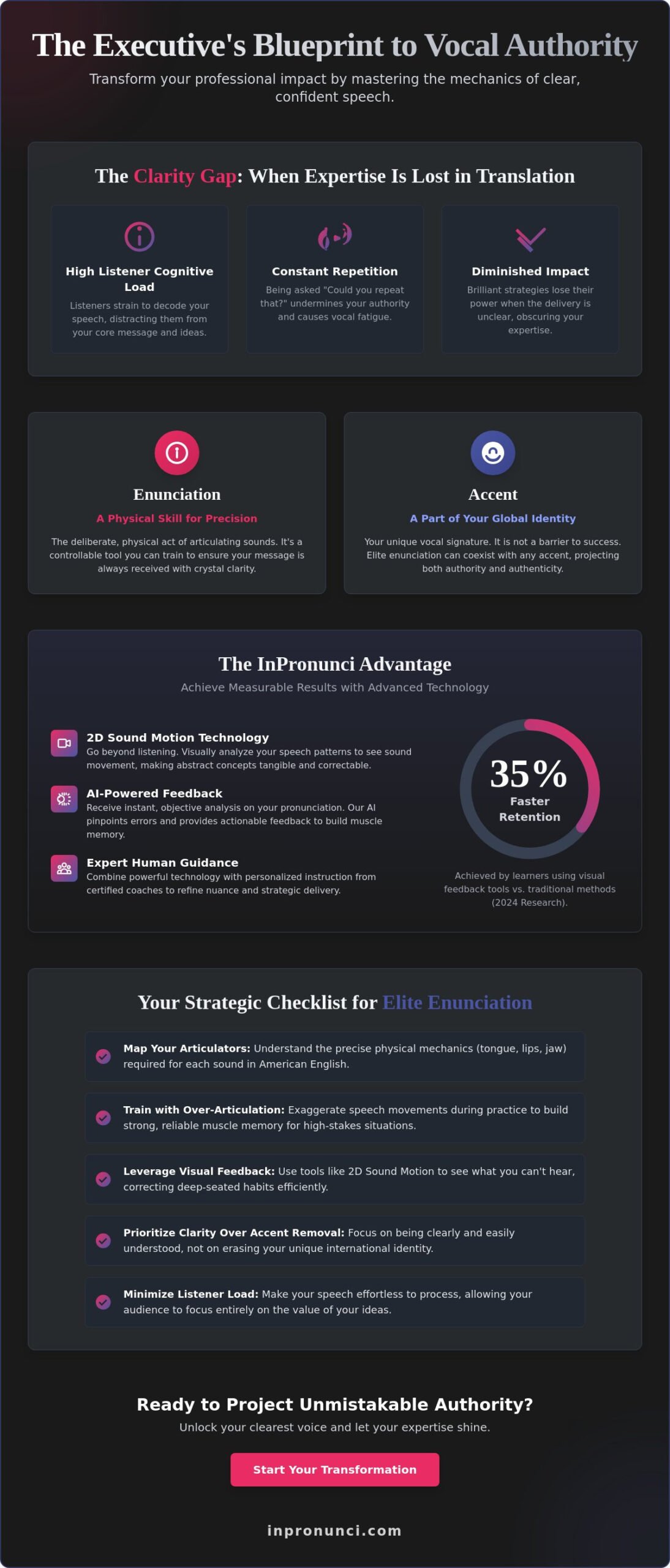
What if the hidden barrier to your next leadership role isn’t your technical expertise, but the mental energy your colleagues spend trying to decode your speech? It’s exhausting to watch a brilliant strategy lose its impact because you’re asked to repeat yourself three times in a single board meeting. You’ve likely felt that your enunciation sometimes obscures your professional authority, leading to vocal fatigue as you struggle to be heard. Research from 2024 shows that learners using speech-organ training feedback tools achieve 35% faster retention than those in traditional settings, proving that clarity is a skill you can master.
This article provides a strategic checklist to help you achieve professional precision without sounding robotic or losing your unique voice. You’ll learn how to reduce the cognitive load on your listeners and build genuine confidence in high-stakes communication. We’ll examine how InPronunci combines 2D Sound Motion Technology with AI feedback and human-based instruction to help you project the clarity your expertise deserves.
What is Enunciation? Understanding Clarity in a Professional Context
Precision is the hallmark of a high-level strategist. While many people use the terms “speaking” and “enunciating” interchangeably, they represent two different levels of communication. Enunciation is the physical act of articulating individual sounds with precision. It’s the deliberate coordination of your speech organs to ensure every syllable is distinct and audible. When you focus on your enunciation, you aren’t just making noise; you’re managing the physical mechanics of speech production to deliver a clear, professional message.
For an international audience, clear speech is the foundation of professional authority. If a listener has to strain to understand your words, their focus shifts from your ideas to the mechanics of your voice. This creates a high listener cognitive load, which is the mental effort required to process your speech. By mastering enunciation, you effectively save your audience’s energy, allowing them to focus entirely on your expertise and strategy. This efficiency builds immediate trust and positions you as a leader who values the time and attention of others.
The Role of Clarity in Career Advancement
In high-stakes environments like tech and healthcare, a “clarity gap” often exists between a professional’s technical knowledge and their perceived leadership. Research from 2024 suggests that learners who use speech-organ training feedback tools can achieve 35% faster retention than those in traditional settings. This data highlights that clarity is a physical habit, not a fixed trait. Focusing on enunciation is a much more professional and attainable goal than the outdated concept of “accent removal.” It’s about being understood the first time, which directly correlates with how colleagues perceive your competence and readiness for promotion. You can learn more about this methodology on the official InPronunci website.
Why Enunciation Differs from Accent
It’s a common misconception that a “heavy” accent prevents professional clarity. In reality, you can maintain your unique international accent and still possess elite enunciation. The goal isn’t to sound like a native speaker; it’s to ensure the clarity of the message is never lost. Consider a global CEO with a distinct French or Indian accent. They’re often highly effective because they’ve mastered the physical execution of sounds, ensuring every word lands with intent. They don’t mumble. They don’t rush. They use their articulators to project confidence, proving that your accent is part of your identity, while your enunciation is a tool for your success.
The Mechanics of Precision: How Your Speech Organs Create Clarity
Elite communication is a physical performance. To master enunciation, you must view your speech not as a collection of abstract ideas, but as a series of precise physical movements. This is where articulatory phonetics training serves as your strategic blueprint. It provides the exact coordinates for every sound you produce. By understanding how your tongue, lips, teeth, and soft palate work together, you transform speech from an unconscious habit into a controlled, professional skill.
Each sound in the English language requires a specific configuration of these articulators. For example, the difference between a clear “th” sound and a muffled “d” is often just a few millimeters of tongue placement. When you understand these mechanics, you gain the ability to troubleshoot your own speech in real time. This level of enunciation is what separates a professional who merely speaks from one who truly communicates with intent and authority.
Muscle Memory and Articulatory Phonetics
Training your voice is remarkably similar to athletic training. It’s about building physical coordination. Often, your brain knows exactly how a word should sound, yet your mouth seems to mumble it. This happens because the neural pathways for those specific movements aren’t strong enough yet. To bridge this gap, you must practice over-articulating during your training sessions. By exaggerating the movements of your jaw and lips, you create deeper speech muscle memory. This ensures that when you’re in a high-pressure meeting, your body defaults to clarity even when you’re focused on your data.
2D Sound Motion: Training Clarity
Listening to your own voice is rarely enough to correct deep-seated habits. InPronunci’s 2D Sound Motion Technology changes the game by training sound movement directly. This speech-organ training is crucial. Learners who train their speech organs retain new sounds faster than those relying on traditional audio methods. Training the exact position of the tongue helps you understand the physical “why” behind a sound. It removes the guesswork.
Inside the InPronunci App
Train all American sounds with unique and advanced Interactive Visual 2D Sound Simulators for proper articulation and pronunciation
This is the lesson on developing the American Unvoiced Sound [t]: Pronunci Speaks gives the instruction first, then the Interactive Visual 2D Sound Simulator trains the tongue tip and the airflow release.
- EffectiveMost apps offer visual learning. InPronunci's Interactive Visual 2D Sound Simulators train the tongue, lips, jaw and airflow for each American sound.
- ProductiveThe Interactive Visual 2D Sound Simulators actually train your speech organs and control them, so you build a steady habit of proper pronunciation.
- ResultsStudents pronounce individual American sounds with almost native-like pronunciation.
When you combine this technology with AI pronunciation feedback, you create a consistent, daily practice routine that yields sustainable results. This hybrid approach ensures you aren’t just guessing if you’re correct; you’re following a structured, visual path to clarity. You can explore these tools further on the official InPronunci website to see how visual learning can accelerate your progress.
Enunciation vs. Pronunciation: Navigating the Nuances
To reach elite levels of clarity, you must first understand a critical distinction. Pronunciation is the “what”—the mental knowledge of which sounds and syllables a word contains according to the dictionary. Enunciation, however, is the “how”—the physical execution of those sounds with sharpness and precision. It’s entirely possible to pronounce a word correctly while still failing to communicate clearly because of mumbling or lazy articulation. For the international professional, mastering pronunciation is only half the battle; the real impact lies in the physical delivery.
Primary failures in professional speech often stem from vowel blurring and consonant dropping. When you blur your vowels, your words lose their shape. When you drop consonants, especially at the end of words, your sentences lose their structure. Total communication mastery requires a synergy between linguistic knowledge and physical control. Without this balance, even the most brilliant strategy can be lost in a sea of muffled syllables.
The Correct Sound vs. The Clear Sound
Consider the word “Internet.” A standard American pronunciation often sounds like “Inner-net,” where the middle “t” is softened or omitted. While this is linguistically “correct” in casual settings, professional enunciation requires more intent. In a high-stakes presentation, clearly hitting that “t” can add a layer of crispness that projects authority. The ultimate test for many non-native speakers is the final consonant cluster. Words like “tests,” “tasks,” or “projects” require specific, deliberate tongue movements to avoid sounding like “tess” or “tass.” Lazy speech patterns like these can subtly chip away at your professional credibility over time.
Reducing Cognitive Load for Your Audience
Every time you speak, your listener’s brain performs a silent task: decoding your sounds. This mental effort is known as cognitive load. If your speech is muffled, your colleagues must spend extra energy “autocorrecting” your words in their heads. This leaves them with less mental capacity to actually process your ideas. Precision in your speech reduces this processing time significantly. By providing clear sounds, you make it easy for your audience to follow your logic. It’s a sign of profound respect for your listener’s time and attention. Understanding how to manage speech cognitive load is essential to eliminating this communication fatigue and projecting genuine authority. You can find more strategies for reducing this load on the official InPronunci website.
The Ultimate Enunciation Checklist for International Professionals
Excellence in communication isn’t accidental; it’s the result of a deliberate, repeatable process. Before you enter a high-stakes negotiation or a technical briefing, you need a reliable way to ensure your physical delivery remains sharp. Benchmarking your current clarity with a strategic tool like the English accent test is the first step in identifying where your enunciation may be faltering under pressure. This diagnostic provides the data you need to move from general speaking to precise articulation.
A professional checklist acts as a mental guardrail. It ensures that even when you’re focused on complex data or emotional narratives, your speech organs continue to perform with precision. Use these checks before every major interaction to reduce listener cognitive load and project authority:
- The Opener Check: Have I practiced the first three sentences of my presentation to ensure my jaw is moving freely?
- The Terminology Check: Can I clearly articulate the technical keywords of my industry without blurring the internal consonants?
- The Benchmark Check: Have I used AI pronunciation feedback today to calibrate my ear to the correct sounds?
Daily Habits for Vocal Precision
Precision starts with the ‘Consonant Pop.’ This involves ensuring that plosive sounds like ‘t’, ‘p’, and ‘k’ are crisp and audible. Without this sharp finish, your words bleed into one another, making it difficult for colleagues to distinguish between similar terms. Vowel separation is equally vital. In rapid speech, it’s easy to ‘merge’ distinct vowel sounds, which can change the meaning of a word entirely. Finally, monitor your jaw relaxation. Speech-organ training helps learners release facial tension that restricts their range of motion. A relaxed jaw is the engine of clear speech.
Strategic Pausing and Pacing
Silence is a strategic asset. The ‘Comma Pause’ involves using brief moments of silence to let your most important keywords resonate with the audience. It gives their brains time to process your expertise. You must also maintain volume control throughout your entire thought. Many professionals let their voices ‘fade out’ at the end of a sentence, which is often where the most critical information is delivered. Practice in front of a mirror to ensure your mouth is physically moving enough to create these sounds. If you can’t see the movement, your audience won’t hear the clarity. To master these physical habits, visit the official InPronunci website and explore our human-guided phonetic exercises.
Elevating Your Speech with InPronunci’s AI Accent Coach
Mastering enunciation is a long-term commitment to physical precision. While the checklist provided earlier gives you a mental framework, the InPronunci app provides the daily infrastructure to turn those checks into unconscious habits. It’s the ultimate synthesis of AI pronunciation feedback and human-led instruction. The AI serves as your 24/7 coach, providing the consistency needed for speech muscle memory training, while human-based guidance helps you master the nuances of rhythm and authoritative intonation. This hybrid approach ensures you aren’t just practicing; you’re practicing correctly every single time.
AI supports, but does not replace, the human element of communication. While the technology handles the repetitive phonetic exercises, our human instructors focus on the “soul” of your speech. They help you understand the strategic narrative and emotional resonance required for leadership. This combination allows you to build a foundation of clarity while developing the sophisticated communication style needed for high-level professional success.
Real-Time Feedback and Visual Learning
The AI Accent Coach identifies specific articulatory missteps instantly. Instead of wondering why a sound feels “off,” you get immediate data on your tongue placement and jaw movement. This is particularly beneficial when you’re mastering American sounds that don’t exist in your native language. By practicing in this low-stakes environment, you can experiment with your voice and make mistakes without any professional risk. This iterative, data-driven practice builds a level of physical confidence that audio-only methods simply cannot match. Research from 2024 shows that this speech-organ training feedback accelerates retention by 35%, making your training sessions significantly more efficient.
Transitioning to Real-World Confidence
The ultimate goal of any training is the successful transition from “app practice” to “boardroom performance.” You don’t need to aim for a perfect, native-like accent to be effective. Instead, set realistic goals focused on clarity and the reduction of listener cognitive load. When you know your physical mechanics are sound, your anxiety levels drop. This allows you to focus entirely on your strategy and the people in the room. You’ll find that as your enunciation improves, your colleagues will stop asking you to repeat yourself, and start focusing on the value of your ideas. This shift in perception is the true measure of communicative success.
Visit the official InPronunci website to learn more about the app, or create your student account on the InPronunci learning platform to start practicing American pronunciation.
Securing Your Communicative Edge in 2026
The strategic mastery of your speech is no longer a luxury in a globalized economy; it’s a fundamental requirement for leadership. By shifting your focus from simple pronunciation to precise enunciation, you’ve taken the first step toward reducing listener cognitive load and projecting undeniable authority. You now understand that clarity is a physical habit built through muscle memory and the deliberate coordination of your speech organs. Research from 2024 proves that this physical approach, supported by speech-organ training feedback, accelerates retention by 35% compared to traditional methods.
The curriculum designed by Prof. Alex, Ph.D. Accent Coach provides the scientific foundation for this transformation. With unique 2D Sound Motion Technology and AI-driven real-time feedback, you have the tools to train and perfect every sound. This modern approach ensures your expertise is never obscured, allowing your strategic vision to remain the center of attention in any professional setting. Use your voice with precision to ensure your message always resonates with the weight it deserves.
Questions & Answers
Frequently Asked Questions
01What is the main difference between enunciation and pronunciation?
Pronunciation is the mental knowledge of a word’s correct sounds, while enunciation is the physical act of articulating those sounds with clarity. You can know exactly how a word should sound according to the dictionary but still fail to communicate if your delivery is lazy or muffled. Think of it as the difference between reading music on a page and actually playing the notes with precision on a physical instrument.
02Can I improve my enunciation without losing my natural accent?
You can definitely achieve elite clarity while maintaining your unique international accent. The goal is to ensure your message is understood the first time, not to erase your identity. By focusing on articulatory precision, you reduce the cognitive load on your listeners. Many global leaders speak with distinct accents but use sharp enunciation to project authority and expertise in high-stakes professional environments.
03Why do I mumble even when I know the correct way to say a word?
Mumbling usually happens because your speech muscle memory hasn’t been trained for specific movements. Your brain understands the word, but your articulators, such as your tongue and jaw, lack the coordination to execute it sharply. Using 2D Sound Motion Technology trains these movements, turning abstract sounds into physical actions. Repetitive, correct practice builds the neural pathways needed to stop mumbling and start speaking with intent.
04How long does it take to see noticeable improvements in speech clarity?
Most professionals see noticeable improvements within 30 to 60 days of consistent daily practice. Research from 2024 shows that learners using speech-organ training feedback tools achieve 35% faster retention than those in traditional tutoring settings. The key is frequency. Practicing for 15 minutes every day with AI pronunciation feedback is more effective than a single long session once a week because it builds sustainable muscle memory. You can learn more about this on the official InPronunci website.
05Is it better to practice enunciation with an AI app or a human coach?
A hybrid approach is the best strategy for professional growth. An AI app provides the daily consistency and real-time feedback needed for phonetic exercises and muscle memory. However, a human coach is essential for mastering complex rhythm and authoritative intonation. AI supports the physical foundation, while human-based instruction helps you apply those skills to boardroom presentations and leadership scenarios.
06What are the most common enunciation mistakes for ESL speakers in tech?
The most frequent errors include dropping final consonant clusters and blurring vowels in technical terminology. For example, failing to articulate the “ts” in “scripts” or the “ks” in “tasks” can lead to confusion during briefings. These small articulatory missteps increase the listener’s mental effort. Professionals in tech and healthcare often benefit when they create your InPronunci student account to isolate and practice these high-impact sounds for better workplace clarity.
InPronunci training structure
How InPronunci trains the American speech system
InPronunci trains the full American speech system: Interactive Visual 2D Sound Simulators and phonetic exercises for articulation and American sound development, sentence practice for intonation, melody, rhythm, and connected speech, paragraph practice for spontaneous speech, public speaking, and real communication confidence, and Advanced AI Accent Coach evaluation as you speak.
InPronunci is an advanced, linguistically structured American accent training platform with more than 1,000 downloads and a growing learner base. It is designed for serious ESL learners who want American pronunciation, stronger intonation, more natural rhythm, better connected speech, and the ability to speak English more confidently in real communication. The program is especially useful for intermediate and advanced English speakers who want to become independent speakers of English with confident communication, stronger speaking control, long-term speech improvement, and great public speaking skills. It is also designed for advanced speakers whose goal is to speak like a native or closer to native-like American speech, including people who were raised in the United States but still have slight accent patterns from the native language they were born with. It is a complete American accent training course and system created by Prof. Alex, Ph.D. Accent Coach, Doctor of Education, and professional linguist based in Austin, Texas, with Pronunci Instructions from Prof. Alex for each lesson that make self-learning more effective, supported, and clear.
Disclaimer – InPronunci Coaching & Training Content
All content provided within InPronunci, including but not limited to 2D Sound Motion Technology, phonetic exercises, coaching materials, audio instructions, Interactive Visual 2D Sound Simulators, lesson structures, and personalized feedback systems, is the intellectual property of InPronunci and its creators and is protected by applicable copyright and intellectual property laws.
The coaching exercises and training methodologies are designed exclusively for personal educational use within the InPronunci platform. Users are granted a limited, non-transferable license to access and use the materials for individual learning purposes only.
Any reproduction, distribution, modification, recording, sharing, or commercial use of InPronunci content without prior written permission is strictly prohibited. This includes, but is not limited to, copying coaching exercises, redistributing training materials, or replicating the methodology in other platforms or products.
InPronunci is a guided pronunciation training system intended to support language development. While the program is designed to improve pronunciation, fluency, and speech clarity, individual results may vary depending on practice, consistency, and learner background.
By using InPronunci, users agree to respect all intellectual property rights and comply with these terms of use.
Plans
What InPronunci costs
InPronunci Basic
$35 per month
Chapter 1 is free after signup.
InPronunci Premium
$200 per month
Includes a coach: