

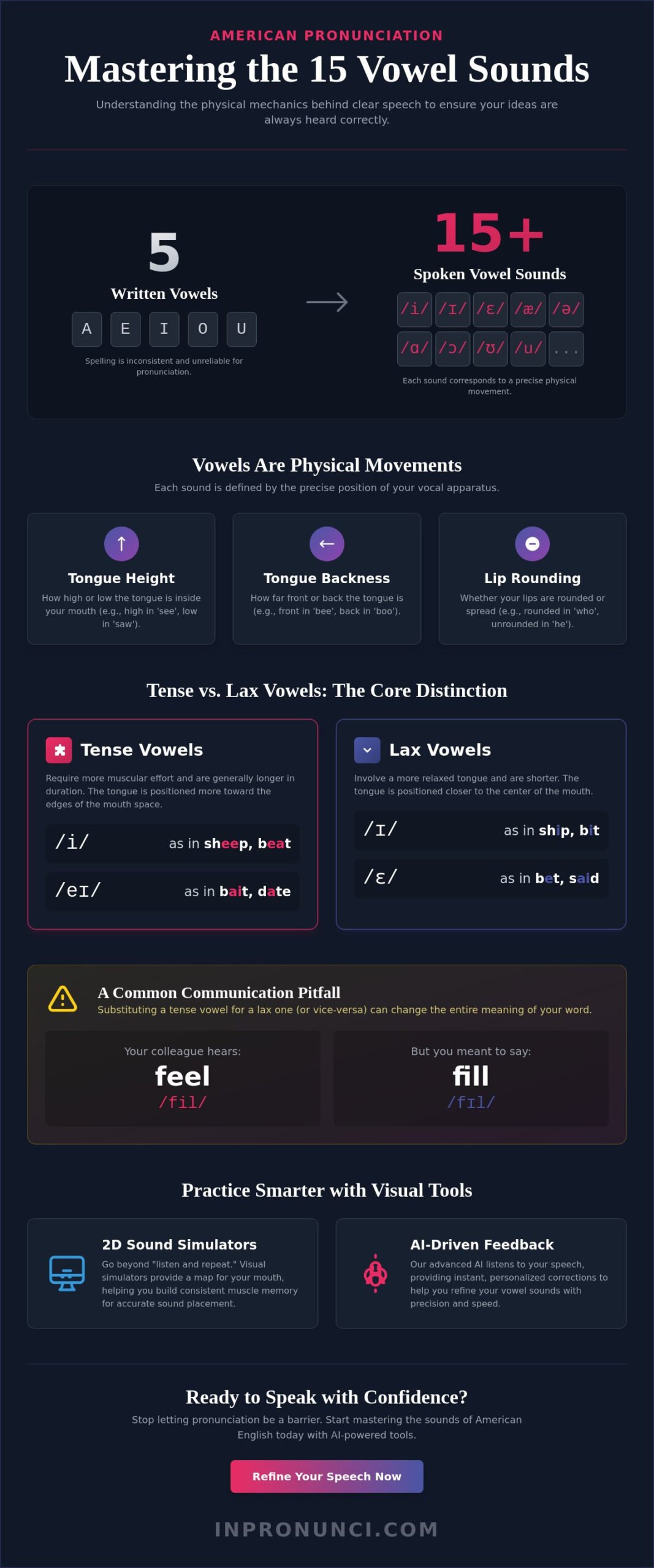
Last Tuesday, a senior analyst named Elena found herself repeating the word “fill” three times during a budget review because her colleagues kept hearing “feel.” This specific phonetic confusion affects a significant number of professionals, as the 15 American vowels rely on anatomical precision that’s rarely taught in traditional language courses. Mastering these sounds isn’t about erasing your background; it’s about gaining the physical control needed to ensure your ideas are heard correctly the first time.
You probably recognize that sinking feeling when a simple word choice creates a sudden communication barrier. It’s a shared experience for many, but it doesn’t have to be a permanent one. This article is designed to help you understand the physical mechanics behind clear speech so you can communicate with greater confidence. We’ll look at the 15 essential vowel sounds, explore the pivotal role of the “schwa,” and demonstrate how 2D Sound Simulators provide the visual clarity needed to develop consistent muscle memory.
Key Takeaways
- Understand why the American English phonetic system relies on 15 essential sounds and how their physical mechanics form the foundation of clear speech.
- Learn to distinguish between “lax” and “tense” American vowels by understanding the specific tongue and jaw positions required for each category.
- Identify common phonetic mergers that can cause professional communication pitfalls and learn the subtle differences between similar sounds like /ɪ/ and /ɛ/.
- Explore how 2D Sound Simulators provide a visual map for your mouth, offering a more sustainable alternative to traditional “listen and repeat” practice.
- Discover how AI-driven feedback is designed to support your progress by providing real-time corrections for more accurate vowel placement.
Understanding the American Vowel System and Why It Matters
American vowels function as the acoustic engine of English, providing the resonance and duration that consonants lack. While consonants provide the structure of a word, vowels act as the musical core that allows for pitch variation and rhythmic emphasis. Mastering these sounds is a prerequisite for anyone seeking to be understood in professional settings. Research in applied linguistics suggests that vowel errors often disrupt listener comprehension more significantly than consonant errors because they alter the fundamental shape and recognition of the word.
To better understand how these sounds function within the broader context of the language, watch this helpful video:
The complexity of this system stems from a significant numerical gap. English uses only five written vowel letters, yet speakers utilize over 15 distinct vowel sounds. This discrepancy is a primary feature of General American English phonology, where the length and quality of a vowel determine the word’s meaning. For instance, the difference between “ship” and “sheep” rests entirely on the nuanced positioning of the tongue and the tension of the facial muscles. Mastering American vowels requires a shift from reading letters to feeling the physical position of the vocal apparatus.
The Gap Between Spelling and Sound
English spelling is notoriously inconsistent. The letter combination “ough” alone can represent seven different vowel sounds, as seen in words like “though,” “through,” “rough,” and “thought.” This unpredictability makes visual learning unreliable. To solve this, linguists use the International Phonetic Alphabet (IPA), which assigns one unique symbol to each sound. Your native language also acts as a filter that might prevent you from hearing these differences. If your first language has only five vowels, your brain may naturally group two distinct English sounds into one category, making it harder to distinguish them without guided practice.
Vowels as Muscle Movements
It’s helpful to view vowels not as letters, but as physical muscle movements. Each sound is defined by three variables: tongue height, tongue backness, and lip rounding. This creates a “vowel space” within the mouth where tiny adjustments in the tongue’s position create entirely different sounds. Understanding this physical aspect is essential for progress. This is why resources dedicated to American sound system mastery focus on the mechanics of speech. By treating pronunciation as a physical skill, you can bypass the confusion of spelling and focus on the precise coordination required for clarity.
Categorizing the 15 Essential American Vowel Sounds
To understand American vowels, we must look at the physical geometry of the mouth. Linguists categorize these sounds based on tongue position (front, central, or back) and the degree of muscular tension used during production. Tense vowels, like the /i/ in “sheep,” require more effort and are usually longer in duration. Lax vowels, such as the /ɪ/ in “ship,” involve a relaxed tongue and shorter execution. This distinction is a primary reason why non-native speakers might be misunderstood, as substituting a tense vowel for a lax one can change the meaning of a word entirely.
Front Vowels: From High to Low
Front vowels are produced with the tongue pushed toward the front of the mouth. This group includes /i/ (beat), /ɪ/ (bit), /eɪ/ (bait), /ɛ/ (bet), and /æ/ (bat). The /æ/ sound is a low-front unrounded vowel that requires a significant jaw drop and a wide mouth position. Many learners find /æ/ challenging because it doesn’t exist in many other languages, often leading them to substitute it with a mid-vowel like /ɛ/. To master this, focus on keeping the tip of your tongue behind your bottom teeth while lowering your jaw further than you think is necessary. This physical adjustment is key to achieving the resonance associated with standard American English.
Back and Central Vowels
Back vowels typically involve some degree of lip rounding, which alters the resonance of the vocal tract. This category includes /u/ (boot), /ʊ/ (foot), /oʊ/ (boat), /ɔ/ (bought), and /ɑ/ (hot). While the back vowels require specific lip shapes, central vowels like /ʌ/ (but) and the unstressed /ə/ (schwa) rely on a neutral, relaxed position. The schwa is the most frequent and important sound in the English language. It acts as a placeholder for almost any vowel in an unstressed syllable, such as the ‘a’ in “sofa” or the ‘o’ in “computer.” Mastering the schwa helps you maintain the correct rhythm and stress patterns of American vowels. Tools like The Color Vowel Chart provide a helpful visual reference for mapping these sounds to specific keywords and colors, making them easier to internalize during practice.
The Diphthongs: Complex Vowel Movements
Diphthongs aren’t static sounds; they’re movements. In American English, we focus on /aɪ/ (buy), /aʊ/ (now), and /ɔɪ/ (boy). Each of these requires the tongue to “slide” from one position to another within a single syllable. A common mistake is cutting the diphthong short, which prevents the second sound from being heard. For example, if you don’t complete the upward movement in /aɪ/, “buy” can sound like “ba.” Ensure the transition is smooth and the final position is reached to maintain clarity. To see how your tongue moves during these transitions, using an AI American accent training app with visual feedback can be quite effective. InPronunci is an AI-powered American accent training app that uses 2D Sound Motion Technology, 2D Sound Simulators, and guided pronunciation practice to help learners improve American pronunciation by visualizing these complex shifts.
Common Vowel Mergers and Professional Communication Pitfalls
In various regions of the United States, certain American vowels have merged, meaning speakers no longer distinguish between two historically different sounds. The “Cot-Caught” merger is perhaps the most widespread, affecting approximately 60% of the American population. In the Western US, “cot” and “caught” sound identical, both using the /ɑ/ sound. However, in the Northeast, many speakers maintain a clear distinction, using a more rounded /ɔ/ for “caught.” While regional mergers are natural, they can create ambiguity in high-stakes professional settings where listeners come from diverse linguistic backgrounds.
The “Pin-Pen” merger is another common shift, particularly in the Southern United States. Speakers merge the /ɪ/ and /ɛ/ sounds before nasal consonants like “n” or “m.” In these regions, a “pen” for writing sounds exactly like a “safety pin.” For a professional, this merger might lead to minor confusion during a presentation or technical briefing. You might wonder if it really matters if you merge these sounds. While it doesn’t necessarily hinder basic communication, mastering the distinction can support a more neutral profile that is easily understood across all 50 states.
Vowel length also plays a strategic role in clarity. In American English, vowels are physically longer when they precede a voiced consonant. Compare the word “bad” to “bat.” The vowel in “bad” is stretched because “d” is voiced, while the same vowel in “bat” is clipped because “t” is unvoiced. This subtle timing is often what helps a listener distinguish between similar words more than the vowel quality itself.
The Critical Schwa and Word Stress
The schwa /ə/ is the most frequent sound in the English language. It’s the key to the stress-timed rhythm of American speech. Unstressed syllables almost always reduce to this neutral sound. For example, in the word “photograph,” the first vowel is stressed and clear. In “photography,” the stress shifts to the second syllable, turning that first “o” into a schwa. Understanding these shifts is vital for professional flow. You can find more details in this strategic guide to professional clarity.
Vowel Clarity in Professional Settings
Mispronouncing vowel pairs can lead to uncomfortable or confusing moments in business meetings. Confusing “fill” with “feel” or “sheet” with “shit” can shift the tone of a conversation unintentionally. To improve your impact, try “vowel stretching.” This technique involves slightly lengthening the stressed vowel in key words to highlight important data points. This practice helps ensure your message is received with the intended nuance and professionalism.
How to Practice American Vowel Sounds for Sustainable Improvement
Traditional “listen and repeat” methods often fall short for adult learners. The human brain is naturally wired to filter out phonetic nuances that don’t match its native phonetic map. This means you might hear a sound correctly but lack the motor control to reproduce it accurately. To see real progress, you need a method that moves beyond simple mimicry. Using 2D Sound Simulators provides a visual map for your tongue and jaw, allowing you to see the exact physical mechanics of speech rather than guessing the internal positions.
Step 1: Visualizing the Muscle Positions
InPronunci is an AI-powered American accent training app that uses 2D Sound Motion Technology to display a cross-section of the vocal tract. This technology helps you focus on three key points: jaw opening, tongue height, and lip shape. By watching these movements, you can consciously adjust your articulators to match the target sound. This visual feedback is vital because it bypasses the auditory “deafness” many adults experience when encountering unfamiliar American vowels for the first time.
Step 2: Isolated Sound Repetition vs. Contextual Practice
Your pronunciation practice should follow a logical progression to be effective. Start with isolated vowels to build the necessary muscle memory. Once the sound is stable, move to minimal pairs, such as “bit” versus “beat,” to train your muscles to distinguish between similar phonetic qualities. Finally, practice these vowels within full sentences to ensure clarity doesn’t drop during connected speech. If you find diphthongs challenging, try the “slow-motion” technique. By slowing down the transition between vowel positions, you can master the fluid movement required for complex sounds.
Step 3: Real-World Application
Sustainable improvement requires a 15 minute daily routine rather than occasional, intensive study sessions. Consistency builds the neural pathways needed for automaticity. To make your practice relevant, identify five high-frequency work words that contain your target American vowels. For example, a project lead might focus on “status,” “budget,” or “feedback.” Practice these words specifically before your next call to prime your muscles for the task.
Recording your speech and playing it back is another essential tool for bridging the gap between “hearing” and “doing.” When you listen to your own voice, you can objectively compare your production to a model and make precise adjustments. This low-stakes, consistent effort builds the confidence needed for high-pressure professional environments where clear communication is non-negotiable.
Refining Your Speech with InPronunci’s AI-Driven Feedback
Understanding the phonetic theory of American vowels is an essential first step; however, turning that knowledge into a habit requires a consistent feedback loop. Most learners find that their ears aren’t yet trained to catch the subtle shifts in tongue height or lip rounding that distinguish one vowel from another. InPronunci serves as a sophisticated partner in this process, providing the objective analysis needed to bridge the gap between theoretical study and natural conversation.
Real-Time Correction with 2D Sound Motion
The app utilizes 2D Sound Motion Technology to analyze your specific speech patterns as you speak. While traditional methods rely solely on audio repetition, this technology provides a visual map of your articulation. By using 2D Sound Simulators, you can observe the exact position of your tongue and jaw on the fly. This visual feedback is often more effective than audio alone because it targets the physical mechanics of speech. It helps you build muscle memory by showing you exactly how to adjust your mouth to reach the target sound. You don’t have to guess if your tongue is high enough for the “ee” sound; the simulator confirms it for you instantly.
A Structured Path to Clarity
InPronunci is an AI-powered American accent training app that uses 2D Sound Motion Technology, 2D Sound Simulators, and guided pronunciation practice to help learners improve American pronunciation. The curriculum doesn’t just present a list of sounds; it follows a logical progression designed by linguists. You begin by mastering individual American vowels in isolation before moving into more demanding professional scenarios. This might include practicing your pitch in a simulated board meeting or refining your clarity for a technical presentation. Personalized coaching elements within the app help you identify which specific sounds require more attention, ensuring your practice time is used efficiently.
Structured linguistic training removes the frustration of trial and error. With consistent practice, the physical movements required for clear speech become second nature. This transition from conscious effort to fluid communication can support your professional growth and help you speak with a sense of quiet assurance. If you’re ready to move beyond basic rules and start refining your speech patterns, you can begin using this AI American accent training app to track your progress and achieve your communication goals.
Elevating Your Speech Through Physical Awareness
Mastering the 15 distinct sounds in the US phonetic system is a foundational step for anyone working toward speech clarity. It isn’t just about memorization. It’s about understanding the physical mechanics behind every sound you make. By identifying common mergers and utilizing targeted feedback, you can begin to bridge the gap between your current speech and your professional communication goals.
Refining your mastery of American vowels requires more than just listening; it involves seeing how sounds move. InPronunci is an AI-powered American accent training app that uses 2D Sound Motion Technology, 2D Sound Simulators, and guided pronunciation practice to help learners improve American pronunciation. This system, guided by linguistic experts like Dr. Alex Obskov, provides the real-time feedback necessary for sustainable improvement. Consistent practice with these specialized tools can support your progress toward more natural speech patterns.
Start your journey toward clearer American pronunciation with the InPronunci App today.
You’ve already taken the first step by learning the theory. With the right technology and a bit of dedication, you’ll find that clear communication becomes a natural part of your professional life.
Frequently Asked Questions
How many vowel sounds are there in American English?
There are approximately 14 to 15 distinct vowel sounds in American English, depending on specific regional dialects. This count includes 11 monophthongs and 3 to 4 diphthongs. While the alphabet only uses 5 letters to represent vowels, the vocal tract produces a much wider variety of sounds. Understanding these variations is essential for mastering American vowels and achieving professional speech clarity.
What is the most common vowel sound in American English?
The schwa sound, represented by the /ə/ symbol, is the most frequently used vowel in the English language. It occurs in unstressed syllables, such as the first sound in “about” or the last sound in “sofa.” Linguistic studies indicate that the schwa accounts for roughly 20 percent of all vowel sounds spoken in natural conversation. It’s the neutral “uh” sound that allows for the rhythmic flow of English.
What is the difference between a “long” and “short” vowel?
These terms refer to the quality and phonetic identity of the sound rather than the actual duration of the speech. A “long” vowel sounds like the name of the letter itself, such as the /eɪ/ in “cake;” conversely, a “short” vowel has a different phonetic quality, like the /æ/ in “cat.” Using 2D Sound Simulators can help you visualize the tongue placement differences between these two categories to ensure accuracy.
Can I improve my American vowels if I am an adult learner?
Yes, adults can certainly refine their pronunciation through consistent practice and physiological awareness. Research in neuroplasticity suggests that the brain remains capable of learning new phonetic patterns well into adulthood. InPronunci is an AI-powered American accent training app that uses 2D Sound Motion Technology and guided pronunciation practice to help learners improve American pronunciation by providing the visual feedback necessary for these adjustments.
Why do “cot” and “caught” sound the same for some people?
This phenomenon is known as the “cot-caught merger,” which affects approximately 40 percent of the U.S. population according to data from the Atlas of North American English. In these dialects, the low back vowels /ɑ/ and /ɔ/ have merged into a single sound. While this merger is common in the Western U.S. and Canada, many professional speakers choose to maintain the distinction to ensure their speech remains clear for all audiences.
How can I tell if I am pronouncing a vowel correctly?
You can verify your accuracy by comparing your speech patterns to visual models or using real-time feedback tools. Recording yourself and listening for specific resonance shifts is one method, but it’s often difficult for the untrained ear to detect subtle errors. Tools like 2D Sound Simulators allow you to see exactly where your tongue should be, ensuring your American vowels match the target phonetic placement during practice.
What are the most difficult American vowels for ESL speakers?
The /æ/ sound in “apple” and the /ɪ/ sound in “sit” are frequently cited as the most challenging for non-native speakers. Many languages lack these specific “lax” vowels, which often leads learners to substitute them with “tense” versions from their native tongue. Mastering these subtle distinctions requires targeted exercises that focus on muscle memory, jaw positioning, and the specific shape of the oral cavity during speech.
Disclaimer – InPronunci Coaching & Training Content
All content provided within InPronunci, including but not limited to 2D Sound Motion Technology, phonetic exercises, coaching materials, audio instructions, visual simulations, lesson structures, and personalized feedback systems, is the intellectual property of InPronunci and its creators and is protected by applicable copyright and intellectual property laws.
The coaching exercises and training methodologies are designed exclusively for personal educational use within the InPronunci platform. Users are granted a limited, non-transferable license to access and use the materials for individual learning purposes only.
Any reproduction, distribution, modification, recording, sharing, or commercial use of InPronunci content without prior written permission is strictly prohibited. This includes, but is not limited to, copying coaching exercises, redistributing training materials, or replicating the methodology in other platforms or products.
InPronunci is a guided pronunciation training system intended to support language development. While the program is designed to improve pronunciation, fluency, and speech clarity, individual results may vary depending on practice, consistency, and learner background.
By using InPronunci, users agree to respect all intellectual property rights and comply with these terms of use.
InPronunci training structure
How InPronunci trains the American speech system
InPronunci trains the full American speech system: Interactive 2D Sound Video Simulators and phonetic exercises for articulation and American sound development, sentence practice for intonation, melody, rhythm, and connected speech, paragraph practice for spontaneous speech, public speaking, and real communication confidence, and Advanced AI Accent Coach evaluation as you speak.
InPronunci is a newer, advanced, and linguistically structured American accent training platform with more than 1,000 downloads and a growing learner base. It is designed for serious learners who want clearer American pronunciation, stronger intonation, more natural rhythm, better connected speech, and the ability to speak English more confidently in real communication. The program is especially useful for intermediate and advanced English speakers who want to become independent speakers of English with confident communication, stronger speaking control, long-term speech improvement, and great public speaking skills. It is also designed for advanced speakers whose goal is to speak like a native or closer to native-like American speech, including people who were raised in the United States but still have slight accent patterns from the native language they were born with.