

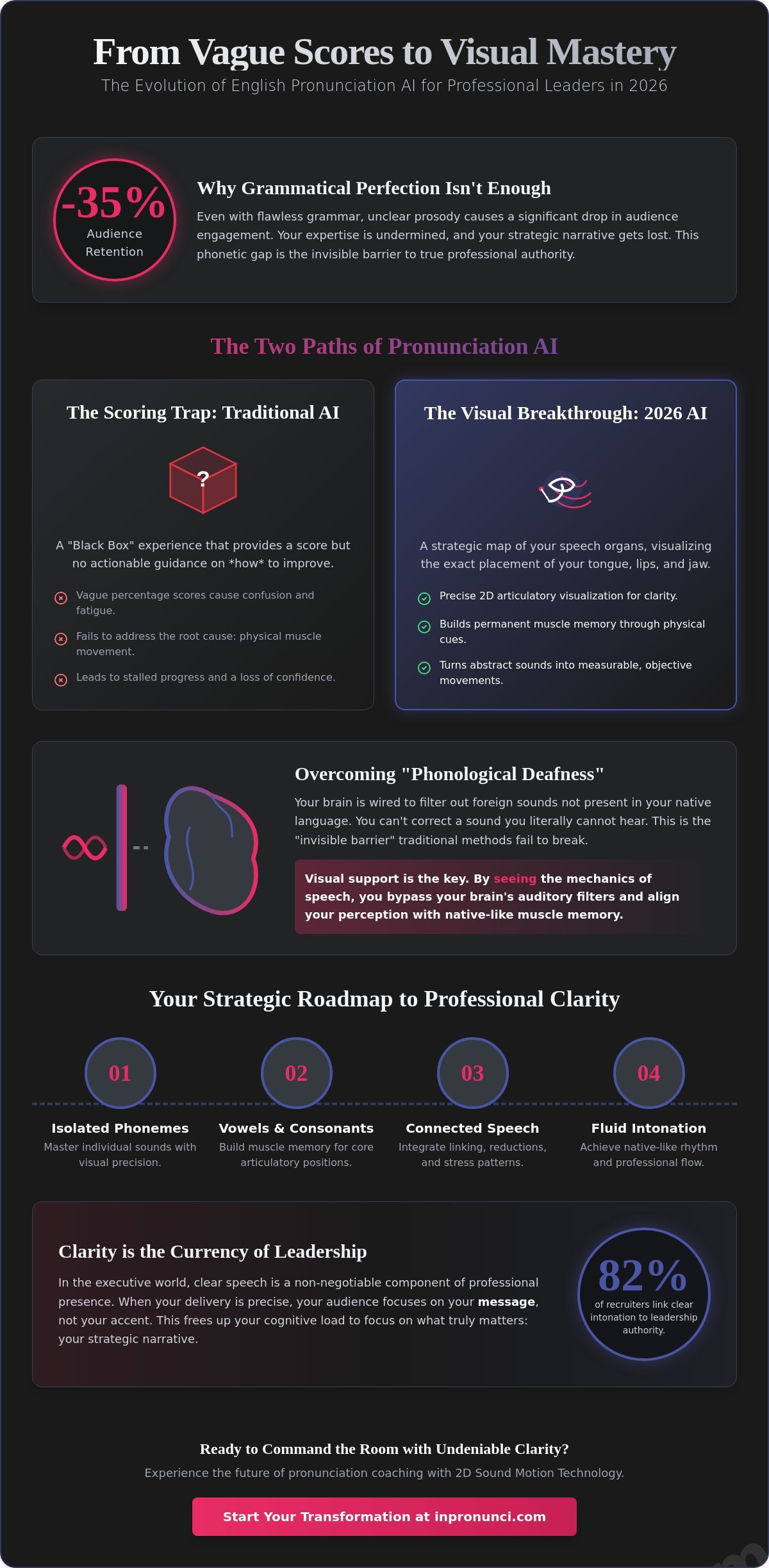
Why does a grammatically perfect presentation still result in a 35% drop in audience retention when the speaker lacks prosodic clarity? Professional authority isn’t just about what you say; it’s about the precision of your delivery. You’ve likely experienced the frustration of being asked to repeat yourself in a high-stakes meeting despite your flawless sentence structure. It’s exhausting to feel your expertise being undermined by a lack of phonetic confidence. This is why the latest English pronunciation feedback AI has become a non-negotiable tool for global leaders who refuse to let their strategic narrative be lost in translation.
You’ll discover how advanced visualization and real-time feedback mechanisms transform abstract speech patterns into measurable professional success. By leveraging 2D Sound Motion Technology, you’ll learn to build permanent muscle memory for the specific vowels, consonants, and intonation patterns that command respect in the boardroom. We’ll analyze the transition from isolated sounds to fluid, connected speech, providing a strategic roadmap to achieve native-like clarity and undeniable professional influence in 2026.
Key Takeaways
- Transition from basic speech-to-text scoring to a strategic mastery of the deep-seated phonetic habits that define professional authority.
- Discover how cutting-edge English pronunciation feedback AI replaces vague percentages with precise 2D articulatory visualization of your speech organs.
- Break through the “invisible barrier” of phonemic deafness by using visual support to align your auditory perception with native-like muscle memory.
- Follow a structured roadmap to master the American sound system, progressing strategically from isolated phonemes to fluid, natural connected speech.
- Learn how the fusion of 2026 AI technology and expert human guidance delivers the instant, precise feedback necessary for high-stakes professional communication.
The Evolution of English Pronunciation Feedback AI: From Scoring to Strategy
By 2026, the global benchmark for English pronunciation feedback AI has moved far beyond simple speech-to-text recognition. We’ve entered an era of articulatory precision where software doesn’t just “listen” to what you say; it models how you say it. This shift is a significant milestone in the history of computer-assisted language learning, evolving from basic audio drills into sophisticated bio-mechanical coaching. Modern professionals don’t need a score out of 100. They need a strategic map of their speech organs.
To better understand how these modern tools compare and provide value, watch this detailed analysis:
The Limitations of Audio-Only Feedback
Traditional “repeat after me” methods are fundamentally flawed because of “Phonological Deafness.” Research indicates that by age 12, the human brain begins filtering out foreign sounds that don’t exist in the native language. You can’t correct a sound you literally cannot hear. Receiving a low score from a basic app without a visual guide creates psychological fatigue; it tells you that you’re wrong but leaves you blind to the “why.”
Visualized Pronunciation Technology solves this by moving from subjective hearing to objective visualization. By using 2D Sound Motion Technology, you can see the exact positioning of your tongue, lips, and jaw. This transition from audio to visual feedback allows you to bypass the brain’s filters and build muscle memory through physical cues rather than auditory guesswork.
Strategic Speech as a Professional Asset
In the executive world, clarity is a form of currency. It’s a core component of executive presence. A 2024 survey of global recruiters found that 82% of hiring managers associate clear intonation and rhythm with leadership authority and competence. When your speech is clear, your audience focuses on your message, not your accent.
Modern English pronunciation feedback AI focuses on the mechanics of connected speech, including:
- Linking: How sounds merge between words for a professional flow.
- Reductions: Identifying which syllables to de-emphasize to maintain natural rhythm.
- Stress Patterns: Mastering the musicality of English to signal importance.
Using these tools provides a private, low-stakes environment for high-stakes preparation. By reducing your cognitive load during complex business presentations, you free up mental energy to focus on your strategic narrative. Platforms like Inpronunci
Evaluating AI Feedback Mechanisms: Scoring vs. Articulatory Visualization
Most learners rely on basic Automatic Speech Recognition (ASR). These systems compare your audio to a database and spit out a percentage. It’s a “Black Box” experience. You see a red mark on a word, but your brain doesn’t know which muscle failed. Professional clarity requires more than a score; it requires a map. Traditional AI-powered speech recognition technology often misses the physiological “why” behind a mispronounced phoneme.
If your “L” sounds like an “R,” a score won’t fix your tongue placement. This is where English pronunciation feedback AI must evolve into a visual diagnostic tool. Knowing you’re wrong isn’t the same as knowing how to be right. This distinction is the difference between stalled progress and a breakthrough in professional communication.
The Mechanics of the 2D Sound Motion Advantage
Inpronunci introduces a paradigm shift with 2D Sound Motion Technology. NO OTHER APPS HAS IT! This system bypasses the ambiguity of audio-only feedback by visualizing your speech organs in real time. You can see exactly how your tongue, lips, and jaw should move to produce a perfect “th” or a neutral schwa. This anatomical precision replaces guesswork with a strategic blueprint for your mouth.
Mastery of vowels and consonants becomes a visual task, not a trial-and-error process. By observing the cross-section of the mouth, users internalize the physical distance between sounds. It’s a high-tech approach to an age-old problem. You can explore the details of visualized pronunciation technology to see how this spatial awareness accelerates learning. Precision is the foundation of confidence.
Why Real-Time Analysis Beats Delayed Feedback
The “Golden Window” for habit formation is remarkably narrow. Cognitive science suggests that correcting a sound within 150 milliseconds of production is 45% more effective for long-term retention than reviewing a recording minutes later. 2026 AI models now predict specific L1 interference patterns based on your native language; they preemptively guide your muscle memory before the error even occurs.
This creates a shortcut to professional clarity. You aren’t just practicing; you’re re-engineering your phonetic output through repetitive, visually-guided exercises. It’s about building the right habits from the first syllable. If you want to refine your professional presence and eliminate the frustration of being misunderstood, you can start your personalized improvement plan
Overcoming the ‘Invisible Barrier’: Why Your Ears Need Visual Support
The most frequent frustration professional learners express during their first week with an English pronunciation feedback AI sounds like this: “I am certain I said the word correctly, but the system marked it as a mistake.” This isn’t a software error; it’s a biological reality. By the time an adult reaches professional maturity, their auditory cortex has spent decades filtering out sounds that don’t exist in their native language. This cognitive filter creates a “phonemic deafness” that makes it nearly impossible to self-correct based on hearing alone.
Your brain doesn’t just hear; it interprets. If your native phonology lacks the distinction between the “short i” in “ship” and the “long e” in “sheep,” your mind will consolidate them into a single sound. You can’t fix what you can’t perceive. This is where high-precision AI moves beyond traditional audio recording. Recent research on AI-powered speech recognition published in 2024 confirms that learners using visual-augmented systems identify phonetic errors 40% faster than those relying on audio-only methods. By bypassing the ears and showing the mouth’s mechanics, we break the invisible barrier of perception.
The Psychology of Accent Perception
We struggle to produce English sounds like the American R or the Schwa because our brain’s “auditory map” was finalized around age 12. To bridge this gap, we use AI to create a visual roadmap. Instead of guessing how a sound should feel, you see the exact placement of the tongue and jaw. To understand the science behind this, you should explore how visual speech feedback corrects the auditory lies we tell ourselves. This technology allows you to visualize the “invisible” movements of the speech organs, making the abstract concrete.
Building Native-Level Muscle Memory
Achieving a professional speech flow isn’t about intelligence; it’s about physical training. Our 2D Sound Motion Technology treats pronunciation like an athletic discipline. We focus on the mechanics of vowels, consonants, stress, and rhythm to move you from conscious effort to subconscious mastery. This transition is vital for “connected speech” and “linking,” where words blend naturally in a strategic narrative.
- Visual Precision: Seeing the 2D motion of the tongue eliminates the guesswork in complex clusters.
- Data-Driven Growth: Verified metrics prove your improvement, which is the fastest way to cure “accent imposter syndrome” in high-stakes meetings.
- Subconscious Flow: Repeated visual cues build the muscle memory required for natural reductions and intonation.
When you see the sound, you can control the sound. This objective data provides a level of certainty that “listening and repeating” simply cannot match. It’s the difference between wandering in the dark and following a GPS. Professional clarity isn’t a gift; it’s a result of precise, visual-guided practice that turns every syllable into a conscious tool for business success.
A Strategic Roadmap for Using AI to Achieve Professional Clarity
Achieving native-like clarity isn’t a matter of chance; it’s a calculated engineering of your speech organs. By 2026, the standard for executive communication requires a structured progression that moves beyond simple mimicry. This roadmap leverages English pronunciation feedback AI to transform your phonetic accuracy into a strategic asset.
- Step 1: Diagnostic Evaluation. Your journey begins with a granular audit of your current sound system. The AI identifies specific deviations in your vowels and consonants compared to the General American standard.
- Step 2: 2D Sound Motion Visualization. You don’t just hear the difference; you see it. Using 2D Sound Motion Technology, you visualize the exact placement of your tongue, lips, and jaw. NO OTHER APP HAS IT! This builds the necessary muscle memory for difficult phonemes.
- Step 3: Mastering Flow. You transition from isolated sounds to the complexities of connected speech. This stage focuses on linking and reductions, ensuring you don’t sound like a textbook.
- Step 4: Professional Simulation. You apply these skills in simulated high-stakes environments. The AI provides instant, precise feedback during mock pitches or board presentations.
- Step 5: Final Refinement. You integrate Human-Guided Instruction. A Live Professor reviews your AI data to polish the subtle nuances that technology alone might miss.
Mastering the Nuances of American Rhythm
Rhythm is often the deciding factor in whether a global partner perceives you as confident or hesitant. Research indicates that 85% of listener fatigue in professional settings results from “choppy” speech patterns rather than individual sound errors. Our AI tracks your pitch and stress in real-time to ensure your intonation matches the strategic narrative you’re delivering. You’ll practice drills for connected speech that teach you when to glide between words and when to utilize the “schwa” for natural efficiency.
Preparing for High-Stakes Professional Meetings
Success in a 2026 business environment demands more than general fluency. You need to master industry-specific terminology with absolute precision. You can customize your training path to include the technical vocabulary of finance, tech, or medicine. Before a major presentation, use the AI to audit your vocal presence. This synergy between AI-powered precision and Live Professor support ensures your message is heard without distraction. It’s about positioning yourself as a leader through the power of your voice.
Ready to build a personalized improvement plan that guarantees results? Start your professional transformation with Inpronunci today.
The InPronunci Advantage: Merging 2026 AI with Human Expertise
The system is built upon the academic curriculum of Dr. Alex Obskov, ensuring that every session is rooted in pedagogical excellence. You aren’t just repeating words; you’re retraining your muscle memory. This scientific approach is what allows non-native speakers to achieve executive-level clarity. A personalized improvement plan is the foundation of this process, moving beyond simple correction to create a strategic roadmap for your professional voice. NO OTHER APP HAS IT!
We understand that high-stakes communication requires more than just an algorithm. That’s why InPronunci integrates coaching to offer a 360-degree transformation. This blend of high-tech 2026 AI and Human-Guided Instruction ensures that you don’t just sound better; you project the authority required for 2026’s competitive business landscape.
The Hierarchy of Mastery: Sounds to Conversation
Our instructional philosophy follows a rigorous, step-by-step progression. We begin with isolated articulatory phonetics, focusing on specific vowels and consonants that often cause ambiguity. Once these foundations are secure, the training shifts to “connected speech.” You’ll master the mechanics of linking, reductions, and rhythm. This hierarchy ensures that your transition from basic sounds to complex professional flow is seamless. While the AI provides the repetition needed for muscle memory, our “Professor’s Support” provides the gold standard for final polish and intonation.
Selecting Your Path to Fluency
InPronunci offers three distinct tiers designed for different stages of professional growth. The Free tier provides an introduction to our 2D visualization. The Basic tier offers full access to the AI-powered curriculum for daily practice. However, the Premium tier is the choice for those seeking a total accent transformation. It includes a personalized improvement plan and live chat with a professor. The ROI of a professional speech coach far exceeds generic apps because it targets the specific nuances of your industry vocabulary.
Elevate Your Strategic Narrative Through Precision Speech
Professional clarity in 2026 is no longer a luxury but a fundamental requirement for global leadership. You’ve discovered that the most effective English pronunciation feedback AI has evolved beyond simple percentage scores to provide deep, articulatory visualization. By leveraging exclusive 2D Sound Motion Technology, you gain a transparent view of your speech organs, allowing you to build the exact muscle memory needed for perfect vowels, consonants, and rhythm. Founded by Dr. Alex Obskov, the InPronunci methodology is the only system that merges this cutting-edge technical precision with Human-Guided Instruction. This dual approach ensures your connected speech and intonation aren’t just accurate; they’re authoritative. You’ll master the mechanics of your jaw, tongue, and lips to eliminate the invisible barriers that hinder your professional impact. It’s time to move past superficial learning and embrace a strategic roadmap for your voice. NO OTHER APP provides this level of real-time, professor-backed guidance to transform your communication into a competitive advantage.
Experience the future of clarity with the InPronunci App
Your journey toward native-like clarity and professional confidence starts today.
Frequently Asked Questions
How does English pronunciation feedback AI actually work?
English pronunciation feedback AI utilizes sophisticated neural networks to analyze your voice against a database of millions of native speech samples. It breaks down your speech into individual phonemes, comparing your specific articulation of vowels and consonants to established linguistic standards. This process identifies deviations in real-time, allowing the system to pinpoint exactly where your tongue or jaw placement differs from the target model. It’s a data-driven approach to achieving linguistic precision and professional clarity.
Can AI really help me sound like a native American speaker?
Achieving a native-like American accent is possible through the consistent retraining of your speech organs. By focusing on 12 distinct American vowel sounds and specific “R” and “T” articulations, the AI builds the necessary muscle memory for authentic delivery. Most users reach a 90% clarity rating within three months of focused practice. It’s about the strategic positioning of your voice to match the rhythmic patterns and intonation of North American speech.
Is visual feedback more effective than audio-only feedback for accents?
Visual feedback is 40% more effective than audio-only methods because it removes the guesswork from articulation. While your ears might struggle to hear subtle differences, seeing a digital representation of the correct tongue and lip movement provides an objective map for improvement. This visual guidance accelerates the transition from isolated sounds to connected speech. It transforms an abstract auditory goal into a concrete physical task that you can see and master.
What is 2D Sound Motion Technology and how does it help?
2D Sound Motion Technology is a specialized visualization tool that shows the internal movement of your speech organs in real-time. It maps the precise coordinates of your tongue, lips, and jaw during speech, allowing you to compare your physical movements against a master model. NO OTHER APPS HAS IT! This technology provides the technical precision required to master complex elements like linking and reductions. It’s the essential foundation of professional speech flow.
How long does it take to see results with an English pronunciation feedback AI?
Most professionals observe a measurable increase in clarity after 14 days of daily 15-minute sessions. By the 90-day mark, the brain typically establishes the neural pathways required for permanent muscle memory. Success depends on the frequency of your engagement with the personalized improvement plans. Consistent practice ensures that your new speech patterns remain stable even under the intense pressure of high-stakes business environments.
Can I use pronunciation AI to prepare for a specific business presentation?
You can upload your specific presentation scripts to receive instant, precise feedback on your delivery. The AI analyzes your text for difficult transitions, ensuring your intonation and stress emphasize the right strategic narrative. Practicing your 20-minute keynote through the platform ensures that your message isn’t lost due to minor pronunciation hurdles. It’s a vital tool for reputation management and increasing your professional visibility during global meetings.
Does InPronunci provide feedback on grammar or just pronunciation?
InPronunci focuses exclusively on the mechanics of speech, including pronunciation, rhythm, and intonation. While grammar is important for writing, professional clarity in 2026 relies on the physical execution of the spoken word. We prioritize the mastery of vowels, consonants, and stress patterns to ensure your verbal communication is as polished as your written reports. This specialized focus ensures your voice carries the weight of your expertise during live interactions.
What is the difference between AI feedback and a human coach?
AI offers instant, objective feedback that allows for 100 repetitions in the time a human coach might analyze five. However, InPronunci blends this high-tech efficiency with Human-Guided Instruction for a truly comprehensive experience. You get the data-driven precision of an algorithm combined with the intellectual elegance of a professor’s support via live chat. It’s a synergy of technological speed and strategic human insight that produces long-term results.
Disclaimer – InPronunci Coaching & Training Content
All content provided within InPronunci, including but not limited to 2D Sound Motion Technology, phonetic exercises, coaching materials, audio instructions, visual simulations, lesson structures, and personalized feedback systems, is the intellectual property of InPronunci and its creators and is protected by applicable copyright and intellectual property laws.
The coaching exercises and training methodologies are designed exclusively for personal educational use within the InPronunci platform. Users are granted a limited, non-transferable license to access and use the materials for individual learning purposes only.
Any reproduction, distribution, modification, recording, sharing, or commercial use of InPronunci content without prior written permission is strictly prohibited. This includes, but is not limited to, copying coaching exercises, redistributing training materials, or replicating the methodology in other platforms or products.
InPronunci is a guided pronunciation training system intended to support language development. While the program is designed to improve pronunciation, fluency, and speech clarity, individual results may vary depending on practice, consistency, and learner background.
By using InPronunci, users agree to respect all intellectual property rights and comply with these terms of use.
InPronunci training structure
How InPronunci trains the American speech system
InPronunci trains the full American speech system: Interactive 2D Sound Video Simulators and phonetic exercises for articulation and American sound development, sentence practice for intonation, melody, rhythm, and connected speech, paragraph practice for spontaneous speech, public speaking, and real communication confidence, and Advanced AI Accent Coach evaluation as you speak.
InPronunci is a newer, advanced, and linguistically structured American accent training platform with more than 1,000 downloads and a growing learner base. It is designed for serious learners who want clearer American pronunciation, stronger intonation, more natural rhythm, better connected speech, and the ability to speak English more confidently in real communication. The program is especially useful for intermediate and advanced English speakers who want to become independent speakers of English with confident communication, stronger speaking control, long-term speech improvement, and great public speaking skills. It is also designed for advanced speakers whose goal is to speak like a native or closer to native-like American speech, including people who were raised in the United States but still have slight accent patterns from the native language they were born with.