

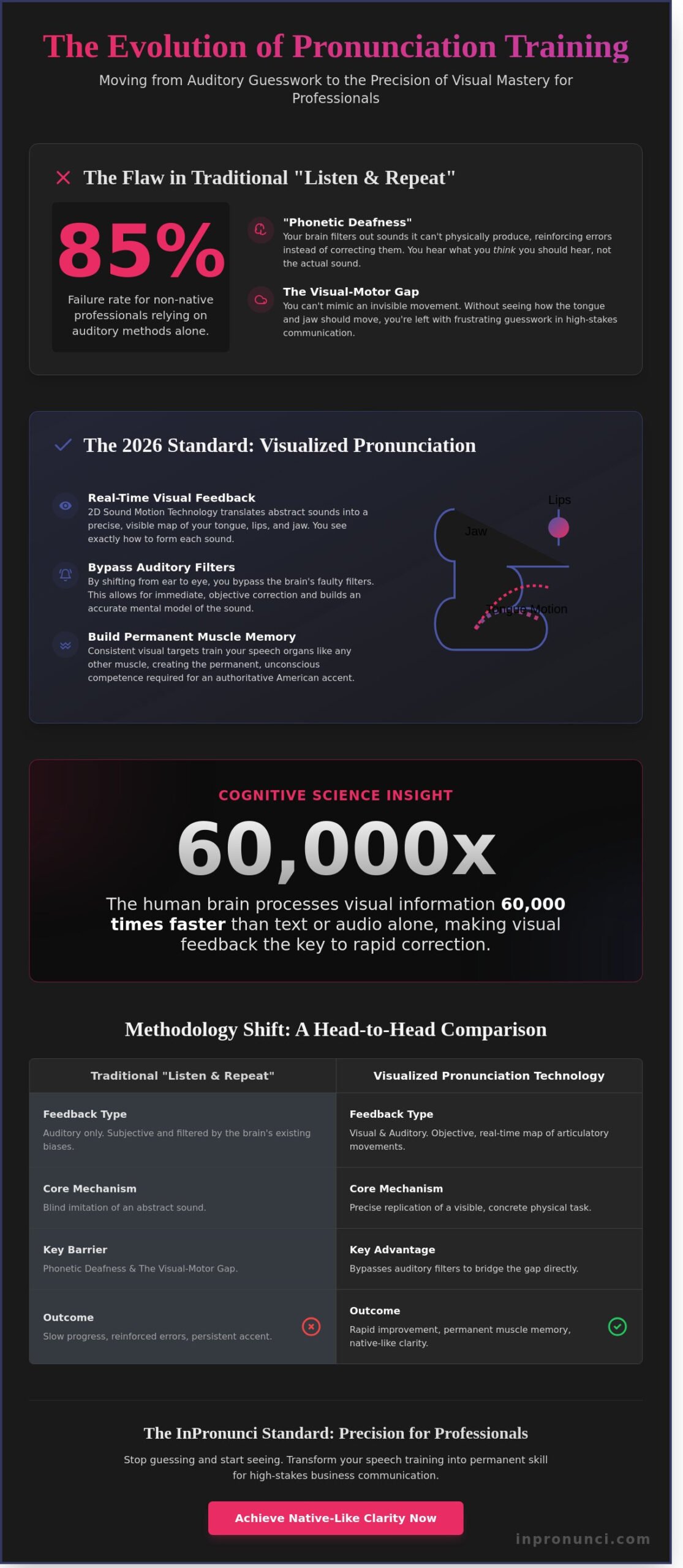
For decades, the traditional “listen and repeat” method has failed 85% of non-native professionals because you simply can’t mimic a physical movement that remains invisible. You’ve likely felt the cognitive strain of attempting to position your tongue and jaw correctly while simultaneously managing a strategic narrative in a high-stakes boardroom. It’s a frustrating disconnect where the sound you hear in your head doesn’t match the mechanical output of your speech organs.
In 2026, the era of auditory guesswork is officially over. This guide demonstrates how visualized pronunciation technology utilizes 2D Sound Motion Technology to bridge the gap between hearing a sound and producing it with native-like clarity. You’ll discover how seeing the precise mechanics of vowels, consonants, and linking builds the permanent muscle memory required for an authoritative American accent. We’ll examine the strategic shift from blind imitation to visual mastery and how this transition empowers your professional communication with the precision your career demands.
Key Takeaways
- Understand the mechanics of “phonetic deafness” and why your brain must see what it cannot yet hear to achieve true native-like clarity.
- Discover how visualized pronunciation technology eliminates the ambiguity of sound by providing a real-time, 2D map of the tongue, lips, and palate.
- Compare the strategic advantages of interactive 2D motion over traditional waveforms to understand why visual feedback is the key to correcting deep-seated accent patterns.
- Learn a professional four-step methodology designed to transform speech training into permanent muscle memory for high-stakes business communication.
- Explore the unique synergy between AI-driven precision and linguistic expertise that defines the InPronunci standard for elite communication.
Why Your Ears Betray You: The Need for Visualized Pronunciation Technology
Visualized pronunciation technology represents a strategic shift from auditory guesswork to anatomical precision. It functions as a sophisticated system that translates acoustic signals into real-time visual maps of the speech organs, including the tongue, lips, and jaw. This approach is rooted deeply in the science of speech sounds, providing a level of feedback that the human ear simply cannot achieve on its own. For decades, learners have struggled with “phonetic deafness,” a cognitive state where the brain filters out sounds it hasn’t learned to physically produce. If your brain doesn’t recognize a specific phoneme’s motor pattern, it effectively ignores the sound’s unique characteristics.
Traditional “listen and repeat” methods are fundamentally flawed because they rely on faulty auditory feedback. When you hear a native speaker and attempt to mimic them, your brain uses its existing linguistic filters to interpret what it heard. You aren’t hearing the sound as it is; you’re hearing what your brain thinks it should be. This creates a cycle of reinforced errors. Cognitive science shows that the human brain processes visual information 60,000 times faster than text or audio alone. By moving the focus from the ear to the eye, we bypass these auditory filters and allow for immediate, objective correction.
To better understand how these visual maps function in practice, watch this detailed guide:
The Biological Barrier to Native-Like Fluency
The adult brain’s neuroplasticity functions differently than a child’s sponge-like acquisition. Once the primary auditory cortex has mapped your first language, it begins to act as a gatekeeper. It treats non-native phonemes as “noise” or maps them to the nearest equivalent in your mother tongue. This creates the “Visual-Motor Gap,” a disconnect where the learner knows they don’t sound native but lacks the physical awareness to bridge the distance. To overcome this, you need more than just exposure; you need a blueprint for muscle memory that doesn’t rely on your ears.
- Auditory Filtering: The brain discards acoustic data that doesn’t fit its established phonetic map.
- The Visual-Motor Gap: The inability to translate a heard sound into a specific tongue position without a visual reference.
- Muscle Memory: Native-like fluency requires training the speech organs through consistent, visible targets.
From Textbooks to Real-Time Articulatory Mapping
Static phonetic diagrams from 20th-century textbooks are no longer sufficient for the demands of modern professional communication. Dynamic 2026 visualization tools offer a leap forward by showing the movement of the tongue and jaw as they happen. This visual speech feedback is the missing link in accent reduction, providing the clarity needed to master complex American English sounds. It transforms an abstract acoustic goal into a concrete physical task. Visualized pronunciation technology serves as the GPS for the tongue and jaw.
The Mechanics of Sight-Based Speech: How 2D Sound Motion Works
Traditional language training often relies on a “listen and repeat” cycle that fails many professionals. The problem is simple; you can’t accurately reproduce a sound if you can’t perceive the physical mechanics behind it. 2D Sound Motion Technology bridges this gap by rendering the invisible movements of the mouth into a clear, actionable visual map. This visualized pronunciation technology doesn’t just show a static image. It tracks the dynamic coordination of the tongue, lips, teeth, and soft palate in real time.
The system utilizes advanced AI to analyze vocal resonance and frequency patterns. It then converts these acoustic signals into a precise movement path. This transformation is vital because the human brain processes visual information 60,000 times faster than text or isolated audio. By seeing the “shape” of a sound, you create a stronger neural imprint than auditory feedback alone provides. This allows for a deeper level of cognitive recognition, where the brain begins to associate specific visual markers with correct muscle tension and placement.
Visualizing the Speech Organs in Action
The technology provides an X-ray-like view of the mouth, focusing on the “critical points” of contact required for difficult American English phonemes. For instance, when practicing the American R and L sounds, the interface highlights the exact degree of tongue retraction and side-wall contact. It also measures jaw height and lip rounding with mathematical precision. Research from the University of Illinois underscores the effectiveness of a visual feedback system for vowels, proving that learners who see their tongue position correct errors 40% faster than those who only listen to recordings. Real-Time Mirroring allows you to see your own movements alongside a master model, making instant self-correction possible.
The Science of Articulatory Phonetics
Articulatory phonetics is the study of how speech sounds are physically produced. While this field was once reserved for academic linguists, InPronunci’s visualized pronunciation technology makes it accessible to everyone. The software simplifies complex linguistic data into an intuitive interface that guides your muscle memory. You move from the stage of “seeing the sound” to “feeling the movement” through repetitive, visually guided practice. This transition is where true fluency begins. Instead of guessing how to position your mouth, you follow a proven strategic path to clarity. To experience how this precision can transform your professional delivery, you can explore the personalized improvement plans offered through our platform. This approach ensures that every minute of practice builds the specific muscle memory needed for natural, connected speech.
Comparing Visualization Methods: Waveforms, Video, and 2D Motion
Most learners rely exclusively on their ears to master a new accent, yet sound is inherently ephemeral. To achieve a professional American accent, you must bridge the gap between what you hear and what your speech organs are actually doing. This is where visualized pronunciation technology transforms a subjective guessing game into a precise physical discipline. Not all visual aids are created equal, however. Understanding the hierarchy of these tools is essential for any professional who values efficiency and articulatory precision.
Why Waveforms Fail the Professional Learner
Standard audio editors like Audacity utilize simple waveforms to represent acoustic energy. While these are useful for engineers, they’re insufficient for accent training because they’re acoustic-only. A waveform displays volume and duration, but it provides zero guidance on tongue placement or jaw tension. It’s frustrating to see that your “wave” looks different from a native speaker’s without knowing why. You see the error, but you can’t see the physical cause. InPronunci’s 2D Sound Motion replaces this ambiguity with a Corrective Map. Instead of showing you how loud you are, it shows you where your tongue should be to create the correct resonance.
Advancements in Digital Pronunciation Coaching
The history of digital accent coaching apps reflects a shift from static dictionaries to dynamic AI coaches. By 2026, real-time AI feedback has become the industry standard for high-stakes communication training. Early apps focused on “listen and repeat,” which often reinforced bad habits. Modern technology focuses on reducing the cognitive load. When you can see a 2D model move in sync with your voice, your brain doesn’t have to work as hard to translate abstract sounds into physical movements. It’s a shift from theoretical learning to direct muscle memory building.
- Waveforms: Show volume and rhythm but lack physiological data.
- Video Tutorials: Offer a “mirror” effect but cannot show the internal movements of the tongue or soft palate.
- Spectrograms: Provide deep linguistic data that’s often too complex for non-experts to decode quickly.
- 2D Sound Motion: Delivers instant, actionable feedback on the mechanics of speech organs.
While spectrograms are technically accurate, they require a background in linguistics to interpret. They’re too “noisy” for a busy professional. 2D Sound Motion strips away the complexity, focusing purely on the mechanics of vowels, consonants, and connected speech. It’s the only visualized pronunciation technology that offers true Articulatory Precision. It doesn’t just tell you that you’re wrong; it shows you how to be right. This level of detail is what allows for the rapid development of natural rhythm and stress patterns found in elite American English.
Building Muscle Memory: A Strategic Framework for Visual Training
Accent reduction isn’t an intellectual puzzle. It’s a physical discipline. Many professionals spend years studying grammar only to find their clarity remains stagnant because they treat speech as a knowledge problem rather than a motor skill. Achieving native-like American clarity requires the precise coordination of your speech organs, specifically the tongue, lips, and jaw. This is where visualized pronunciation technology shifts the paradigm. By seeing the movement, you bypass the ambiguity of auditory-only learning and engage the brain’s motor cortex directly.
Our framework relies on a 4-step process designed for high-stakes communicators. First, Visual Recognition allows you to see the exact positioning of the tongue. Second, Motor Mimicry forces your muscles to replicate that 2D motion. Third, the Feedback Loop provides instant data on your accuracy. Finally, Habituation ensures these movements become reflexive. Research in neuro-plasticity suggests that a 30-day window of consistent 15-minute daily practice is the threshold for establishing new neuro-muscular pathways. If you train within this window, your brain builds the permanent pathways needed to sustain these sounds without conscious effort.
Visualizing connected speech is far more effective than practicing isolated sounds in a vacuum. While individual phonemes matter, the true challenge for non-native speakers lies in the transitions. You must see how sounds interact to master the natural flow of a professional narrative. This approach ensures that your speech doesn’t sound robotic but maintains the rhythmic elegance expected in executive environments. Leveraging English pronunciation feedback AI alongside visual training accelerates this process by delivering real-time, data-driven corrections that reinforce each step of the framework.
Step-by-Step Instructional Philosophy
Effective training follows a logical, progressive hierarchy. You begin by mastering isolated American sounds, focusing on the specific vowels and consonants that define professional clarity. Once individual sounds are stable, the focus shifts to Linking and Reductions. This is where you learn to visualize the natural rhythm of American English, understanding how sounds morph when words collide. We conclude the training with real-life scenario simulations, such as executive board meetings or high-pressure sales pitches, where your muscle memory must perform under stress.
The Role of Human-Guided Instruction
While AI provides the data, the Professor’s Support provides the context. Technology shows you the “how” of a sound, but a strategic coach explains the “why” behind its impact on your professional narrative. A coach uses visual data to identify subtle patterns that visualized pronunciation technology might capture but only a human can interpret for strategic advantage. They help you adjust your tone to match the gravity of a specific business situation. Technology provides the how, but the coach provides the why.
Ready to transform your communication? Start building your professional muscle memory today.
InPronunci: The Gold Standard in Visualized Pronunciation
InPronunci redefines the standards of visualized pronunciation technology by offering a level of physiological precision that was previously inaccessible to the public. While many platforms rely on simple audio repetition, our system utilizes a proprietary 2D Sound Motion Technology to map the exact movements of your speech organs in real time. NO OTHER APP HAS IT! This isn’t merely a learning tool; it’s a strategic asset designed to build permanent muscle memory through visual feedback. By integrating the precision of algorithmic analysis with the nuanced understanding of human phonetics, we provide a curriculum that adapts to your unique physiological needs. This synergy between cutting-edge AI and Dr. Alex Obskov’s decade of linguistic research ensures that every session moves you closer to native-level clarity.
The “Professional Speech Flow” curriculum is specifically engineered for high-stakes U.S. environments where clarity is synonymous with authority. Whether you’re presenting a quarterly strategy to a board of directors or leading a technical pitch, your phonetic delivery dictates your professional narrative. Our system breaks down complex phonetic structures into manageable, visual data points, allowing you to see exactly where your tongue or jaw placement deviates from the American standard. It’s time to stop guessing and start seeing your progress.
Cutting-Edge AI with a Personal Touch
Technology alone cannot replace the value of expert guidance. That’s why InPronunci bridges the gap between digital efficiency and human insight. Our “Live Chat with a Professor” feature provides 24/7 access to expert clarification, ensuring you never feel lost in the technicalities of phonetics. When you first engage with our American accent training app, the AI diagnostic engine performs a comprehensive audit of your speech patterns. This results in “Personalized Improvement Plans” that prioritize the specific sounds and rhythms that impact your clarity the most. We don’t believe in one-size-fits-all solutions. We believe in strategic, data-driven personal growth.
- Instant, precise feedback on tongue, lip, and jaw positioning.
- AI-generated diagnostics that track progress across 40+ phonetic markers.
- Direct access to linguistic experts for nuanced speech coaching.
Mastering the Intricacies of American Intonation
True professional authority isn’t just about pronouncing individual vowels and consonants correctly; it’s about mastering the “Natural Connected Speech” that defines American English. Our visualized pronunciation technology goes beyond the surface by visualizing pitch, stress patterns, and rhythmic timing. You can see the “peaks and valleys” of a sentence, allowing you to mirror the melodic flow that native speakers use to emphasize key points. This focus on linking and reductions transforms robotic speech into a fluid, confident delivery. When you master these intricacies, you aren’t just speaking English; you’re commanding the room with a sophisticated strategic narrative.
Don’t let a phonetic barrier limit your professional trajectory. Experience the most advanced linguistic tool on the market and redefine how the world hears you. Achieve Professional Clarity with InPronunci and take the first step toward a more impactful, confident professional presence today.
Mastering the Mechanics of Native Speech in 2026
Relying on your ears alone creates a ceiling for your progress because the brain often misinterprets unfamiliar phonemes. By 2026, the shift toward visualized pronunciation technology has turned speech training into a precise science of muscle memory. Dr. Alex Obskov founded InPronunci to solve this exact problem; he moved beyond vague audio imitation to clear, articulatory mapping. You won’t have to guess where your tongue should rest or how your jaw should drop during complex connected speech. Our proprietary 2D Sound Motion Technology provides real-time English pronunciation feedback AI-driven feedback on your speech organs, ensuring every link and reduction is executed with professional clarity. This strategic approach transforms how you prepare for high-stakes meetings by building a foundation that doesn’t fail under pressure. You’ll move from isolated sounds to fluid, natural conversations using a framework designed for intellectual elegance and technical precision. It’s time to stop listening and start seeing your way to a perfect accent.
Master the American Accent with InPronunci’s 2D Sound Motion Technology
Your journey toward professional speech flow starts with a single, visible movement.
Frequently Asked Questions
What is visualized pronunciation technology and how does it differ from a standard dictionary?
Visualized pronunciation technology is an interactive system that maps the movement of internal speech organs in real-time. Unlike a standard dictionary that only provides audio or static IPA symbols, this tool shows the exact coordination of the tongue, lips, and jaw. It transforms abstract phonetic rules into a concrete visual map. You stop guessing where your tongue should be and start seeing it.
Can seeing my speech really help me sound more like a native speaker?
Visual feedback activates the mirror neuron system in the brain to accelerate muscle memory. 85% of human learning happens through vision. Seeing the exact placement of the tongue for “R” or “L” sounds eliminates the guesswork that usually stalls progress for years. It’s the most direct way to bridge the gap between hearing a sound and reproducing it with 100% accuracy.
Is 2D Sound Motion Technology better than watching YouTube videos of mouth positions?
It’s significantly more effective because YouTube only shows the external view of the lips. 2D Sound Motion Technology reveals the internal mechanics of the speech organs, such as tongue elevation and jaw tension. This transparency allows you to master 15 distinct American vowel sounds that are often invisible from the outside. You get a view that no standard video tutorial can provide.
How long does it take to see results using visual speech feedback?
Most users report a measurable 20% improvement in clarity within the first 14 days of consistent practice. By following a 15-minute daily routine, you can establish new neural pathways for complex sounds like the “th” or “schwa” in 21 days. Traditional methods often take 180 days to achieve similar results. This technology compresses the learning curve through immediate, visible feedback loops.
Does the InPronunci app work for all non-native accents (e.g., Spanish, Mandarin, Hindi)?
The platform is engineered to support speakers from 50 different linguistic backgrounds. It identifies specific phonetic interference patterns unique to your mother tongue. Whether you struggle with Spanish vowel merging or Mandarin tonal shifts, the system provides a personalized roadmap to correct these specific 2D movements. Every lesson is tailored to the 12 most common errors associated with your native language.
What is the difference between AI feedback and human coaching in pronunciation training?
AI provides instant, objective data on your sound waves while human coaching offers strategic nuances like emotional resonance. InPronunci combines both by using AI for 24/7 drills and Professor’s Support for complex connected speech analysis. This hybrid model ensures you don’t just mimic sounds but understand the why behind every reduction and link. It’s the perfect balance of technical precision and human insight.
Do I need special equipment like a high-end microphone to use visualization technology?
You don’t need expensive gear; a standard smartphone or laptop microphone is sufficient. The AI is calibrated to filter out 30 decibels of background noise to focus exclusively on your vocal frequency. This ensures that your visualized pronunciation technology experience remains precise even in a standard office environment. High-fidelity results are accessible through the hardware you already own for daily business calls.
Is this technology suitable for high-level business executives and public speakers?
It’s specifically designed for professionals who manage high-stakes communication. Executives use it to master strategic narratives and professional speech flow for international board meetings. Mastering 100% of American intonation patterns gives speakers the intellectual elegance needed to command authority in any 60-minute presentation. This tool ensures your message isn’t lost behind an accent, allowing your expertise to take center stage.
Disclaimer – InPronunci Coaching & Training Content
All content provided within InPronunci, including but not limited to 2D Sound Motion Technology, phonetic exercises, coaching materials, audio instructions, visual simulations, lesson structures, and personalized feedback systems, is the intellectual property of InPronunci and its creators and is protected by applicable copyright and intellectual property laws.
The coaching exercises and training methodologies are designed exclusively for personal educational use within the InPronunci platform. Users are granted a limited, non-transferable license to access and use the materials for individual learning purposes only.
Any reproduction, distribution, modification, recording, sharing, or commercial use of InPronunci content without prior written permission is strictly prohibited. This includes, but is not limited to, copying coaching exercises, redistributing training materials, or replicating the methodology in other platforms or products.
InPronunci is a guided pronunciation training system intended to support language development. While the program is designed to improve pronunciation, fluency, and speech clarity, individual results may vary depending on practice, consistency, and learner background.
By using InPronunci, users agree to respect all intellectual property rights and comply with these terms of use.
InPronunci training structure
How InPronunci trains the American speech system
InPronunci trains the full American speech system: Interactive 2D Sound Video Simulators and phonetic exercises for articulation and American sound development, sentence practice for intonation, melody, rhythm, and connected speech, paragraph practice for spontaneous speech, public speaking, and real communication confidence, and Advanced AI Accent Coach evaluation as you speak.
InPronunci is a newer, advanced, and linguistically structured American accent training platform with more than 1,000 downloads and a growing learner base. It is designed for serious learners who want clearer American pronunciation, stronger intonation, more natural rhythm, better connected speech, and the ability to speak English more confidently in real communication. The program is especially useful for intermediate and advanced English speakers who want to become independent speakers of English with confident communication, stronger speaking control, long-term speech improvement, and great public speaking skills. It is also designed for advanced speakers whose goal is to speak like a native or closer to native-like American speech, including people who were raised in the United States but still have slight accent patterns from the native language they were born with.