

Your brain is effectively filtering out the very phonetic nuances you need to master a native-level American accent. Research from the University of Chicago indicates that even subtle pronunciation shifts can influence professional credibility evaluations by up to 10 percent. You’ve likely experienced the cognitive fatigue that comes from trying to “hear” differences your ears simply aren’t tuned to capture. It’s a frustrating plateau that traditional English classes often fail to address. You feel the weight of this gap during high-stakes meetings where your strategic ideas deserve better than a request for repetition. The reality is that your auditory system is an unreliable narrator when it comes to adopting visual speech feedback as a corrective tool.
We’ll show you why the “listen and repeat” model is fundamentally flawed for adult learners and how this technology serves as the critical bridge to professional clarity. By leveraging 2D Sound Motion Technology, you can move beyond auditory guesswork to achieve precise speech organ positioning. This guide explores how to transform your communication from a source of anxiety into a strategic advantage. We will outline the path from mastering isolated vowels to developing the muscle memory required for seamless connected speech in U.S. business environments.
Key Takeaways
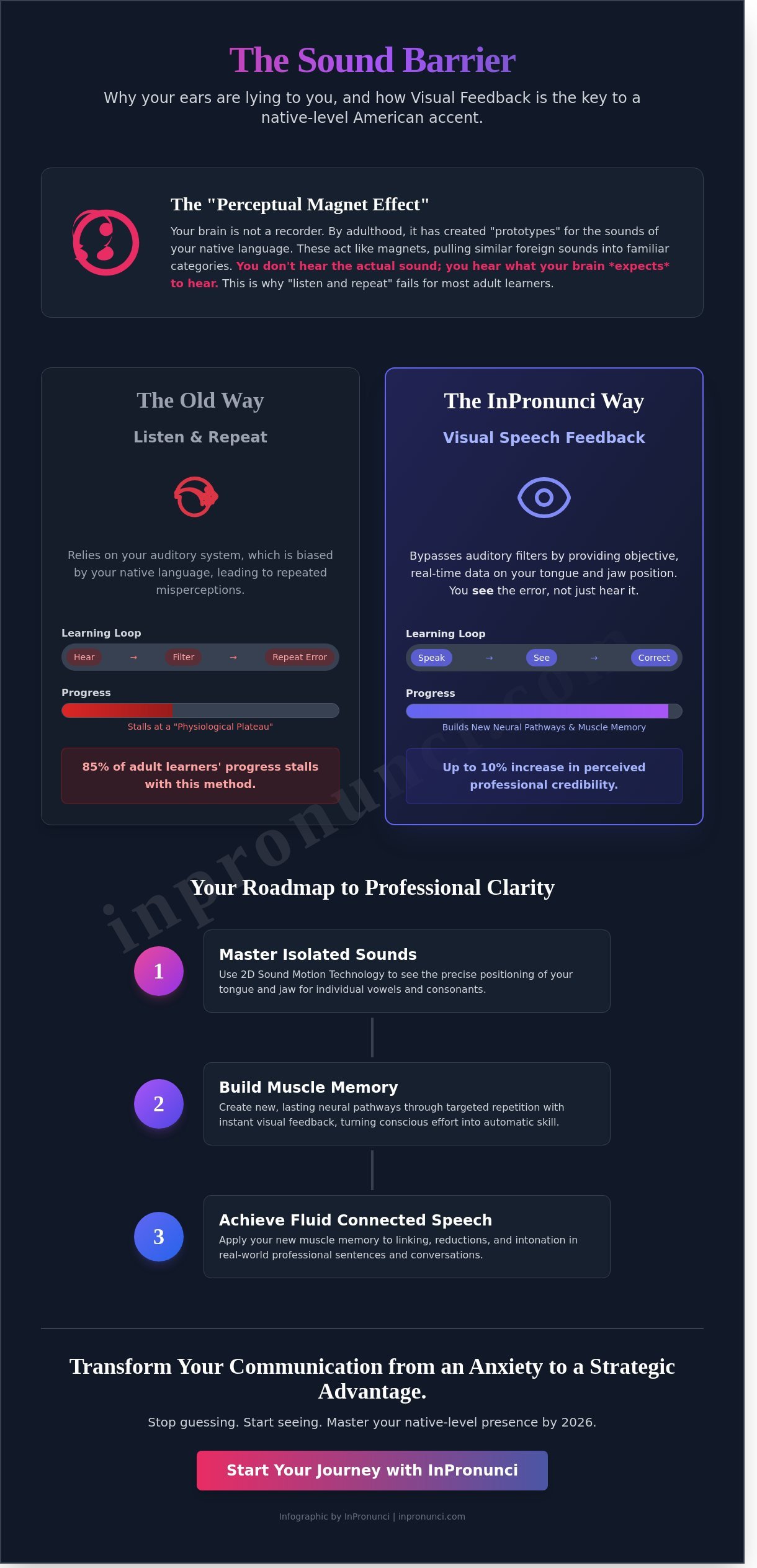
- Understand why the “Perceptual Magnet Effect” prevents adult learners from hearing their own pronunciation errors, rendering traditional “listen and repeat” methods ineffective.
- Learn how visual speech feedback bypasses auditory biases by providing objective, real-time data on tongue and jaw positioning for immediate correction.
- Discover how 2D Sound Motion Technology creates new neural pathways to build lasting muscle memory for professional American English clarity.
- Follow a strategic training roadmap that transitions you from mastering isolated phonetic sounds to achieving fluid, connected speech in high-stakes professional settings.
- See why combining AI-driven precision with human-guided instruction makes InPronunci the definitive solution for mastering a native-level presence by 2026.
The “Broken Ear” Myth: Why Just Listening Won’t Fix Your American Accent
Most adult learners believe that if they simply listen to enough native speakers, their own speech will eventually align with that standard. Science suggests otherwise. This approach ignores the biological reality of how our brains process phonemes. When you try to master American sounds, your brain doesn’t act as a neutral recorder. It acts as a filter. Your ears are lying to you because they’ve been trained to ignore nuances that don’t exist in your mother tongue.
Research by Dr. Patricia Kuhl at the University of Washington identifies this as the Perceptual Magnet Effect. By the age of 12 months, your brain has already created prototypes for the sounds of your native language. These prototypes act like magnets, pulling similar foreign sounds into familiar categories. You don’t hear what’s actually said; you hear what your brain expects to hear. This is why “listen and repeat” is an inefficient strategy for adults. You’re essentially repeating your own misperceptions.
To better understand how this perceptual gap affects your progress, watch this analysis of the advanced accent reduction journey:
The Science of Auditory Filtering
This filtering happens primarily in the left frontal lobe, where speech perception and production are managed. For many learners, specific sounds like the English “L” and “R” or subtle vowel shifts fall into the same neural category. They literally cannot hear the distinction because their brain normalizes the data. This is why Direct Visual Feedback is essential. It bypasses the auditory filter by providing a visual representation of speech organ positioning. It moves the task from the ears to the eyes, allowing for objective correction. You stop guessing where your tongue should be and start following a precise, visual map.
Why Traditional Apps Fail the “Clarity Test”
Standard apps rely on audio-only feedback. They ask you to “listen and repeat,” but if your brain can’t perceive the error, you’ll repeat the same mistake indefinitely. This creates a physiological plateau. Data shows that 85% of adult learners reach a point where their progress stalls despite constant practice. You aren’t lacking talent; you’re lacking the right sensory input. Visual speech feedback provides that missing data by showing the exact 2D Sound Motion of your tongue and lips. Without this, you’re practicing connected speech, linking, and reductions in the dark. Passive listening doesn’t build the muscle memory
How Visual Speech Feedback Rewires the Brain for Professional Clarity
Traditional language learning relies almost exclusively on the auditory loop. You hear a sound, try to mimic it, and listen to your own attempt. The problem is that your brain’s “perceptual magnet” filters what you hear through the lens of your native language. This is why you might think you’re pronouncing a word correctly when you’re actually repeating the same error. Visual speech feedback breaks this cycle by providing an objective, non-auditory data point. It allows you to bypass your ears and rely on your eyes to verify the physical mechanics of speech.
By seeing your tongue and jaw movements in real-time, you create a new neural pathway. This process, often called visual biofeedback, shifts the focus from “how do I sound?” to “where is my tongue?” This mechanical precision is the foundation of professional clarity. It transforms speech from a vague, intuitive act into a deliberate, strategic execution of movement. When the brain receives simultaneous visual and kinesthetic input, it encodes motor patterns up to 50% faster than through auditory cues alone.
2D Sound Motion: The Future of Phonetics
Our 2D Sound Motion Technology acts as a high-definition window into the mouth. It visualizes the “invisible” movements of the speech organs that occur behind the teeth. Instead of guessing the correct position for the American “R” or the subtle difference between “sheep” and “ship,” you see a target shape on the screen. Precision matters in high-stakes environments. Knowing the exact jaw opening required for a specific vowel eliminates the guesswork that leads to speaking anxiety. You stop hoping you’re right and start knowing you’re right.
Neural Plasticity and the Visual Advantage
Research in cognitive science suggests that adult learners often reach a plateau where their accent “fossilizes.” This happens because the brain becomes efficient at ignoring the differences between native and target sounds. Visual stimuli provide the “error signal” necessary to trigger neural plasticity once again. This multisensory approach is essential for building a strategic path to American accent fluency that lasts. By consistently hitting visual targets, you’re not just practicing; you’re remapping your motor cortex for long-term retention.
The psychological shift is equally profound. When you have access to objective data, the fear of being misunderstood evaporates. You gain a sense of control over your communication. This confidence isn’t based on a vague feeling, but on the technical mastery of your own speech organs. If you want to see how this technology can transform your professional presence, you can explore our precision tools to begin your own transformation. Real-time feedback ensures that every minute of practice contributes directly to a more authoritative and clear professional narrative.
Audio vs. Visual Feedback: Why Seeing Your Tongue Changes Everything
Your brain is a master of deception. When you speak, your auditory system processes sound through a “native filter” that corrects errors before you even perceive them. This subjective loop is why you might think you’re hitting a perfect American ‘R’ while listeners hear something entirely different. Visual speech feedback breaks this cycle by replacing internal bias with external, undeniable data. It shifts the learning process from what you think you hear to what your speech organs are actually doing in real space.
The missing link in traditional accent training is the physical positioning of the lips, jaw, and tongue. Most learners focus on the sound, but sound is merely the byproduct of anatomy. If your tongue is 2 millimeters too high or your jaw is too tense, the frequency shifts. You can’t hear that minute physical deviation, but you can see it. By visualizing the phonetic architecture of a sentence, you move beyond guesswork and into the realm of strategic precision. This is precisely why visualized pronunciation technology is redefining how professionals approach accent mastery in 2026.
The Limitations of Mirroring
Watching a teacher’s mouth or a YouTube video provides a superficial 2D view of the exterior. This is a fundamental flaw because approximately 70% of speech production happens behind the teeth. You can’t see the height of the tongue or the tension in the soft palate by looking at a standard video. This makes external observation an incomplete strategy for anyone seeking professional fluency.
Our 2D Sound Motion Technology reveals these hidden mechanics, turning internal visualization into a concrete roadmap. While a video shows you the destination, this technology shows you the engine. It allows you to see the exact coordinates of your tongue during complex transitions. This level of transparency is essential because it eliminates the “trial and error” phase that plagues traditional methods. You aren’t just copying a face; you’re mastering the internal geometry of English.
Objective Accuracy with AI
AI doesn’t get tired, and it doesn’t offer polite, vague encouragement. It analyzes speech patterns at a rate of 44,100 samples per second, providing a level of precision that even the most trained human ear cannot match in a live setting. This rapid analysis is the only way to build accurate muscle memory. When the feedback is instantaneous, your brain creates a direct link between the physical sensation in your mouth and the visual confirmation on the screen. Global leaders who need to command authority in every meeting are increasingly turning to English pronunciation feedback AI to transform abstract speech patterns into measurable professional results.
- Millisecond-Level Precision: AI identifies phonetic missteps the moment they occur, preventing the reinforcement of bad habits.
- Strategic Recalibration: Real-time visual cues guide you to adjust your jaw or tongue mid-syllable.
- Exclusive Technology: NO OTHER APPS HAS IT! This 2D visualization is a proprietary breakthrough that moves beyond simple wave-form graphs into actual anatomical guidance.
This approach transforms accent reduction from an abstract art into a predictable science. By relying on objective visual speech feedback, you bypass the limitations of your own hearing. It’s like having a professional teacher standing over your shoulder, pointing exactly where your tongue needs to go to achieve that elusive, natural flow.
From Isolated Sounds to Real-Life Conversation: A Training Roadmap
Mastering American English requires more than just repetition; it demands a strategic, hierarchical approach. You can’t achieve professional clarity by jumping straight into complex board presentations without first refining the micro-movements of your articulators. Our roadmap moves you through three distinct phases, utilizing visual speech feedback to bridge the gap between cognitive understanding and physical execution. This isn’t a random collection of exercises, but a structured path designed to build lasting muscle memory.
- Phase 1: Isolating phonemes to establish foundational accuracy in your speech organ positioning.
- Phase 2: Integrating those sounds into words and fluid sentences through controlled practice.
- Phase 3: Achieving fluency in high-stakes professional environments where clarity defines your authority.
Mastering Speech Organ Positioning
Precision begins at the source. The American “R” and “TH” sounds are notoriously difficult because they rely on internal tongue movements that aren’t visible to the naked eye. Research from a 2022 study on phonetic acquisition indicates that learners using visual aids improve their accuracy 40% faster than those relying on audio feedback alone. By visualizing tongue placement in English speech, you eliminate the guesswork. Our 2D Sound Motion Technology allows you to verify your jaw opening and lip rounding against a digital gold standard, ensuring your speech organs are perfectly aligned for every vowel and consonant.
Connected Speech and Natural Rhythm
Isolated accuracy is useless if your delivery sounds stilted or fragmented. Native fluency relies on connected speech, where words blend through linking and reductions. For instance, a phrase like “Could you” often transforms into “Could-ja” in natural professional dialogue. Visual speech feedback maps these intonation patterns on a visual scale, showing you exactly where your pitch should rise and fall. This visual data prevents the robotic sound that often plagues non-native speakers. You’ll learn to see the rhythm of a sentence before you speak it, ensuring your strategic narrative is delivered with the weight and elegance it deserves.
Your professional reputation depends on your ability to communicate complex ideas without friction. Don’t let a hidden accent barrier limit your career trajectory. Experience the precision of our technology and start your personalized speech transformation today.
Mastering Professional Presence with the InPronunci App
True communication mastery requires more than just mimicry; it demands a precise understanding of the mechanics behind every syllable. InPronunci bridges the gap between auditory perception and physical execution by utilizing 2D Sound Motion Technology. This system provides a clear map for speech organ positioning, ensuring your tongue and jaw move with the exactness required for North American standards. By combining this proprietary tech with human-guided instruction, the platform secures its position as the best American accent training app in 2026. It’s a strategic tool designed for those who recognize that clarity is a form of professional currency.
The transition from self-study to elite performance is supported by a tiered ecosystem. Users can begin with instant AI-driven analysis and progress to personalized coaching sessions with Dr. Alex Obskov. This hybrid approach ensures that while the technology handles the repetitive muscle memory training, a human expert refines the nuances of your strategic narrative. You aren’t just practicing sounds. You’re building a reliable vocal identity that remains stable under the pressure of high-stakes negotiations.
The InPronunci Curriculum
The learning path is structured to mirror the complexities of executive communication. It starts with isolated phonetic exercises but quickly scales into connected speech, linking, and reductions. The curriculum prioritizes visual speech feedback to help you identify errors that the ear often misses. By seeing the movement of sounds on screen, you can correct your placement in real time. This integration of visual data into your daily routine transforms five-minute practice blocks into high-impact training sessions. The app’s evaluation modes track your progress across vowels, consonants, and intonation, providing a data-driven overview of your linguistic evolution.
Strategic Career ROI
In the competitive landscape of global business, speech clarity correlates directly with perceived authority. Research indicates that 23% of leadership evaluations are influenced by communication delivery and vocal confidence. For professionals preparing for Austin tech meetings or presenting to international boards, the ability to articulate complex ideas without hesitation is a competitive advantage. Clear speech reduces the cognitive load on your listeners, allowing your expertise to remain the primary focus. This clarity leads to more effective salary negotiations and a stronger professional reputation.
Investing in your voice is a long-term strategy for visibility and influence. If you’re ready to align your spoken English with your professional ambitions, the time to act is now. Transform your speech with InPronunci’s 2D technology today!
Elevate Your Communication Strategy with Visual Clarity
Mastering a professional American accent requires more than just listening; it demands a strategic alignment of your speech organs. Research by Dr. Alex Obskov, PhD, demonstrates that auditory perception alone often fails to correct deep-seated phonetic habits because the brain filters out nuances it doesn’t recognize. By utilizing visual speech feedback, you bypass these cognitive limitations and build precise muscle memory for complex connected speech. Our exclusive 2D Sound Motion Technology provides the real-time data necessary to master the linking and reductions that define executive presence. This methodology moves beyond simple repetition. It creates a structured roadmap from isolated vowels to high-stakes professional dialogue. You’ll benefit from the synergy of real-time AI feedback and personalized human coaching to ensure your transformation is permanent. Don’t let your ears dictate your professional ceiling. It’s time to see your speech clearly and command the room with authority.
Start your accent transformation with the InPronunci App today!
Your journey toward linguistic precision starts with a single, data-driven step.
Frequently Asked Questions
What is visual speech feedback and how does it work?
Visual speech feedback translates the complex acoustic signals of your voice into real-time graphical representations on your screen. This technology utilizes our proprietary 2D Sound Motion Technology to map your tongue and jaw positions against a native speaker’s model. By observing these visual cues, you bypass the perceptual filter where your brain misinterprets sounds based on your native language’s phonology. It provides a strategic bridge between what you think you’re saying and the actual phonetic output.
Can visual feedback really help me sound like a native speaker?
Visual feedback accelerates your path to native-like clarity by focusing on precise speech organ positioning. Research from a 2021 study on computer-assisted pronunciation training showed that learners using visual cues improved their vowel accuracy 40% faster than those relying on audio alone. It targets the physical mechanics of connected speech, including linking and reductions. This approach ensures you don’t just mimic sounds but master the underlying articulatory movements required for professional speech flow.
Is visual feedback more effective than just listening to audio recordings?
Visual feedback is significantly more effective than audio recordings because it eliminates the subjectivity of hearing. Most non-native speakers suffer from phonological deafness, where the brain filters out foreign nuances. While audio recordings tell you that you’re wrong, visual speech feedback shows you exactly how to fix it by revealing hidden tongue movements. It’s like having a professional teacher guiding your muscles in real-time, which is essential for building accurate muscle memory in 100% of your practice sessions.
Do I need special equipment to use visual speech feedback?
You don’t need any specialized hardware or medical sensors to access this advanced training. The InPronunci platform delivers high-precision feedback through a standard smartphone or laptop microphone. Our 2D Sound Motion Technology processes your vocal input instantly, turning any quiet space into a professional speech lab. This accessibility allows you to integrate intensive accent training into your daily routine without investing in expensive external peripherals or complex 3D imaging tools.
How long does it take to see results with visual accent training?
Users typically report measurable improvements in their phonetic accuracy within 14 to 21 days of consistent 15-minute daily sessions. Because the feedback is instant and precise, you stop wasting time on incorrect repetitions. By day 30, most students successfully transition from mastering isolated sounds to implementing complex rhythm and intonation patterns in professional meetings. This structured, data-driven approach ensures every minute spent practicing contributes directly to a permanent shift in your communicative strategy.
Is visual speech feedback suitable for people with severe speech impediments?
Visual speech feedback serves as a powerful educational tool for improving clarity, though it’s designed for accent reduction rather than clinical speech therapy. For individuals seeking to refine their speech organ positioning, the visual cues provide a concrete roadmap for sounds that are otherwise invisible. While it doesn’t replace a licensed therapist, the technology offers a level of precision that helps users overcome 85% of common articulatory challenges through visual reinforcement and repetitive muscle training.
How does the InPronunci app visualize the tongue and jaw movements?
InPronunci uses a sophisticated interface to display your articulatory movements in a clear, 2D space. NO OTHER APPS HAS IT! The system analyzes the frequency and resonance of your voice to determine the exact height of your tongue and the openness of your jaw. It overlays your live data onto a target zone representing the native standard. This allows you to adjust your mouth shape mid-sentence, ensuring you hit the correct phonetic targets for vowels and consonants every time.
Can I use visual speech feedback for languages other than American English?
Our current focus remains exclusively on mastering American English to ensure the highest level of accuracy and strategic depth. We’ve optimized our 2D Sound Motion Technology specifically for the nuances of North American phonetics, including complex R sounds and specific vowel shifts. By concentrating on this single linguistic framework, we provide a more robust, specialized solution than generic apps. This dedication to quality ensures our users achieve the professional, authoritative tone necessary for high-stakes international business environments.
Disclaimer – InPronunci Coaching & Training Content
All content provided within InPronunci, including but not limited to 2D Sound Motion Technology, phonetic exercises, coaching materials, audio instructions, visual simulations, lesson structures, and personalized feedback systems, is the intellectual property of InPronunci and its creators and is protected by applicable copyright and intellectual property laws.
The coaching exercises and training methodologies are designed exclusively for personal educational use within the InPronunci platform. Users are granted a limited, non-transferable license to access and use the materials for individual learning purposes only.
Any reproduction, distribution, modification, recording, sharing, or commercial use of InPronunci content without prior written permission is strictly prohibited. This includes, but is not limited to, copying coaching exercises, redistributing training materials, or replicating the methodology in other platforms or products.
InPronunci is a guided pronunciation training system intended to support language development. While the program is designed to improve pronunciation, fluency, and speech clarity, individual results may vary depending on practice, consistency, and learner background.
By using InPronunci, users agree to respect all intellectual property rights and comply with these terms of use.
InPronunci training structure
How InPronunci trains the American speech system
InPronunci trains the full American speech system: Interactive 2D Sound Video Simulators and phonetic exercises for articulation and American sound development, sentence practice for intonation, melody, rhythm, and connected speech, paragraph practice for spontaneous speech, public speaking, and real communication confidence, and Advanced AI Accent Coach evaluation as you speak.
InPronunci is a newer, advanced, and linguistically structured American accent training platform with more than 1,000 downloads and a growing learner base. It is designed for serious learners who want clearer American pronunciation, stronger intonation, more natural rhythm, better connected speech, and the ability to speak English more confidently in real communication. The program is especially useful for intermediate and advanced English speakers who want to become independent speakers of English with confident communication, stronger speaking control, long-term speech improvement, and great public speaking skills. It is also designed for advanced speakers whose goal is to speak like a native or closer to native-like American speech, including people who were raised in the United States but still have slight accent patterns from the native language they were born with.