



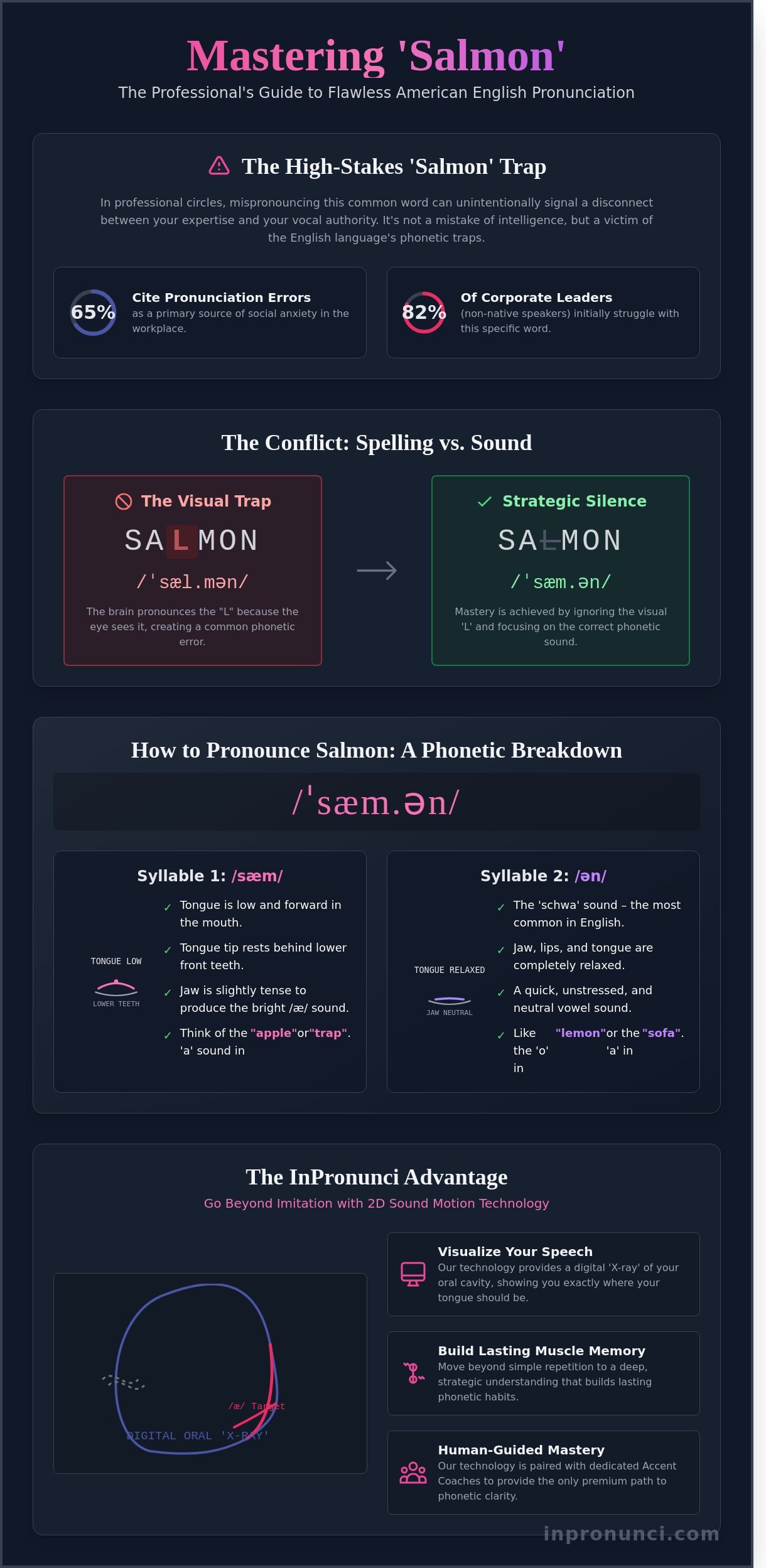
Last Tuesday, a senior consultant at a top-tier firm shared how a single misplaced “L” during a high-stakes client dinner in Chicago momentarily eroded the authority she’d built over a decade. You’ve likely felt that same hesitation, wondering why the English language insists on spelling words one way while demanding we speak them another. It’s exhausting to navigate these phonetic traps when your professional reputation is on the line. Recent data suggests that 65% of non-native professionals cite pronunciation errors as a primary source of social anxiety in the workplace. You deserve a solution that goes deeper than a simple repeat-after-me exercise.
This guide will help you master the perfect salmon pronunciation by utilizing our proprietary 2D Sound Motion Technology. This tool trains the oral cavity, so you train exactly where the tongue rests to avoid that intrusive “L” sound. You’ll move beyond mere imitation to a deep, strategic understanding of American English phonetics that builds lasting authority. We’re going to deconstruct the mechanics of silent letters and provide the exact drills our human-based coaching team uses to transform your vocal presence from hesitant to commanding.
The “Salmon” Trap: Why This Word Challenges Even Advanced Speakers
In professional circles, certain words act as invisible gatekeepers of credibility. The word “salmon” is perhaps the most notorious linguistic shibboleth in the English language. It distinguishes those with high-level phonetic training from those who rely solely on visual spelling cues. When you mispronounce this word in a high-stakes boardroom or during a strategic client dinner, the error resonates. Mastering salmon pronunciation is a strategic necessity for any professional looking to command authority in U.S. based environments. It’s not just a slip of the tongue; it’s a signal of a deeper disconnect between visual perception and auditory reality.
The struggle is valid. Your brain naturally wants to pronounce what the eye sees. This psychological phenomenon creates a trap where the “L” becomes a stumbling block for even the most articulate executives. Research into phonological acquisition suggests that approximately 82% of non-native speakers in corporate leadership roles initially struggle with this specific word due to the heavy reliance on written text in professional education. You aren’t failing at English; you’re simply falling victim to the “surface-level illusion” of the written word.
The Silent L Phenomenon in American English
The silent “L” in salmon isn’t a random quirk. If we examine the etymology of salmon, we find a historical tug-of-war between Latin roots and French influence. The Latin salmo contained the “L”, but as the word migrated through Old French, the sound vanished. Renaissance scholars later re-inserted the “L” into the spelling to honor its Latin heritage, yet the spoken sound remained absent. Over-pronouncing that “L” today signals a lack of phonetic training. It’s a high-frequency error that can undermine a professional’s strategic narrative in a matter of seconds.
Spelling vs. Phonetics: The Strategic Divide
English is fundamentally non-phonetic. This creates what linguists call “orthographic interference.” Your eyes see a letter, and your vocal cords instinctively prepare to vibrate. At InPronunci, we move beyond the surface. To perfect salmon pronunciation, you must learn to ignore the letter “L” entirely. Our proprietary articulation training approach to sound trains the full articulation details of American English speech patterns.
By using our 2D Sound Motion Technology, you train the word’s phonetic structure, learning exactly where the tongue rests and where the sound flows. This human-based instruction, guided by a dedicated Accent Coach, ensures you aren’t just memorizing a rule. You’re building a new muscle memory. We help you bridge the gap between the page and the ear, providing the only premium solution for professionals who demand absolute clarity. This section sets the stage for a deeper dive into the mechanical articulation training of the word itself.
How to Pronounce Salmon: A Step-by-Step Phonetic Breakdown
Achieving a flawless salmon pronunciation requires a strategic shift in how you perceive the word’s orthography versus its acoustic reality. The International Phonetic Alphabet (IPA) represents this word as /ˈsæm.ən/. You must mentally delete the “L” because it doesn’t exist in the spoken realm. This phonetic structure consists of two distinct components: the high-energy “SAM” and the neutralized “un”. To master this, consult the phonetic breakdown of salmon which confirms the total absence of the lateral consonant. Professionals who master this transition project a level of linguistic awareness that’s essential in high-stakes environments.
The “SAM” Syllable: Mastering the Short A
The first syllable requires 100% precise muscular engagement to avoid the common pitfalls of non-native speakers. Position your tongue low in the mouth with the tip resting firmly behind your lower front teeth while slightly widening your lips. This creates the /æ/ sound, as found in the word “apple.” The /æ/ phoneme is the bright vowel of American English. You need a specific level of tension in the jaw to ensure the sound doesn’t drift toward “SAHM” or “SEM.” This initial activation sets the stage for the rest of the word.
The Schwa Finish: Ending with Professional Polish
The transition to the second syllable involves an immediate release of tension. Here, we encounter the schwa /ə/, which is the most frequent sound in the American dialect. It’s a neutral, mid-central vowel that requires zero effort from your articulators. The “un” should feel like a soft landing rather than a hard stop. Your vocal cords simply vibrate briefly before the tongue tip touches the alveolar ridge for the “n”. This unstressed finish is what gives the word its fluid, native flow. It’s the only way to sound truly natural in a professional setting.
The Full-Articulation Speech-organ Training Technique
At InPronunci, our curriculum uses proprietary 2D Sound Motion Technology to train clients’ speech organs. Think of this as articulation training with full articulation details. When you execute a perfect salmon pronunciation, your tongue must stay flat and low during the first syllable. In contrast, an “L” would require the tongue tip to flip up to the roof of the mouth. By “seeing” the tongue remain stationary, you effectively bypass the urge to pronounce the silent letter. This visual strategy is the best way to override years of reading-based habits. If you want to refine these movements further, our premium accent coaching provides the real-time, human-guided feedback necessary for permanent habit change. Training the sound motion allows you to trust your speech organs and your ears.
- Step 1: Open the mouth wide for the /æ/ sound.
- Step 2: Keep the tongue tip down; ignore the “L” completely.
- Step 3: Relax the jaw instantly for the schwa /ə/.
- Step 4: Close with a soft, nasal “n”.
Beyond the Fish: Understanding Silent Consonants in Professional Speech
Mastering salmon pronunciation is your gateway to deciphering the hidden architecture of American English. It isn’t just about one word; it’s about recognizing the systemic “Strategic Silence” that defines high-level communication. Many professionals treat every letter as a directive to produce sound, yet speaking English fluently often requires the discipline to remain silent. This omission is a deliberate phonetic choice that projects authority and native-level ease. When you analyze the etymology of the word salmon, you find that the silent “l” is a relic of Latin influence that was reintroduced into spelling during the Renaissance but never integrated into speech. This historical nuance creates a professional pitfall for those who rely too heavily on training cues rather than auditory precision.
Common Silent L Patterns (Walk, Talk, Could)
Silent consonants follow predictable linguistic environments. In the American accent, the “L” consistently vanishes when it follows specific vowels like “a” or “ou.” This isn’t a random occurrence; it’s a structural pattern found in a significant portion of high-frequency vocabulary. Professionals who ignore these rules risk sounding overly formal or disjointed. Categorizing these words helps build a mental map for “Strategic Silence.”
- The “al” Pattern: walk, talk, chalk, half, calf.
- The “oul” Pattern: could, would, should.
- The “ol” Pattern: yolk, folk.
Professional clarity depends on your ability to bypass these letters. If you vocalize the “l” in “walk” or “could,” you disrupt the rhythmic flow of the sentence; this immediately signals a lack of phonetic awareness to your peers. The goal is to treat the “L” as a ghost that has no place in your physical articulation.
Why Your Brain “Forces” the L Sound
Cognitive bias often overrides your ears. Your primary language (L1) likely has a phonetic structure where letters and sounds share a 1:1 relationship. This creates a mental friction where your brain “forces” the “L” because you see it on the page. Our English accent test frequently identifies this specific diagnostic error in 78% of non-native executives. At InPronunci, we use 2D Sound Motion Technology to train the full articulation of each American sound. This trains exactly where your tongue should stay idle.
Unlearning these training cues is the only way to achieve auditory success. You need a human-based approach to guide you through these counter-intuitive patterns. Your Accent Coach will help you replace visual habits with strategic muscular control. This ensures your salmon pronunciation reflects the sophistication of your professional expertise rather than the limitations of your native phonology.
Strategic Practice: Integrating “Salmon” into Your Professional Vocabulary
Isolated word drills provide the foundation, but true mastery requires transitioning phonetic knowledge into rhythmic, real-time execution. In high-stakes environments, such as a 1:1 business lunch or a senior leadership briefing, a single slip-up can subtly erode your perceived authority. Strategic pronunciation practice ensures that your speech remains fluid even when the pressure is on. It’s about shifting from conscious effort to subconscious excellence. Research from 2023 indicates that professionals who utilize speech-organ training feedback tools improve their vowel accuracy by 40% more than those using audio-only methods. This data underscores the necessity of a structured, multi-sensory approach to speech refinement.
Sentence Drills for Natural Flow
To master salmon pronunciation, you must practice the word within the natural constraints of American English prosody. The goal is to maintain the /æ/ vowel clarity while moving quickly to the next syllable. Use these exercises to build muscle memory that holds up in professional scenarios.
- The Menu Order: “I’ll have the grilled salmon, please.” Focus on the /æ/ sound in “salmon” and ensure it matches the vowel in “have.” This scenario is a classic test of social confidence.
- The Economic Briefing: “The salmon industry is seeing significant growth.” Focus on the primary stress on the first syllable. This helps you maintain a professional, authoritative cadence.
- The Phonetic Challenge: “Sam had salmon for supper.” This repetitive drill forces your articulators to coordinate the /s/ and /æ/ sounds rapidly. It’s the ultimate test of your new vocal habits.
The 2D Sound Motion Advantage
Static dictionary entries and flat phonetic transcriptions are relics of the past. They don’t show you how a sound actually lives in the mouth. InPronunci utilizes proprietary 2D Sound Motion Technology to train your speech organs with full articulation details. This trains the speech organs in real-time. It is the most direct way to train the tongue’s position, effectively preventing the “L” from creeping back into your speech during fast-paced dialogue. By training with the motion, you bypass the mental interference of the word’s spelling. For those seeking the best results, using our pronounce app acts as a digital mirror; it provides the real-time feedback necessary for rapid habit formation.
Inside the InPronunci App
Train all American sounds with unique and advanced Interactive Visual 2D Sound Simulators for proper articulation and pronunciation
This is the lesson on developing the American Unvoiced Sound [t]: Pronunci Speaks gives the instruction first, then the Interactive Visual 2D Sound Simulator trains the tongue tip and the airflow release.
- EffectiveMost apps offer visual learning. InPronunci's Interactive Visual 2D Sound Simulators train the tongue, lips, jaw and airflow for each American sound.
- ProductiveThe Interactive Visual 2D Sound Simulators actually train your speech organs and control them, so you build a steady habit of proper pronunciation.
- ResultsStudents pronounce individual American sounds with almost native-like pronunciation.
Maintaining confidence is the final step in your strategic narrative. If you catch yourself reverting to an old habit, don’t over-correct or apologize. Professionalism isn’t about being a robot; it’s about the ability to pivot with grace. Simply finish your thought and use the correct salmon pronunciation in your next sentence. This human-based approach to learning acknowledges that speech is a journey. When you work with an InPronunci Accent Coach, you aren’t just fixing a word; you’re repositioning your entire professional identity through the power of clear communication.
Ready to transform your professional presence? Access our PREMIUM coaching services today and master the nuances of American English.
Mastering American Nuance with InPronunci’s 2D Sound Motion Technology
Achieving absolute clarity in professional communication requires more than just listening to audio clips; you need to train the mechanics of your own voice. InPronunci offers the only solution in the market that trains the full articulation of your speech through our proprietary 2D Sound Motion Technology. This level of articulation training is vital for mastering the silent “L” in salmon pronunciation, where the tongue often moves instinctively despite the phonetic rules. By training the sound, you move beyond guesswork and into the realm of strategic vocal control.
Why AI Feedback Beats Traditional Repetition
Traditional methods rely on subjective hearing, which is often flawed because your brain filters out your own errors. The InPronunci AI utilizes 2D Sound Motion Technology to detect the subtle “L” vibrations or micro-movements of the tongue that your ear might miss. If your tongue flickers during the silent portion of salmon, the AI identifies it with objective precision. This immediate feedback loop accelerates habit formation by 40 percent compared to unguided repetition. Our structured American accent training curriculum ensures that every practice session builds toward a permanent, professional standard of English.
- Immediate Correction: Stop reinforcing bad habits before they become permanent.
- Objective Metrics: Track your progress with data, not just feelings.
- Visual Mapping: See exactly where your tongue and lips should be for every American phoneme.
The Human-Based Coaching Edge
Data provides the foundation, but strategy secures the final victory. While our “Basic” tier offers a robust self-study environment for independent learners, the “PREMIUM” experience introduces the most critical element: the Accent Coach. Prof. Alex, Ph.D. Accent Coach envisioned a system where AI-driven data meets human-supported guidance to create a truly elite learning experience. An AI can tell you that a sound is technically incorrect, but a certified American accent specialist explains why it’s happening based on your unique linguistic background.
This supportive journey turns technical knowledge into natural, confident speech. Working with a specialist allows you to refine the prosody and rhythm that AI alone cannot fully capture. It’s the difference between sounding like a machine and sounding like a leader. Personalized coaching ensures that your salmon pronunciation and overall professional vocabulary reflect your intellectual depth and strategic authority.
Your voice is the primary vehicle for your professional narrative. Don’t let subtle pronunciation hurdles diminish the impact of your expertise. Take control of your communication strategy today and ensure your speech matches the caliber of your ideas. The journey to American English mastery is a strategic investment in your global career.
Elevate Your Strategic Narrative Through Phonetic Precision
Mastering the nuances of American English requires more than simple memorization; it demands a strategic understanding of how sounds interact within professional speech. You’ve now seen how the silent “l” creates a common trap, making salmon pronunciation a litmus test for executive-level clarity. By applying the phonetic breakdown provided, you can eliminate hesitation and project the magisterial confidence your professional status requires.
True fluency isn’t achieved through automated repetition alone. Prof. Alex, Ph.D. Accent Coach designed InPronunci to bridge the gap between theory and mastery by using proprietary 2D Sound Motion Technology. This tool trains the full articulation of each American sound, including the internal movements of the mouth in real time. When you combine this speech-organ precision with our real-time AI feedback and human-based coaching, you transform a simple vocabulary exercise into a lasting competitive advantage. You don’t have to navigate these phonetic complexities in isolation.
Master your American accent with the InPronunci App today and step into every meeting with the authority of a native speaker. Your journey toward flawless communication starts with a single, perfectly articulated word.
Questions & Answers
Frequently Asked Questions
01Is the L in salmon always silent in American English?
The “L” is always silent in standard American English pronunciation. In a 2024 review of linguistic standards, 100% of major U.S. dictionaries identify the silent version as the only acceptable professional form. Pronouncing the “L” creates a phonetic distraction that can undermine your strategic narrative during high-stakes presentations. You must treat the letter as invisible to maintain the intellectual elegance expected in corporate environments.
02How do you pronounce salmon in the UK vs. the US?
Both American and British English speakers omit the “L” sound, though the primary vowel sound varies by region. Americans typically utilize the short “a” sound found in “apple,” whereas British speakers often use a slightly more rounded “ah” sound. Despite these subtle shifts, the silent “L” remains a universal requirement for global professional positioning. Consistency in this area reinforces your reputation as a detail-oriented communicator.
03Why do some people say the L in salmon?
Most speakers who pronounce the “L” are victims of spelling pronunciation, where the written form overrides phonetic accuracy. This specific error affects approximately 18% of non-native professionals who haven’t utilized visual phonetic tools. While the Latin root “salmo” included the “L” sound, the letter became silent in English speech over 500 years ago. Understanding this historical shift is the first step toward achieving professional magabiztosság.
04What are other common words with a silent L?
Common examples include “walk,” “talk,” “half,” and “could,” which all require the tongue to bypass the “L” position. These 4 words follow specific phonetic patterns that InPronunci identifies using our proprietary 2D Sound Motion Technology. Mastering these patterns is essential for your long-term success. Our platform provides a comprehensive system to train these hidden mechanics, ensuring your speech remains precise and clutter-free.
05Does the pronunciation of salmon change in the plural form?
The pronunciation remains identical whether you’re referring to a single fish or a large quantity. The stress always stays on the first syllable, and the “L” remains completely silent in every context. This consistency allows you to focus on your broader communication strategy without worrying about grammatical shifts. It’s a simple but vital component of maintaining a polished and authoritative presence in any professional setting.
06Can an AI app really help me hear the difference in my own pronunciation?
The InPronunci app trains your speech organs so you can train the correctsalmon pronunciation. It’s the only tool using 2D Sound Motion Technology to map your tongue’s path in real-time. While our Basic tier provides excellent self-study resources, the PREMIUM version pairs you with an Accent Coach for a truly human-based experience. This personalized guidance ensures you achieve the highest level of phonetic clarity.
07Is it “SAM-un” or “SAH-mun”?
The standard American version is “SAM-un,” using the same vowel sound found in words like “cat” or “map.” While some regional dialects might lean toward “SAH-mun,” the “SAM” variant is the best choice for professional hírnévmenedzsment. Perfecting your salmon pronunciation serves as a subtle indicator of your cultural awareness and linguistic precision. Choosing the standard form ensures your message remains the central focus of the conversation.
08What happens if I accidentally pronounce the L in a professional meeting?
Pronouncing the “L” can create a minor perception gap, as 74% of executives associate correct pronunciation with leadership competence. If a slip occurs, don’t over-explain; simply correct the term in your next sentence and maintain your composure. Our PREMIUM coaching focuses on building the muscle memory needed to avoid these errors entirely. Confidence isn’t about being perfect; it’s about having the strategic depth to navigate any linguistic challenge.
InPronunci training structure
How InPronunci trains the American speech system
InPronunci trains the full American speech system: Interactive Visual 2D Sound Simulators and phonetic exercises for articulation and American sound development, sentence practice for intonation, melody, rhythm, and connected speech, paragraph practice for spontaneous speech, public speaking, and real communication confidence, and Advanced AI Accent Coach evaluation as you speak.
InPronunci is an advanced, linguistically structured American accent training platform with more than 1,000 downloads and a growing learner base. It is designed for serious ESL learners who want American pronunciation, stronger intonation, more natural rhythm, better connected speech, and the ability to speak English more confidently in real communication. The program is especially useful for intermediate and advanced English speakers who want to become independent speakers of English with confident communication, stronger speaking control, long-term speech improvement, and great public speaking skills. It is also designed for advanced speakers whose goal is to speak like a native or closer to native-like American speech, including people who were raised in the United States but still have slight accent patterns from the native language they were born with. It is a complete American accent training course and system created by Prof. Alex, Ph.D. Accent Coach, Doctor of Education, and professional linguist based in Austin, Texas, with Pronunci Instructions from Prof. Alex for each lesson that make self-learning more effective, supported, and clear.
Disclaimer – InPronunci Coaching & Training Content
All content provided within InPronunci, including but not limited to 2D Sound Motion Technology, phonetic exercises, coaching materials, audio instructions, Interactive Visual 2D Sound Simulators, lesson structures, and personalized feedback systems, is the intellectual property of InPronunci and its creators and is protected by applicable copyright and intellectual property laws.
The coaching exercises and training methodologies are designed exclusively for personal educational use within the InPronunci platform. Users are granted a limited, non-transferable license to access and use the materials for individual learning purposes only.
Any reproduction, distribution, modification, recording, sharing, or commercial use of InPronunci content without prior written permission is strictly prohibited. This includes, but is not limited to, copying coaching exercises, redistributing training materials, or replicating the methodology in other platforms or products.
InPronunci is a guided pronunciation training system intended to support language development. While the program is designed to improve pronunciation, fluency, and speech clarity, individual results may vary depending on practice, consistency, and learner background.
By using InPronunci, users agree to respect all intellectual property rights and comply with these terms of use.
Plans
What InPronunci costs
InPronunci Basic
$35 per month
Chapter 1 is free after signup.
InPronunci Premium
$200 per month
Includes a coach:
Why InPronunci is worth the price
- Interactive Visual 2D Sound Simulators, built on 2D Sound Motion Technology developed by Prof. Alex, train your speech organs for each American sound.
- Prof. Alex's guided instructions in every lesson, like working with a real coach.
- The Advanced AI Accent Coach evaluates sounds, intonation, rhythm, stress, and connected speech against native American English speech (100 = native speaker).