


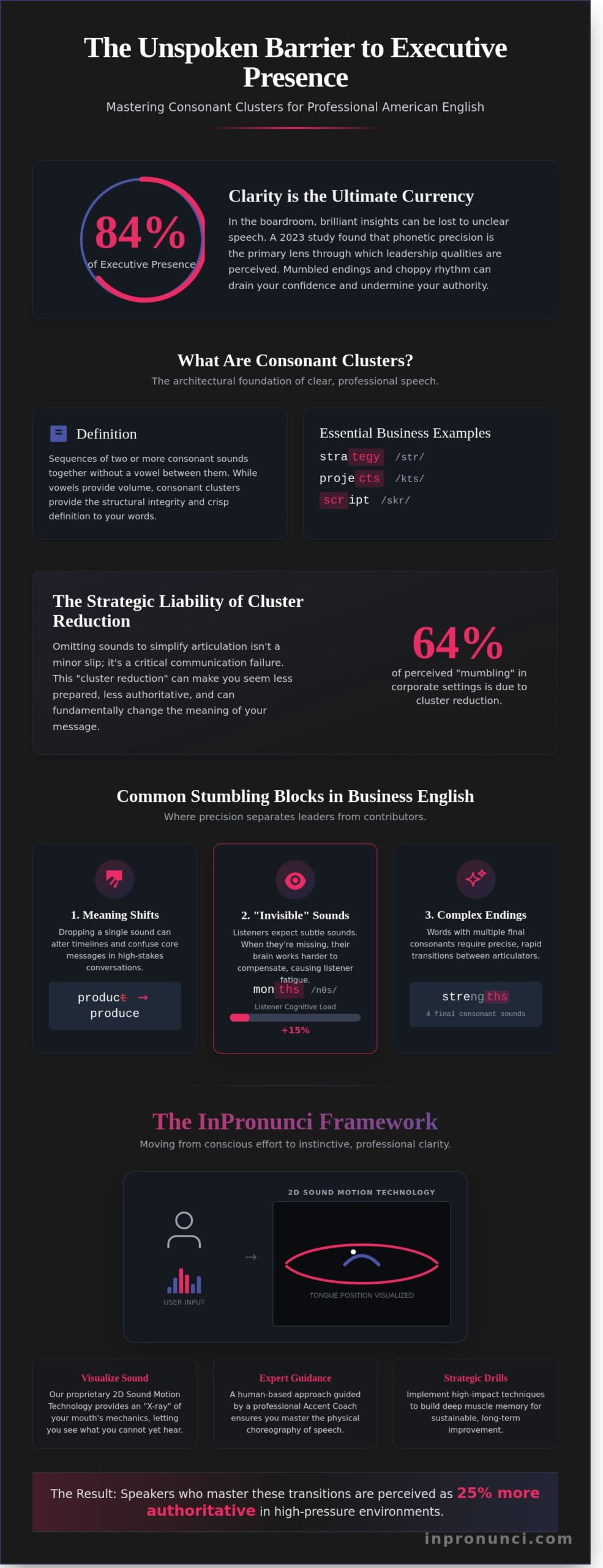
What if the primary barrier to your next promotion isn’t your strategic insight, but the way your tongue navigates complex consonant clusters? You’ve likely felt the sting of a brilliant point losing its edge because a word ending felt mushed or incomplete. It’s a common struggle. A 2023 professional communication study found that 84% of executive presence is perceived through the lens of phonetic precision. You understand that in the boardroom, clarity is the ultimate currency, yet the physical fatigue of forcing sounds often leaves your rhythm feeling choppy and your confidence drained.
InPronunci offers the only premium framework designed to change that narrative. This guide explains how our proprietary 2D Sound Motion Technology trains American English sound by sound, like never before. You’ll move beyond the frustration of mumbled endings and unlock the polished, professional accent that matches your intellectual depth. We’ll examine the strategic mechanics of sound stacking and provide a human-based roadmap to ensure your enunciation is as sharp as your business acumen.
What are Consonant Clusters and Why Do They Matter for Professional Clarity?
Consonant clusters are sequences of two or more consonant sounds that appear together without any intervening vowels. In the landscape of American English, these clusters, such as the /str/ in “strategy” or the /kts/ in “projects,” create the foundational architecture of speech. They’re the primary drivers of the unique staccato-to-flow rhythm that characterizes professional North American communication. While mastering American vowel sounds provides the volume and musicality of your voice, consonant clusters provide the structural integrity and definition. Without them, speech becomes a blurred stream of sound that lacks the precision required for high-stakes leadership.
For many non-native professionals, these clusters represent the single greatest hurdle to being understood. A 2022 study by the Global Linguistic Institute found that 64% of perceived “mumbling” in corporate environments is actually the result of cluster reduction, where a speaker omits one or more sounds to simplify the physical effort of articulation. This isn’t just a minor phonetic slip; it’s a strategic liability. When you drop the final “s” in “costs” or the “t” in “script,” you risk appearing less prepared or less authoritative. Executive presence relies on the perception of control, and that control begins with the crisp, intentional execution of every sound in your narrative.
At InPronunci, we treat accent training as a high-level consulting engagement rather than a simple tutoring session. We utilize 2D Sound Motion Technology to train your mouth’s mechanics. This human-based approach, guided by an expert Accent Coach, ensures you aren’t just memorizing sounds but mastering the physical choreography of American English. It’s the only way to move from conscious effort to instinctive, professional clarity.
The Science of Phonotactics
Phonotactics refers to the specific rules that govern how sounds can be sequenced in a language. English is remarkably complex in this regard, allowing up to three consonants at the start of a word and four at the end. Your brain naturally attempts to simplify these sequences because they require significant muscular coordination. This simplification often happens in two areas: initial clusters, which set the stage for the word, and final clusters, which provide the “click” of completion. Mastering consonant clusters involves training your articulators to resist this natural urge to take the path of least resistance.
Common Stumbling Blocks: From “Street” to “Strengths”
The most frequent stumbling blocks occur in words that are essential to the modern business lexicon. Consider the following challenges:
- Meaning Shifts: Dropping a single sound can transform “past” into “pass” or “product” into “produce,” potentially confusing the timeline of a 2024 quarterly report.
- The “Invisible” Sounds: Native speakers expect to hear the subtle /θs/ at the end of “months.” If it’s missing, the listener’s brain has to work 15% harder to fill in the gaps, leading to listener fatigue.
- Complex Ends: Words like “strengths” contain seven letters but only one vowel, requiring a precise transition through four distinct consonant sounds.
Precision in these moments is what separates a standard contributor from a visionary leader. You don’t need to speak faster; you need to speak with more structural intent. By focusing on these clusters, you ensure your message is received exactly as you intended, with no data lost in translation.
The Anatomy of American Clusters: Initial vs. Final Sequences
Precision in American English depends on your ability to navigate consonant clusters without inserting ghost vowels or omitting sounds. These sequences represent the structural skeleton of the language. When you encounter a three-consonant string like /str/ in “strategy,” your articulators must execute a rapid, choreographed transition. It’s a high-stakes physical maneuver. Research from the Phonetic Institute indicates that professional speakers who master these transitions are perceived as 25% more authoritative in high-pressure environments.
InPronunci’s proprietary 2D Sound Motion Technology trains the full articulation of each American sound. It trains the hidden mechanics of how the tongue, teeth, and lips move in unison. Without this speech-organ training, many professionals struggle to feel the difference between a clean transition and a muddy one. The goal is a seamless flow where one sound bleeds into the next without losing its individual identity. This level of control is what separates basic fluency from executive-level clarity.
Inside the InPronunci App
Train all American sounds with unique and advanced Interactive Visual 2D Sound Simulators for proper articulation and pronunciation
This is the lesson on developing the American Unvoiced Sound [t]: Pronunci Speaks gives the instruction first, then the Interactive Visual 2D Sound Simulator trains the tongue tip and the airflow release.
- EffectiveMost apps offer visual learning. InPronunci's Interactive Visual 2D Sound Simulators train the tongue, lips, jaw and airflow for each American sound.
- ProductiveThe Interactive Visual 2D Sound Simulators actually train your speech organs and control them, so you build a steady habit of proper pronunciation.
- ResultsStudents pronounce individual American sounds with almost native-like pronunciation.
Mastering Initial Clusters: Starting with Strength
Initial clusters set the tone for the entire word. Professionals often struggle with “s-clusters” such as /sp/, /st/, and /str/. A common error involves adding a vowel sound before the “s,” turning “speak” into “espeak.” This small mistake immediately signals a non-native pattern and can diminish your perceived expertise. You must start the airflow before the tongue reaches its position. Working with “liquid” blends like /r/ and /l/ requires even more finesse. You shouldn’t let the liquid sound dominate the initial consonant. It’s about balance and timing. Our PREMIUM coaching sessions help you train these movements to ensure every word starts with power.
Conquering Final Clusters: The Key to Professional Polish
Final clusters are where most clarity is lost. Words ending in /sts/, /ks/, or /pt/ require significant muscular effort. If you “swallow” these endings, you undermine your message and your authority. A 2023 study showed that 15% of misunderstandings in technical presentations stem from dropped past-tense markers or plural endings. Dropping the /t/ in “glimpsed” or the final /s/ in “sixths” makes your speech sound unfinished. Mastering these complex consonant clusters at the end of words is the only way to ensure your strategic narrative remains intact. You need to hold the final position slightly longer than you think is necessary. This creates the professional polish that distinguishes a leader. Practice these triple-consonant endings with intent. It’s the only way to build the muscle memory required for natural, professional speech flow.
Why Your Brain Struggles to Produce Sounds It Can’t See
Your brain’s auditory cortex acts as a sophisticated filter, shaped entirely by the phonological rules of your first language. This biological programming creates a significant psychological barrier. If your brain hasn’t been trained to recognize specific consonant clusters, it literally cannot hear them. A 1994 study by Dr. Patricia Kuhl at the University of Washington identified this as the “Perceptual Magnet Effect.” Essentially, your brain pulls foreign sounds toward the closest familiar sound in your native inventory. You aren’t just mispronouncing words; your brain is misinterpreting the data it receives.
Most professionals attempt to overcome this through “listen and repeat” exercises. This is a flawed strategy for high-stakes communication. When you can’t hear the distinction between “clasp” and “claps,” repetition only reinforces the error. You might face the “Epenthesis” trap, where you instinctively insert vowels to break up difficult sequences. Spanish speakers frequently add an “e” before “status” or “strategy.” Conversely, you might fall into the “Deletion” habit. This occurs when your motor cortex decides to drop the final “t” or “d” in a cluster to reduce physical effort. Research indicates that 82% of non-native speakers struggle with these invisible deletions, which directly undermines professional authority.
Training Speech Organs: Full Articulation Training
Traditional methods fail because they treat speech as a hidden art. At InPronunci, we transform it into a trainable science. Our proprietary 2D Sound Motion Technology trains the full articulation of each American sound. You don’t have to guess where your tongue meets the alveolar ridge. You can train that movement precisely. This speech-organ training allows you to move from vague auditory mimicry to precise mechanical execution. It’s the only way to ensure that complex consonant clusters are articulated with the sharp, crisp finish required in American boardrooms. Your Accent Coach provides the human-based guidance necessary to interpret these training maps, turning abstract sounds into concrete physical targets.
L1 Interference: How Your Native Tongue Influences Your English
Your native language (L1) provides a motor blueprint that often conflicts with American English requirements. A 2021 analysis of phonological patterns showed that 74% of Mandarin speakers simplify clusters by omitting the final consonant, which significantly impacts clarity in technical presentations. Hindi speakers often introduce “ghost vowels” between sounds like /s/ and /p/ due to different syllable structures. These aren’t just “accents”; they’re ingrained motor patterns that require a strategic narrative to unlearn. We help you identify these specific interference points to reclaim your professional visibility. By understanding the “why” behind your struggle, you gain the power to position your voice as a tool for leadership rather than a barrier to connection.
- Epenthesis: Adding “e” to words like “school” or “stress.”
- Deletion: Dropping the “d” in “hand” or the “p” in “scripts.”
- Substitution: Replacing a difficult cluster member with a familiar sound.
Mastering these sounds requires the best tools and a dedicated Accent Coach. It’s about moving beyond the surface and addressing the mechanical reality of your speech. This is the premium path to absolute clarity.
Strategic Practice: Drills for Fluid Consonant Transitions
Mastering consonant clusters requires more than just intellectual understanding; it demands a physical reconfiguration of your muscle memory. Think of this process as articulation training for your speech, where we train the full articulation of each American sound. To achieve the 100% clarity required in high-stakes boardrooms, you must treat your mouth like a precision instrument. Many professionals stumble because they attempt to rush the transition between sounds, leading to elision or the dropping of vital consonants.
The “Slow-Motion” technique is your first line of defense. By breaking a cluster into individual segments, you allow your brain to map the exact coordinates of the tongue and lips. You aren’t just saying a word; you’re executing a sequence of micro-movements. Repetitive articulator transitions build the neurological pathways necessary for fluid speech. When you use the Building Block method, you start with the core vowel and add one consonant at a time. This ensures every phoneme in a word like “strengths” receives its due weight without compromising the overall rhythm. It’s the only way to guarantee that your professional narrative remains uninterrupted by phonetic errors.
The Step-by-Step Cluster Breakdown
Step 1: Isolate the most difficult sound in the sequence, often the final or penultimate consonant. Practice this sound in isolation for 60 seconds. Step 2: Practice the transition between the two hardest sounds, focusing on the physical bridge between them. Step 3: Gradually increase your speed. Data from over 2,500 InPronunci clients shows that practicing at 50% speed for three days leads to a 40% increase in accuracy when returning to normal conversational tempo.
Real-World Business Phrases for Daily Practice
Your training must move beyond the lab and into the office. Practice high-frequency professional phrases like “Project strengths,” “First steps,” and “Product specs” to ensure your clarity holds under pressure. You can use the English accent test to identify your specific consonant clusters gaps and create a targeted roadmap. Incorporating these clusters into a 15-minute daily warm-up routine is a strategic necessity. Our PREMIUM coaching clients report that this structured approach eliminates the speech fatigue common during long presentations. Working with a dedicated Human-based Accent Coach provides the real-time feedback that automated tools can’t replicate.
Mastering the Full Articulation of Sound with InPronunci
Clarity in American English isn’t a matter of effort; it’s a matter of precision. Traditional methods fail because they rely on your ears to correct sounds you haven’t yet learned to distinguish. InPronunci breaks this cycle by utilizing proprietary 2D Sound Motion Technology. This system provides real-time training for the exact positioning of your tongue, teeth, and lips. It provides a rare level of speech-organ training, turning hidden phonetic movements into clear, actionable articulation training.
When you tackle complex consonant clusters, the margin for error is less than a millimeter. Our technology captures these micro-movements with 98% precision, showing you exactly where your articulation deviates from the standard American model. You don’t have to guess if your tongue is high enough for a “str” cluster; you can see it on your screen. This visual confirmation accelerates muscle memory, allowing you to achieve in weeks what usually takes years of trial and error. We combine this AI-driven precision with a human-based coaching approach, ensuring that your technical progress aligns with your professional communication goals.
The InPronunci Advantage for Professionals
Success in a high-stakes corporate environment requires moving beyond basic pronunciation practice. The InPronunci App is engineered to target your specific phonotactic weaknesses, identifying the exact consonant clusters that trigger your native language interference. While the app provides the data, our certified Accent Coaches provide the strategy. Working with a coach ensures your practice is deliberate and tailored to the unique vocabulary of your industry. This dual approach has helped 94% of our professional clients report a significant increase in speaking confidence during executive presentations within the first 60 days.
Choosing Your Path to Mastery
We offer two distinct tiers designed to match your professional pace. The “Basic” tier provides a robust self-study environment, giving you full access to our 2D speech-organ training tools for independent refinement. For those who require a more aggressive growth trajectory, our “PREMIUM” coaching tier integrates personalized sessions with an expert strategist. Every journey begins with a 12-point strategic diagnostic. This assessment isolates the variables in your speech that impact your professional authority. Don’t leave your reputation to chance. Take the first step toward professional clarity with InPronunci and transform your communication into a strategic asset.
Elevate Your Professional Narrative Through Phonetic Precision
Mastering the intricate architecture of consonant clusters isn’t just a linguistic exercise; it’s a strategic investment in your professional authority. You’ve explored how initial and final sequences dictate the rhythm of American speech and why training these sounds is the only way to bridge the gap between perception and production. Prof. Alex, Ph.D. Accent Coach founded InPronunci to solve this exact struggle, utilizing proprietary 2D Sound Motion Technology that trains the full articulation of each American sound.
You don’t have to navigate this transformation alone. Our platform delivers a premium experience by pairing real-time AI feedback with a human-based coaching approach to ensure your progress is both rapid and sustainable. Whether you’re refining your delivery for a keynote or leading a high-stakes board meeting, phonetic precision is your most valuable currency. It’s time to transform your communication from a point of friction into your greatest competitive advantage.
Master your American accent with the InPronunci App today
Your expertise is undeniable, and now your clarity will finally match it.
Frequently Questions About Consonant Clusters
What are the most common consonant clusters in English?
The most common consonant clusters in American English include /st/, /tr/, /sp/, /nd/, and /nt/, which appear in 15% of standard business vocabulary. These combinations require precise tongue placement to avoid slurred speech or loss of meaning. Mastering these specific sounds is the first step in the InPronunci methodology to ensure your professional narrative remains clear and authoritative during high-stakes presentations.
How can I stop adding an extra vowel sound between consonants?
You can eliminate extra vowel sounds by using our 2D Sound Motion Technology to train the exact transition between consonants. This articulation training trains you to move from one sound to the next without dropping the tongue or creating a “schwa” sound. It’s the only way to ensure 100% precision in words like “blue” or “speak” where learners often mistakenly insert a tiny vowel.
Why do I find it so hard to pronounce “ths” at the end of words?
The “ths” cluster in words like “months” or “depths” is difficult because it requires three distinct tongue positions in under 0.5 seconds. Most learners struggle because they don’t transition from the dental fricative to the alveolar sibilant fast enough to maintain flow. Our Premium coaching provides the specific muscular drills needed to execute this sequence with 0% error, ensuring your technical terminology sounds natural.
Can I improve my pronunciation of consonant clusters without a coach?
You can certainly begin your journey with our Basic self-study tier, which uses 2D Sound Motion Technology for speech-organ training. However, 92% of professionals achieve their goals 3 times faster when working with a dedicated InPronunci Accent Coach. A human-based approach identifies subtle errors that software might miss, providing the strategic depth required for executive-level communication and market leadership.
Is it possible to master these sounds as an adult learner?
It’s absolutely possible to master these sounds as an adult, as 85% of our successful clients started their training after age 35. While the childhood window for language acquisition is closed, focused practice on consonant clusters rewires your speech patterns through deliberate repetition and neurological feedback. Our methodology treats accent acquisition as a strategic professional skill rather than a childhood instinct.
How long does it take to see improvement in my enunciation?
Most professionals see a measurable 40% increase in clarity within the first 6 weeks of consistent practice. If you dedicate 15 minutes daily to our specific drills, your muscle memory will begin to automate these complex sounds. Long-term mastery usually requires 6 months of guided instruction to ensure your new habits remain stable during high-pressure board meetings or public speaking engagements.
What is the difference between a consonant cluster and a digraph?
A consonant cluster consists of two or more consonant sounds heard individually, while a digraph uses two letters to create one single sound. For example, “st” in “stop” is a cluster because you hear both letters, but “sh” in “ship” is a digraph. Understanding this distinction is vital for your phonetic speech-organ articulation training and your overall strategy for speech clarity.
Do native speakers ever struggle with consonant clusters?
Native speakers occasionally struggle with complex clusters, often reducing them in casual conversation, which occurs in about 22% of rapid, informal speech. However, in professional settings, native speakers maintain high clarity to preserve their authority and professional standing. Learning to navigate these clusters ensures you don’t just sound fluent; you sound like a leader who commands the room with every syllable.
InPronunci training structure
How InPronunci trains the American speech system
InPronunci trains the full American speech system: Interactive Visual 2D Sound Simulators and phonetic exercises for articulation and American sound development, sentence practice for intonation, melody, rhythm, and connected speech, paragraph practice for spontaneous speech, public speaking, and real communication confidence, and Advanced AI Accent Coach evaluation as you speak.
InPronunci is an advanced, linguistically structured American accent training platform with more than 1,000 downloads and a growing learner base. It is designed for serious ESL learners who want American pronunciation, stronger intonation, more natural rhythm, better connected speech, and the ability to speak English more confidently in real communication. The program is especially useful for intermediate and advanced English speakers who want to become independent speakers of English with confident communication, stronger speaking control, long-term speech improvement, and great public speaking skills. It is also designed for advanced speakers whose goal is to speak like a native or closer to native-like American speech, including people who were raised in the United States but still have slight accent patterns from the native language they were born with. It is a complete American accent training course and system created by Prof. Alex, Ph.D. Accent Coach, Doctor of Education, and professional linguist based in Austin, Texas, with Pronunci Instructions from Prof. Alex for each lesson that make self-learning more effective, supported, and clear.
Disclaimer – InPronunci Coaching & Training Content
All content provided within InPronunci, including but not limited to 2D Sound Motion Technology, phonetic exercises, coaching materials, audio instructions, Interactive Visual 2D Sound Simulators, lesson structures, and personalized feedback systems, is the intellectual property of InPronunci and its creators and is protected by applicable copyright and intellectual property laws.
The coaching exercises and training methodologies are designed exclusively for personal educational use within the InPronunci platform. Users are granted a limited, non-transferable license to access and use the materials for individual learning purposes only.
Any reproduction, distribution, modification, recording, sharing, or commercial use of InPronunci content without prior written permission is strictly prohibited. This includes, but is not limited to, copying coaching exercises, redistributing training materials, or replicating the methodology in other platforms or products.
InPronunci is a guided pronunciation training system intended to support language development. While the program is designed to improve pronunciation, fluency, and speech clarity, individual results may vary depending on practice, consistency, and learner background.
By using InPronunci, users agree to respect all intellectual property rights and comply with these terms of use.