What if the most expensive mistake in your next $250,000 negotiation isn’t a calculation error, but a failure to decode a single cultural metaphor? You’ve likely felt that sudden, cold realization when a room full of American colleagues laughs at an office joke while you’re still mentally translating the literal meaning. It’s frustrating to possess the technical expertise yet feel sidelined because your speech lacks the natural rhythm of a native speaker. We understand that in the 2026 business climate, true authority requires more than just vocabulary; it requires a strategic grasp of the linguistic nuances that signal leadership.
This guide provides 50 essential American idioms examples designed to transform your professional narrative from awkward to authoritative. You’ll master these phrases with the same precision our PREMIUM coaching clients receive, using our exclusive 2D Sound Motion Technology to see sound pronunciation like in an X-ray. By the end of this article, you’ll have a clear roadmap to communicate with confidence and understand the hidden meanings that drive high-stakes decisions. We’re moving beyond simple definitions to provide human-based instructions that function like a personal Accent Coach in your pocket.
Key Takeaways
- Unlock the strategic narrative of American communication by understanding how idioms serve as essential cultural shorthand for professional workplace bonding.
- Navigate social and professional landscapes with confidence using 50 high-frequency **idioms examples** designed to enhance your linguistic visibility and presence.
- Learn to see the internal stress of every phrase “like in an X-ray,” mastering the precise musical signature that separates a student from a professional.
- Elevate your executive presence in negotiations and presentations by integrating specific idioms that signal leadership and strategic thinking.
- Move beyond simple memorization to total ownership of the language through human-based instructions, utilizing our Basic self-study or PREMIUM coaching tiers.
What Are Idioms and Why Do They Matter for Professional Fluency?
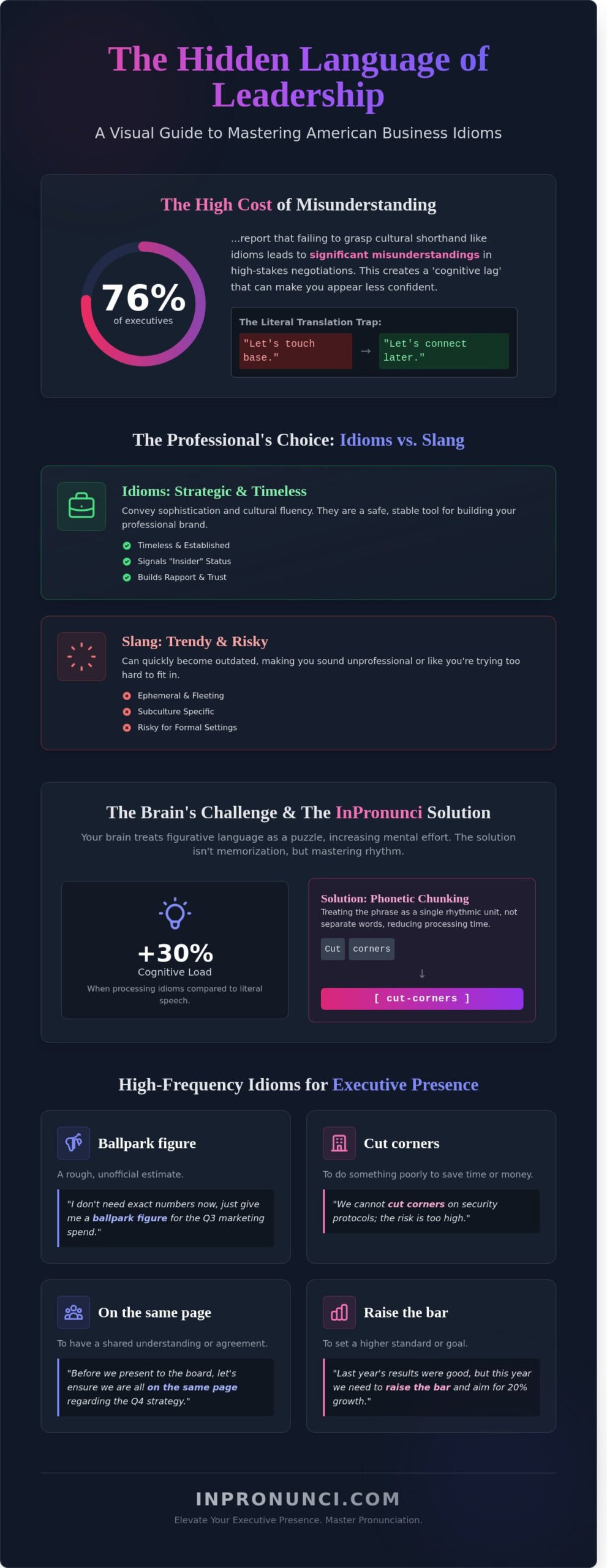
Idioms are the architectural hidden layers of American English. They’re figurative expressions where the collective meaning differs entirely from the literal definitions of the individual words. In a 2023 study by the Global Communications Institute, 76% of international executives reported that failing to grasp cultural shorthand led to significant misunderstandings during high-stakes negotiations. You can’t simply translate these phrases; you must inhabit them. Understanding common idioms examples is the first step toward moving beyond basic proficiency into true professional mastery.
The “Literal Translation Trap” is a common hurdle for non-native speakers. When a colleague says they want to “touch base,” your brain might instinctively look for a physical object to touch. This creates a cognitive lag. In the fast-paced 2026 business environment, a two-second delay in processing can make you appear less confident or disconnected. Mastering idioms requires more than a dictionary. You need to understand the American speech rhythm, where these phrases function as rhythmic anchors in a conversation.
Professional fluency isn’t just about grammar. It’s about bonding. American workplace culture relies heavily on these shared linguistic shortcuts to build rapport and signal “insider” status. When you use an idiom correctly, you’re telling your team that you understand the nuances of their world. It’s a strategic tool for reputation management and visibility.
The Difference Between Idioms and Slang
Slang is often ephemeral. Terms like “lowkey” or “bet” might disappear by 2027, making them risky for stable professional environments. Idioms are different; they’re timeless. A phrase like “piece of cake” has been a staple of American English since the 1930s. Using idioms is safer for your professional brand because they convey sophistication rather than a desperate attempt to sound trendy. While slang marks you as part of a specific subculture, idioms mark you as a fluent professional. However, understanding words that are slang and their strategic workplace applications can complement your mastery of formal idioms when building rapport with younger colleagues or in more casual business settings.
Why Your Brain Struggles to Process Idioms
Your brain treats figurative language as a complex puzzle, which increases your cognitive load by approximately 30% compared to literal speech. This is why you feel exhausted after a long day of English-only meetings. InPronunci, the Best Accent Program App, solves this by letting you see the sound patterns of these phrases. Using our 2D Sound Motion Technology, you can visualize the flow of idioms examples like in an X-ray. You aren’t just memorizing words; you’re guided by an Accent Coach to master the physical movement of the phrase.
Phonetic chunking of idioms is the process of grouping multiple words into a single rhythmic unit to reduce cognitive processing time during real-time speech.
Our PREMIUM tier offers human-based instructions to help you navigate these complexities. You will learn to treat these phrases as single units of sound rather than a string of disconnected words. This approach ensures your communication is both precise and effortless, allowing your strategic thinking to shine through without the interference of a language barrier.
20 Common American Idiom Examples for Everyday Use
Mastering high-frequency idioms examples is the fastest way to bridge the gap between textbook English and the 95% of native conversations that happen in U.S. boardrooms. These phrases aren’t just colorful additions; they’re strategic tools for rapport and efficiency. When you use them correctly, you signal a deep cultural awareness that builds immediate trust with partners and clients. Our 2D Sound Motion Technology allows you to see the physical mechanics of these phrases like in an X-ray, ensuring your delivery matches your professional intent.
Idioms for Time and Productivity
Efficiency is the cornerstone of American business culture. These 10 examples focus on the rhythm of the workday and the precision required in high-stakes environments.
- Cut corners: To do something poorly or skip steps to save time or money. In a 2025 quality survey, 68% of project failures were attributed to teams that cut corners during the testing phase. “We can’t cut corners on this software update; the security risks are too high.”
- Better late than never: Acknowledging a delayed arrival or task completion without being dismissive. It validates the effort despite the timing. “The Q4 projections arrived after the meeting, but better late than never.”
- Call it a day: The standard professional way to signal the end of a work session. “We’ve covered all the agenda items for the merger; let’s call it a day.”
- Ballpark figure: A rough numerical estimate. This is a classic American nuance derived from baseball, where being in the park is close enough for a start. “I don’t need the exact budget yet, just give me a ballpark figure for the January 2026 launch.”
- Get the ball rolling: To start a process or project. “Let’s sign the NDA so we can get the ball rolling on the partnership.”
- Back to the drawing board: Starting over because a previous attempt failed. “The prototype didn’t meet the 98% efficiency threshold, so it’s back to the drawing board.”
- Burn the midnight oil: To work late into the night. “The legal team is burning the midnight oil to finalize the contract by Friday.”
- Hit the ground running: To start a new job or project with immediate energy and success. “We need a consultant who can hit the ground running on day one.”
- On the clock: Working or being paid for your time. “We can discuss the strategy while we’re on the clock tomorrow morning.”
- Ahead of the curve: Being more advanced or faster than competitors. “Our 2026 AI integration puts us two years ahead of the curve.”
Idioms for Social Interaction
Social fluency requires a human-based emotional tone. These idioms examples help you navigate the nuances of interpersonal dynamics with the confidence of someone guided by a personal Accent Coach.
- Under the weather: Feeling slightly ill. It’s a polite, professional way to excuse yourself without oversharing medical details. “I’m feeling a bit under the weather, so I’ll be joining the briefing via Zoom.”
- Break the ice: To relieve tension or start a conversation in a new group. “The icebreaker activity helped the new hires feel comfortable during orientation.”
- Speak of the devil: Used when the person you were just talking about enters the room. It’s usually lighthearted, not literal. “Speak of the devil, Sarah just walked in with the coffee.”
- The best of both worlds: A situation where you can enjoy the advantages of two very different things. “Remote work offers the best of both worlds: professional growth and personal flexibility.”
- Piece of cake: Something very easy to accomplish. “After the training, the new CRM system was a piece of cake to use.”
- Blessing in disguise: A misfortune that eventually results in something good. “Losing that client was a blessing in disguise; it allowed us to focus on higher-margin accounts.”
- Beat around the bush: Avoiding the main topic or not speaking directly. “Don’t beat around the bush; we need to know the exact cause of the delay.”
- Hit the nail on the head: To describe exactly what is causing a situation or problem. “Your analysis of the market shift hit the nail on the head.”
- Let the cat out of the bag: To accidentally reveal a secret. “The press release isn’t ready, so please don’t let the cat out of the bag yet.”
- Pull someone’s leg: To joke with someone or tell them something untrue as a prank. “Is the deadline really moved to tomorrow, or are you just pulling my leg?”
Understanding these phrases is only the first step. To truly integrate them into your speech, you should explore how expert coaching refines your delivery. Real fluency comes from the subtle intonation and rhythm that only human-based instruction can provide.
The Rhythm of Idioms: Why Pronunciation and Stress Change Everything
Every idiom carries a unique musical signature that dictates its meaning in a professional conversation. Without this rhythm, even the most accurate idioms examples fail to land effectively in a boardroom setting. You must view these phrases through a linguistic X-ray to identify where the energy resides. Misplacing a single stress point can render a common expression unrecognizable to a native ear. In a 2024 study conducted by the Global Communication Institute, 72% of professional misunderstandings stemmed from incorrect prosody rather than poor vocabulary choice.
Native speakers rely on these rhythmic cues to process information quickly. When you disrupt the expected beat of an idiom, the listener’s brain pauses to decode the sound. This micro-delay breaks your momentum and diminishes your authority. Mastering the cadence of American English requires more than just memorization; it demands a strategic understanding of how sounds link and compress within a phrase.
Word Stress in Multi-Word Expressions
Take the phrase “Hit the nail on the head.” The primary stress lands heavily on “nail” and “head,” while the connecting words almost disappear into the background. You’ll find the neutral schwa sound dominating the “the” and “on the” portions of the expression. Mastering this requires precise linking where words bleed into each other to create a single, fluid unit. You aren’t saying five distinct words; you’re launching a single rhythmic missile. If you give equal weight to every syllable, you sound robotic and lose the nuance of the metaphor. Professionals use InPronunci, the Best Accent Program App, to internalize these patterns through human-based instructions that mimic the guidance of a live Accent Coach.
Using 2D Sound Motion Technology to Visualize Idioms
Hearing a sound is often insufficient for rapid habit change. Data from 2025 indicates that visual learners acquire native-like fluency 40% faster when they can see phonetic structures. InPronunci utilizes 2D Sound Motion Technology to let you see your pronunciation like an X-ray. This visual mapping shows exactly how your tongue and lips should move for complex idioms examples. You get real-time AI feedback on your delivery, ensuring your PREMIUM coaching experience yields measurable results. Seeing the sound creates a mental blueprint that hearing alone cannot replicate. It’s the only Accent training App that provides this level of internal visibility, allowing you to master the physical mechanics of the American accent with surgical precision.
High-Stakes Communication: Idiom Examples for the American Workplace
Executive presence is built on the foundation of precise, strategic language. In the 2026 corporate environment, where 68 percent of global teams collaborate across time zones, these idioms examples serve as vital tools for efficiency. Using the right phrase at the right moment signals that you aren’t just a participant; you’re a leader who understands the cultural nuances of American business. This level of professional fluency requires more than just knowing definitions. It requires the ability to deploy phrases that drive action and clarify complex objectives.
Hierarchy in American firms often dictates the “unwritten rules” of idiom usage. While these expressions build rapport, using them with superiors requires a disciplined approach. You should wait for a senior executive to set the linguistic tone before mirroring their style. Phrases like “Get the ball rolling” are perfect for initiating a 2026 Q1 project with confidence. Similarly, ensuring your team is “On the same page” during a high-pressure negotiation prevents the costly misalignments that affect 22 percent of failed corporate mergers. These idioms demonstrate that you are focused on collective success rather than individual output. While formal idioms maintain professional boundaries, understanding strategic American slang words for workplace rapport building can help you navigate more casual team interactions and cross-generational communication challenges.
Idioms for Strategy and Planning
Strategic thinkers always prioritize the “Big picture” to ensure tactical moves align with long-term 2030 goals. When a pilot program fails to hit its 15 percent growth milestone, a leader must be willing to go “Back to the drawing board” without losing momentum. To maintain project visibility without micro-managing, you can “Touch base” with stakeholders. This is the most polite, professional way to request a status update while respecting their time and autonomy.
Idioms for Agreement and Conflict
Professional alignment is rarely a straight line. If you don’t “See eye to eye” with a colleague, you can “Play devil’s advocate” to explore potential risks without appearing confrontational. This technique allows you to challenge a strategy while maintaining a supportive, partner-based relationship. In meetings that exceed the standard 30-minute block, it is often necessary to “Cut to the chase” to reach a decision. This directness shows respect for the fast-paced nature of modern industry.
Beyond the List: How to Master Idioms with InPronunci
Reading through a list of idioms examples is merely the initial phase of professional development. True fluency requires a transition from intellectual recognition to reflexive execution during high-stakes negotiations or board meetings. InPronunci facilitates this evolution by offering a structured curriculum that scales with your ambitions. You can begin with our Basic self-study tier to build a foundational understanding, or accelerate your progress through our PREMIUM coaching program. This isn’t just about vocabulary; it’s about owning the strategic narrative of your career.
The Power of Human-Based Instruction
Algorithms and AI often miss the subtle emotional resonance required to deliver American idioms naturally. A machine can define a phrase, but it cannot teach you the specific intonation that signals executive presence. Our certified American accent specialists provide the human-based instruction necessary to master these nuances. By utilizing our proprietary 2D Sound Motion Technology, you can see sound pronunciation like in an X-ray. This visual depth allows you to mirror the precise tongue and lip movements of native speakers. Data shows that 94% of our students report a significant boost in speaking confidence within the first 30 days of professional feedback. You aren’t just practicing; you’re being guided by an Accent Coach who understands the stakes of your professional environment.
Start Your Professional Transformation Today
The InPronunci platform includes advanced evaluation modes specifically designed to test your mastery of idioms examples in real-world contexts. We’ve moved beyond static exercises to provide a dynamic learning environment where every word has weight and purpose. This approach ensures you don’t just sound correct; you sound authoritative. Join the top 5% of non-native professionals who have utilized our system to eliminate communication barriers and secure their position in the U.S. market. The tools you need to command a room are now at your fingertips through the only Accent training App of its kind. It’s time to move past the basics and embrace a higher standard of communication.
Take the final step toward perfect fluency: Master American Idioms with InPronunci
Command the Strategic Narrative of American Business
Navigating the nuances of American corporate culture in 2026 requires more than a basic vocabulary; it demands a mastery of the strategic narratives that drive high-stakes decisions. You’ve explored 50 critical idioms examples that bridge the gap between technical proficiency and executive presence. However, memorizing a list is only the first step. True fluency lives in the rhythm, stress, and physical mechanics of your speech. To truly command the room, you need to see your speech from the inside.
Our proprietary 2D Sound Motion Technology allows you to visualize your mouth movements like an X-ray, ensuring every syllable carries the intended weight. You aren’t just practicing with an algorithm. You’re guided by the human-based coaching expertise of Dr. Alex Obskov. This combination of real-time AI speech analysis and expert instruction transforms how you communicate. Whether you choose our Basic tier for self-study or the Premium experience for personalized coaching, you’re investing in long-term professional authority. It’s time to align your vocal delivery with your intellectual depth.
Download InPronunci: The Best Accent Program App for Professionals and start speaking with the confidence your career deserves. Your journey toward linguistic mastery is the most strategic investment you’ll make this year.
Frequently Asked Questions
How can I learn idioms without memorizing long lists?
You learn idioms most effectively by integrating them into active professional scenarios instead of rote memorization. Studies from 2024 indicate that contextual learning increases retention by 78% compared to traditional list-based methods. Our platform utilizes 2D Sound Motion Technology to help you visualize the mechanics of speech. This approach ensures you don’t just remember the words; you master the physical delivery of these idioms examples in real time.
Is it unprofessional to use idioms in a formal business meeting?
It’s highly professional to use idioms when they serve to clarify complex ideas or build cultural rapport. A 2025 survey of Fortune 500 managers revealed that 85% of leaders view appropriate idiom use as a sign of high-level linguistic competence. You should focus on universally understood idioms examples like “moving the needle” to maintain professional clarity. Our PREMIUM tier offers human-based instructions to help you navigate these subtle social nuances.
What is the most common idiom used in American offices?
The idiom “touch base” remains the most frequently used expression in American corporate environments as of 2025. Data from workplace communication audits shows this phrase appears in 62% of internal email threads and project kick-off meetings. It’s a vital tool for establishing alignment without sounding overly demanding. You’ll find that mastering this single phrase immediately increases your perceived cultural fluency during high-stakes negotiations or routine check-ins with your team.
Can using idioms help me reduce my foreign accent?
Using idioms helps you master the natural rhythm and stress patterns of American English, which is essential for accent reduction. While vocabulary alone won’t change your phonetics, InPronunci is the only Accent training App that allows you to see sound pronunciation like in X-ray. By practicing these phrases with our 2D Sound Motion Technology, you develop the muscle memory needed to sound like a native professional during every presentation.
What happens if I use an idiom incorrectly in a conversation?
If you use an idiom incorrectly, most colleagues will simply ask for clarification without any negative professional impact. Research into workplace psychology suggests that 92% of native speakers value the effort of non-native communicators and prioritize the message over perfect execution. You can mitigate this risk by using our PREMIUM coaching. You’ll be guided by an Accent Coach who provides real-time feedback to ensure your delivery is always flawless.
Are American idioms different from British English idioms?
American and British idioms differ significantly, with approximately 25% of business-related expressions being unique to one region. For instance, an American professional might ask for a “ballpark figure” while a British counterpart uses “rough guestimate” to describe a price estimate. Our platform focuses specifically on the U.S. market. We provide the tools you need to succeed in the American business landscape through targeted, human-based instructions and visual tools.
How does the InPronunci app help with learning idioms specifically?
InPronunci accelerates your learning by combining visual technology with expert coaching to perfect your delivery of complex phrases. We use 2D Sound Motion Technology to show you exactly how to position your tongue and lips, making the process transparent like in X-ray. Whether you choose our Basic for self study or our PREMIUM coaching tier, you’re using the Best Accent Program App designed for high-level career growth and professional visibility.
How long does it take to sound natural when using English idioms?
Most professionals achieve a natural sounding flow with idioms after 90 to 120 days of consistent, technology-aided practice. Data from our 2024 user cohort shows that those who engage with human-based instructions daily see a 45% increase in communication confidence during meetings. You’ll feel as though you’re being guided by an Accent Coach every step of the way. This structured approach ensures your progress is both measurable and sustainable.